Used Car Buying Guide – Check RC, Insurance, Challan & Ownership Before Payment
Buying a second-hand car can save a significant amount of money, but a low selling price does not always mean a good deal. Before making any payment, buyers should verify the car’s RC, insurance, ownership, pending challans, loan status and physical condition.
A few checks before purchase can protect you from unexpected repair costs, unpaid fines, ownership-transfer problems and insurance complications later.
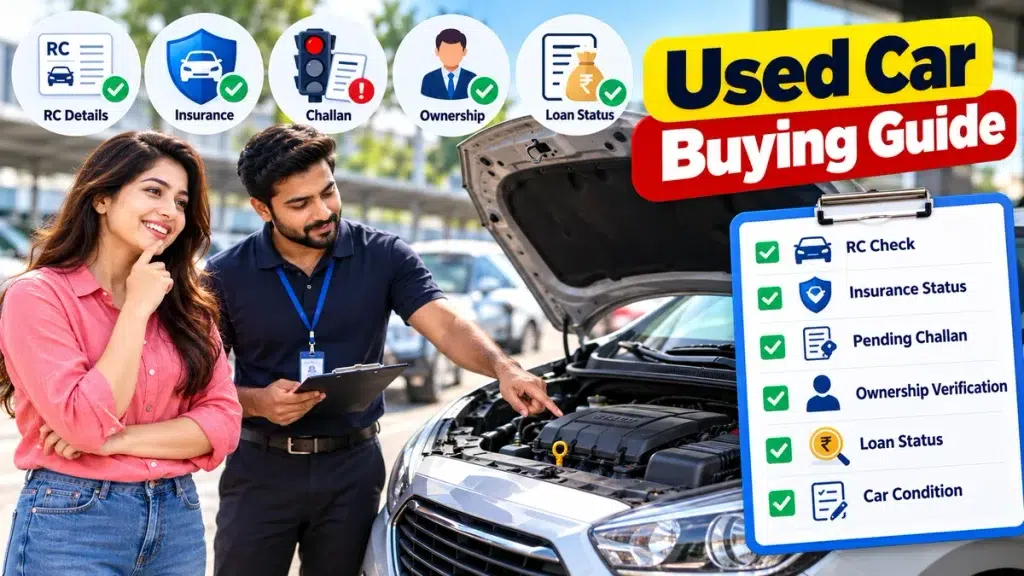
What Should You Check Before Buying a Used Car?
| Check | Why It Matters |
|---|---|
| RC Details | Confirms registration and vehicle information |
| Ownership | Helps verify the registered owner |
| Insurance | Checks whether valid coverage exists |
| IDV | Helps understand insured vehicle value |
| Pending Challan | Identifies unpaid traffic fines |
| PUC | Confirms pollution certificate status |
| Hypothecation | Shows whether a loan may still be linked |
| Service History | Helps assess maintenance |
| Accident History | Can reveal previous major repairs |
| Ownership Transfer | Makes the vehicle legally registered in your name |
1. Check the RC Before Paying
The Registration Certificate (RC) should be one of your first checks.
Compare the RC details with the actual car, including:
- Registration number
- Manufacturer and model
- Fuel type
- Registration date
- Chassis number
- Engine details where applicable
- Owner information available through authorised services
The Ministry of Road Transport and Highways provides VAHAN-based vehicle services, including vehicle details, RC-related services and ownership transfer.
Never rely only on a photograph or photocopy sent by the seller. Compare the documents with the physical vehicle.
2. Verify the Registered Owner
Make sure the person selling the car is authorised to sell it.
If the seller’s details and RC ownership do not match, ask for proper documentation before making payment.
A normal vehicle sale requires the registered ownership to be transferred from the seller to the purchaser. Parivahan identifies Form 29 and Form 30 among the documents used for ownership transfer.
Avoid completing a purchase with the promise that the RC will be transferred “later.”
3. Check Car Insurance Status
Insurance is an important part of used-car verification.
Check:
- Insurance expiry date
- Type of policy
- Comprehensive or third-party coverage
- Insurer name
- Current IDV
- Add-ons, if any
- Previous claim history where available from the seller or insurer
The IDV or Insured Declared Value should broadly reflect the insured value of the car. IRDAI recommends comparing IDV, premium, coverage and deductibles instead of judging an insurance policy only by price.
If the existing insurance is close to expiry, compare new comprehensive car insurance premiums, Zero Depreciation, Roadside Assistance and Engine Protection before buying.
4. Transfer the Insurance to Your Name
Buying the car does not mean you should continue indefinitely with insurance in the previous owner’s name.
IRDAI states that vehicle insurance can be transferred to the purchaser, but the seller should inform the insurer. It also states that registration and insurance should be in the same name and address. For comprehensive/package policies, transfer should be recorded within the applicable period stated by the insurer/regulations to preserve own-damage claim eligibility.
Also remember that the seller’s No Claim Bonus (NCB) belongs to the seller, not the car.
5. Check Pending Traffic Challans
Before paying for a used vehicle, check whether there are unpaid traffic challans.
A pending challan can create unnecessary confusion between buyer and seller after the sale.
Verify challans using the official eChallan service and ask the seller to clear outstanding dues before completing the transaction.
Keep proof of payment if any challans are settled immediately before the sale.
6. Check Whether a Car Loan Is Still Active
If the vehicle was purchased through finance, its RC may show hypothecation in favour of the bank or finance company.
Before buying, confirm whether the loan has been fully repaid.
If required, ask for:
- Bank NOC
- Loan closure documents
- Hypothecation termination record
- Updated RC
Parivahan provides services for hypothecation termination, and documents can include Form 35, registration certificate, valid insurance and financier NOC where applicable.
Do not make full payment until loan-related ownership issues are clear.
7. Inspect the Car’s Condition
Online records cannot tell you everything.
Have the vehicle inspected for:
- Engine condition
- Transmission
- Suspension
- Brakes
- Tyres
- Battery
- AC
- Electrical systems
- Body repairs
- Flood damage
- Accident repairs
For an expensive vehicle, a professional pre-purchase inspection can be worth the cost.
8. Check Service and Accident History
Ask the seller for service records and repair invoices.
Frequent major repairs, inconsistent odometer readings or missing service records can be warning signs.
You should also inspect:
- Panel gaps
- Repainted body panels
- Chassis damage
- Airbag replacement
- Structural repairs
A car that looks attractive from outside may still require expensive mechanical repairs.
9. Complete Ownership Transfer Properly
For a normal sale, Parivahan states that ownership transfer involves Form 29 and Form 30. For a vehicle registered within the same state, the transferee is generally required to apply within 14 days; different timelines and additional documentation can apply for inter-state transfers.
VAHAN also provides an online ownership-transfer workflow involving vehicle details, OTP verification, document upload and fee payment where the service is supported.
Keep copies of all sale and transfer documents until the updated RC is issued.
Used Car Payment Checklist
Before making the final payment, confirm:
- RC matches the car.
- Seller is authorised to sell.
- Insurance status is verified.
- Pending challans are cleared.
- Loan/hypothecation status is clear.
- PUC is valid where required.
- Chassis details match.
- Service history has been checked.
- Price reflects the car’s actual condition.
- Ownership-transfer paperwork is ready.
FAQs
Should I buy a used car with expired insurance?
You can purchase it, but arrange valid insurance before driving it on public roads. Third-party motor insurance is mandatory in India.
Is comprehensive insurance better for a used car?
It can be worthwhile if the car still has significant market value and repair costs would be difficult to bear yourself.
Can I use the previous owner’s NCB?
No. IRDAI states that NCB belongs to the insured person, not the vehicle.
Should I pay before RC transfer?
Avoid making the full payment without proper sale documentation and a clear ownership-transfer process.
What if the car still has an active loan?
Ask the seller to resolve the finance and hypothecation requirements and provide the necessary lender documentation before completing the transaction.
Conclusion
A used car can offer excellent value, but the real price includes much more than the seller’s asking amount.
Before paying, verify the RC, ownership, insurance, IDV, challan, loan status, service history and vehicle condition. Complete the ownership and insurance transfer correctly, and compare suitable comprehensive insurance options before driving away.
A careful verification process before payment can save you from expensive legal, insurance and repair problems later.