How IDV Affects Car Insurance Premium and Claim Amount
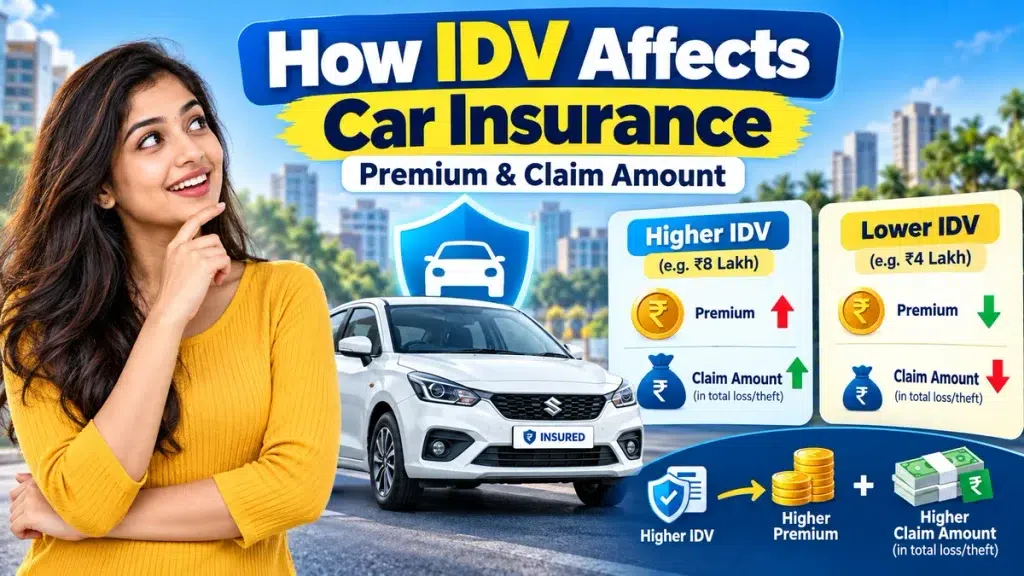
When buying or renewing car insurance, IDV (Insured Declared Value) is one of the most important numbers to check. It can directly influence your own-damage insurance premium and also plays a major role in how much you may receive if your car is stolen or declared a total loss.
Choosing an IDV that is too low may reduce your premium, but it can also reduce your financial protection. On the other hand, selecting an unnecessarily high IDV may increase the premium without always providing proportionate benefits.
What Is IDV in Car Insurance?
IDV stands for Insured Declared Value. It represents the insured value of your vehicle for the policy period.
Standard motor policy wording defines IDV as the vehicle’s sum insured. It is generally determined using the manufacturer’s listed selling price and applicable depreciation.
IDV becomes especially important when the vehicle is:
- Stolen and not recovered
- Completely damaged
- Declared a total loss
- Declared a constructive total loss
How IDV Affects Car Insurance Premium
There is generally a direct relationship between IDV and the own-damage portion of your car insurance premium.
Higher IDV → Higher premium
Lower IDV → Lower premium
Insurers such as HDFC ERGO and ICICI Lombard explain that increasing IDV generally increases premium, while lowering IDV can reduce premium.
Simple Example
| Option | IDV | Premium Impact | Total-Loss Protection |
|---|---|---|---|
| Plan A | ₹4 lakh | Lower | Lower |
| Plan B | ₹5 lakh | Moderate | Better |
| Plan C | ₹6 lakh | Higher | Higher |
These figures are only an illustration. Actual premium depends on the insurer, vehicle and other risk factors.
How IDV Affects Claim Amount
A common misunderstanding is that IDV determines the payout for every car insurance claim.
That is not necessarily correct.
IDV is particularly important for theft, total-loss and constructive-total-loss claims. Standard policy wording states that the IDV is used as the insured value for Total Loss and Constructive Total Loss purposes.
For normal repair claims, the insurer generally considers eligible repair costs, deductibles, depreciation, policy coverage and applicable add-ons.
So, if your bumper costs ₹20,000 to repair, having an IDV of ₹5 lakh does not automatically mean you receive ₹5 lakh.
What Is Constructive Total Loss?
A vehicle may be treated as a Constructive Total Loss (CTL) when the cost of retrieval and/or repair exceeds 75% of the vehicle’s IDV, subject to policy conditions.
For example:
Car IDV: ₹5,00,000
75% of IDV: ₹3,75,000
If eligible retrieval and repair costs cross the applicable threshold, the vehicle may be considered a constructive total loss under standard policy terms.
How Is IDV Calculated?
IDV generally starts with the manufacturer’s listed selling price and is adjusted for depreciation.
The standard depreciation schedule commonly used for IDV includes:
| Vehicle Age | Depreciation for IDV |
|---|---|
| Up to 6 months | 5% |
| 6 months–1 year | 15% |
| 1–2 years | 20% |
| 2–3 years | 30% |
| 3–4 years | 40% |
| 4–5 years | 50% |
For vehicles older than five years or discontinued models, the IDV may be determined by agreement between the insurer and insured.
Should You Select the Lowest IDV?
Selecting the lowest available IDV just to reduce premium may not always be a good decision.
Suppose your car reasonably qualifies for an IDV around ₹6 lakh, but you choose ₹4.5 lakh simply to save on premium.
If the vehicle is later stolen or suffers an eligible total loss, the lower insured value may result in substantially less financial protection.
HDFC ERGO specifically notes that a lower IDV can reduce premium but also lower the payout for total loss or theft.
Should You Choose the Highest Possible IDV?
Not necessarily.
An excessively high IDV can mean paying a higher insurance premium. Your goal should generally be to choose a realistic IDV appropriate to the vehicle’s age and applicable valuation, rather than simply selecting the maximum number offered.
Compare several insurance quotes using similar IDVs to understand the true premium difference.
IDV vs Resale Value
IDV and the actual resale price of your car are not always the same.
A used car’s selling price can be affected by:
- Vehicle condition
- Mileage
- Accident history
- Service records
- Number of owners
- Local demand
- Model popularity
IDV is an insurance valuation, whereas resale value depends heavily on the used-car market.
IDV and Zero Depreciation Cover
IDV and Zero Depreciation are different concepts.
IDV mainly determines the insured vehicle value relevant to situations such as total loss or theft.
Zero Depreciation is an optional add-on designed to reduce depreciation deductions on eligible parts during certain repair claims.
For a newer vehicle, buyers may therefore compare:
- Suitable IDV
- Zero Depreciation
- Engine Protection
- Roadside Assistance
- Return to Invoice
- Consumables Cover
How to Choose the Right IDV During Renewal
Before renewing car insurance:
- Check the IDV offered by different insurers.
- Compare quotes using similar IDVs.
- Do not choose solely on the lowest premium.
- Check deductibles and exclusions.
- Compare useful add-ons.
- Review your car’s age and current condition.
- Check the total premium after add-ons.
A ₹1,000 cheaper policy may not be a better deal if it provides a substantially lower IDV or weaker coverage.
FAQs
Does higher IDV increase car insurance premium?
Generally, yes. A higher IDV can increase the own-damage premium because the insurer is providing a higher insured value.
Does lower IDV reduce premium?
Generally yes, but it can also reduce the amount payable in an eligible theft or total-loss claim.
Is IDV the same as car market price?
Not exactly. IDV is an insurance valuation calculated according to applicable policy methodology, while actual resale value depends on market conditions.
Does IDV affect minor accident claims?
IDV is most directly relevant to theft and total-loss/constructive-total-loss situations. Normal repair claims depend on eligible repair costs and policy terms.
What happens to IDV as a car gets older?
IDV generally decreases as depreciation increases.
Conclusion
IDV can significantly affect both your car insurance premium and protection during major claims.
A higher IDV generally means a higher premium but provides a larger insured value for eligible total-loss or theft situations. A lower IDV can reduce premium but may leave you underinsured.
When renewing car insurance, compare IDV, premium, deductibles, claim coverage and add-ons together rather than choosing the cheapest quote alone.