Comprehensive vs Third-Party Car Insurance – Which One Should You Choose?
Choosing between Comprehensive Car Insurance and Third-Party Car Insurance can have a major impact on both your yearly premium and how much financial protection you receive after an accident, theft or vehicle damage.
Third-party insurance is mandatory for vehicles using public roads in India, while comprehensive insurance provides broader protection by combining third-party liability with own-damage cover. IRDAI also advises vehicle owners to compare premium, IDV, deductibles and coverage rather than choosing a plan only because it is cheaper.
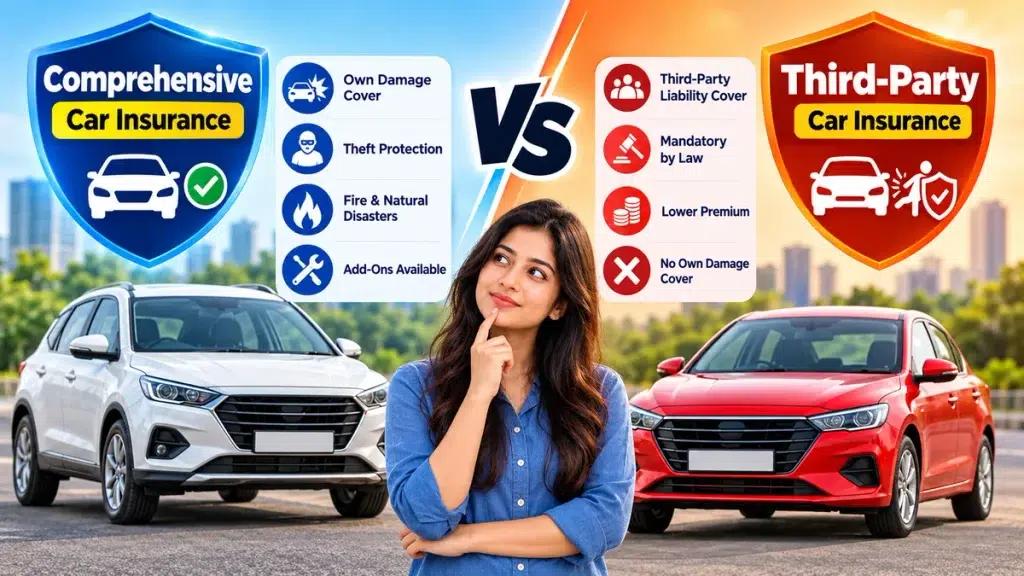
Comprehensive vs Third-Party Car Insurance
| Feature | Comprehensive Insurance | Third-Party Insurance |
|---|---|---|
| Third-Party Liability | Yes | Yes |
| Damage to Your Car | Yes, subject to policy | No |
| Theft Cover | Usually included | No |
| Fire Damage | Usually included | No |
| Natural Disaster Cover | Usually included | No |
| IDV Applicable | Yes | No own-damage IDV |
| Add-Ons Available | Yes | Usually not for own damage |
| Premium | Higher | Lower |
| Best For | Broader protection | Basic mandatory cover |
What Is Third-Party Car Insurance?
Third-party car insurance is the basic liability cover required for vehicles operating on public roads in India.
It protects you against specified legal liabilities arising from injury, death or property damage caused to another person.
IRDAI states that third-party liability insurance is mandatory for all vehicles plying on public roads. It also notes that third-party property damage is covered up to ₹7.5 lakh under standard liability cover, while liability for third-party injury or death is not subject to that same property-damage limit.
What Third-Party Insurance Does Not Cover
Third-party-only insurance generally does not pay for damage to your own car.
For example, if your car is damaged in an accident, stolen or affected by flooding, a third-party-only policy will normally not compensate you for your own vehicle loss.
This is the biggest reason many car owners consider comprehensive coverage.
What Is Comprehensive Car Insurance?
Comprehensive car insurance generally combines:
- Third-party liability cover
- Own-damage protection
- Theft protection
- Fire-related damage cover
- Specified natural disaster protection
- Specified man-made damage protection
You may also be able to add optional covers such as Zero Depreciation, Roadside Assistance, Engine Protection, Return to Invoice and Consumables Cover, depending on the insurer.
IRDAI describes comprehensive or package insurance as cover that includes both liability and own damage to the insured vehicle.
Which Insurance Has a Lower Premium?
Third-party insurance usually has the lower premium because it does not include own-damage protection.
For own-damage insurance, insurers can price similar coverage differently. Factors affecting the premium may include:
- Car age
- Vehicle model
- IDV
- Registration location
- Previous claims
- No Claim Bonus
- Selected add-ons
- Deductibles
IRDAI recommends comparing three or more quotes because a lower premium can sometimes come with a lower IDV, higher deductible or reduced coverage.
What Is IDV and Why Does It Matter?
IDV or Insured Declared Value is the insured value used for your vehicle under own-damage coverage.
It becomes particularly important in situations such as theft or total loss.
A lower IDV may reduce the premium, but it can also reduce the amount on which certain total-loss claims are assessed.
That is why you should compare premium and IDV together instead of automatically choosing the cheapest insurance quote.
When Should You Choose Third-Party Insurance?
Third-party insurance may be considered when:
- You only want the legally required liability cover.
- Your car is very old and has a relatively low value.
- You are willing to bear the cost of repairing your own vehicle.
- Keeping the insurance premium low is your main priority.
However, remember that you may have to pay your own repair expenses after an accident.
When Should You Choose Comprehensive Insurance?
Comprehensive insurance may be more suitable when:
- Your car is new or valuable.
- You drive regularly.
- You live in an area with accident, theft or flood risk.
- Repair costs could significantly affect your finances.
- You want access to useful insurance add-ons.
- Your car is financed through a loan.
- You want broader protection during insurance renewal.
For many newer vehicles, the additional premium can be worthwhile because modern body panels, sensors, lights and other parts can be expensive to repair.
Add-Ons That Can Improve Comprehensive Coverage
Zero Depreciation
Zero-depreciation cover can reduce depreciation deductions on eligible parts during claims, subject to policy conditions.
Roadside Assistance
RSA can provide assistance such as towing, battery support, flat-tyre help or emergency assistance, depending on the insurer.
Engine Protection
This add-on can protect against specified engine or gearbox damage that may otherwise be excluded from standard coverage.
Return to Invoice
RTI can provide enhanced protection in eligible total-loss or theft cases, subject to policy terms.
What About No Claim Bonus?
No Claim Bonus or NCB is associated with the own-damage portion of motor insurance.
IRDAI states that NCB may begin at 20% of the own-damage premium after a claim-free year and progressively increase up to 50% under applicable norms. NCB applies to the insured person rather than the vehicle itself.
This makes claim history an important factor to consider at renewal.
Comprehensive vs Third-Party: Simple Example
Suppose Car A suffers ₹70,000 worth of accidental damage.
With a third-party-only policy, the owner may need to bear the repair cost for their own car.
With a comprehensive policy, eligible own-damage repair costs may be covered according to the policy terms, deductibles and exclusions.
This is why the cheapest premium does not always mean the lowest overall financial risk.
FAQs
Is comprehensive car insurance mandatory?
No. Third-party liability cover is mandatory for vehicles using public roads in India. Own-damage or comprehensive protection is optional, although it offers broader protection.
Which insurance is cheaper?
Third-party insurance generally costs less because it does not cover damage to your own vehicle.
Which insurance is better for a new car?
For a new or higher-value car, comprehensive insurance can provide substantially broader protection than third-party-only cover.
Can comprehensive insurance include Zero Dep?
Zero Depreciation is commonly offered as an optional add-on with eligible comprehensive or own-damage policies.
Should I compare car insurance before renewal?
Yes. Compare the premium, IDV, deductible, coverage, add-ons and claim-related features before renewing. IRDAI specifically recommends comparing multiple quotes.
Conclusion
If your priority is only meeting the legal requirement at the lowest premium, Third-Party Car Insurance may be sufficient.
If you also want protection for your own car against covered accidents, theft, fire and other specified risks, Comprehensive Car Insurance offers much broader financial protection.
Before buying or renewing, compare premium, IDV, deductibles, claim coverage, Zero Depreciation, Roadside Assistance and other add-ons. The best policy is not necessarily the cheapest one—it is the one that provides suitable protection for your vehicle and budget.