Car Loan vs Personal Loan for Vehicle Purchase – Interest Rate & EMI Comparison
Planning to buy a new or used car? Apart from choosing the vehicle, one of the biggest financial decisions is whether to finance it through a Car Loan or Personal Loan.
Both options can provide funds for a vehicle purchase, but their interest rates, EMI, tenure, processing fees, eligibility and ownership conditions can be very different. Choosing the right loan can potentially save a significant amount over the repayment period.
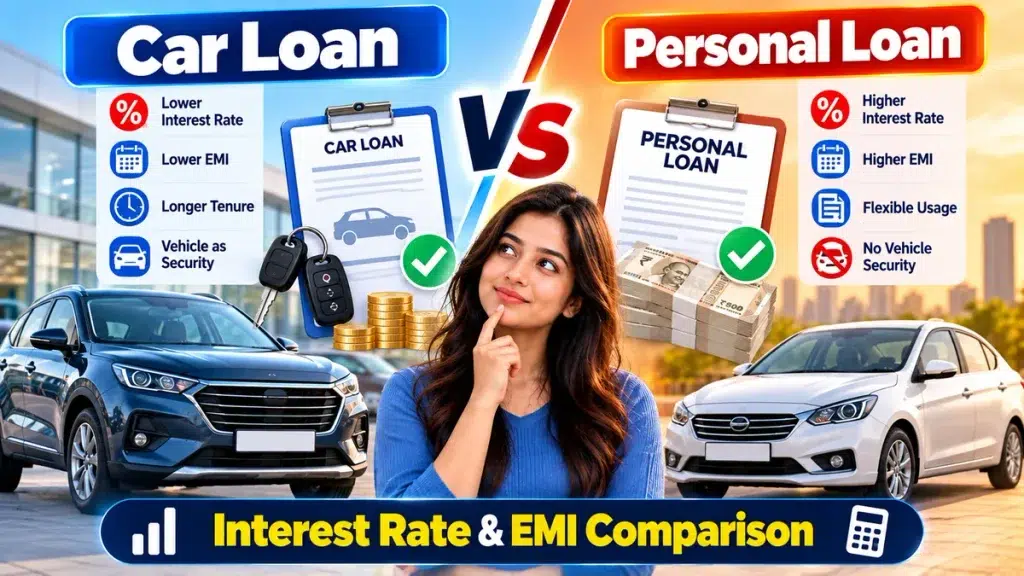
Car Loan vs Personal Loan – Quick Comparison
| Feature | Car Loan | Personal Loan |
|---|---|---|
| Loan Type | Secured | Usually unsecured |
| Vehicle as Security | Yes | No |
| Interest Rate | Usually lower | Often higher |
| EMI | Usually lower for similar terms | Can be higher |
| Loan Tenure | Often longer | Usually flexible |
| Usage | Vehicle purchase | Almost any personal purpose |
| Down Payment | May be required | No vehicle-specific down payment |
| Approval | Vehicle and borrower assessed | Mainly borrower eligibility |
| Vehicle Hypothecation | Usually yes | Usually no |
| Best For | Most planned vehicle purchases | Flexibility or smaller funding gaps |
What Is a Car Loan?
A car loan is specifically designed to finance a vehicle purchase. The lender generally provides part or most of the vehicle cost, while the purchased vehicle acts as security for the loan.
For example, Axis Bank describes its new-car loan as financing where the vehicle serves as collateral, with the loan repaid through regular EMIs.
Because the lender has security against the loan, car-loan interest rates can often be more competitive than unsecured borrowing.
What Is a Personal Loan?
A personal loan is generally an unsecured loan, meaning you normally do not have to pledge the car as collateral.
You can use the funds for a variety of personal requirements, including buying a vehicle, paying part of the purchase price or covering other expenses.
Axis Bank, for example, describes its personal loan as unsecured and currently advertises repayment tenure of up to 84 months, subject to eligibility.
Which Has a Lower Interest Rate?
In many cases, a car loan can offer a lower interest rate because the vehicle acts as security.
Personal loans can carry higher rates because the lender does not have the same vehicle collateral.
However, your actual rate can depend on:
- Credit score
- Monthly income
- Existing EMIs
- Loan amount
- Loan tenure
- Employer or business profile
- Relationship with the lender
- New or used vehicle
- Down payment
Published lender rates can vary widely. For example, Axis Bank’s pages show different rate ranges for new-car and personal loans, reinforcing why borrowers should compare individual offers rather than assuming one fixed market rate.
EMI Comparison Example
Suppose you need ₹8 lakh for 5 years.
This is only an illustration, not a lender quote:
| Loan Example | Interest Rate | Approx. EMI | Approx. Total Interest |
|---|---|---|---|
| Car Loan | 9% p.a. | ₹16,607 | ₹1.96 lakh |
| Personal Loan | 13% p.a. | ₹18,202 | ₹2.92 lakh |
In this example, the higher personal-loan rate increases both the monthly EMI and overall interest expense.
Even a difference of a few percentage points can therefore become important on a large vehicle loan.
When Is a Car Loan Better?
A car loan may be the better option when:
- You are purchasing a new car.
- You want a lower EMI.
- You need a larger loan amount.
- You want a longer repayment period.
- You are comfortable with vehicle hypothecation.
- Your main objective is reducing total borrowing cost.
For most conventional car purchases, comparing car-loan offers should usually be the starting point.
When Can a Personal Loan Make Sense?
A personal loan may be useful when:
- You need only a small amount.
- You are buying a low-value used car.
- You do not want the vehicle hypothecated.
- You need funds for the vehicle plus other expenses.
- A lender is offering you a particularly competitive pre-approved rate.
- Your car-loan eligibility is limited.
However, always compare the total repayment, not just the speed of approval.
Car Loan for a Used Vehicle
Used-car financing deserves extra attention.
Interest rates on used-car loans can sometimes be higher than rates on new-car loans because of vehicle age, valuation and resale-risk considerations.
Before financing a second-hand car, also verify:
- RC details
- Existing loan or hypothecation
- Insurance validity
- Pending challans
- Ownership history
- Vehicle condition
- Market value
Do not borrow based only on the seller’s asking price.
Check Processing Fees and Other Charges
A low advertised interest rate does not automatically mean the cheapest loan.
Compare:
- Processing fee
- Documentation charges
- Foreclosure charges
- Part-payment charges
- Penal charges
- Stamp duty
- Insurance requirements
- Other applicable fees
Axis Bank, for instance, separately lists processing and documentation charges for its car-loan products and processing fees for personal loans.
How Credit Score Affects Your Loan
A stronger credit profile can improve your chances of receiving competitive financing.
Before applying:
- Check your credit report.
- Correct any reporting errors.
- Reduce excessive existing debt if possible.
- Avoid making too many loan applications together.
- Compare offers from multiple lenders.
A small reduction in interest rate can significantly reduce interest expense on a multi-year loan.
Should You Choose a Longer Tenure?
A longer tenure can reduce monthly EMI, but it may increase the total interest paid.
For example, a 7-year loan may feel more affordable every month than a 5-year loan, but you remain in debt longer and can pay substantially more interest.
Choose an EMI that fits comfortably within your monthly budget without unnecessarily extending the repayment period.
FAQs
Which is better for buying a car: car loan or personal loan?
For many buyers, a car loan can be more economical because it is secured by the vehicle and may offer a more competitive interest rate. Personal loans offer greater flexibility.
Can I buy a car with a personal loan?
Yes, subject to the lender’s permitted loan usage and eligibility conditions.
Which loan usually has the lower EMI?
For the same loan amount and tenure, the loan with the lower interest rate will generally have the lower EMI.
Does a car loan require a down payment?
Many vehicle loans finance only a certain percentage of the vehicle cost, although funding levels vary by lender and borrower profile.
Is a personal loan better for a used car?
It can be useful for a low-cost used vehicle or a small funding gap, but compare its interest cost with available used-car financing first.
Conclusion
For most buyers, a Car Loan can offer a better combination of interest rate, EMI and repayment cost, particularly for a new or higher-value vehicle.
A Personal Loan provides greater flexibility and may be useful when you need a smaller amount or do not want vehicle-specific financing.
Before choosing, compare the interest rate, EMI, loan tenure, processing fee, prepayment charges and total amount payable. The lowest EMI is not always the cheapest loan—the total cost over the complete tenure matters most.