Property Transfer Philippines – Title Transfer, Documents, Fees & Process
Transferring property ownership in the Philippines involves more than signing a Deed of Sale and handing over the keys. A proper property transfer can require title verification, preparation of legal documents, payment of applicable taxes and fees, Bureau of Internal Revenue (BIR) processing, local government requirements, and registration with the appropriate Registry of Deeds.
Whether you are buying or selling a house, residential lot, condominium, or another type of real property, understanding the transfer process can help prevent delays and costly mistakes. It is especially important to verify the property’s title and tax status before substantial money changes hands.
For titled property, buyers may encounter an Original Certificate of Title (OCT), Transfer Certificate of Title (TCT), or Condominium Certificate of Title (CCT). After a qualifying transfer is properly registered, the ownership records are updated through the applicable land registration process.
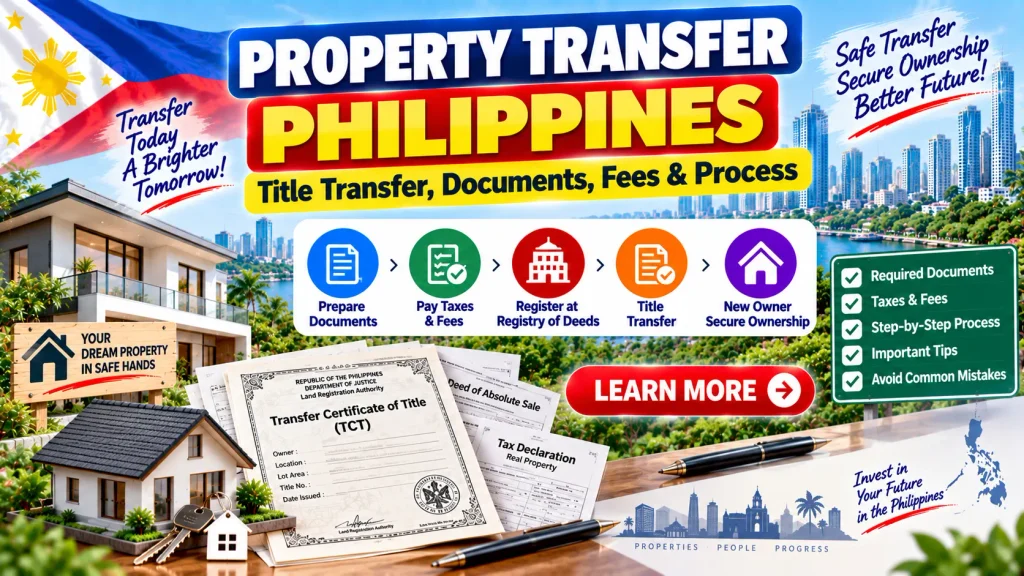
This guide explains the general Property Transfer Philippines process, title transfer requirements, important documents, taxes and fees, BIR eCAR, Registry of Deeds registration, and steps for updating local property records.
Important: Requirements, tax treatment, fees, deadlines, and procedures can vary according to the property and type of transfer. A sale, donation, inheritance, and other forms of transfer do not necessarily follow identical rules. Always confirm current requirements with the appropriate BIR office, Registry of Deeds, local government unit, and qualified legal or tax professionals when necessary.
Property Transfer Philippines – Quick Overview
| Item | General Information |
|---|---|
| Transaction | Transfer of real property ownership |
| Title Types | OCT, TCT or CCT |
| Main Sale Document | Deed of Absolute Sale |
| Tax Processing | Bureau of Internal Revenue |
| BIR Document | Applicable CAR/eCAR |
| Local Requirements | Property tax and transfer-related processing |
| Registration Office | Appropriate Registry of Deeds |
| Tax Declaration | Local assessment record |
| Transfer Tax | May apply under local rules |
| Registration Fees | Assessed for the registration transaction |
| Title Verification | Recommended before purchase |
| Final Local Step | Update applicable Tax Declaration/assessment records |
What Is Property Transfer?
Property transfer is the legal process of transferring rights or ownership in real estate from one party to another.
The transfer may occur because of:
- Sale
- Donation
- Inheritance
- Estate settlement
- Court order
- Other legally recognized transaction
For an ordinary sale, the process commonly involves the seller and buyer executing the appropriate sale document, satisfying applicable tax requirements, completing local government procedures, and registering the transaction.
Simply paying the seller does not automatically complete every government registration requirement.
Why Is Title Transfer Important?
A buyer may have possession of the property and a signed contract, but registered property records also need to be properly processed.
Completing the title transfer helps establish updated registered ownership information.
This can be important when the new owner later wants to:
- Sell the property
- Mortgage it
- Use it for financing
- Transfer it to heirs
- Verify ownership
- Complete other property transactions
Leaving a property indefinitely in the previous owner’s name can create future complications.
Understand OCT, TCT and CCT
Original Certificate of Title – OCT
An OCT is associated with the original registration of titled land.
Transfer Certificate of Title – TCT
A TCT is commonly encountered when registered land has undergone an applicable ownership transfer.
Condominium Certificate of Title – CCT
A CCT relates to ownership of an individual condominium unit.
Title Types at a Glance
| Document | General Purpose |
|---|---|
| OCT | Original registration of titled land |
| TCT | Registered ownership after an applicable transfer |
| CCT | Individual condominium unit ownership |
| Tax Declaration | Local property assessment/tax record |
A Tax Declaration should not automatically be treated as equivalent to a registered title.
Verify the Property Before Starting the Transfer
Buyers should conduct due diligence before executing the final transaction.
Check:
- Registered owner’s name
- Title number
- Property location
- Land area
- Technical description
- Title annotations
- Tax Declaration
- Real property tax status
- Seller’s identity
- Seller’s authority to sell
- Actual physical property
Do not rely solely on a photocopy of a title supplied by the seller.
Use appropriate official procedures to verify relevant title information.
Check for Title Annotations
Annotations can reveal matters affecting the property.
These can include:
- Mortgage
- Adverse claim
- Easement
- Restrictions
- Notices involving legal proceedings
- Other registered interests
If the title contains an unfamiliar annotation, determine its legal effect before completing the purchase.
A lawyer can be particularly helpful for complicated annotations.
What if the Property Is Mortgaged?
A mortgaged property can require additional steps.
Before buying, determine:
- Who holds the mortgage
- Whether the debt remains outstanding
- How it will be paid
- How the mortgage will be cancelled
- Which documents will prove cancellation
- When the property can be transferred
Do not rely only on a seller’s statement that the mortgage will be removed later.
Important Documents for Property Transfer
The exact checklist varies, but a typical sale can involve documents such as:
| Document | General Purpose |
|---|---|
| Deed of Absolute Sale | Documents the completed sale |
| Owner’s Duplicate Title | Used in applicable title registration |
| Certified Title Information | Helps verify current title details |
| Tax Declaration | Local assessment information |
| Real Property Tax Records | Shows applicable tax status |
| BIR CAR/eCAR | Supports registration after applicable tax processing |
| Transfer Tax Receipt | Proof of applicable local payment |
| Tax Clearance | May be required |
| Valid IDs | Identifies buyer and seller |
| SPA | Relevant if a representative acts |
| Supporting Documents | Depend on the particular transaction |
Always obtain the current official checklist for your transaction.
What Is a Deed of Absolute Sale?
The Deed of Absolute Sale is a key legal document in many completed property sales.
It generally identifies:
- Seller
- Buyer
- Property
- Consideration or purchase price
- Terms and representations
- Signatures of the parties
The deed should accurately describe the property and transaction.
It generally needs to satisfy applicable execution and notarization requirements.
Never sign a blank Deed of Sale or a document containing information you know is incorrect.
Step 1: Verify Buyer, Seller and Property Information
Before preparing the final documents, verify the names and information of all parties.
Make sure the seller is the registered owner or has proper authority to act.
If the seller is acting under a Special Power of Attorney, verify the document and the authority granted.
If the registered owner has died, estate settlement requirements may apply before the intended transfer can be completed.
Step 2: Execute the Appropriate Transfer Document
For an ordinary sale, the parties can execute the applicable Deed of Absolute Sale.
Different transactions require different instruments.
For example:
- Sale → appropriate Deed of Sale
- Donation → Deed of Donation
- Inheritance → estate settlement documents
- Court transfer → applicable court order/instrument
Do not use the wrong transaction type simply to avoid proper taxes or requirements.
Step 3: Complete BIR Tax Processing
Property transfers can involve applicable national taxes administered by the Bureau of Internal Revenue.
The tax treatment depends on the nature of the transaction and circumstances of the property.
Possible requirements can involve:
- Applicable tax returns
- Deed or transfer instrument
- Title documents
- Tax Declaration
- Identification
- Proof of payment
- Other BIR-required supporting documents
Follow the current BIR procedure applicable to the transaction.
What Is an eCAR?
eCAR stands for Electronic Certificate Authorizing Registration.
For applicable property transfers, it is an important BIR document connected with the tax-processing stage.
After applicable tax requirements are satisfied, the relevant CAR/eCAR is used as part of the documentation for registering the transfer.
An eCAR should not be confused with the new property title.
It is a tax-related authorization document supporting registration.
Step 4: Check Real Property Tax
Before registration, confirm the property’s Real Property Tax status.
The appropriate local Treasurer’s Office can provide information about applicable RPT payments or outstanding obligations.
If unpaid taxes exist, determine:
- Amount outstanding
- Applicable penalties
- Years involved
- Who will pay
- Requirements for tax clearance
Keep all official receipts.
Step 5: Pay Applicable Local Transfer Tax
Property transfers can be subject to local transfer tax.
The applicable procedure and amount depend on current law and the local government unit.
Prepare the required documents and obtain official proof of payment.
Do not rely on a generic online figure for the exact transfer tax on your property.
Step 6: Obtain Required Tax Clearance and Documents
Depending on the transaction and locality, additional local documents can be needed.
Organize these before Registry of Deeds submission.
Check that:
- Names are consistent
- Title number is correct
- Property description is accurate
- Receipts are complete
- Documents are properly executed
Even small errors can delay processing.
Step 7: Submit Documents to the Registry of Deeds
Once the required BIR and local government procedures are completed, submit the registration package to the appropriate Registry of Deeds.
A typical package can include:
- Original transfer instrument
- Owner’s duplicate title
- Applicable eCAR/CAR
- Tax Declaration
- Real property tax clearance
- Transfer tax proof
- Supporting identification/documents
- Other requirements for the transaction
The Registry of Deeds will examine the documents before completing the appropriate registration action.
Step 8: Pay Registration Fees
Registration involves applicable fees assessed according to the transaction.
The exact amount can vary depending on factors such as:
- Property/transaction value
- Type of registration
- Documents submitted
- Current fee schedules
Use the official Registry of Deeds assessment.
Keep the official receipt and transaction details.
Step 9: Processing of the New Title
For an eligible completed transfer, the Registry of Deeds processes the transaction and updates the registered title records.
When the resulting title is available, carefully check:
- New owner’s name
- Property location
- Land area
- Technical description
- Title number
- Annotations
If you notice an important error, address it through the proper process.
Step 10: Update the Tax Declaration
Receiving the transferred title does not necessarily complete every local administrative requirement.
The buyer should also check the process for updating the Tax Declaration and relevant assessment records with the local Assessor’s Office.
The updated records should reflect the new ownership information where applicable.
Property Transfer Process – Step-by-Step Table
| Step | Action |
|---|---|
| 1 | Verify title, owner and property |
| 2 | Check annotations and tax status |
| 3 | Execute appropriate transfer document |
| 4 | Complete applicable BIR requirements |
| 5 | Obtain relevant CAR/eCAR |
| 6 | Settle applicable Real Property Tax issues |
| 7 | Pay applicable local transfer tax |
| 8 | Prepare Registry of Deeds requirements |
| 9 | Pay registration fees |
| 10 | Complete title registration |
| 11 | Check resulting title |
| 12 | Update Tax Declaration/local records |
How Much Does Property Transfer Cost?
There is no single fixed amount for every property transfer.
Potential costs can include:
- Applicable BIR taxes
- Documentary Stamp Tax
- Local transfer tax
- Registry of Deeds fees
- Notarial fees
- Legal fees
- Brokerage expenses
- Survey expenses
- Outstanding Real Property Tax
- Other transaction-specific charges
The actual cost depends on the property, value, transaction type, location, and current rules.
Who Pays the Fees?
Some tax obligations are determined by applicable law, while certain transaction expenses may be allocated between buyer and seller under their agreement, subject to legal requirements.
Before signing, clarify responsibility for:
- Applicable seller taxes
- Documentary taxes
- Transfer tax
- Registration fees
- Notarial expenses
- Outstanding property taxes
- Broker fees
- Other processing costs
Put important agreements in writing.
How Long Does Property Transfer Take?
There is no universal processing time.
The timeline can depend on:
- Completeness of documents
- BIR processing
- LGU processing
- Registry of Deeds workload
- Existing title annotations
- Incorrect names or documents
- Unpaid taxes
- Mortgage cancellation
- Estate issues
Prepare complete and accurate documents to reduce avoidable delays.
Transfer of Inherited Property
An inherited property can require estate settlement before the title can be properly transferred.
Depending on the circumstances, requirements may involve:
- Estate documents
- Applicable estate taxes
- Extrajudicial settlement
- Publication requirements
- Court proceedings
- Heir documentation
Inherited property can be significantly more complicated than an ordinary sale.
Property Transfer by Donation
Donation follows a different legal and tax process.
Possible requirements can involve:
- Deed of Donation
- Acceptance where required
- Applicable donor’s tax
- BIR processing
- CAR/eCAR
- Local requirements
- Registry of Deeds registration
Use the correct legal transaction rather than creating a simulated sale.
Common Property Transfer Problems
Seller Is Not the Registered Owner
Verify authority before proceeding.
Registered Owner Is Deceased
Estate settlement may be required.
Title Has a Mortgage
Complete the proper mortgage settlement and cancellation process.
Documents Have Different Names
Name discrepancies may need correction or supporting documentation.
Taxes Are Unpaid
Outstanding taxes can delay required clearances.
Property Boundaries Are Unclear
Consider a professional survey before completing the purchase.
Avoid Property Transfer Scams
Be cautious of individuals claiming they can:
- Transfer a title instantly without documents
- Secretly remove a mortgage
- Delete an adverse claim for cash
- Skip BIR requirements
- Create a title through an unofficial payment
- Guarantee Registry of Deeds approval
Use legitimate government procedures.
Keep original property documents secure and provide copies only when necessary.
Property Transfer Safety Checklist
Before completing the transaction:
- Verify registered ownership.
- Obtain reliable title information.
- Review annotations.
- Verify seller identity.
- Inspect the property.
- Check tax status.
- Use the correct transfer instrument.
- Follow BIR procedures.
- Obtain official receipts.
- Pay through authorized channels.
- Complete Registry of Deeds registration.
- Update local property records.
For complicated or high-value property transactions, qualified legal and tax professionals can provide valuable protection.
Frequently Asked Questions (FAQ)
1. How do I transfer a property title in the Philippines?
Generally, verify the property, execute the appropriate transfer instrument, complete applicable BIR and local tax requirements, obtain required documents such as the relevant CAR/eCAR, and register the transaction with the appropriate Registry of Deeds.
2. What documents are needed for a title transfer?
Depending on the transaction, documents can include the deed, owner’s duplicate title, Tax Declaration, applicable CAR/eCAR, tax clearance, transfer tax receipt, identification, and other supporting records.
3. What is an eCAR?
An eCAR is an Electronic Certificate Authorizing Registration connected with BIR processing for applicable property transfers.
4. Is the Deed of Sale enough to transfer the title?
No. Signing a Deed of Sale does not by itself complete all tax, local government, and Registry of Deeds requirements.
5. How much does title transfer cost?
Costs vary depending on the property’s value, location, transaction type, applicable taxes, registration fees, and professional expenses.
6. Who pays property transfer fees?
Responsibility depends on applicable law and the agreement between the parties for costs that can legally be allocated. Clarify this before signing.
7. Can I transfer a mortgaged property?
A mortgaged property requires proper handling of the mortgage obligation and applicable cancellation or transfer procedures.
8. How long does title transfer take?
There is no single timeline. Processing depends on document completeness, tax processing, LGU requirements, Registry of Deeds workload, and property issues.
9. Do I need to update the Tax Declaration after title transfer?
The new owner should check the applicable local Assessor’s Office procedure for updating assessment and Tax Declaration records.
10. Can inherited property be transferred?
Yes, but estate settlement, tax, heir, publication, court, or other requirements can apply depending on the circumstances.
Final Words
Completing a Property Transfer in the Philippines requires careful coordination between the parties and relevant government offices.
Begin by verifying the registered owner, title number, property description, land area, annotations, and tax status. Never rely solely on a seller’s photocopied title or verbal assurances.
For an ordinary sale, the parties generally need to execute the appropriate sale document, comply with applicable BIR tax requirements, obtain the relevant CAR/eCAR, settle local property and transfer-tax requirements, and submit the complete documentation to the appropriate Registry of Deeds.
After registration, carefully review the resulting title and complete any required update of local Tax Declaration and assessment records.
Inherited, donated, mortgaged, disputed, and co-owned properties can require additional procedures.
Most importantly, avoid unofficial shortcuts. Proper title verification, complete documentation, tax compliance, official registration, and careful recordkeeping can help make a Philippine property transfer safer and more transparent for both buyer and seller.
Declaration
The information provided on this website is published for informational purposes only. While every effort is made to ensure the accuracy and timely updating of the content, we do not guarantee the completeness, reliability, or authenticity of any information. Candidates and users are strongly advised to visit the official websites of the respective departments, organizations, or authorizing bodies before applying for any job, scheme, examination, or benefit program. This website is not associated with any government organisation and does not provide any recruitment guarantee or official confirmation. We are not responsible for any loss, error, or misunderstanding arising from the use of the information available on this website.