Property Ownership Verification Philippines – Important Details to Check Before Buying
Buying land, a house, or a condominium in the Philippines can be one of the biggest financial commitments a person makes. Before paying a reservation fee, down payment, or full purchase price, buyers should perform property ownership verification to confirm that the person offering the property has the legal right or proper authority to sell it.
A property may look attractive, have a reasonable price, and come with photocopies of seemingly official documents, but these factors alone are not enough to establish a safe transaction. Buyers should check the registered title information, seller identity, property description, annotations, tax records, physical boundaries, and other documents relevant to the transaction.
The Land Registration Authority (LRA) and the appropriate Registry of Deeds play important roles in the Philippine land registration system. Depending on the property, buyers may encounter an Original Certificate of Title (OCT), Transfer Certificate of Title (TCT), or Condominium Certificate of Title (CCT).
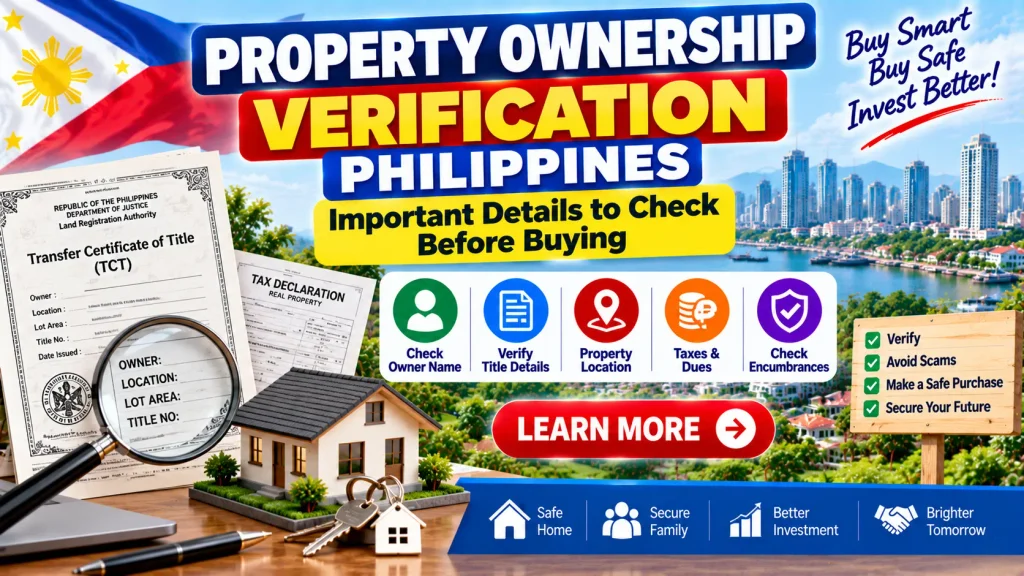
This guide explains the important property ownership details to check before buying in the Philippines, along with practical steps for title verification and safer property due diligence.
Important: Real estate transactions can involve complex legal, tax, inheritance, and ownership issues. Procedures and documentary requirements can vary. For a high-value or complicated transaction, consider obtaining advice from a qualified Philippine lawyer and other appropriate property professionals.
Property Ownership Verification – Quick Overview
| Detail to Check | Why It Is Important |
|---|---|
| Registered Owner | Helps establish who is named on the title |
| Seller Identity | Should correspond with ownership/authority |
| Title Number | Identifies the registered title |
| Title Type | OCT, TCT or CCT |
| Property Location | Confirms the correct property |
| Land Area | Should correspond with the transaction |
| Technical Description | Identifies boundaries and measurements |
| Annotations | Can reveal interests or restrictions |
| Mortgage | May affect the proposed sale |
| Tax Declaration | Provides local assessment information |
| Property Taxes | Check applicable tax status |
| Physical Boundaries | Should correspond with the property records |
| Authority to Sell | Important when a representative is involved |
What Is Property Ownership Verification?
Property ownership verification is the process of checking relevant documents and official records to determine who is registered as the owner of a particular property and whether the proposed seller has the authority to complete the transaction.
Verification should not be limited to asking:
“Whose name appears on this photocopy?”
A proper check can involve comparing the seller’s documents with official title information and investigating any inconsistencies or annotations.
The goal is to understand the property’s legal and physical status before committing substantial money.
Why Is Ownership Verification Important?
Property fraud and ownership disputes can be extremely expensive to resolve.
Verification can help identify potential problems such as:
- Fake or altered title documents
- Someone pretending to be the owner
- Unauthorized representatives
- Multiple registered owners
- Unsettled inheritance
- Existing mortgages
- Adverse claims
- Property restrictions
- Boundary disputes
- Conflicting property descriptions
- Outstanding tax issues
Finding a problem before paying is generally much better than discovering it after the transaction.
Check the Registered Owner
The registered owner’s name is one of the first details to examine.
Compare it with the seller’s valid identification.
Names should be reviewed carefully, including spelling and other identifying information.
If the seller’s name does not match the registered owner’s name, do not immediately proceed based on a verbal explanation.
Ask for supporting legal documents.
What if the Seller Is Not the Registered Owner?
There can be legitimate reasons for this situation, but additional verification becomes necessary.
Authorized Representative
A representative may be acting for the owner under an appropriate legal authorization.
Verify the document and the extent of the person’s authority.
Deceased Registered Owner
If the registered owner has died, estate settlement and inheritance requirements may apply.
An heir saying “this land belongs to me” does not by itself establish that every requirement for a valid transfer has been completed.
Multiple Owners
Property can be co-owned.
Determine which parties need to participate in the transaction.
Corporate Ownership
If a company owns the property, verify the company and the authority of the person executing documents on its behalf.
Complex ownership situations are good reasons to obtain legal assistance.
Understand the Main Title Types
Buyers should know which type of title they are examining.
Original Certificate of Title (OCT)
An OCT is associated with the original registration of titled land.
Transfer Certificate of Title (TCT)
A TCT is commonly encountered after registered land has undergone an applicable ownership transfer.
Condominium Certificate of Title (CCT)
A CCT relates to ownership of an individual condominium unit.
For condominium purchases, buyers should also review relevant condominium corporation, association, developer, and unit information.
OCT vs TCT vs CCT
| Document | General Use |
|---|---|
| OCT | Original registration of titled land |
| TCT | Registered ownership following an applicable land transfer |
| CCT | Individual condominium unit ownership |
| Tax Declaration | Local assessment/tax record, not the same as a title |
Knowing the document type helps determine what other records should be reviewed.
Verify the Title Through Appropriate Official Channels
Do not rely solely on the seller’s photocopy.
Buyers can use appropriate Land Registration Authority or Registry of Deeds procedures to obtain or verify relevant title information.
A Certified True Copy of a title can be particularly useful for due diligence.
When comparing records, review:
- Registered owner’s name
- Title number
- Property location
- Land area
- Technical description
- Annotations
If the official information does not match the seller’s documents, investigate before making a payment.
Check the Title Number
The title number helps identify the particular registered title.
Make sure the title number shown in documents corresponds with the property being offered.
Be cautious if:
- Different copies show different title numbers
- The seller refuses to provide the title number
- Property descriptions do not match
- The seller discourages independent verification
A legitimate transaction should be able to withstand reasonable due diligence.
Review the Property Location and Land Area
Confirm that the property described in the documents is actually the property you are being shown.
Check:
- Province/city or municipality
- Barangay where applicable
- Lot information
- Land area
- Technical description
A seller could show a buyer an attractive parcel of land while presenting documents relating to another property.
Physical verification is therefore essential.
Understand the Technical Description
A technical description identifies property boundaries through survey-related measurements and reference information.
Most buyers will not be expected to interpret complex technical descriptions themselves.
If the property’s boundaries are unclear, consider hiring an appropriately qualified geodetic engineer or other suitable professional.
A survey can be particularly useful when:
- Boundary markers are missing
- Fences appear misplaced
- Neighboring owners disagree
- The lot will be subdivided
- Actual area seems inconsistent
Check Title Annotations
A title can contain annotations affecting the property.
These may involve matters such as:
- Mortgage
- Adverse claim
- Easement
- Restrictions
- Notices relating to litigation
- Other registered interests
Do not ignore an annotation simply because the seller says, “That is old.”
Determine its current status.
Check for an Existing Mortgage
A property subject to a mortgage requires careful handling.
Ask:
- Who is the mortgagee?
- Is the obligation fully paid?
- Is the mortgage still annotated?
- How will it be discharged?
- Who will process the cancellation?
- When will the property be ready for transfer?
The transaction should clearly explain how the mortgage will be addressed.
Do not rely only on a promise that it will be removed after you pay.
What Is an Adverse Claim?
An adverse claim can indicate that another person is asserting an interest in the property.
This deserves careful investigation.
Find out:
- Who filed the claim
- What interest is being asserted
- Its current status
- Whether legal proceedings exist
- How it could affect your purchase
Consider professional legal review before proceeding.
Check the Tax Declaration
A tax declaration is an important local property assessment record.
It can contain information relating to:
- Declared owner
- Property location
- Property classification
- Assessed value
- Land and improvements
However, buyers should understand an important distinction:
A tax declaration is not automatically equivalent to a registered land title or conclusive proof of registered ownership.
It should be reviewed together with other relevant property records.
Verify Real Property Tax Status
Buyers should also investigate whether applicable real property taxes are current.
Request relevant receipts or tax information and verify them with the appropriate local government office when necessary.
Ask:
- Are there unpaid taxes?
- What period do the records cover?
- Who will settle any outstanding amount?
- Is tax clearance required for the transfer?
Resolve these questions before completing the transaction.
Inspect the Property Personally
Ownership verification should include physical due diligence.
Visit the property and check:
- Exact location
- Road access
- Boundaries
- Existing buildings
- Occupants
- Utilities
- Encroachments
- Neighborhood
- Drainage
- Flood exposure
- Visible disputes
Do not purchase property solely from photographs, videos, or online advertisements.
Verify Who Occupies the Property
The registered owner and physical occupant are not always the same person.
Ask whether the property is:
- Owner-occupied
- Rented
- Occupied by relatives
- Vacant
- Used by informal occupants
- Subject to another possession arrangement
Possession issues can complicate turnover.
Make sure you understand who currently occupies the property and under what arrangement.
Buying a Condominium
Condominium ownership verification requires additional checks.
Review:
- CCT
- Registered unit owner
- Unit number
- Parking title or rights
- Association dues
- Condominium corporation rules
- Outstanding balances
- Restrictions
- Developer information
Never assume parking is automatically included in the unit purchase unless the transaction documents clearly establish it.
Buying From a Developer
When buying a new or pre-selling property, investigate the developer and project.
Check:
- Developer identity
- Project details
- Reservation agreement
- Payment schedule
- Turnover terms
- Additional charges
- Cancellation conditions
- Association dues
- Applicable permits and regulatory documentation
Keep copies of advertisements, contracts, official receipts, and communications.
Buying From an Individual Seller
Direct transactions require careful seller verification.
Before paying, check:
| Verification | Question to Ask |
|---|---|
| Identity | Is this really the seller? |
| Ownership | Is the seller the registered owner? |
| Authority | Can this person legally sell? |
| Title | Does official information match? |
| Annotations | Are there claims or mortgages? |
| Taxes | Are applicable property taxes current? |
| Boundaries | Is this the exact property? |
| Occupancy | Who currently possesses the property? |
| Contract | Are all terms clearly written? |
| Payment | Will every payment be documented? |
Documents to Check Before Buying
Depending on the transaction, important documents can include:
- OCT, TCT or CCT
- Certified True Copy of title
- Seller’s valid identification
- Tax Declaration
- Real property tax records
- Contract to Sell
- Deed of Absolute Sale
- Special Power of Attorney, where applicable
- Estate documents, where applicable
- Corporate authorization, where applicable
- Survey or property plan
- Other transaction-specific records
The exact requirements vary according to the property and transaction.
Warning Signs Buyers Should Not Ignore
Price Is Unusually Low
A bargain can be legitimate, but a dramatically low price deserves additional verification.
Seller Demands Immediate Payment
Be cautious when told to send money immediately before you can inspect or verify the property.
Seller Refuses Title Verification
Independent verification should not be treated as unreasonable.
Different Names Appear on Documents
Investigate every important discrepancy.
Only Photocopies Are Available
Understand why original or official records cannot be properly verified.
Payment Is Requested to an Unrelated Person
Confirm exactly who is receiving your money and why.
Avoid Fake Online Property Verification Services
Online tools can be convenient, but property ownership information is legally significant.
Be cautious of websites claiming:
“Enter any person’s name and instantly see every property they own.”
Use legitimate government procedures for official title-related requests.
Also avoid submitting IDs, banking information, or payments to unknown websites merely because they display government-style logos.
Property Ownership Verification Checklist
Before purchasing, try to complete the following:
- Verify seller identity.
- Check registered ownership.
- Verify the title number.
- Obtain appropriate official title information.
- Compare property location.
- Check land area.
- Review technical description.
- Investigate annotations.
- Check mortgage status.
- Review tax declaration.
- Verify property tax status.
- Inspect the actual property.
- Check physical boundaries.
- Confirm occupancy.
- Review the sale contract.
- Document all payments.
Why Professional Assistance Can Be Valuable
Not every simple property purchase requires the same level of professional involvement.
However, qualified legal or technical assistance is particularly valuable when:
- Property is inherited
- Registered owner is deceased
- Multiple heirs are involved
- Seller uses a representative
- Title contains an adverse claim
- Property is mortgaged
- Boundaries are disputed
- Documents conflict
- Transaction value is substantial
The cost of proper due diligence can be far smaller than the cost of resolving a serious ownership dispute later.
Frequently Asked Questions (FAQ)
1. How can I verify property ownership in the Philippines?
Check the title information supplied by the seller and compare it with relevant information obtained through appropriate LRA or Registry of Deeds procedures.
2. What is the most important information to check on a title?
Check the registered owner, title number, property location, land area, technical description, and relevant annotations.
3. Is a TCT proof of registered property ownership?
A TCT is an important registered title document. Buyers should still verify current title information and review its annotations before purchasing.
4. Is a tax declaration the same as a land title?
No. A tax declaration relates to local property assessment and taxation and is not automatically equivalent to a registered land title.
5. What if the seller’s name is different from the registered owner?
Request documentation proving the seller’s legal authority. The situation may involve representation, inheritance, co-ownership, or another legal arrangement.
6. How can I check whether a property has a mortgage?
Review current title information and its annotations. If a mortgage appears, determine its current status and how it will be properly discharged.
7. What is an adverse claim?
An adverse claim can indicate that another party is asserting an interest in the property and should be carefully investigated before purchase.
8. Should I check the property boundaries?
Yes. Physical boundaries should correspond with the property you intend to buy. Consider a professional survey when boundaries are uncertain.
9. Is it safe to buy property advertised on Facebook?
Social media can be used to discover properties, but an advertisement itself does not establish ownership. Independently verify the seller, title, property, and transaction before paying.
10. When should I consult a lawyer?
Legal assistance is particularly advisable for high-value, inherited, mortgaged, disputed, co-owned, or otherwise complicated properties.
Final Words
Property Ownership Verification in the Philippines should be completed before a buyer releases a substantial amount of money.
Start by confirming the seller’s identity and comparing it with the property’s registered ownership information. Verify the title number, property location, land area, technical description, and relevant annotations through appropriate official procedures.
Do not ignore mortgages, adverse claims, restrictions, inheritance issues, or discrepancies between documents.
Next, review the tax declaration and applicable property tax status. Visit the property personally, check access and occupancy, and confirm physical boundaries. A professional survey can provide additional protection when boundaries are unclear.
If someone other than the registered owner is selling the property, verify the person’s legal authority before proceeding.
Finally, read every contract carefully and keep records of all payments.
A low price, beautiful house, or urgent sales offer should never replace proper due diligence. Verifying ownership, title details, seller authority, taxes, and the physical property before buying can significantly reduce the risk of fraud and costly property disputes.
Declaration
The information provided on this website is published for informational purposes only. While every effort is made to ensure the accuracy and timely updating of the content, we do not guarantee the completeness, reliability, or authenticity of any information. Candidates and users are strongly advised to visit the official websites of the respective departments, organizations, or authorizing bodies before applying for any job, scheme, examination, or benefit program. This website is not associated with any government organisation and does not provide any recruitment guarantee or official confirmation. We are not responsible for any loss, error, or misunderstanding arising from the use of the information available on this website.