Philippines Property Guide – Check Ownership, Title & Property Details
Buying land, a house, condominium, or other real estate in the Philippines can involve a substantial financial commitment. Before paying a reservation fee, down payment, or the full purchase price, buyers should carefully verify the property ownership, land title, property details, taxes, boundaries, and possible legal restrictions.
Property verification is important because a seller’s name, advertisement, photocopied title, or tax declaration alone may not provide everything a buyer needs to confirm legal ownership. Proper due diligence can help identify issues such as title discrepancies, mortgages, liens, adverse claims, unpaid taxes, ownership disputes, or differences between the property being shown and the property described in official records.
In the Philippines, land title records are closely associated with the Registry of Deeds, while the Land Registration Authority (LRA) has a central role in the country’s land registration system. Other government offices can also hold information relevant to taxation, property classification, and local records.
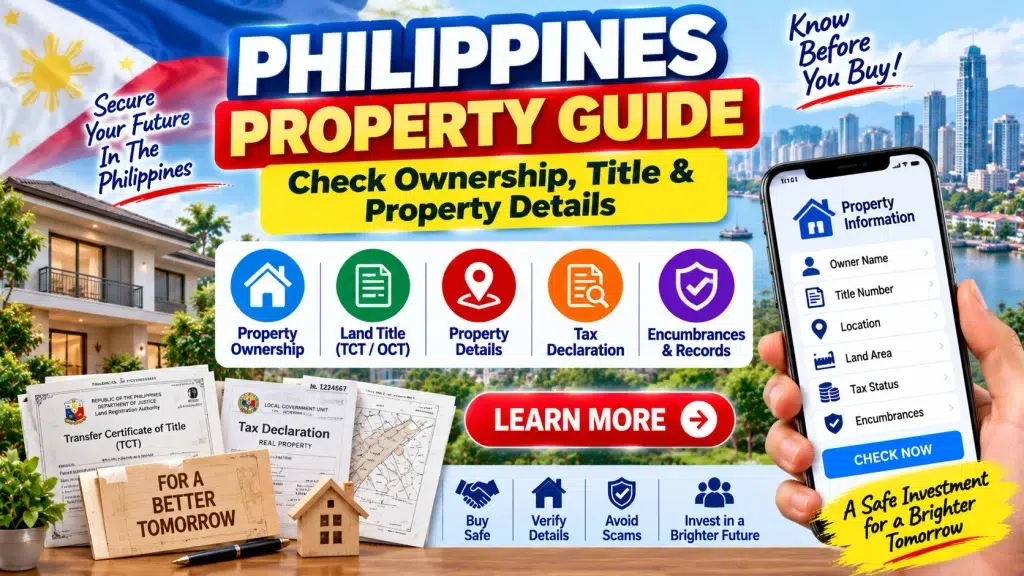
This guide explains how to check property ownership in the Philippines, verify a land title, review property details, understand tax declarations, identify encumbrances, and perform due diligence before buying real estate.
Important: Property transactions can involve significant legal and financial consequences. Procedures and documentary requirements can vary by property and location. For a high-value or complicated transaction, consider obtaining assistance from a qualified Philippine real estate lawyer or other appropriate professional.
Philippines Property Verification – Quick Overview
| Item to Check | Why It Matters |
|---|---|
| Registered Owner | Helps confirm who legally holds the registered title |
| Title Number | Identifies the registered property record |
| Registry of Deeds | Holds relevant land registration records |
| Property Location | Confirms where the property is registered |
| Technical Description | Describes the property’s boundaries and measurements |
| Land Area | Should correspond with relevant documents |
| Encumbrances | May reveal mortgages, liens or other annotations |
| Tax Declaration | Useful for local property/tax information |
| Real Property Tax | Check applicable local tax status |
| Seller Identity | Should be verified against official documents |
| Authority to Sell | Important if a representative is involved |
| Property Inspection | Confirms physical condition and location |
| Survey | Can help clarify boundaries |
| Legal Review | Useful before completing a major transaction |
Why Check Property Ownership Before Buying?
Property advertisements often focus on location, price, lot area, house design, or investment potential.
Legal ownership deserves equal attention.
A buyer should determine whether the person offering the property actually has the legal authority to sell it.
Ownership verification can help detect situations involving:
- Someone selling property they do not own
- Multiple people claiming the same property
- Inherited property with unresolved estate issues
- A representative without sufficient authority
- A property subject to a mortgage
- An adverse claim or other annotation
- Incorrect boundaries
- Fake or altered documents
Never rely entirely on verbal assurances.
Understanding Land Titles in the Philippines
A land title is an important document in the Philippine property registration system.
Depending on the circumstances, buyers may encounter terms such as Original Certificate of Title (OCT) or Transfer Certificate of Title (TCT).
Condominium ownership can involve a Condominium Certificate of Title (CCT).
These documents contain important information about the registered property and owner.
A title can include:
- Registered owner’s name
- Title number
- Property location
- Technical description
- Land area
- Annotations
- Mortgages or other encumbrances, where recorded
Buyers should examine both the main title information and relevant annotations.
OCT vs TCT vs CCT
| Document | General Purpose |
|---|---|
| OCT | Original Certificate of Title associated with original registration |
| TCT | Transfer Certificate of Title issued following applicable transfer |
| CCT | Condominium Certificate of Title for condominium ownership |
| Tax Declaration | Local property/tax record; not the same as a land title |
Understanding the document type can help buyers know what additional verification may be necessary.
What Is the Registry of Deeds?
The Registry of Deeds is central to land title registration and property transactions in the Philippines.
The appropriate Registry of Deeds is generally associated with the location where the property is registered.
A buyer performing due diligence may need to verify title information through the appropriate official channels rather than relying solely on a photocopy supplied by the seller.
This is especially important when a substantial amount of money is involved.
How to Check a Property Title
A practical verification process can include the following steps.
Step 1: Ask the Seller for Property Information
Request relevant information and documents, which may include:
- Copy of the title
- Title number
- Registered owner’s name
- Property address or location
- Tax declaration
- Latest applicable tax information
- Seller’s identification
Do not treat the photocopy as final proof by itself.
Step 2: Compare the Seller’s Name
Check whether the seller’s identity corresponds with the registered owner.
If the seller is not the registered owner, ask why.
There may be a legitimate explanation, such as:
- Authorized representative
- Estate settlement
- Corporate ownership
- Attorney-in-fact
- Co-ownership
However, each situation requires additional documentation.
Step 3: Verify Through Official Records
Use the appropriate official process to obtain or verify relevant title information.
The goal is to compare official information with the documents presented by the seller.
Step 4: Check the Technical Description
Review the property’s technical description.
It helps identify the land and its boundaries.
If the property being shown does not seem consistent with the documents, consider professional surveying assistance.
Step 5: Review Annotations
Do not check only the owner’s name.
Review the title for annotations that can affect the property.
Step 6: Investigate Any Discrepancies
If names, lot areas, boundaries, or other details differ, resolve the issue before making a major payment.
What Are Encumbrances?
An encumbrance is a claim, restriction, or interest that can affect property rights.
Examples can include:
- Mortgage
- Lien
- Adverse claim
- Notice relating to litigation
- Easement
- Restrictions
- Other registered annotations
The presence of an annotation does not always mean a property cannot be purchased.
However, buyers need to understand exactly what it means and how it will be addressed before completing the transaction.
For complicated annotations, legal advice is advisable.
What Is a Tax Declaration?
A tax declaration is a local government property record used in connection with real property assessment and taxation.
It can contain information such as:
- Declared owner
- Property location
- Classification
- Assessed value
- Land or improvement details
- Other local assessment information
However, a tax declaration should not automatically be treated as equivalent to a Torrens title or conclusive proof of registered ownership.
Buyers should understand what documents actually establish the property’s legal status.
Check Real Property Taxes
Before completing a purchase, investigate applicable real property tax obligations.
Ask for relevant records or receipts and verify information with the appropriate local government office when necessary.
Unpaid taxes can complicate a transaction.
A buyer should understand:
- Current tax status
- Outstanding obligations
- Who is responsible for unpaid amounts
- Applicable transaction taxes
- Local requirements
Do not assume that a clean-looking property means its taxes are current.
Check the Property’s Physical Location
Legal documents are only part of due diligence.
Visit the property personally whenever possible.
Confirm:
- Actual location
- Access road
- Boundaries
- Occupants
- Neighboring properties
- Utilities
- Physical condition
- Flood exposure
- Visible disputes or encroachments
A property may look excellent in photographs while having practical problems that are difficult to see online.
Why a Land Survey Can Be Important
A professional survey can help determine whether the physical property corresponds with its technical description and boundaries.
This can be especially important when:
- Boundary markers are unclear
- Neighbors dispute boundaries
- Fences appear misplaced
- The lot is being subdivided
- Actual area seems inconsistent
- The property is undeveloped land
For significant boundary questions, use an appropriately qualified professional.
Check the Seller Carefully
Property verification should include verification of the seller.
Check the seller’s valid identification and compare it with relevant property documents.
If the owner is married, deceased, represented by another person, or the property is co-owned, additional legal issues may arise.
If a Representative Is Selling
Verify the representative’s legal authority.
A verbal statement such as “I am authorized by the owner” is not enough for a major property transaction.
If the Registered Owner Is Deceased
Inheritance and estate-settlement requirements may apply.
If There Are Multiple Owners
Determine whether all necessary parties are participating and whether appropriate consent is required.
Buying a Condominium
Condominium buyers should conduct additional checks beyond the unit itself.
Consider reviewing:
- Condominium Certificate of Title
- Developer or seller information
- Condominium corporation rules
- Association dues
- Outstanding balances
- Parking ownership or rights
- Restrictions on use
- Unit condition
- Project documentation
Do not assume that parking is included merely because it appears in the advertisement.
Buying From a Real Estate Developer
If purchasing from a developer, review:
- Developer identity
- Project details
- Contract terms
- Payment schedule
- Turnover date
- Reservation terms
- Cancellation/refund conditions
- Additional charges
- Association dues
- Applicable permits and regulatory information
Keep copies of advertisements and official transaction documents.
Buying Land From an Individual Owner
Direct purchases can require particularly careful verification.
Before paying, check:
- Seller identity
- Registered ownership
- Title information
- Property boundaries
- Tax status
- Encumbrances
- Authority to sell
- Physical possession
- Applicable contracts
- Transfer requirements
Consider professional assistance before releasing a large amount of money.
Property Verification Checklist
| Verification | What to Compare |
|---|---|
| Owner Name | Seller ID vs registered records |
| Title Number | Seller’s copy vs official information |
| Lot Area | Title vs actual property |
| Technical Description | Official record vs property boundaries |
| Tax Declaration | Property and assessment information |
| Tax Status | Applicable local tax records |
| Annotations | Mortgages, claims, restrictions |
| Seller Authority | Ownership or legal authorization |
| Physical Property | Location, access, condition |
| Occupancy | Seller’s claims vs actual occupants |
Property Ownership and Online Checking
Digital services can make some property-related information easier to access, but buyers should be cautious about websites claiming to provide complete ownership details simply by entering a person’s name or phone number.
Land ownership records contain sensitive and legally significant information.
Use authorized government services and legitimate verification procedures.
Do not submit identity documents or payment information to an unknown “property checker” website.
Can You Search Property Ownership by Name?
Property verification is not always as simple as entering someone’s name into a public search engine.
The correct method depends on the record being requested, the property location, and the applicable agency procedure.
If you know the title number and property information, official verification can be more straightforward.
For uncertain ownership situations, professional legal assistance may be useful.
What to Do Before Paying a Reservation Fee
Before paying a significant reservation amount:
- Verify who is receiving the money.
- Read the reservation agreement.
- Understand whether the payment is refundable.
- Check the property and seller.
- Ask what happens if financing is rejected.
- Get an official receipt.
- Avoid cash payments without documentation.
Do not let artificial urgency prevent proper verification.
Statements such as “pay within one hour or lose the property” should be treated cautiously when major due diligence remains incomplete.
Common Property Scams to Avoid
Fake Titles
A professional-looking photocopy does not guarantee authenticity.
Fake Owners
Someone may pose as the owner or use another person’s identity.
Duplicate Sale
A dishonest seller may attempt to sell the same property to multiple buyers.
Unrealistically Cheap Property
A price far below comparable properties can be a warning sign requiring extra verification.
Fake Online Agents
Scammers can copy legitimate property photographs and create fake listings.
Unofficial Verification Fees
Avoid sending money to individuals claiming they can secretly “clear” or alter government property records.
Title Transfer After Buying Property
After a legitimate sale, the buyer and seller generally need to complete applicable legal, tax, registration, and documentation requirements to transfer ownership.
The process can involve:
- Sale documentation
- Applicable tax requirements
- Government clearances
- Registry of Deeds processing
- Local government records
- Issuance/update of relevant ownership records
Requirements vary depending on the property and transaction.
A licensed professional can help with complicated transfers.
Why Legal Due Diligence Is Worth Considering
A property purchase can involve savings accumulated over many years.
Paying for professional verification can be small compared with the potential loss caused by a fraudulent or legally defective transaction.
Legal assistance is particularly valuable when:
- Ownership is disputed
- The seller acts through a representative
- The owner is deceased
- There are multiple heirs
- The title contains unusual annotations
- The property is mortgaged
- Documents do not match
- The transaction value is substantial
Frequently Asked Questions (FAQ)
1. How do I check property ownership in the Philippines?
Start by obtaining the property’s title information and verifying relevant records through appropriate official channels, including the Registry of Deeds where applicable.
2. What is a TCT?
A Transfer Certificate of Title is a land title issued in connection with registered ownership following an applicable transfer.
3. What is an OCT?
An Original Certificate of Title is associated with the original registration of titled land.
4. What is a CCT?
A Condominium Certificate of Title is used in connection with ownership of an individual condominium unit.
5. Is a tax declaration proof of land ownership?
A tax declaration is an important property and taxation record, but it should not automatically be treated as equivalent to a registered Torrens title or conclusive proof of ownership.
6. How can I check whether a property is mortgaged?
Review the title and applicable annotations through official verification. Mortgages and other interests may be reflected in relevant registered records.
7. Should I verify the title before paying?
Yes. Buyers should conduct appropriate ownership, title, property, and seller verification before releasing substantial funds.
8. What if the seller is not the registered owner?
Ask for documentation showing the seller’s legal authority. Depending on the situation, professional legal review may be advisable.
9. Should I check property taxes?
Yes. Applicable real property tax information should be reviewed before completing a purchase.
10. Which agencies are important for property verification?
Depending on the transaction, relevant offices can include the Registry of Deeds, Land Registration Authority, local government assessor/treasurer offices, and other agencies responsible for specific property records.
Final Words
Buying property in the Philippines requires more than choosing the right location and negotiating a good price. Ownership and title verification should be an essential part of every buyer’s due diligence.
Start by checking the seller’s identity and comparing it with the registered property information. Review the title number, land area, technical description, and annotations. Investigate mortgages, liens, adverse claims, or other restrictions before making a major payment.
Also check the tax declaration and applicable real property tax status, inspect the physical property, and consider a professional land survey when boundaries are unclear.
If the property involves inheritance, multiple owners, a representative, a mortgage, unusual annotations, or conflicting documents, consider obtaining qualified legal assistance before proceeding.
Most importantly, never rely solely on a photocopied title, Facebook listing, verbal promise, or unusually attractive price.
Careful verification through appropriate official records can help reduce the risk of fraud, ownership disputes, unexpected obligations, and costly property problems.
Declaration
The information provided on this website is published for informational purposes only. While every effort is made to ensure the accuracy and timely updating of the content, we do not guarantee the completeness, reliability, or authenticity of any information. Candidates and users are strongly advised to visit the official websites of the respective departments, organizations, or authorizing bodies before applying for any job, scheme, examination, or benefit program. This website is not associated with any government organisation and does not provide any recruitment guarantee or official confirmation. We are not responsible for any loss, error, or misunderstanding arising from the use of the information available on this website.