LTO Traffic Violations & Fines Philippines – Check Penalties Before You Drive
Driving in the Philippines comes with responsibilities that go beyond knowing how to operate a vehicle. Every driver should understand basic traffic laws, licensing requirements, vehicle registration rules, road signs, and the possible consequences of traffic violations.
The Land Transportation Office (LTO) is one of the key government agencies responsible for driver licensing, motor vehicle registration, and enforcement of various land transportation regulations. Depending on the violation and the authority involved, motorists may face fines, penalties, demerit points, vehicle-related consequences, or other administrative action.
Common concerns include driving without a valid license, using an unregistered vehicle, reckless driving, disregarding traffic signs, illegal modifications, failure to wear required safety equipment, and other road violations.
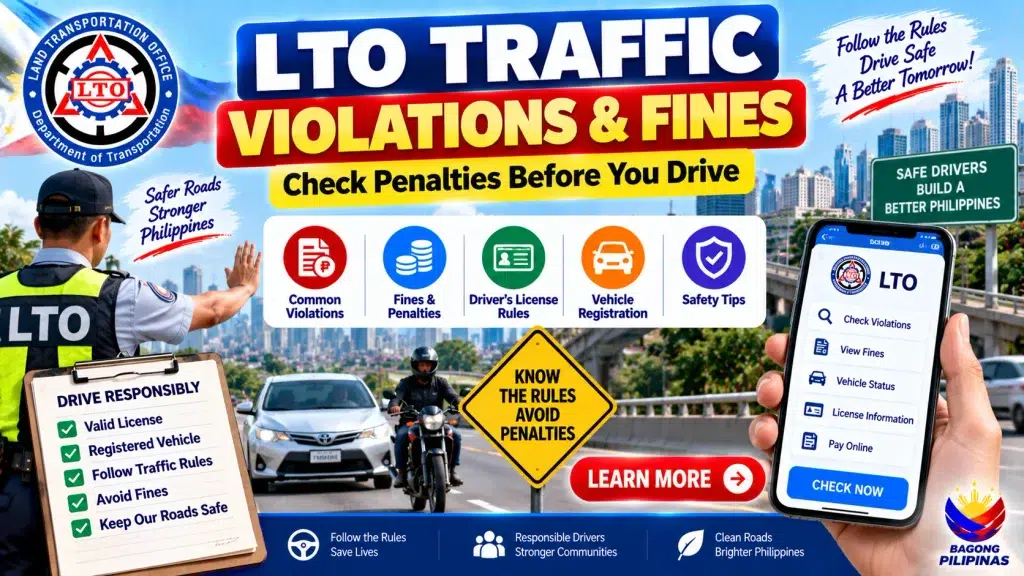
Because penalties and enforcement rules can be updated, motorists should verify the exact amount associated with a violation through current official LTO information or their official transaction/violation records.
This guide explains LTO traffic violations and fines in the Philippines, how motorists can check penalties, common violations to avoid, and what to do if a violation appears on your record.
Important: This article is for general information. Exact fines, demerit points, enforcement procedures, and penalties can depend on the specific violation, applicable law or regulation, and enforcing authority. Always verify your actual violation and amount due through official government channels.
LTO Traffic Violations & Fines – Quick Overview
| Topic | What Drivers Should Know |
|---|---|
| Driver’s License | Must be valid and appropriate for the vehicle |
| Vehicle Registration | Vehicle must meet applicable registration requirements |
| Traffic Signs | Drivers must obey regulatory signs and signals |
| Reckless Driving | Can result in penalties and additional consequences |
| Seat Belts | Applicable seat-belt requirements must be followed |
| Motorcycle Helmets | Riders must comply with applicable helmet rules |
| Distracted Driving | Prohibited conduct can result in penalties |
| DUI | Driving under the influence carries serious consequences |
| Vehicle Modifications | Certain unauthorized modifications can create violations |
| Demerit Points | Some violations can affect a driver’s record |
| Penalty Check | Use official LTO/LTMS information where available |
| Payment | Use authorized payment channels only |
What Are LTO Traffic Violations?
An LTO-related traffic violation generally refers to conduct that violates applicable land transportation laws, rules, or regulations administered or enforced by the relevant authorities.
Violations can relate to the:
- Driver
- Driver’s license
- Motor vehicle
- Vehicle registration
- Road behavior
- Required safety equipment
- Vehicle condition
- Traffic rules
Not every traffic citation in the Philippines necessarily comes from the LTO. Local government traffic authorities and other authorized enforcement bodies can also issue citations under applicable rules.
This is why drivers should first identify which authority issued the violation before attempting to pay it.
Why Should Drivers Check Their Violations?
Ignoring a traffic violation can create problems later.
Depending on the circumstances, unresolved violations may affect:
- Driver’s license transactions
- Renewal procedures
- Vehicle-related transactions
- Driver records
- Outstanding financial obligations
- Other administrative processes
If you receive a citation or believe a violation has been recorded, check the information instead of waiting until your next LTO transaction.
Common Traffic Violations in the Philippines
Drivers can encounter many different violations. The following categories are among the most important to understand.
1. Driving Without a Valid Driver’s License
A person should not operate a motor vehicle without the appropriate valid driving authority required under Philippine law.
Problems can arise when:
- The driver has no license
- The license is expired
- The driver is not authorized for the applicable vehicle category
- The license is suspended or otherwise invalid
Always check your license validity before driving.
2. Driving an Unregistered Vehicle
Motor vehicles are subject to applicable registration requirements.
Driving a vehicle with registration problems can result in penalties depending on the circumstances.
Before using a vehicle, check:
- Registration status
- Applicable renewal requirements
- Vehicle documents
- Plate-related requirements
- Other registration information
Do not assume a vehicle is properly registered simply because you recently purchased it from another person.
3. Reckless Driving
Reckless driving is a serious road-safety issue.
Examples of dangerous behavior can include:
- Aggressive driving
- Unsafe overtaking
- Excessive speed for conditions
- Dangerous lane changes
- Ignoring other road users
- Operating a vehicle in an unsafe manner
The consequences can become more serious when reckless behavior results in injury, property damage, or repeated violations.
4. Disregarding Traffic Signs and Signals
Traffic lights, regulatory signs, road markings, and authorized traffic directions are designed to manage traffic safely.
Examples of prohibited conduct can include:
- Running a red light
- Ignoring a stop sign
- Making a prohibited turn
- Entering a restricted road
- Disregarding lane markings
- Ignoring lawful traffic directions
Drivers should pay attention even on familiar roads because traffic schemes can change.
5. Distracted Driving
Using electronic devices while driving can create serious safety risks and may violate applicable distracted-driving rules.
Drivers should avoid prohibited mobile phone use and other distracting activities while operating a vehicle.
If you need to use your phone, stop in an appropriate safe location before doing so.
6. Driving Under the Influence
Driving under the influence of alcohol or dangerous drugs is a serious offense.
The consequences can go far beyond an ordinary traffic fine and can involve:
- License-related penalties
- Criminal consequences
- Financial penalties
- Other sanctions
Never drive when impaired.
Use a safe alternative such as a designated driver or legitimate transportation service.
7. Seat Belt Violations
Seat belts are an essential safety feature.
Drivers and applicable passengers should comply with current seat-belt requirements.
Before starting the vehicle, make sure occupants are properly secured according to applicable law and vehicle requirements.
8. Motorcycle Helmet Violations
Motorcycle riders should use appropriate helmets that comply with applicable safety requirements.
A helmet should also be worn correctly rather than simply carried on the motorcycle.
Both riders and passengers should understand the safety requirements that apply to them.
9. Illegal or Unauthorized Vehicle Modifications
Vehicle owners should be careful when modifying:
- Lights
- Exhaust systems
- Vehicle dimensions
- Body configuration
- Plates
- Other regulated components
A modification that looks attractive does not necessarily comply with applicable regulations.
Check current requirements before making major changes.
10. Plate and Registration-Related Violations
Vehicle identification and registration information must comply with applicable rules.
Drivers should avoid:
- Unauthorized plate alterations
- Improper display
- Deliberate obstruction
- Fake registration information
- Other prohibited plate-related conduct
Never purchase unofficial documents or plates from someone promising to “fix” a registration problem.
Traffic Violation Categories at a Glance
| Violation Category | Possible Consequence |
|---|---|
| No Valid License | Fine and/or licensing consequences |
| Registration Violation | Fine and possible vehicle-related action |
| Reckless Driving | Fine, record impact, or additional consequences |
| Traffic Signal Violation | Applicable citation/fine |
| Distracted Driving | Penalties under applicable rules |
| DUI | Serious legal and licensing consequences |
| Seat Belt Violation | Applicable fine |
| Helmet Violation | Applicable fine |
| Plate Violation | Fine and possible registration consequences |
| Unauthorized Modification | Applicable vehicle/registration penalties |
Note: This table describes general categories, not a guaranteed penalty amount.
Why Fine Amounts Should Be Checked Officially
Traffic-penalty information is frequently shared through social media, blogs, videos, and screenshots.
The problem is that some lists may be:
- Outdated
- Incomplete
- Based on old regulations
- Applicable only to a particular authority
- Missing repeat-offense consequences
- Missing demerit points
- Incorrectly copied
Therefore, if you actually received a citation, use the details on the citation and official government records to determine the applicable penalty.
What Is the LTMS Portal?
The Land Transportation Management System (LTMS) is the LTO’s digital platform for various driver and motor vehicle services.
Depending on the service and available records, motorists can use their account for relevant LTO transactions and information.
Keeping your LTMS account details secure is important.
Never give your password or one-time password to someone claiming they can remove a violation.
How to Check LTO-Related Information Online
The exact options available can depend on your account and transaction, but the general process is:
Step 1: Use the Official LTO/LTMS Service
Make sure you are using the legitimate government service.
Step 2: Log In to Your Account
Use your registered credentials.
Step 3: Review Relevant Records or Transactions
Check available licensing, transaction, or violation-related information.
Step 4: Verify the Violation Details
Review information such as:
- Violation
- Date
- Status
- Issuing authority
- Applicable amount or instruction
Step 5: Follow the Official Resolution Procedure
If payment or another action is required, follow the authorized instructions.
Do not send money to a personal account because someone says they can clear the record faster.
What if the Violation Was Issued by an LGU?
Some traffic citations are handled by local government traffic enforcement agencies rather than directly through LTO.
If your citation was issued by a city or municipality:
- Read the citation carefully.
- Identify the issuing authority.
- Check its official payment or settlement procedure.
- Verify the violation and amount.
- Pay only through an authorized channel.
- Keep your official receipt.
Do not assume every local traffic ticket can be paid through the same system.
Understanding Driver Demerit Points
Drivers should also understand that some violations can have consequences beyond a monetary fine.
Under applicable driver licensing rules, violations can affect a motorist’s record through a demerit point system.
Demerit points can become relevant to matters such as:
- Driver record
- License renewal
- Repeat violations
- Applicable licensing consequences
This is another reason to focus on safe driving rather than treating traffic fines as simply another road expense.
First Offense vs Repeat Violations
Some violations can carry different consequences depending on whether they are repeated.
For example, a first offense may not always have the same consequences as a second or subsequent offense.
Repeat violations can potentially result in:
- Higher penalties
- Additional demerit points
- Suspension-related consequences
- Other administrative action
Always check the rule applicable to the actual violation.
Can an LTO Fine Affect License Renewal?
Outstanding violations or driver-record issues can potentially affect licensing transactions depending on the nature and status of the violation.
Before your renewal date:
- Review your records
- Resolve legitimate outstanding violations
- Prepare required documents
- Complete applicable requirements
Do not wait until the final day of license validity to investigate an unresolved issue.
What to Do After Receiving a Traffic Citation
If an enforcement officer issues a citation:
Read It Carefully
Check the alleged violation and issuing authority.
Keep the Citation
Do not lose the document.
Verify the Information
Make sure your name, vehicle details, date, and other important information are accurate.
Follow the Correct Procedure
Use the instructions provided by the legitimate issuing authority.
Keep Payment Proof
After paying an applicable penalty, retain the official receipt or electronic confirmation.
What if You Believe the Violation Is Incorrect?
Do not attempt to “fix” an incorrect violation through unofficial payments.
Instead:
- Gather your citation and supporting records.
- Identify the issuing authority.
- Ask about the official contest or dispute procedure.
- Submit relevant evidence where permitted.
- Keep copies of communications and documents.
The procedure can vary depending on which authority issued the citation.
LTO Traffic Violation Safety Checklist
Before driving, check:
- Driver’s license validity
- Vehicle registration
- Required vehicle documents
- Seat belts
- Motorcycle helmet, when applicable
- Lights and signals
- Tires
- Brakes
- Mirrors
- Plates
- Vehicle condition
- Road signs and traffic rules
A few minutes of checking before a trip can help prevent both safety problems and avoidable violations.
Common Mistakes Drivers Should Avoid
Driving With an Expired License
Check the validity period before it expires.
Forgetting Vehicle Registration
Keep track of applicable registration requirements.
Using a Phone While Driving
Avoid prohibited distracted-driving behavior.
Ignoring Small Violations
Minor violations can still affect your record or create additional costs.
Paying Through an Unofficial Link
Verify the issuing authority and payment channel.
Believing Every Fine List Online
Traffic regulations can change. Check current official information.
Avoid LTO Fine and Penalty Scams
Scammers sometimes use fear of fines to collect money or personal information.
Be cautious of messages saying:
- “Your license will be cancelled today.”
- “Pay immediately to remove your violation.”
- “Send your OTP to clear your record.”
- “Click this link to avoid suspension.”
- “We can delete your LTO violation.”
Before taking action, independently verify the information through legitimate LTO or issuing-authority channels.
Never share passwords, OTPs, or unnecessary financial information.
Frequently Asked Questions (FAQ)
1. What are common LTO traffic violations in the Philippines?
Common categories include licensing violations, registration problems, reckless driving, distracted driving, safety-equipment violations, plate-related violations, and other prohibited road behavior.
2. How can I check my LTO violation?
Review your official citation and use available official LTO/LTMS services or contact the legitimate issuing authority for current information.
3. How much is an LTO traffic fine?
There is no single amount for all violations. The applicable penalty depends on the offense and current rules.
4. Can traffic fines change?
Yes. Regulations and penalty schedules can be updated, which is why motorists should verify current information.
5. Are all traffic tickets issued by LTO?
No. Authorized local government and other traffic enforcement authorities can also issue citations under applicable rules.
6. What are driver demerit points?
Demerit points are part of the driver-record system associated with applicable traffic violations and can have licensing consequences.
7. Can a traffic violation affect driver’s license renewal?
Depending on the violation and its status, driver-record issues or unresolved violations can affect applicable licensing procedures.
8. Where should I pay a traffic fine?
Use only the authorized payment method specified by the legitimate issuing authority.
9. What should I do if I think a violation is incorrect?
Use the official contest, dispute, or review process of the authority that issued the citation and provide supporting evidence where applicable.
10. How can I avoid LTO violations?
Maintain a valid license and vehicle registration, follow traffic laws and road signs, use required safety equipment, keep the vehicle roadworthy, and avoid distracted, reckless, or impaired driving.
Final Words
Understanding LTO Traffic Violations and Fines in the Philippines can help motorists avoid unnecessary penalties and, more importantly, become safer road users.
Before driving, check that your driver’s license is valid and that the vehicle meets applicable registration requirements. Make sure safety equipment such as seat belts, helmets, lights, brakes, mirrors, and other required components are properly used and maintained.
While driving, follow traffic signals, signs, lane rules, and lawful instructions from authorized traffic personnel. Avoid distracted driving, reckless behavior, and driving under the influence.
If you receive a citation, identify the issuing authority and verify the exact violation, penalty, and resolution procedure through legitimate channels. Remember that not every traffic ticket is handled directly by LTO, and fine amounts can vary according to the offense and current rules.
Be particularly careful with social media posts and messages promising to remove traffic violations for a fee. Never share your LTMS password or OTP with anyone.
Ultimately, the best way to reduce traffic fines is not simply to memorize a penalty list. Keep your documents current, maintain your vehicle, understand the rules, and practice safe and responsible driving every time you are on the road.
Declaration
The information provided on this website is published for informational purposes only. While every effort is made to ensure the accuracy and timely updating of the content, we do not guarantee the completeness, reliability, or authenticity of any information. Candidates and users are strongly advised to visit the official websites of the respective departments, organizations, or authorizing bodies before applying for any job, scheme, examination, or benefit program. This website is not associated with any government organisation and does not provide any recruitment guarantee or official confirmation. We are not responsible for any loss, error, or misunderstanding arising from the use of the information available on this website.