Got a Traffic Violation in the Philippines? Check LTO Fines & Penalties
Receiving a traffic citation can be confusing, especially if you are unsure about the violation, the amount you need to pay, or where the penalty should be settled. In the Philippines, motorists can encounter violations involving driver’s licenses, vehicle registration, reckless driving, traffic signs, safety requirements, distracted driving, and other road rules.
The Land Transportation Office (LTO) handles important responsibilities involving driver licensing, motor vehicle registration, and enforcement of land transportation regulations. However, motorists should understand that not every traffic ticket is necessarily issued directly by the LTO. Local government traffic offices and other authorized enforcement agencies can also issue citations.
If you receive a traffic violation, the safest approach is to identify the issuing authority, verify the violation, check the applicable fine or penalty through official channels, and follow the authorized settlement procedure.
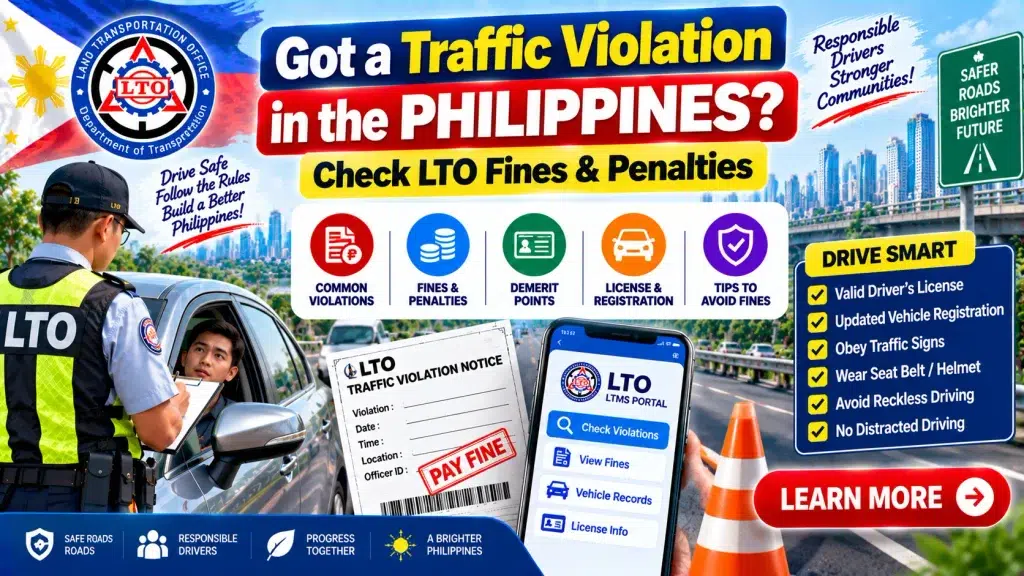
This guide explains how to check LTO-related fines and penalties, common traffic violations, demerit points, payment information, and what to do after receiving a citation.
Important: Traffic fines, demerit points, repeat-offense penalties, and enforcement procedures can change or differ depending on the violation and issuing authority. Always verify the exact amount and current requirements through the official LTO/LTMS service or the authority that issued your citation.
LTO Fines & Penalties – Quick Overview
| Topic | Important Information |
|---|---|
| Traffic Violation | Check the exact offense on the citation |
| Issuing Authority | May be LTO or another authorized authority |
| Driver’s License | Check validity and applicable restrictions |
| Vehicle Registration | Must comply with current requirements |
| Fine Amount | Depends on the specific violation |
| Repeat Offense | May result in additional consequences |
| Demerit Points | Can affect the driver’s record |
| LTMS | LTO’s digital management platform |
| Payment | Use authorized channels only |
| Official Receipt | Keep proof of payment |
| Incorrect Citation | Follow the official dispute procedure |
| Safety | Compliance helps prevent violations |
What Should You Do After Getting a Traffic Violation?
Do not panic or immediately pay someone who claims they can “clear” the violation.
Start by reading the citation carefully.
Check:
- Driver’s name
- Date and time
- Vehicle information
- Alleged violation
- Location
- Issuing authority
- Citation or reference number
- Settlement instructions
If any important information appears incorrect, keep the citation and supporting documents.
Do not alter the ticket yourself.
Identify Who Issued the Traffic Ticket
This is one of the most important steps.
A citation may come from:
- LTO
- Authorized local traffic enforcement office
- Another government enforcement authority with applicable jurisdiction
The correct payment or contest procedure can depend on the issuing authority.
For example, a city-issued traffic citation may need to be resolved through that city’s authorized system rather than through an unrelated payment portal.
Always follow the information from the legitimate issuing authority.
What Are LTO Traffic Violations?
LTO-related violations can involve the driver, vehicle, documents, or road behavior.
Common categories can include:
- Driver’s license violations
- Vehicle registration violations
- Reckless driving
- Vehicle equipment violations
- Plate-related violations
- Unauthorized modifications
- Safety-related violations
- Other prohibited conduct under applicable transportation rules
The consequences are not identical for every offense.
Some violations may involve more than a monetary fine.
Common Traffic Violations Drivers Should Know
Driving Without a Valid License
Drivers should have the appropriate valid authority to operate the vehicle they are driving.
Problems can arise when a person:
- Has no valid license
- Drives with an expired license
- Drives while the license is suspended
- Operates a vehicle outside applicable licensing authority
Check your license status before driving.
Vehicle Registration Violations
Motor vehicles must comply with applicable registration requirements.
Registration-related problems can occur when:
- Registration is not current
- Required vehicle documents are incomplete
- Vehicle information does not correspond with records
- Other applicable registration rules are violated
When buying a used vehicle, verify its registration status rather than relying only on the seller’s statement.
Reckless Driving
Unsafe driving behavior can put drivers, passengers, pedestrians, cyclists, and other motorists at risk.
Examples can include:
- Dangerous overtaking
- Aggressive lane changes
- Driving without reasonable regard for road conditions
- Other unsafe vehicle operation
Consequences can become more serious for repeated offenses or when dangerous driving results in an accident.
Disregarding Traffic Signs
Drivers must pay attention to traffic signs, signals, road markings, and lawful instructions.
Examples include:
- Running a red light
- Ignoring a stop sign
- Making prohibited turns
- Entering restricted areas
- Ignoring lane markings
Road schemes can change, so even experienced drivers should remain attentive.
Distracted Driving
Using a mobile device in a prohibited manner while driving can reduce reaction time and create serious risks.
Drivers should avoid prohibited phone use and other distracting behavior.
If you need to use your device, stop at an appropriate safe location first.
Seat Belt Violations
Seat belts can significantly reduce injury risk during collisions.
Drivers and applicable passengers should follow current seat-belt requirements.
Motorcycle Helmet Violations
Motorcycle riders and applicable passengers should use compliant helmets and wear them correctly.
Safety equipment should not be used merely to avoid a fine—it can save lives.
Driving Under the Influence
Driving while impaired by alcohol or dangerous drugs can result in serious legal consequences.
Possible consequences can extend beyond an ordinary traffic fine and involve licensing or criminal matters under applicable law.
Never drive while impaired.
Common Violation Categories & Possible Consequences
| Violation Category | Possible Result |
|---|---|
| Invalid/No Appropriate License | Fine and licensing consequences |
| Registration Violation | Fine and vehicle-related consequences |
| Reckless Driving | Fine, demerit points or other action |
| Traffic Signal Violation | Applicable citation/penalty |
| Distracted Driving | Fine and other applicable consequences |
| Seat Belt Violation | Applicable penalty |
| Helmet Violation | Applicable penalty |
| DUI | Serious legal/licensing consequences |
| Plate Violation | Fine or registration-related action |
| Unauthorized Modification | Vehicle-related penalty/action |
Note: This table is a general guide and does not represent a guaranteed current fine schedule.
Why Isn’t There One Fixed LTO Fine?
A common mistake is searching online for “LTO fine amount” as though every violation has the same penalty.
The actual amount can depend on:
- Specific violation
- Applicable law or regulation
- First or repeat offense
- Driver or vehicle circumstances
- Issuing authority
- Current penalty schedule
This is why screenshots of old fine lists should not be treated as final payment information.
Check the actual citation and current official records.
How to Check LTO Fines and Penalties
For an LTO-related violation, a general verification process can include:
Step 1: Check Your Citation
Identify the exact violation and reference information.
Step 2: Confirm the Issuing Authority
Determine whether the citation was issued by LTO or another authorized traffic authority.
Step 3: Use Official Services
For relevant LTO transactions, use legitimate LTO/LTMS channels.
Step 4: Review Available Records
Check the violation or transaction information available for your account or case.
Step 5: Verify the Amount
Confirm the applicable penalty before paying.
Step 6: Follow Official Instructions
Complete the required payment or resolution process through an authorized channel.
Step 7: Keep Proof
Save the official receipt or electronic payment confirmation.
What Is LTMS?
The Land Transportation Management System (LTMS) is the LTO’s digital platform supporting various driver and motor vehicle services.
Motorists may use the platform for applicable online LTO transactions and account information.
Protect your LTMS account carefully.
Never provide your:
- Password
- One-time password
- Security codes
- Sensitive payment details
to someone claiming to be an unofficial LTO agent.
Understanding LTO Demerit Points
A traffic violation can involve more than a fine.
Applicable violations can also affect a driver’s record through the demerit point system.
Demerit points are important because they can become relevant to driver licensing and repeat-offense consequences.
Therefore, drivers should not think:
“I’ll just pay the fine and continue driving the same way.”
Repeated unsafe behavior can create additional licensing problems.
First Offense vs Repeat Offense
Some traffic violations can have escalating consequences.
A subsequent offense may involve different penalties from the first offense.
Depending on the applicable rule, repeated violations can potentially lead to:
- Higher financial penalties
- Additional demerit points
- License-related consequences
- Suspension or other administrative action
Always check the current rule for your specific violation.
Can Traffic Violations Affect License Renewal?
Outstanding or unresolved violations and driver-record issues can affect applicable LTO transactions.
Before renewing your driver’s license, it is sensible to:
- Check your license information.
- Review unresolved traffic issues.
- Settle legitimate outstanding violations.
- Complete applicable requirements.
- Keep your receipts and supporting records.
Do not wait until your license is about to expire before checking a known unresolved citation.
How to Pay a Traffic Fine Safely
Never pay a traffic penalty through a random social media account or personal bank account.
Use the payment method authorized by the issuing authority.
Before payment, verify:
- Violation
- Citation number
- Amount
- Payment recipient
- Official payment channel
- Transaction reference
After payment, save the receipt.
A screenshot alone may not always be the best permanent record, so keep downloadable or printed documentation where available.
What if an LGU Issued the Violation?
If a city or municipal traffic office issued the citation, follow that authority’s procedure.
Generally:
- Identify the LGU.
- Verify the citation.
- Check its official payment or settlement process.
- Confirm the amount.
- Pay through the authorized channel.
- Keep the receipt.
Do not assume every LGU ticket will automatically appear in the same place as every LTO transaction.
What if You Think the Violation Is Wrong?
If you believe the citation was issued incorrectly, use the legitimate dispute or review process.
Prepare relevant evidence such as:
- Citation
- Driver’s license information
- Vehicle documents
- Photographs
- Video where lawfully available
- Other relevant records
Contact the authority that issued the citation and ask about its official contest procedure.
Avoid anyone offering to secretly delete the violation.
Avoid Traffic Fine Scams
Motorists can receive fake SMS, email, or social media messages pretending to be from transportation authorities.
Common scam messages can say:
- “Pay your LTO fine immediately.”
- “Your license will be suspended today.”
- “Click here to remove your violation.”
- “Send your OTP to verify your license.”
- “We can delete your violation for a fee.”
Do not click suspicious links.
Instead, independently access the official service and check your records.
Before You Drive – Quick Checklist
| Check | Why It Matters |
|---|---|
| Valid Driver’s License | Helps avoid licensing violations |
| Vehicle Registration | Confirms current registration status |
| Seat Belts | Important safety requirement |
| Motorcycle Helmet | Required where applicable |
| Lights | Essential for visibility |
| Brakes | Critical for vehicle safety |
| Tires | Important for control and braking |
| Mirrors | Help maintain road awareness |
| Plates | Must comply with applicable rules |
| Mobile Phone | Avoid prohibited use while driving |
How to Reduce the Risk of Traffic Violations
The easiest way to deal with a traffic fine is to avoid the violation in the first place.
Before every trip:
- Keep your license current.
- Maintain your vehicle registration.
- Check basic vehicle condition.
- Follow road signs.
- Observe traffic signals.
- Wear required safety equipment.
- Avoid distracted driving.
- Never drive impaired.
- Give other road users enough space.
- Follow lawful instructions from authorized traffic personnel.
Safe driving protects more than your wallet.
Frequently Asked Questions (FAQ)
1. How do I check an LTO traffic violation?
Review your citation and use legitimate LTO/LTMS services for applicable LTO records or contact the authority that issued the ticket.
2. How much is an LTO traffic fine?
The amount depends on the specific violation, applicable regulation, offense history, and current penalty schedule.
3. Can I check LTO fines online?
Relevant LTO information and transactions may be available through official LTO/LTMS services, depending on the record and service.
4. Are all Philippine traffic violations handled by LTO?
No. Local government and other authorized traffic authorities can also issue citations.
5. What are LTO demerit points?
Demerit points are associated with applicable traffic violations and can affect a driver’s record and licensing consequences.
6. Can a traffic violation affect license renewal?
Unresolved violations or driver-record issues can affect applicable licensing procedures depending on the circumstances.
7. Can I pay an LGU traffic ticket through LTO?
Not necessarily. Follow the payment procedure of the authority that issued the citation.
8. What if my traffic citation is incorrect?
Ask the issuing authority about its official contest or review procedure and provide relevant evidence.
9. Is it safe to pay an LTO fine from an SMS link?
Do not assume an unsolicited link is legitimate. Independently verify the violation and payment channel through official sources.
10. How can I avoid traffic penalties?
Maintain valid documents, keep your vehicle roadworthy, obey traffic signs and signals, use required safety equipment, and practice responsible driving.
Final Words
If you got a traffic violation in the Philippines, the first thing to do is identify exactly what happened rather than immediately paying an unknown person or clicking a suspicious link.
Read your citation carefully and determine which authority issued it. Verify the offense, reference number, applicable fine, demerit points, and resolution procedure through legitimate channels.
For LTO-related records and transactions, use official LTO/LTMS services where applicable. For citations issued by a local traffic authority, follow that authority’s official procedure.
Remember that a traffic violation may involve more than a financial penalty. Depending on the offense, demerit points and other licensing or administrative consequences can also apply, particularly for repeat violations.
Keep every official receipt after settlement and retain copies of important documents.
Most importantly, use traffic-penalty information as a reminder to drive more safely. A valid license, properly registered vehicle, good vehicle maintenance, attention to traffic signs, and responsible driving can help you avoid penalties while making Philippine roads safer for everyone.
Declaration
The information provided on this website is published for informational purposes only. While every effort is made to ensure the accuracy and timely updating of the content, we do not guarantee the completeness, reliability, or authenticity of any information. Candidates and users are strongly advised to visit the official websites of the respective departments, organizations, or authorizing bodies before applying for any job, scheme, examination, or benefit program. This website is not associated with any government organisation and does not provide any recruitment guarantee or official confirmation. We are not responsible for any loss, error, or misunderstanding arising from the use of the information available on this website.