Driving Without Registration? Check LTO Violations & Penalties in the Philippines
Driving a motor vehicle in the Philippines comes with legal and administrative responsibilities. One of the most important is keeping the vehicle properly registered with the Land Transportation Office (LTO). Vehicle registration helps establish official vehicle information and confirms compliance with applicable registration requirements.
If you drive a vehicle with expired, incomplete, or otherwise invalid registration, you may face a traffic citation, financial penalty, or other vehicle-related consequences depending on the circumstances. Registration problems can also create difficulties when selling a vehicle, transferring ownership, renewing documents, or completing other LTO transactions.
Many motorists search for questions such as “What is the LTO penalty for an unregistered vehicle?”, “Can I drive with expired registration?”, and “How can I check my vehicle registration?”
This guide explains LTO vehicle-registration violations in the Philippines, commonly referenced penalties, important OR/CR information, how to check registration details, and what motorists should do before driving.
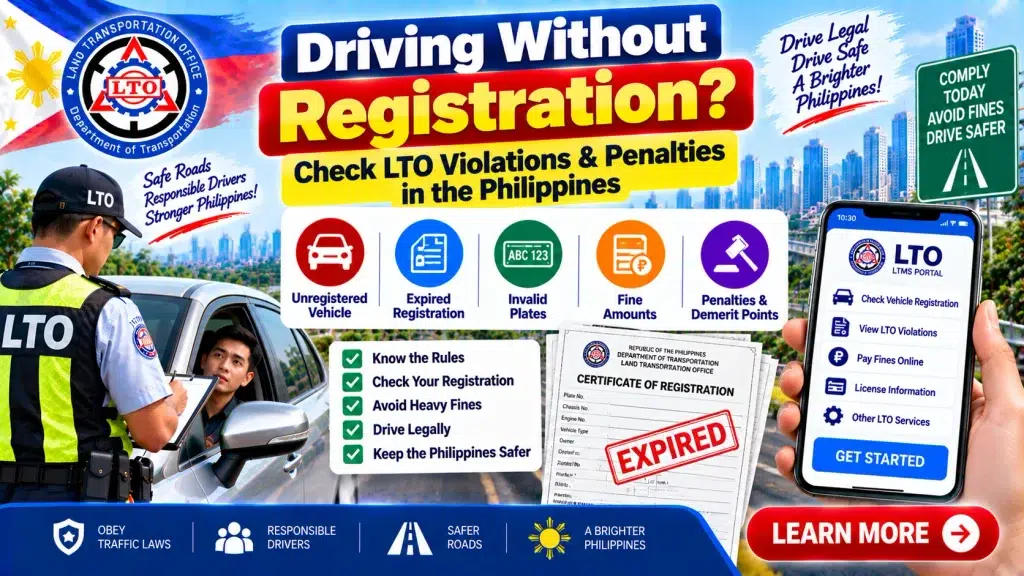
Important: LTO regulations, penalties, procedures, and requirements can be updated. The actual penalty can depend on the specific violation and circumstances. Always verify your citation and current requirements through official LTO/LTMS information before making a payment or completing a transaction.
LTO Vehicle Registration – Quick Overview
| Topic | Important Information |
|---|---|
| Vehicle Registration | Required for applicable motor vehicles |
| Registration Status | Should be kept current |
| Expired Registration | Can lead to penalties |
| Unregistered Vehicle | Can carry significant consequences |
| Common Reference Fine | ₱10,000 in applicable unregistered-vehicle cases |
| OR | Official Receipt |
| CR | Certificate of Registration |
| LTMS | LTO’s digital management platform |
| Renewal | Complete according to applicable LTO schedule |
| Vehicle Inspection | May be required in the registration process |
| Insurance | Applicable coverage/documentation may be required |
| Payment | Use authorized channels only |
Why Is Vehicle Registration Important?
Vehicle registration is an essential part of the Philippine land transportation system.
Registration records help identify information relating to a vehicle, including matters such as:
- Registered owner
- Vehicle classification
- Engine information
- Chassis information
- Plate information
- Registration status
- Other official vehicle details
Proper registration is important not only for avoiding penalties but also for maintaining accurate vehicle records.
When purchasing a second-hand vehicle, checking registration documents is one of the most important due-diligence steps.
What Does “Unregistered Vehicle” Mean?
The exact legal classification depends on the circumstances, but registration problems can arise when a vehicle does not meet applicable registration requirements.
Possible situations can include:
- Registration has expired.
- Required registration was not completed.
- Vehicle information has registration irregularities.
- Vehicle changes were not properly reflected where required.
- Documents are fraudulent or invalid.
- Other applicable registration requirements were not satisfied.
Do not assume every registration problem receives exactly the same treatment.
The violation written on the actual citation is important.
What Is the LTO Fine for an Unregistered Vehicle?
One of the most searched questions is:
“How much is the LTO fine for driving an unregistered vehicle?”
Commonly referenced LTO penalty schedules have listed a ₱10,000 fine for applicable driving-an-unregistered-motor-vehicle violations.
However, motorists should not automatically assume that ₱10,000 will be the final amount in every registration-related situation.
The actual consequences can depend on:
- Exact violation
- Vehicle circumstances
- Registration history
- Other associated violations
- Current LTO regulations
If you receive a citation, verify the exact penalty through official channels.
Registration Violation vs Late Registration
Motorists should understand that a registration problem can involve different issues.
| Situation | Possible Issue |
|---|---|
| Registration expired | Late/expired registration consequences |
| Vehicle driven without proper registration | Unregistered-vehicle violation |
| Incorrect vehicle information | May require correction |
| Unauthorized vehicle changes | May create registration/compliance issues |
| Fake registration documents | Serious legal/administrative issue |
| Transfer not properly processed | Ownership/registration complications |
This is why a generic online fine calculator may not accurately determine your actual liability.
What Are OR and CR?
Two terms commonly associated with Philippine vehicle documentation are OR and CR.
OR – Official Receipt
The OR is connected with the applicable registration transaction and payment record.
CR – Certificate of Registration
The CR contains important registered vehicle information.
Depending on the document, information can include:
- Registered owner’s name
- Vehicle make
- Vehicle model
- Engine number
- Chassis number
- Vehicle classification
- Other identifying details
Vehicle owners should keep these records secure.
Check Your OR/CR Information
Review your vehicle documents carefully.
Check whether:
- Registered owner’s name is correct.
- Engine number matches the vehicle.
- Chassis number corresponds with records.
- Vehicle details are accurate.
- Registration information is current.
- Major changes have been properly handled where required.
If you find an important discrepancy, use the proper LTO process to address it.
Do not alter official documents yourself.
Can You Drive With Expired Registration?
Driving a vehicle when applicable registration requirements are no longer current can expose the driver or owner to penalties.
If you realize that your registration has expired, avoid assuming that it is safe to continue driving simply because the vehicle was previously registered.
Check the applicable LTO renewal requirements and resolve the registration issue as soon as possible.
A delay can potentially result in additional costs or enforcement problems.
How to Check Vehicle Registration Information
Depending on available LTO services and the particular transaction, motorists can review relevant information through legitimate LTO channels.
A general process is:
Step 1: Prepare Your Vehicle Details
Keep your vehicle records available.
Step 2: Use Official LTO Services
Use legitimate LTO/LTMS services applicable to your transaction.
Step 3: Review Vehicle Information
Check available registration and transaction information.
Step 4: Identify Outstanding Requirements
Determine whether renewal, document correction, payment, or another action is required.
Step 5: Complete the Official Procedure
Follow the applicable LTO instructions.
Never provide your account password or OTP to someone offering to “update” your registration unofficially.
What Is LTMS?
The Land Transportation Management System (LTMS) is the LTO’s digital platform supporting various driver and motor vehicle services.
Depending on the available service, motorists may use LTMS for relevant transactions and account information.
If you use LTMS:
- Protect your password.
- Do not share OTPs.
- Avoid suspicious login links.
- Verify payment instructions.
- Keep transaction confirmations.
Scammers sometimes imitate government services, so access legitimate channels independently.
Vehicle Registration Renewal
Vehicle owners should monitor when their registration needs renewal.
The process can involve applicable requirements relating to:
- Vehicle documentation
- Inspection/compliance
- Insurance requirements
- Registration fees
- Other LTO requirements
The exact process can depend on the vehicle and current regulations.
Do not wait until you receive a traffic citation to check your registration status.
Vehicle Inspection and Roadworthiness
Registration is not simply paperwork. Vehicle safety and roadworthiness are also important.
Before driving, regularly inspect:
- Tires
- Brakes
- Headlights
- Brake lights
- Turn signals
- Mirrors
- Windshield
- Wipers
- Seat belts
- Other required equipment
A registered vehicle can still create separate violations if it does not comply with applicable equipment or safety requirements.
Registration Problems After Buying a Used Vehicle
Second-hand vehicle buyers should be particularly careful.
Before making a substantial payment, review:
| Detail | What to Check |
|---|---|
| Registered Owner | Does it correspond with seller information? |
| OR/CR | Are documents consistent? |
| Engine Number | Does it match official records? |
| Chassis Number | Does it match the vehicle? |
| Registration Status | Is it current? |
| Plate Details | Are they consistent with records? |
| Modifications | Could they create compliance issues? |
| Ownership Transfer | What documents/process are required? |
Do not rely solely on photocopies or screenshots supplied by the seller.
Transfer of Ownership Matters
Buying a registered vehicle does not mean ownership records should remain indefinitely under the previous owner.
The parties should understand the applicable transfer-of-ownership requirements.
Keeping vehicle ownership records accurate can help avoid future complications involving:
- Registration
- Sale
- Insurance
- Traffic violations
- Ownership disputes
- Other vehicle transactions
Follow current LTO requirements for the specific transfer.
Unauthorized Vehicle Modifications
Certain modifications can potentially affect vehicle compliance or registration records.
Examples can involve changes to:
- Engine
- Body
- Dimensions
- Vehicle classification
- Lighting
- Other regulated components
Before carrying out a major modification, check whether it is permitted and whether documentation or record updates are required.
A modification being commercially available does not automatically mean it is compliant for road use.
Fake OR/CR and Registration Scams
Never buy unofficial OR/CR documents or accept an offer to “register” a vehicle through a fixer without legitimate processing.
Warning signs include:
- “No inspection needed.”
- “Instant registration.”
- “Pay personal account only.”
- “No LTO transaction required.”
- “We can create OR/CR.”
- “Send your LTMS OTP.”
Fake documents can create much more serious problems than an ordinary late-registration penalty.
Use authorized LTO procedures.
What to Do If You Receive a Registration Citation
If you are cited for a registration-related violation:
1. Read the Citation
Identify the exact violation.
2. Check the Issuing Authority
Determine whether LTO or another authorized authority issued it.
3. Verify the Vehicle Record
Check your registration information.
4. Confirm the Penalty
Use current official information.
5. Resolve the Registration Problem
A fine does not necessarily replace the need to correct the underlying registration issue.
6. Pay Through an Authorized Channel
Avoid unofficial payment requests.
7. Keep the Receipt
Save proof of payment and completed transactions.
Could Other Violations Apply?
A registration problem may not be the only issue identified during enforcement.
Separate violations could involve:
- Invalid driver’s license
- Plate problems
- Unauthorized modifications
- Defective equipment
- Reckless driving
- Distracted driving
- Safety-equipment violations
Each offense can have its own consequences.
This is another reason to keep both the driver and vehicle compliant.
Vehicle Registration Compliance Checklist
Before driving, check:
- Registration status
- OR/CR information
- Driver’s license validity
- Vehicle plates
- Engine/chassis details where relevant
- Tires
- Brakes
- Lights
- Mirrors
- Seat belts
- Motorcycle helmet, when applicable
- Major vehicle modifications
- Required insurance/documentation
- Outstanding registration issues
A simple routine can prevent expensive and inconvenient problems.
Frequently Asked Questions (FAQ)
1. What is the penalty for driving an unregistered vehicle in the Philippines?
Common LTO penalty references have listed ₱10,000 in applicable unregistered-motor-vehicle cases. The current amount and consequences should be verified for the specific violation.
2. Can I drive if my vehicle registration has expired?
Driving without meeting current registration requirements can expose you to penalties. Check and complete the applicable renewal process before continuing normal vehicle use.
3. What does OR mean?
OR generally refers to the Official Receipt associated with an applicable LTO transaction.
4. What does CR mean?
CR means Certificate of Registration and contains important registered vehicle information.
5. How can I check my vehicle registration?
Use applicable legitimate LTO/LTMS services or follow current LTO procedures for your vehicle transaction.
6. Is late registration the same as every unregistered-vehicle violation?
Not necessarily. Registration violations can involve different circumstances and consequences.
7. Can a modified vehicle have registration problems?
Yes. Certain modifications may create compliance or record-update requirements depending on applicable rules.
8. Should I check registration before buying a used car?
Yes. Verify OR/CR information, registered ownership, engine/chassis details, registration status and other important records.
9. Can I pay someone to update my registration faster?
Use only legitimate authorized procedures. Avoid fixers, fake documents and requests for passwords or OTPs.
10. Is paying the fine enough after a registration violation?
Not necessarily. You may still need to correct or renew the underlying vehicle registration issue according to applicable requirements.
Final Words
Driving without proper vehicle registration in the Philippines can become an expensive and avoidable problem. Commonly referenced LTO penalty information has listed a substantial fine for applicable unregistered-vehicle violations, but the exact consequence depends on the actual offense and current regulations.
Instead of relying solely on old penalty charts, check your vehicle’s registration information and follow current LTO procedures.
Review your OR/CR, verify important vehicle details, keep registration requirements current, and complete ownership transfers properly when buying a second-hand vehicle.
Also remember that paying a traffic fine does not necessarily solve the underlying registration problem. If your registration is expired or inaccurate, complete the required corrective process.
Avoid fixers, fake OR/CR documents, suspicious payment links, and anyone asking for your LTMS password or OTP.
Most importantly, keeping your vehicle properly registered, documented, maintained and roadworthy can help you avoid LTO penalties while making every trip safer and more responsible.
Declaration
The information provided on this website is published for informational purposes only. While every effort is made to ensure the accuracy and timely updating of the content, we do not guarantee the completeness, reliability, or authenticity of any information. Candidates and users are strongly advised to visit the official websites of the respective departments, organizations, or authorizing bodies before applying for any job, scheme, examination, or benefit program. This website is not associated with any government organisation and does not provide any recruitment guarantee or official confirmation. We are not responsible for any loss, error, or misunderstanding arising from the use of the information available on this website.