MP Khasra and B-1 Records – Understand Land Area, Ownership Entries and Record Details
Land records are important for farmers, landowners, buyers and families who want to understand the recorded details of agricultural property. In Madhya Pradesh, two important revenue records commonly used for this purpose are Khasra and B-1 Khatauni.
Although these records are related, they do not provide exactly the same type of information. A Khasra is primarily connected with an individual surveyed land parcel, while B-1 Khatauni provides broader information about the applicable landholding or revenue account.
Understanding the difference between these records can help you check land area, recorded landholder entries, parcel references and other revenue information more accurately.
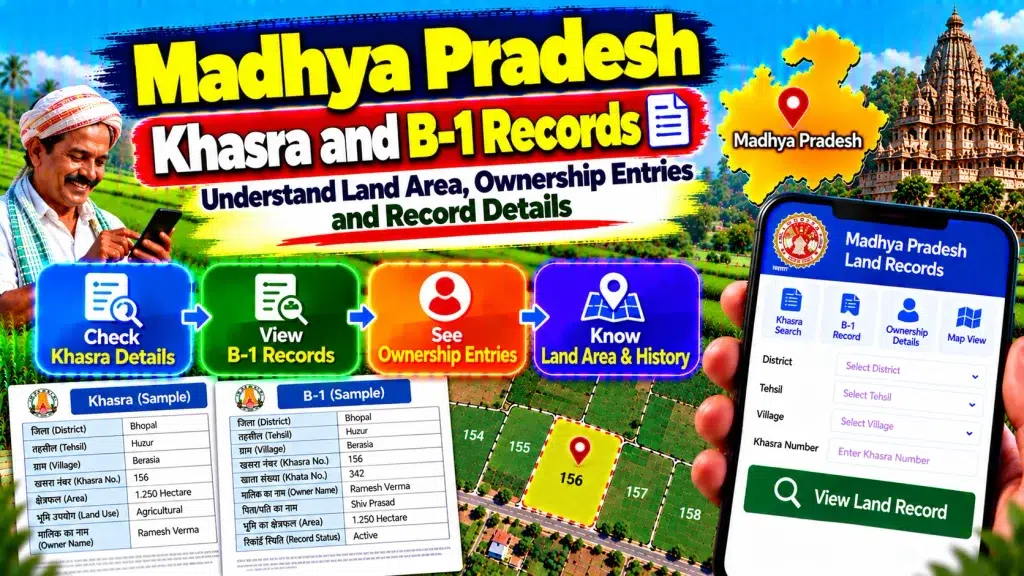
This guide explains MP Khasra and B-1 Records, their differences, how they work together, and what you should check when reviewing Madhya Pradesh land records from your mobile.
MP Khasra and B-1 Records – Quick Overview
| Details | Khasra | B-1 Khatauni |
|---|---|---|
| Record Type | Parcel-based revenue record | Holding/account-based revenue record |
| Main Focus | Individual surveyed parcel | Broader landholding |
| Main Reference | Khasra / Survey Number | Khata / Khatauni details |
| Land Area | Parcel-specific area can be checked | Holding-related context |
| Landholder Entry | Available in applicable record | Available in applicable record |
| Location Required | District, Tehsil, Village | District, Tehsil, Village |
| Related Map | Cadastral map | Can be compared with parcel maps |
| Certified Copy | Available | Available |
| Mutation Relevance | Updated parcel information | Updated holding information |
| Best Use | Checking individual plots | Understanding broader holding |
What Is an MP Khasra Record?
A Khasra is an important parcel-oriented land record in Madhya Pradesh.
Each surveyed parcel is associated with a Khasra or Survey Number within the relevant revenue village.
The record can help identify a particular field or plot and connect it with the applicable revenue information.
Khasra is especially useful when agricultural land consists of several separate parcels.
Instead of treating the entire holding as one piece of land, users can check each relevant Khasra Number individually.
This makes Khasra particularly useful when verifying land area before a purchase, sale, partition or other transaction.
What Is B-1 Khatauni?
B-1 Khatauni is another important Madhya Pradesh revenue record.
Unlike Khasra, which focuses more closely on an individual parcel, B-1 provides broader information connected with a landholding or revenue account.
A single holding can potentially be associated with several Khasra parcels.
Therefore, B-1 helps users understand the broader holding context, while individual Khasra records provide more detailed parcel-level information.
For better verification, these two records should be compared rather than treated as interchangeable documents.
Khasra vs B-1 – What Is the Main Difference?
The easiest way to understand the difference is to think about parcel versus holding.
Khasra focuses on a specific surveyed parcel.
B-1 Khatauni focuses on the broader landholding or account context.
For example, a farmer may have agricultural land spread across several Khasra Numbers in the same village. Each Khasra identifies a specific parcel, while B-1 can provide broader information associated with the holding.
Therefore, checking only one Khasra may not provide a complete picture of the person’s entire recorded holding.
What Is a Khasra or Survey Number?
A Khasra Number, often used in the Survey Number context, is an important reference for identifying an individual parcel.
However, the number must always be connected with its location.
When checking a Khasra, verify the correct District, Tehsil and Village.
The same numerical Khasra reference can potentially exist in different villages.
Therefore, a number alone should never be used to identify a property without checking the corresponding revenue location.
What Is a Khata?
A Khata generally refers to a landholding or revenue-account context.
It is different from a Khasra Number.
A Khasra identifies an individual parcel, whereas a Khata can provide a broader account-level connection between the landholder and applicable land parcels.
This distinction becomes important when one person or family has several agricultural plots.
Always identify which Khasra Numbers are relevant to the particular property or transaction you are examining.
How to Check Land Area in Khasra Records
When you need to verify land area, start with the exact Khasra/Survey Number.
Check the recorded area associated with that parcel.
Then compare it with the relevant B-1 and registered property documents.
If the property includes three different Khasra Numbers, for example, check the area of each parcel separately.
Do not assume that the total area associated with a broader holding represents the area of one individual Khasra.
Parcel-specific verification is particularly important when only part of a larger holding is being transferred.
Understanding Landholder and Ownership Entries
Khasra and B-1 records can contain entries connected with the recorded landholding.
These entries are useful when checking whether the revenue information corresponds with the person and parcel shown in other documents.
However, revenue entries should be interpreted carefully.
A recorded landholder entry is important, but it should not automatically be treated as standalone conclusive proof of legal ownership.
For an important property matter, compare revenue entries with registered deeds and other applicable legal documents.
How to Check MP Khasra and B-1 From Your Mobile
A smartphone can be used to perform an initial Madhya Pradesh land-record check.
Keep your District, Tehsil and Village details ready.
For a parcel-specific search, keep the Khasra/Survey Number available.
Use the applicable official Madhya Pradesh land-record service and select the relevant record.
Review the information displayed and compare it with your existing documents.
For formal purposes, check whether you need a certified Khasra or B-1 copy instead of relying only on an online screen view.
Khasra and B-1 Certified Copies
Madhya Pradesh provides services for obtaining certified copies of Khasra and B-1 Khatauni.
This distinction is important when land records are needed for official purposes.
An ordinary online view can help you perform a preliminary check, but it is not necessarily equivalent to a certified record.
Use the applicable certified-copy service when an authority, legal process or administrative application requires an authenticated land record.
Always check the specific document requirements for your purpose.
Khasra, B-1 and Cadastral Maps
A cadastral map adds a visual layer to textual land records.
The Khasra identifies the parcel and provides parcel-related revenue information.
B-1 provides broader holding context.
The cadastral map can help you understand the parcel’s shape and relative position among neighbouring plots.
When all three are compared, it becomes easier to understand the relationship between the landholding, individual parcels and their mapped location.
However, a map does not automatically establish the exact physical boundary on the ground.
What Is Mutation or Namantaran?
Mutation or Namantaran is the applicable revenue-record update process following qualifying changes such as a sale, inheritance, gift, partition or certain court orders.
When a property changes hands, the relevant revenue records may need to be updated through the mutation process.
After mutation is completed, check both Khasra and B-1 records where applicable.
Confirm that the expected landholder information and affected parcel references have been updated.
Remember that mutation and registration of a deed are separate processes.
What If the Old Landholder Name Appears?
First confirm that you are checking the correct and latest record.
Verify the District, Tehsil, Village and Khasra Number.
If the property was recently sold, inherited or partitioned, check whether the applicable mutation has been completed.
Compare the latest Khasra and B-1 with the registered deed or inheritance-related documents.
If the mutation has been completed but the expected entry is still not reflected, the appropriate official revenue correction process may need to be followed.
Khasra and B-1 After Partition
Partition can affect the way a landholding and its parcels are recorded.
If a larger family holding is divided, the applicable revenue and survey records may need corresponding updates.
After the official process is completed, check the new or updated parcel references carefully.
Compare the Khasra records with B-1 and the applicable map.
This is important because an older B-1 or Khasra copy may no longer fully represent the latest recorded arrangement after a completed partition.
How to Check Records Before Buying Land
Before buying agricultural land, identify every Khasra Number included in the proposed transaction.
Check the recorded area for each parcel.
Review the applicable B-1.
Compare the landholder entries.
Check the cadastral map where relevant.
Review recent mutation information.
Finally, compare the revenue records with the registered property documents.
If a physical boundary is disputed, consider the applicable official demarcation process rather than relying only on a map or online record.
Are Khasra and B-1 Proof of Ownership?
Khasra and B-1 are important revenue records, but they should not automatically be treated as standalone conclusive proof of legal title.
Complete property verification can involve the registered sale deed, inheritance or succession documents, gift or partition deeds, court orders, mutation history and other applicable records.
The best approach is to use Khasra and B-1 as important components of a broader land-document verification process.
Frequently Asked Questions (FAQ)
1. What is an MP Khasra record?
Khasra is a parcel-oriented revenue record associated with an individual surveyed land parcel in Madhya Pradesh.
2. What is B-1 Khatauni?
B-1 Khatauni is a broader landholding or account-related revenue record used in Madhya Pradesh.
3. Are Khasra and B-1 the same?
No. Khasra focuses primarily on individual parcels, while B-1 provides broader holding-related information.
4. Can I check land area using Khasra?
Yes. The applicable Khasra record can provide parcel-specific recorded area information.
5. Can I check the landholder name in B-1?
Applicable B-1 records contain information connected with the recorded landholding and landholder entries.
6. Can I check Khasra and B-1 from my mobile?
Yes. Applicable Madhya Pradesh digital land-record services can be accessed using a smartphone.
7. Can I get certified Khasra and B-1 copies?
Yes. Madhya Pradesh provides official services for certified Khasra and B-1 Khatauni copies.
8. What should I do if the old owner’s name appears?
Check whether the applicable mutation has been completed and compare the latest Khasra and B-1 with the registered documents.
9. Should I also check the land map?
A cadastral map can provide useful spatial context and help you understand the relative location of Khasra parcels.
10. Do Khasra and B-1 alone prove ownership?
No. They are important revenue records but should be considered together with registered deeds and other applicable legal documents.
Conclusion
MP Khasra and B-1 Records are important for understanding land area, landholder entries and revenue-record details in Madhya Pradesh.
Khasra provides parcel-specific information and helps identify an individual plot through its Khasra/Survey Number. B-1 Khatauni provides broader information about the applicable landholding or revenue account.
For better verification, compare the latest Khasra and B-1 with the cadastral map, mutation information and registered property documents.
If you require records for an official purpose, use the appropriate certified-copy service instead of relying only on a mobile screenshot.
Understanding the difference between parcel-level Khasra information and broader B-1 holding information can help landowners and buyers review Madhya Pradesh land records more accurately.