Maharashtra Land Mutation Status – How to Track Ferfar Entries and Record Updates
Keeping land records updated is important after a property-related change such as a sale, inheritance, gift, partition or another applicable event. In Maharashtra, changes made to the revenue record are commonly associated with mutation or Ferfar entries.
The Maharashtra Revenue Department has digitized many parts of this process through services such as e-Hakk and e-Ferfar. Citizens can submit applicable mutation requests online, track previously submitted applications and later check whether the expected change has been reflected in land records such as the 7/12 Utara.
Understanding the status is important because submitting a mutation application does not necessarily mean that the land record has already been updated. The application may pass through verification, notice, objection or certification-related stages.
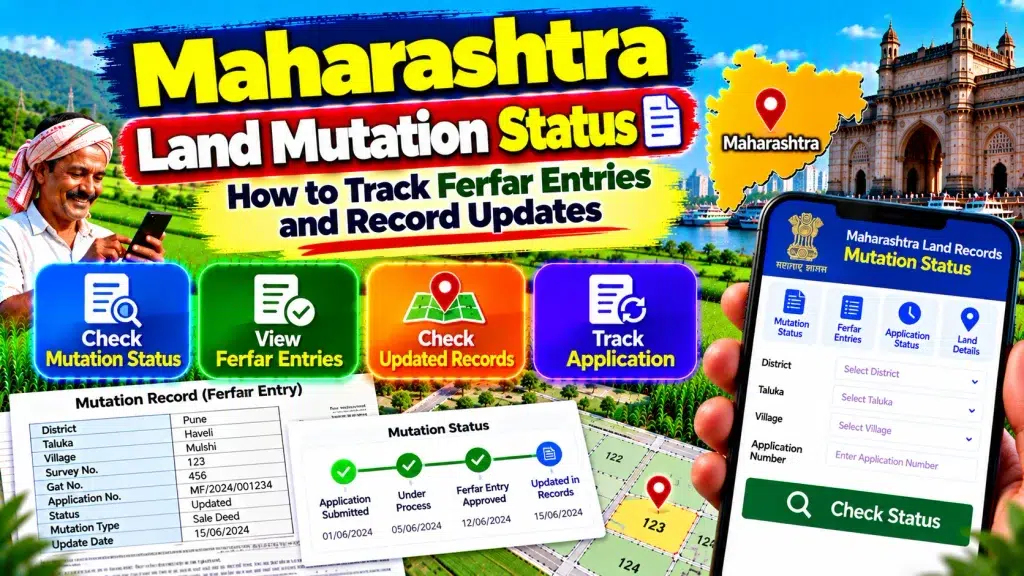
This guide explains Maharashtra Land Mutation Status, how to track Ferfar entries and record updates, and what to check after the mutation process is completed.
Maharashtra Land Mutation Status – Quick Overview
| Particular | Details |
|---|---|
| State | Maharashtra |
| Process | Land Mutation / Ferfar |
| Online Application System | e-Hakk |
| Mutation Processing System | e-Ferfar |
| Main Rural Record | 7/12 Utara |
| Related Record | 8A Extract |
| Parcel Reference | Survey Number / Gat Number |
| Account Reference | Khata Number |
| Location | District, Taluka and Village |
| Online Application | Available for applicable mutations |
| Application Status | Available |
| Ferfar Processing | Digitally managed |
| Returned Application | Correction and resubmission may be available |
| Final Record Check | Latest 7/12 and related records |
| Access | Mobile or Computer |
What Is Land Mutation in Maharashtra?
Land mutation is the process through which an applicable change is entered into the revenue records.
In Maharashtra, mutation entries are commonly called Ferfar entries.
For example, land records may require an update following a registered property transaction. Mutation may also become relevant after inheritance, gift, partition or another recognized change affecting the landholding.
The mutation process helps keep the revenue record aligned with applicable changes.
However, mutation should not be confused with the legal document or event underlying the change.
What Is a Ferfar Entry?
A Ferfar Entry records an applicable change in the land revenue record.
Each mutation can be associated with a Ferfar or mutation reference that helps identify the change in the record history.
Ferfar records can be useful when examining how a landholding has changed over time.
For example, an older 7/12 may contain one set of recorded details, while a later 7/12 may reflect changes following a mutation.
Reviewing the relevant Ferfar can help explain the record update.
What Is Maharashtra e-Hakk?
e-Hakk is Maharashtra’s online Public Data Entry system for applicable 7/12 mutation applications.
Citizens can use the system to submit supported mutation requests electronically.
Applicants select the relevant property location, mutation type and other information requested by the system.
Documents applicable to the selected mutation can also be submitted through the process.
The system maintains previously submitted applications with details such as the application number, mutation type, District, Taluka, Village, application date and status.
What Is e-Ferfar?
e-Ferfar is Maharashtra’s computerized mutation-management system.
It handles mutation entries and provides administrative information about different processing stages.
The official e-Ferfar dashboard separately tracks registered and non-registered mutation entries.
It also tracks pending entries, notice-related cases, certification-related stages and mutations where objections have been recorded.
Therefore, a mutation can involve several steps before the final change is reflected in the applicable land record.
How to Apply for Maharashtra Land Mutation
Start with the official e-Hakk mutation service.
Select or enter the correct applicant information.
Choose the District, Taluka and Village where the property is situated.
Select the appropriate mutation category.
Enter the land and property details requested by the system.
Provide the relevant Survey/Gat, Khata or other land references where applicable.
Upload the supporting documents required for the selected case.
Review everything carefully before final submission.
Preserve the Application Number after submission because it can help with future tracking.
How to Track Maharashtra Land Mutation Status
Maharashtra’s Mahabhumi portal currently lists Mutation Application Status among its free online services.
Applicants using e-Hakk can also review previously submitted applications.
Open the applicable official mutation service and locate your submitted application.
Check the Application Number and property location.
Review the displayed application status.
If the application has been returned for correction, examine the requirement carefully.
If a Ferfar has been created, continue checking the applicable mutation and land records until the expected update is reflected.
What Does “Ferfar Created” Mean?
The e-Hakk system can display a status indicating that a Ferfar has been created.
This means that the application has progressed to the creation of a mutation entry.
However, it should not automatically be interpreted as confirmation that every later stage is finished.
Mutation entries can still be subject to the applicable processing, notice, objection or certification procedure.
After completion, verify the latest 7/12 and related land records.
What Does a Pending Mutation Mean?
A pending mutation means that the Ferfar has not yet completed the applicable process.
The official e-Ferfar dashboard tracks pending records at different administrative levels.
Some cases can also remain in a notice-related stage.
An individual mutation may take longer if there is an objection, documentation issue or other case-specific requirement.
For this reason, applicants should rely on their official application status rather than assuming that every mutation follows exactly the same timeline.
Notice Period and Ferfar Entries
Notice can form part of Maharashtra’s mutation process.
The e-Ferfar dashboard specifically tracks entries where notice has been served but the applicable period has not yet been completed.
It also tracks Ferfar entries where objections have been recorded.
Therefore, an application does not necessarily move directly from submission to a final 7/12 update.
Applicants should check whether any action or objection is associated with their case and follow the instructions provided by the competent revenue authority.
What If Your Application Is Returned?
An e-Hakk application may be returned where an error or deficiency needs to be corrected.
The current official system states that an application returned by the Talathi for error correction can be corrected and resubmitted within the prescribed period.
Check what information or document requires correction.
Compare the application with your deed, 7/12, 8A and other supporting records.
Make the necessary correction and resubmit it through the official system within the permitted period.
Ignoring a returned application can prevent the mutation from progressing.
How Long Does Mutation Take?
Processing time can vary depending on the type of mutation and circumstances of the application.
Maharashtra publishes mutation-disposal statistics, but statewide averages should not be treated as a guaranteed completion time for an individual application.
Registered and non-registered cases can have different processing patterns.
Notice periods, objections, document deficiencies and administrative verification can also affect the timeline.
Therefore, regularly check the official status for your particular application.
How to Check a Ferfar Entry
When checking a Ferfar, make sure you have the correct property details.
Confirm the District, Taluka and Village.
Check the Survey or Gat Number.
Compare the Ferfar information with the previous and latest land records.
Maharashtra’s digital land ecosystem also provides digitally signed Ferfar documents among its land-record services.
If you require a formal record rather than basic online information, use the appropriate official document service.
Ferfar Entry and 7/12 Utara
The 7/12 Utara is an important rural land record in Maharashtra.
After a mutation is completed, check the latest 7/12 for the affected Survey or Gat Number.
Review the recorded holder information.
Check the land area and parcel reference.
If the transaction involved multiple Survey/Gat Numbers, check each relevant parcel separately.
Do not assume that an update to one parcel automatically confirms an update to every parcel mentioned in a transaction.
Mutation and 8A Extract
The 8A Extract provides related land-account or Khata information.
After an important mutation, checking both the 7/12 and applicable 8A can provide a broader view of the updated revenue record.
The Survey/Gat Number identifies the relevant parcel, while the Khata provides account or holding context.
These references should not be treated as identical.
Compare them carefully with the underlying property documents.
Registered Deed and Ferfar Entry
A registered deed and a Ferfar entry are different.
The registered deed relates to the applicable legal transaction or instrument.
The Ferfar entry updates the relevant revenue record following an applicable change.
Therefore, completing property registration should not automatically be described as completing mutation.
After registration, check whether the applicable mutation has been processed and whether the current 7/12 reflects the expected information.
Mutation After Inheritance
Inheritance can also lead to mutation of land records.
The applicable heirs may need to provide the required inheritance-related information and documents.
Once the mutation is processed, check the updated 7/12 and relevant 8A information.
If several heirs are involved, examine how the applicable names or interests have been recorded.
Do not assume that the entire holding should automatically be entered in the name of one heir.
Mutation After Gift or Partition
A gift or partition can also result in changes requiring mutation.
Where land is divided, carefully check each Survey/Gat Number involved.
A partition may change the relationship between individual parcels and landholding accounts.
After mutation, compare the latest revenue records with the applicable gift or partition documents.
Where parcel boundaries are affected, relevant survey or map information may also be useful.
What If the Name Is Not Updated on 7/12?
First check the current mutation application status.
Confirm whether a Ferfar has been created and whether the applicable processing has been completed.
Then check the latest 7/12 using the correct District, Taluka, Village and Survey/Gat Number.
If the application has been returned, complete the required correction.
If an objection or another issue is recorded, follow the applicable official procedure.
Do not rely only on an older downloaded copy of the 7/12.
Does Ferfar Prove Ownership?
A Ferfar entry is an important revenue-record entry, but it should not automatically be treated as standalone conclusive proof of legal ownership.
Property rights can depend on registered deeds, inheritance or succession records, gift deeds, partition documents, court orders and other legally relevant documents.
For important property verification, examine the current 7/12, 8A and Ferfar history together with the underlying legal documents.
Frequently Asked Questions (FAQ)
1. What is Ferfar in Maharashtra?
Ferfar refers to a mutation or change entry made in the applicable land revenue record.
2. What is e-Hakk?
e-Hakk is Maharashtra’s online Public Data Entry system for applicable 7/12 mutation applications.
3. What is e-Ferfar?
e-Ferfar is the computerized system used to manage and process mutation entries.
4. Can I check Maharashtra mutation status online?
Yes. Mahabhumi currently lists Mutation Application Status as an online service.
5. What does “Ferfar Created” mean?
It indicates that the mutation application has progressed to creation of a Ferfar entry, although additional processing may still apply.
6. What if my mutation application is returned?
Check the correction requirement and resubmit the corrected application within the period provided by the official system.
7. Is mutation the same as registration?
No. Registration and mutation are separate processes.
8. Should I check 7/12 after mutation?
Yes. Check the latest 7/12 to see how the applicable change is reflected against the relevant Survey/Gat Number.
9. Can a Ferfar entry face an objection?
Yes. Maharashtra’s e-Ferfar system tracks mutation entries where objections have been recorded.
10. Does Ferfar alone prove land ownership?
No. Ferfar should be reviewed together with registered deeds and other applicable legal and revenue records.
Conclusion
Maharashtra Land Mutation Status services help citizens follow Ferfar entries and record updates through the state’s digital land-record system.
The e-Hakk platform supports applicable online 7/12 mutation applications, while e-Ferfar manages mutation entries and their processing stages. Mahabhumi also provides a dedicated Mutation Application Status service.
Keep your Application Number, District, Taluka, Village and Survey/Gat Number available while checking the status. If the application is returned, complete the required correction within the prescribed period.
After the mutation process is completed, check the latest 7/12 Utara and 8A Extract to verify the resulting revenue-record information.
For complete property verification, compare the Ferfar and updated land records with the registered deed, inheritance documents or other legally relevant records connected with the property.