Land & Property Records Online India – Check Ownership, Property Type, Survey & Plot Details, Buy/Sell Verification State-Wise
Buying or selling a property in India involves much more than checking its location, appearance or asking price. Whether the property is an apartment, flat, independent house, villa, residential plot, builder floor or residential land, buyers and sellers should understand the property type and verify the relevant ownership, land, registration and approval records.
India has different land-record systems across states. Depending on the location, records may be known as RoR, Khasra, Khatauni, Khatian, Jamabandi, Patta, Chitta, RTC, Pahani, Adangal, 7/12 Utara, 8A or Property Card.
The documents that matter can also change according to the property type. Checking an agricultural or residential land parcel is different from verifying a flat in a multi-storey building.
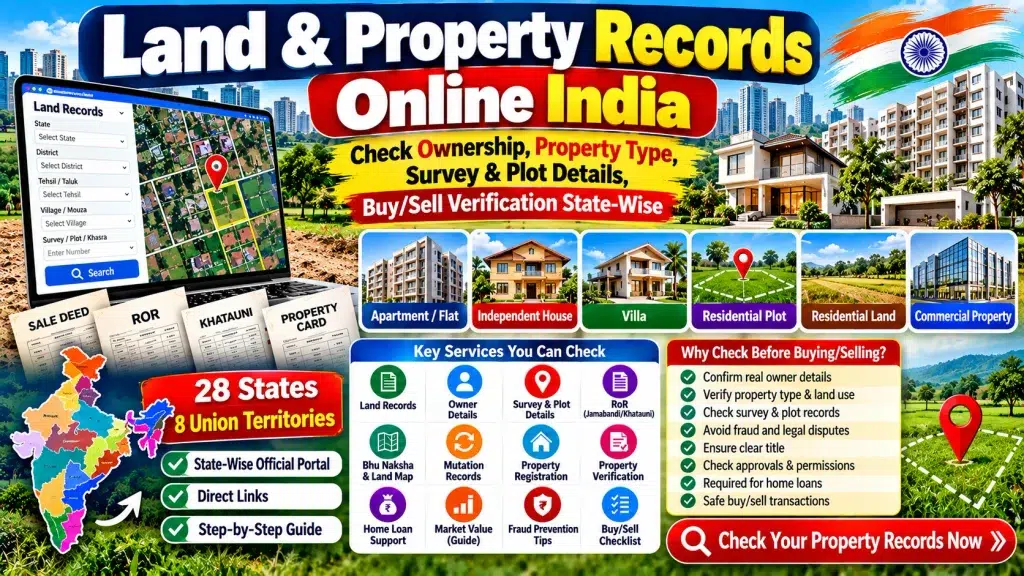
This guide explains Land & Property Records Online India, major residential property types, ownership verification, survey and plot details, property registration, mutation, buy/sell verification and important documents to check before a property transaction.
Land & Property Records India – Quick Overview
| Particular | Details |
|---|---|
| Service | Land & Property Records |
| Coverage | States and Union Territories |
| Property Types | Flat, Apartment, House, Villa, Plot, Builder Floor, Residential Land |
| Land Records | RoR, Khasra, Khatauni, Khatian, Jamabandi etc. |
| Property Search | Survey No., Plot No., Khasra, Khata, Khatian |
| Ownership | Recorded Landholder/Owner Information |
| Buy Property | Ownership, Title, Registration & Document Verification |
| Sell Property | Property Papers & Ownership Records |
| Mutation | State-Specific Revenue Record Update |
| Registration | State Registration Department/SRO |
| Map | Cadastral Map/Bhu Naksha where available |
| Finance | Home Loan & Property Finance Documentation |
What Are Land & Property Records?
Land records are government-maintained records relating to land parcels, landholdings, revenue administration and recorded rights or interests.
Depending on the state, a land record may contain:
- Recorded landholder details
- Survey number
- Plot number
- Khasra or Gata number
- Khata, Khatauni or Khatian
- Land area
- Land classification
- Mutation entries
- Record of Rights
- Cadastral-map information
Property records can involve a wider range of documents.
For example, a buyer purchasing a flat may need to check the sale deed, project-related approvals and applicable building documents in addition to land/title information.
Therefore, land records are an important part of property verification, but they are not necessarily the complete property-verification process.
Property Types in India
Understanding the property type is important because ownership structure, documents, maintenance responsibilities, land rights and verification requirements can differ.
Common residential property categories include:
Apartments & Flats, Independent Houses, Villas, Residential Plots, Builder Floors and Residential Land.
1. Apartments and Flats
An apartment or flat is generally a separate self-contained unit within a larger residential building or project.
A buyer usually acquires rights in a particular residential unit together with applicable rights or interests in common areas and/or the underlying property according to the relevant documents and local law.
Apartments may be found in:
- Low-rise residential buildings
- High-rise towers
- Gated communities
- Housing societies
- Integrated townships
- Mixed-use developments
Apartments can offer shared facilities such as lifts, security, parking, common areas, gardens, clubhouses or other amenities depending on the project.
What to Check Before Buying a Flat or Apartment
Depending on whether it is a new or resale property, buyers may need to review:
- Seller/developer details
- Ownership/title documents
- Agreement for Sale
- Registered Sale Deed where applicable
- Project approvals
- Sanctioned building/layout plans
- Completion/Occupancy-related documents where applicable
- Property-tax information
- Society/association-related documents for resale properties
- Applicable maintenance dues
- Parking rights/details
- Applicable RERA information
RERA defines an apartment broadly as a separate and self-contained part of immovable property and also defines concepts including carpet area, common areas and sanctioned plans.
Flat vs Apartment
In everyday Indian real estate usage, the words flat and apartment are frequently used interchangeably.
The more important issue for a buyer is not the marketing term but the exact property described in the registered and approved documents.
2. Independent Houses
An independent house is generally a standalone residential structure built on a separate plot.
Unlike a typical apartment, the property may involve ownership or other applicable rights over both the building and the underlying plot, subject to the title documents and local rules.
Independent houses can range from small single-storey homes to large multi-storey residences.
Advantages of an Independent House
Depending on the property, an independent house may provide:
- Greater privacy
- More control over the property
- Private entrance
- More flexibility for renovation
- Potential open space
- Direct connection with the underlying land
However, maintenance and repair responsibilities generally fall more directly on the owner than in a managed apartment complex.
What to Check Before Buying an Independent House
Important checks may include:
- Ownership/title documents
- Registered Sale Deed
- Survey/Plot Number
- Land records
- Mutation records
- Property-tax records
- Land-use classification
- Approved building plan
- Applicable construction approvals
- Access to the property
- Actual boundaries and measurements
- Applicable encumbrance-related information
For an independent house, buyers should pay particular attention to both the building and the land on which the building stands.
3. Villas
A villa generally refers to a premium or larger residential house, often built as an individual unit or as part of a planned residential development.
Villas may be:
- Standalone villas
- Gated-community villas
- Row villas
- Duplex villas
- Luxury villas
Some villas come with private land or gardens, while others form part of a larger project with common amenities.
Therefore, buyers should not assume that every property marketed as a villa has the same ownership structure.
What to Check Before Buying a Villa
Important documents and information may include:
- Ownership/title documents
- Sale agreement/deed
- Underlying land details
- Plot or survey number
- Approved layout
- Sanctioned building plan
- Completion/occupancy documents where applicable
- Property-tax records
- Common-area rights
- Maintenance obligations
- Applicable RERA/project information
- Access roads and shared facilities
For a villa in a gated development, buyers should understand which areas are privately owned and which facilities are common.
4. Residential Plots
A residential plot is a parcel of land intended or permitted for residential development.
The buyer generally purchases land rather than a completed residential building.
This means land verification becomes especially important.
What to Check Before Buying a Residential Plot
A plot buyer may need to verify:
- Owner/title documents
- Survey number
- Plot number
- Land area
- Plot dimensions
- Boundaries
- Land-use classification
- Approved layout where applicable
- Road/access rights
- Mutation records
- Property/land tax information
- Applicable development permissions
- Registration documents
Where the plot forms part of a real-estate project, applicable RERA information may also be relevant. RERA’s definition of a real-estate project includes development of land into plots for sale.
Plot Number vs Survey Number
A plot number identifies a specific plot according to the applicable layout or land-record system.
A survey number generally identifies surveyed land according to the concerned land/revenue system.
The relationship between the two depends on the state and property.
Buyers should ensure that the plot being shown physically corresponds with the parcel described in the legal and land documents.
5. Builder Floors
A builder floor generally refers to an individual residential floor in a low-rise building, often constructed on a residential plot.
Instead of purchasing one apartment in a large multi-storey complex, the buyer may purchase an entire floor of a smaller building.
A typical builder-floor property may have only a few residential units, such as one unit on each floor.
Why Buyers Choose Builder Floors
Potential features can include:
- Fewer residents than large apartment complexes
- Greater privacy
- Larger floor area in some developments
- Independent or semi-independent access
- Lower dependence on large common amenities
However, the exact ownership and common-area arrangement needs careful verification.
What to Check Before Buying a Builder Floor
Buyers may need to examine:
- Title to the underlying plot
- Seller/developer authority
- Registered Sale Deed
- Sanctioned building plan
- Floor mentioned in approved documents
- Property-tax information
- Parking rights
- Roof/terrace rights, if claimed
- Share/right in underlying land where applicable
- Common staircase and access rights
- Utility arrangements
- Applicable completion/occupancy documents
- Applicable RERA requirements
Never assume that parking, terrace or roof rights automatically come with a builder floor. The actual registered documents and applicable rules should be checked.
6. Residential Land
Residential land generally refers to land that is classified, approved or otherwise permitted for residential use under the applicable planning and land-use framework.
Residential land may later be used for constructing:
- Independent houses
- Villas
- Residential buildings
- Other permitted residential development
Residential land and a residential plot can sometimes be used similarly in everyday language, but the exact legal description, layout status and development permissions can differ.
What to Check Before Buying Residential Land
Relevant verification can include:
- Ownership/title
- Survey number
- Plot/parcel number
- Record of Rights
- Mutation
- Land classification
- Residential-use permission
- Conversion records where applicable
- Access road
- Boundaries
- Cadastral map
- Development restrictions
- Local planning rules
- Registration records
A buyer should not assume that every vacant parcel can legally be used to construct a house simply because nearby properties are residential.
Quick Property Type Comparison
| Property Type | What You Are Mainly Buying | Important Checks |
|---|---|---|
| Apartment/Flat | Unit in a building/project | Title, Sale Deed, approvals, RERA where applicable |
| Independent House | House + applicable land rights | Land title, survey, building approval, mutation |
| Villa | House/unit with applicable plot/project rights | Title, plot, approvals, common/private areas |
| Residential Plot | Vacant plot for residential use | Title, survey, layout, land use, boundaries |
| Builder Floor | Individual floor in low-rise building | Plot title, floor approval, land/common rights |
| Residential Land | Land intended/permitted for residential use | RoR, title, land use, survey, access, permissions |
Commercial and Other Property Types
Apart from residential properties, buyers may also encounter:
Commercial Property
Commercial property can include shops, offices, showrooms, retail spaces and commercial buildings.
Agricultural Land
Agricultural land is generally intended for agricultural use and is governed by state-specific land laws and restrictions.
Industrial Property
Industrial property can include industrial plots, factories, warehouses and manufacturing premises.
The required documentation and purchase restrictions can vary considerably according to property type and state.
New Property vs Resale Property
A new property is generally purchased directly from a developer, builder or first seller.
Buyers may need to check project registration where applicable, title to the project land, approved plans, agreement terms and other project documents.
A resale property has already been owned or transferred.
For resale property, additional attention may be given to:
- Previous Sale Deed
- Seller’s title
- Earlier transaction documents
- Property-tax status
- Society/association records where applicable
- Maintenance dues
- Mutation/land records where relevant
- Applicable encumbrance information
What Is Property Ownership Verification?
Property ownership verification involves examining relevant records to determine whether the person selling the property has the required rights and authority to sell it.
Online land records can help with preliminary verification.
Compare:
Owner/Landholder Name → Property Type → Survey Number → Plot Number → Area → Location → Registration Details
A revenue-record entry alone should not automatically be treated as conclusive proof of clear legal title.
What Is Survey Number?
A survey number is an identifier assigned to surveyed land.
It helps identify a parcel in official land and survey records.
A parcel may also have subdivisions, so buyers should check the complete and current number.
What Is Plot Number?
A plot number identifies a particular parcel according to the relevant land or approved-layout system.
Depending on the state, equivalent terms may include:
Khasra Number – Gata Number – Dag Number – Survey Number
Record of Rights – RoR
The Record of Rights (RoR) is an important land/revenue record.
Depending on the state, similar records may be known as:
Jamabandi – Khatauni – Khatian – RTC – Pahani – 7/12 – Patta – Adangal
The exact information and legal significance differ by jurisdiction.
State-Wise Land & Property Records
| State | Common Land / Property Records | Official Portal / System |
|---|---|---|
| Andhra Pradesh | Adangal, RoR-1B, Survey, Pattadar | Mee Bhoomi / CCLA |
| Arunachal Pradesh | Land & Revenue Records | Concerned State Revenue Authority |
| Assam | Jamabandi, Patta, Dag | Dharitree |
| Bihar | Jamabandi, Khata, Khesra | Bihar Bhumi |
| Chhattisgarh | B1, P-II, Khasra | Bhuiyan |
| Goa | Form I & XIV, Survey | DSLR Goa |
| Gujarat | 7/12, 8A, Survey | AnyRoR / e-Dhara |
| Haryana | Jamabandi, Khewat, Khatauni | Jamabandi Haryana |
| Himachal Pradesh | Jamabandi, Khata, Khasra | Himbhoomi |
| Jharkhand | Register-II, Khata, Plot | Jharbhoomi |
| Karnataka | RTC, Pahani, Survey | Bhoomi |
| Kerala | Survey, Thandaper | ReLIS |
| Madhya Pradesh | Khasra, B-1 | MP Bhulekh |
| Maharashtra | 7/12, 8A, Property Card | Mahabhumi / Mahabhulekh |
| Manipur | Patta, Dag | Loucha Pathap |
| Meghalaya | Land & Revenue Records | Concerned Revenue Authority |
| Mizoram | Land & Revenue Records | Concerned Revenue Authority |
| Nagaland | Land & Revenue Records | Concerned Revenue Authority |
| Odisha | RoR, Khatiyan, Plot | Bhulekh Odisha |
| Punjab | Jamabandi, Fard, Khewat | Punjab Land Records |
| Rajasthan | Jamabandi, Khasra, Khata | Apna Khata |
| Sikkim | Land & Revenue Records | Concerned Revenue Authority |
| Tamil Nadu | Patta, Chitta, Survey | Tamil Nadu Land Records |
| Telangana | RoR, Survey Details | State Land Records System |
| Tripura | RoR, Khatian, Plot | Jami / e-Jami |
| Uttar Pradesh | Khasra, Khatauni, Gata | UP Bhulekh |
| Uttarakhand | Khatauni, Khasra | Bhulekh Uttarakhand |
| West Bengal | Khatian, Plot, Mouza | State Land Records System |
Buy Property – Important Verification
Before purchasing any property, check the documents relevant to that particular property type.
| Check | Details |
|---|---|
| Seller | Identity and authority to sell |
| Property Type | Flat, House, Villa, Plot, Floor or Land |
| Title | Applicable ownership/title documents |
| Sale Deed | Registered transaction document |
| Land Record | Recorded landholder and parcel information |
| Survey/Plot | Correct parcel identifier |
| Area | Document vs actual/recorded area |
| Mutation | Current revenue entry where applicable |
| Land Use | Permitted property use |
| Approvals | Applicable layout/building approvals |
| Tax | Applicable property-tax records |
| Map | Parcel and boundary information |
Sell Property – Documents to Keep Ready
A seller should consider organizing:
- Ownership/title documents
- Registered Sale Deed
- Survey and plot details
- Land records
- Mutation documents where applicable
- Property-tax receipts
- Approved building/layout plans
- Applicable completion/occupancy documents
- Society/association records where relevant
- Applicable loan/mortgage closure documents
- Other property-specific permissions
Property Registration and Sale Deed
Property registration generally involves registration of the relevant deed or document through the concerned Registration Department/Sub-Registrar Office.
A Sale Deed can contain information such as:
- Buyer
- Seller
- Property description
- Consideration
- Survey/plot details
- Boundaries
- Rights transferred
Registration requirements, stamp duty and fees vary by state.
Property Mutation
Mutation generally refers to updating the relevant revenue record after a recognized transfer or change.
It may become relevant after:
- Sale
- Inheritance
- Gift
- Partition
- Other recognized transfers
Registration and mutation are different processes.
Property Price and Market Value
Land records generally should not be treated as a source of current property market prices.
Market value can depend on:
- Location
- Property type
- Area
- Connectivity
- Infrastructure
- Demand and supply
- Property age/condition
- Development potential
Government-notified circle rates, guideline values or ready-reckoner values used for registration purposes should also not automatically be considered identical to actual market price.
Home Loan for Property Purchase
Banks and housing finance companies may provide finance for eligible residential properties.
Depending on the property type, a lender may ask for:
- Applicant’s income documents
- Property title papers
- Sale documents
- Approved plans
- Property-tax information
- Land records
- Other applicable property documents
Documentation for a flat may differ from a residential plot or independent house.
Loan approval depends on the lender’s financial, legal and technical assessment.
Bhu Naksha and Property Maps
Bhu Naksha generally refers to a digital cadastral-map system.
Where available, it can help users view parcel-related map information.
For plots, residential land and independent houses, comparing map/parcel information can be particularly useful.
An online map should not automatically replace a professional or official physical survey when precise boundaries need to be established.
How to Check Land Records Online
A typical process is:
Step 1: Select the State or Union Territory.
Step 2: Identify the concerned official land-record portal.
Step 3: Select District, Tehsil/Taluk/Circle and Village/Mouza.
Step 4: Search using Survey Number, Plot, Khasra, Khata, Khatian or another available identifier.
Step 5: Check the displayed record.
Step 6: Compare owner, parcel and area information with the property documents.
Step 7: Obtain the appropriate official/digitally signed copy where available.
How to Avoid Property Fraud
Whether you are buying a flat, villa, house, plot or land, do not rely only on marketing materials or documents supplied without independent verification.
Check important information such as:
Seller → Ownership → Property Type → Survey/Plot → Area → Registration → Land Use → Approvals
Be cautious if there are significant differences between the physical property and its documents.
For major transactions, appropriate legal and technical due diligence can be valuable.
Frequently Asked Questions
What are the main residential property types in India?
Common categories include apartments/flats, independent houses, villas, residential plots, builder floors and residential land.
Is a flat the same as an apartment?
The terms are commonly used interchangeably in India. The exact rights and property description should be determined from the applicable documents.
What is an independent house?
It generally refers to a standalone residential house built on a separate plot, subject to the applicable ownership/title arrangement.
What is a villa?
A villa is generally a standalone or project-based premium residential house. Ownership of the underlying land and common areas should be verified from the property documents.
What is a builder floor?
A builder floor usually refers to an individual residential floor within a low-rise building constructed on a plot.
What is a residential plot?
It is a parcel intended or permitted for residential development, subject to applicable land-use and planning rules.
Is residential land the same as a residential plot?
The terms can overlap in everyday usage, but a plotted development and a broader parcel of residential-use land may have different approvals and documentation.
What should I check before buying a flat?
Check applicable title documents, sale documents, approvals, project information, property tax, society/association records for resale property and other relevant documents.
What should I check before buying a residential plot?
Check title, survey/plot number, area, boundaries, land use, layout approval where applicable, access and registration records.
Can I check property ownership online?
Many state systems provide access to recorded landholder information, although facilities vary by jurisdiction.
Is an online land record proof of ownership?
An online revenue record alone should not automatically be treated as conclusive proof of clear title.
Is mutation the same as property registration?
No. They are different processes.
Can I get a home loan for a plot?
Some lenders offer eligible plot loans subject to their terms, property eligibility and legal/technical verification.
Can I check property market value from land records?
Land records generally do not provide a reliable current market price. Government-notified registration values and actual market values are also different concepts.
Conclusion
Land & Property Records Online India can help buyers, sellers and property owners access important information relating to land and property.
However, the verification process should be matched to the property type.
For an apartment or flat, focus on the unit, project, title, approvals and applicable common-area rights.
For an independent house, verify both the building and underlying land.
For a villa, understand the plot, project and private/common-area rights.
For a residential plot, carefully check the survey number, plot number, land use, boundaries and layout.
For a builder floor, verify the underlying plot title, sanctioned building plan, floor rights, parking and common areas.
For residential land, check ownership, RoR, survey information, land classification, access and development permissions.
A practical property-verification sequence is:
Choose Property Type → Verify Seller/Owner → Check Title → Match Survey & Plot → Review Land Records → Check Registration → Verify Land Use & Approvals → Review Mutation → Complete Buy/Sell Verification
Whether you are buying or selling a flat, apartment, independent house, villa, builder floor, residential plot or residential land, proper document and record verification can help identify inconsistencies before a major financial commitment.
Disclaimer: This article is for general informational and educational purposes only. Property terminology, land records, title systems, RERA applicability, planning rules, purchase restrictions, approvals, registration requirements, taxes and documentation vary by state and transaction and may change. Always verify current information through the relevant government authority. For major property transactions or title questions, consider advice from appropriately qualified legal, financial and property professionals.