Hair Treatment & Makeover – Try New Hairstyles and Hair Colors Virtually
Changing your hairstyle or hair color can completely refresh your appearance, but choosing the right look is not always easy. A haircut that looks great on someone else may not work the same way with your face shape, hair texture, or personal style. Similarly, selecting a new hair color without knowing how it will look can make the decision difficult.
This is where virtual hair treatment and makeover tools can be helpful. With modern AI-powered hairstyle apps, you can upload a photo and experiment with different hairstyles, hair lengths, colors, bangs, curls, and other looks virtually before making a real change.
Some tools also provide general hair-care suggestions based on visible hair characteristics and information provided by the user. Whether you are planning a haircut, considering a new hair color, or simply searching for inspiration, virtual hair makeover technology can make the process easier.
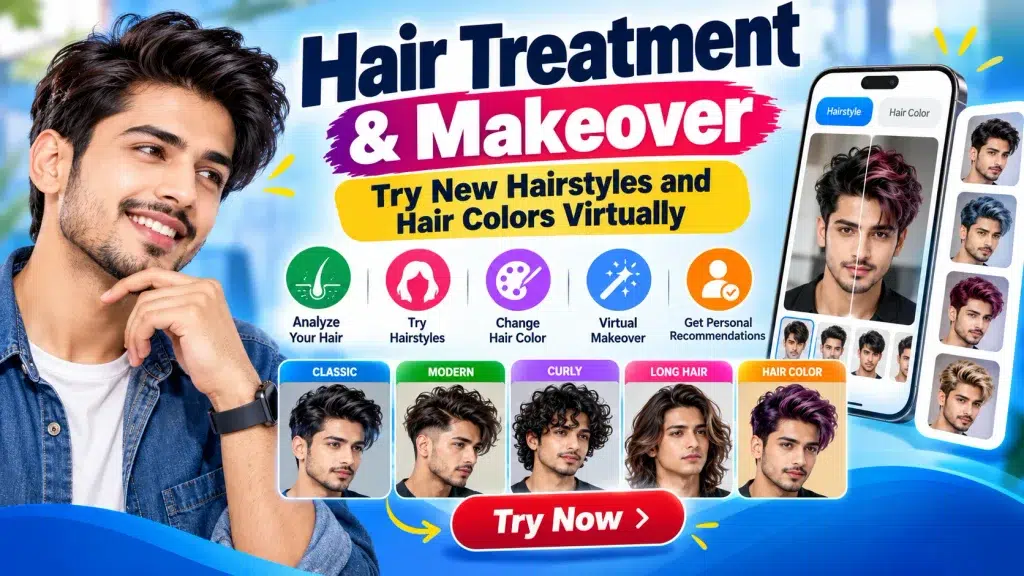
In this guide, we will explain how virtual hairstyle and hair color tools work, how to explore different looks, and how to combine a digital makeover with a practical hair-care routine.
What Is a Virtual Hair Treatment & Makeover?
A virtual hair makeover uses artificial intelligence, image processing, or augmented reality technology to show how different hairstyles or colors may appear on your photo.
Instead of immediately cutting or coloring your real hair, you can experiment digitally.
Depending on the app or platform, you may be able to try:
- Short and long hairstyles
- Straight, wavy, and curly looks
- Bangs and fringes
- Layered haircuts
- Bob hairstyles
- Different hair colors
- Highlights and color effects
- Men’s and women’s hairstyles
- Different hair lengths and volumes
Some AI hair apps may also analyze visible characteristics such as hair texture, face shape, and current hairstyle to provide personalized styling suggestions.
How Does an AI Virtual Hairstyle Tool Work?
Using a virtual hairstyle tool is generally straightforward.
First, you upload a clear photo or take a selfie. The AI system then analyzes visible facial features, the position of your head, existing hair, and other characteristics.
The software can digitally apply different hairstyles over your image. More advanced tools may automatically adjust the virtual hairstyle according to the position and shape of your face.
This gives you an approximate preview of how a particular haircut or color could look.
For better results, use a clear, front-facing photo with good lighting and minimal obstruction around your hair and face.
Virtual Hair Makeover Features at a Glance
| Feature | What You Can Explore | Main Purpose |
|---|---|---|
| AI Hairstyle Try-On | Short, medium and long styles | Preview a haircut |
| Hair Color Try-On | Natural and creative colors | Test colors virtually |
| Face Shape Analysis | Facial proportions | Explore suitable styles |
| Hair Length Preview | Short to long hair | Compare different lengths |
| Bangs & Fringe | Multiple bang styles | Preview front-hair changes |
| Curly Hair Preview | Waves and curls | Experiment with texture |
| Hair Care Suggestions | General routine ideas | Improve everyday care |
| Before & After View | Existing vs. virtual look | Compare makeover options |
Try New Hairstyles Virtually Before a Haircut
Getting a new haircut can feel like a big decision, particularly when you are making a dramatic change.
For example, someone with long hair may be interested in a short bob but hesitate because it is difficult to imagine the final appearance.
A virtual hairstyle try-on tool can solve part of this problem.
Upload your photo and test several styles before visiting a salon. You can compare long layers, shoulder-length hair, bobs, bangs, short hairstyles, waves, curls, and other options.
Although a virtual preview cannot guarantee exactly how the real haircut will look, it can help you identify the general styles you prefer.
You can also save a preferred look as inspiration to discuss with a professional hairstylist.
Try Different Hair Colors Virtually
Hair coloring can require both time and money, and major color changes may involve chemical processing. Therefore, choosing a shade carefully is important.
A virtual hair color try-on feature allows you to experiment without immediately applying dye.
Depending on the tool, you may be able to preview shades such as:
- Black
- Dark brown
- Chocolate brown
- Golden brown
- Blonde
- Copper
- Burgundy
- Red
- Silver or grey
- Blue, pink, purple and other creative shades
Try several colors using the same photograph. This makes it easier to compare how different shades interact with your complexion and overall appearance.
Remember that digital colors are simulations. Your actual result can vary depending on your natural hair color, previous treatments, dye formulation, lighting, and application technique.
Find Hairstyles Based on Face Shape
Face shape can be one useful consideration when exploring hairstyles. AI tools may estimate facial proportions and help you preview different options.
Oval Face
People with oval faces can experiment with many hairstyles, including long layers, shoulder-length cuts, bobs, waves, and short styles.
Round Face
Long layers, side parts, textured cuts, and styles with additional height can be tested if you want to visually change the proportions of a round face.
Square Face
Soft waves, layered styles, side-swept bangs, and textured hairstyles are popular options to preview.
Heart-Shaped Face
Side-swept bangs, shoulder-length hairstyles, waves, and styles that create volume around the lower part of the face can be explored.
Long or Oblong Face
Bangs, medium-length cuts, curls, and waves can be tested to see whether they create the visual balance you prefer.
These suggestions are not strict beauty rules. Your preferred hairstyle should ultimately reflect your own taste, comfort, and lifestyle.
Understanding Your Hair Type Before a Makeover
Hair type is another important consideration when planning a makeover.
Straight, wavy, curly, and coily hair behave differently. A hairstyle shown by an AI app may look attractive in a virtual image but require different maintenance depending on your natural texture.
For example, a sleek straight style may require regular heat styling for someone with naturally curly hair. Similarly, certain highly structured hairstyles may require more daily maintenance than relaxed or layered cuts.
Before choosing a hairstyle, consider how much time you want to spend washing, drying, styling, and maintaining it.
Hair Treatment for Dry and Frizzy Hair
A makeover is not only about changing your haircut or color. Healthy-looking, manageable hair can make almost any hairstyle easier to maintain.
If your hair feels dry or appears frizzy, focus on a routine that supports moisture and gentle handling.
Using an appropriate conditioner can improve softness and manageability. A leave-in conditioner or suitable styling product may also help control frizz for some hair types.
Try to avoid unnecessarily high heat when using straighteners, curling tools, or hair dryers. When heat styling is required, consider using an appropriate heat-protection product.
Chemical treatments such as bleaching and repeated coloring can also affect hair condition, so consider the existing state of your hair before making another major chemical change.
Hair Treatment for Oily Hair
Oily hair usually relates to sebum produced by the scalp. Some people may notice oily roots shortly after washing while their ends remain comparatively dry.
Choosing a cleansing routine appropriate for your scalp and lifestyle can help.
Avoid assuming that every oily scalp requires extremely harsh cleansing products. Overuse of products or heavy styling formulas can also create buildup.
Apply conditioner mainly to the mid-lengths and ends if applying it directly to the scalp makes your hair feel too heavy.
The ideal washing frequency varies from person to person.
Care for Colored or Chemically Treated Hair
If you decide to make your virtual hair-color experiment real, aftercare becomes important.
Bleaching, permanent coloring, straightening, perming, and similar chemical processes can alter the hair structure and may increase dryness or breakage.
Choose products suitable for chemically treated hair, condition regularly, and avoid combining too many intensive chemical procedures within a short period.
If your hair is already severely damaged, discuss the condition of your hair with an experienced stylist before undergoing another chemical treatment.
Create a Simple Hair Care Routine
You do not necessarily need a complicated routine with many products.
Start by identifying your scalp condition, hair texture, and primary concern. Then build a manageable routine.
Step 1: Cleanse
Use a shampoo appropriate for your scalp and hair characteristics.
Step 2: Condition
Apply conditioner as appropriate, especially to areas that tend to become dry or tangled.
Step 3: Dry Gently
Avoid aggressively rubbing wet hair with a towel. Gentle drying can reduce unnecessary mechanical stress.
Step 4: Protect From Excessive Heat
Limit very high temperatures and repeated heat styling where possible.
Step 5: Style According to Hair Type
Choose hairstyles and styling methods that work with your natural hair rather than requiring excessive manipulation every day.
Step 6: Adjust Your Routine
Your hair needs can change because of weather, hair length, coloring, styling habits, and other factors. Adjust your routine when necessary.
Benefits of Virtual Hairstyle and Hair Color Try-On
The biggest benefit of a virtual makeover is the freedom to experiment.
You can compare multiple hairstyles in minutes without actually cutting your hair. Similarly, you can preview dramatic colors without immediately using permanent dye.
This can help you narrow down your preferences before visiting a salon.
Virtual tools are also useful for inspiration. You may discover a hairstyle or color combination you had never previously considered.
For people who frequently change their style, an AI hairstyle app can become a convenient planning tool.
Can AI Recommend Hair Treatment?
Some AI tools offer general hair-care recommendations after analyzing a photo or asking questions about your hair.
For example, an app might identify visible frizz, dryness, or low volume and suggest general care categories.
However, there is an important limitation.
AI cannot reliably diagnose medical causes of hair loss, scalp disease, or other health conditions simply from a virtual makeover photo.
If you experience sudden hair loss, bald patches, persistent itching, scalp pain, sores, redness, or unusual changes, consult a qualified dermatologist or healthcare professional.
AI Hair Makeover vs. Traditional Hairstyle Selection
Traditionally, people choose hairstyles by browsing magazines, social media posts, or salon catalogs. The problem is that the hairstyle is displayed on another person.
AI changes this experience by allowing the style to be visualized directly on your own photo.
This makes comparison more personalized.
However, virtual previews still cannot perfectly simulate real-world hair texture, movement, thickness, styling effort, or final salon results.
The most practical approach is to use AI for inspiration and then discuss your preferred style with an experienced hairstylist.
Tips for Getting Better Virtual Makeover Results
The quality of your photograph can significantly influence your virtual result.
Use a clear image taken in good lighting. Keep your face visible and preferably look directly at the camera.
Avoid photos with heavy beauty filters because they can alter facial proportions and colors.
If possible, try the same hairstyle using several photos. This can give you a better idea of how it might appear from different perspectives.
When testing hair colors, remember that screen brightness and lighting can affect the displayed shade.
Final Thoughts
Hair Treatment & Makeover tools provide a convenient way to explore a new appearance before committing to a real haircut or color.
With an AI hairstyle or virtual hair color tool, you can experiment with short hair, long hair, curls, waves, bangs, layers, natural shades, and creative colors directly on your photo.
At the same time, a successful makeover involves more than appearance. Understanding your natural hair texture, maintaining an appropriate cleansing and conditioning routine, reducing unnecessary heat or chemical damage, and choosing manageable hairstyles can support healthier-looking hair.
Use virtual makeover technology as an inspiration and planning tool rather than expecting a digital preview to reproduce a salon result perfectly.
For cosmetic styling decisions, AI can provide useful ideas. For persistent hair loss, scalp problems, or other medical concerns, seek advice from a qualified healthcare professional.
Frequently Asked Questions (FAQ)
1. What is a virtual hair makeover?
A virtual hair makeover uses AI or image-processing technology to display different hairstyles, hair lengths, textures, or colors on your photo without physically changing your hair.
2. Can I try a new hairstyle using my photo?
Yes. Many virtual hairstyle tools allow you to upload a clear selfie and preview different hairstyles directly on your image.
3. Can I try different hair colors virtually?
Yes. Virtual hair-color tools can simulate natural shades such as black, brown, blonde, copper, and red, as well as creative colors such as blue, pink, or purple.
4. Are virtual hairstyle results accurate?
They can provide a useful visual approximation, but they are not completely accurate. Real results depend on hair texture, thickness, haircut technique, styling, lighting, and other factors.
5. Can AI find a hairstyle for my face shape?
Some AI hairstyle tools analyze facial proportions and recommend or display styles based on estimated face shape. You can then compare the options and choose according to your preference.
6. Can AI provide hair treatment suggestions?
Some tools provide general hair-care suggestions based on visible characteristics and user-provided information. These suggestions should not be treated as medical advice or diagnosis.
7. Can I preview short hair before cutting my long hair?
Yes. This is one of the most practical uses of virtual hairstyle tools. You can preview bobs, pixie cuts, shoulder-length styles, and other shorter hairstyles before deciding on a haircut.
8. Is virtual hair color the same as the final salon color?
No. It is a digital simulation. Natural hair color, bleaching, dye formulation, hair condition, lighting, and salon techniques can affect the actual result.
9. Can a hair makeover app diagnose hair loss?
No. An app may identify visible changes, but the cause of hair loss requires proper medical evaluation when the problem is persistent, sudden, or significant.
10. Who should use a virtual hairstyle and hair color tool?
Anyone considering a new haircut, hairstyle, or hair color can use a virtual makeover tool to explore options and gather inspiration before making a real-world change.
Disclaimer: This content is provided for general informational and educational purposes only. Virtual hairstyle, hair-color, and AI hair-analysis tools provide simulations and general suggestions. They are not substitutes for professional medical diagnosis or treatment. Consult a qualified dermatologist or healthcare professional for persistent hair loss, scalp conditions, or other medical concerns.