Dry and Frizzy Hair Treatment – Find the Right Hair Care & Virtual Hairstyle
Dry and frizzy hair can be difficult to manage, especially when your hair feels rough, looks dull, tangles easily, or becomes more frizzy in humid weather. Heat styling, chemical treatments, frequent coloring, environmental exposure, natural hair texture, and everyday styling habits can all influence how dry or frizzy your hair appears.
The right dry and frizzy hair treatment does not necessarily require a complicated routine. Understanding your hair type, choosing suitable cleansing and conditioning products, handling your hair gently, and reducing unnecessary heat or chemical stress can help improve softness and manageability.
At the same time, modern AI hairstyle and virtual hairstyle tools make it possible to experiment with different haircuts, lengths, textures, and colors without immediately changing your real hair. This can be especially helpful if you want a hairstyle that works better with naturally dry, wavy, curly, or frizz-prone hair.
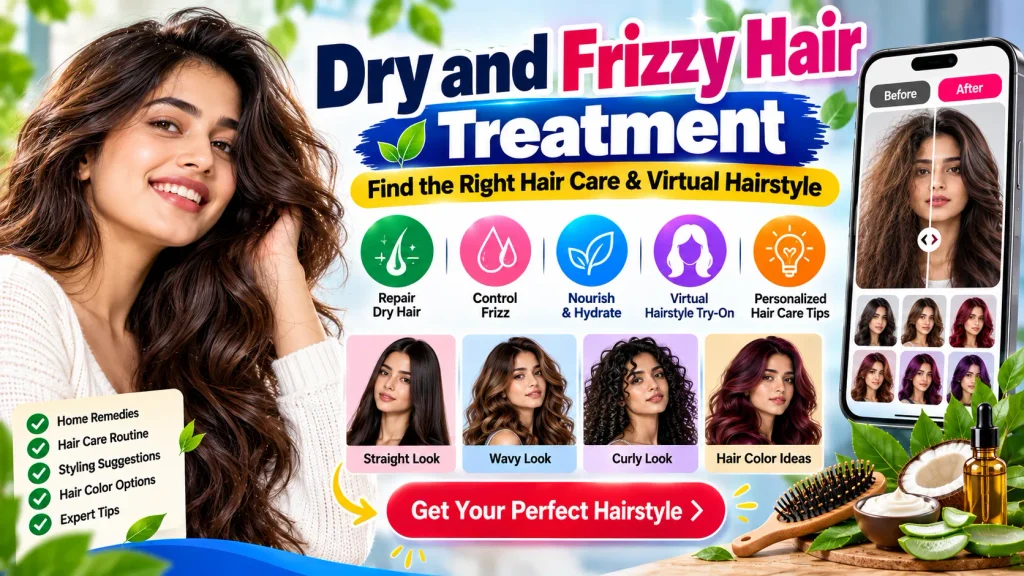
This guide covers practical hair care ideas for dry and frizzy hair, common causes of frizz, styling habits to consider, and ways to use virtual hairstyle technology to explore a new look.
What Is Dry and Frizzy Hair?
Dry hair generally refers to hair that lacks enough moisture or natural oils to feel soft and manageable. It may appear rough, dull, brittle, or more prone to tangling.
Frizz occurs when individual hair strands do not lie smoothly together. This can create a fluffy, uneven, or flyaway appearance.
Dryness and frizz often occur together, but they are not exactly the same thing. Someone can have frizzy hair because of natural texture or humidity even when the hair is not severely dry.
Similarly, a person can have an oily scalp while the mid-lengths and ends remain dry and frizzy.
Understanding this difference can help you choose a more appropriate hair care routine.
Common Causes of Dry and Frizzy Hair
Several factors can influence hair dryness and frizz.
Natural Hair Texture
Wavy, curly, and coily hair may be more prone to dryness because natural scalp oils do not always travel as easily along curved hair strands.
This does not mean curly hair is unhealthy. It simply means its care needs can differ from naturally straight hair.
Excessive Heat Styling
Regular use of straighteners, curling irons, and high-temperature blow drying can affect the hair shaft and contribute to dryness or breakage.
Chemical Treatments
Bleaching, permanent coloring, chemical straightening, relaxing, and perming can change the hair structure and may increase dryness.
Rough Hair Handling
Aggressive towel drying, forceful brushing, and pulling through knots can contribute to frizz and breakage.
Environmental Conditions
Humidity can increase visible frizz, while sun exposure, dry air, wind, and other environmental conditions may affect how hair feels and behaves.
Dry and Frizzy Hair Care Guide
| Hair Concern | General Care Idea | What to Limit |
|---|---|---|
| Dry Hair | Regular conditioning | Excessive heat |
| Frizzy Hair | Gentle handling and suitable styling products | Rough towel drying |
| Curly & Dry Hair | Moisture-focused care | Aggressive dry brushing |
| Split Ends | Regular trims when needed | Repeated chemical stress |
| Heat-Damaged Hair | Lower heat exposure | Very high temperatures |
| Color-Treated Hair | Gentle cleansing and conditioning | Frequent bleaching |
| Tangled Hair | Careful detangling | Forceful brushing |
| Dry Ends & Oily Roots | Target products to different areas | Heavy products on oily roots |
The ideal routine will vary according to your hair texture, scalp condition, lifestyle, and previous chemical treatments.
Best Hair Care Routine for Dry Hair
A practical dry-hair routine can start with three basic areas: cleansing, conditioning, and protection.
Choose a shampoo appropriate for your scalp rather than simply selecting the strongest cleanser available. If your hair is dry, you may want to avoid cleansing practices that leave the lengths feeling excessively rough.
Follow shampoo with conditioner, particularly on the mid-lengths and ends.
After washing, gently remove excess water rather than aggressively rubbing your hair with a towel.
If additional moisture or manageability is needed, an appropriate leave-in conditioner or styling product may be useful.
The objective is not to apply as many products as possible. A simple routine that works consistently for your hair is usually easier to maintain.
How to Manage Frizzy Hair
Completely eliminating frizz may not be realistic or necessary, especially for naturally textured hair. Instead, focus on making your hair more manageable and achieving the appearance you prefer.
Conditioning can help improve smoothness and reduce roughness.
After washing, avoid unnecessary friction. A gentle drying technique can help preserve the natural hair pattern.
If you have wavy or curly hair, excessive brushing after the hair is completely dry may separate the natural curl pattern and create additional visible frizz.
Experiment with styling techniques appropriate for your texture.
Leave-in conditioners, creams, gels, mousses, or anti-frizz products can be useful depending on your hair type, but heavier products may weigh down fine hair.
Hair Care for Dry and Curly Hair
Curly hair can be naturally more susceptible to dryness, so maintaining moisture and minimizing unnecessary manipulation can be important.
After cleansing, apply conditioner and detangle carefully. Some people find it easier to detangle curly hair while it is damp and conditioned.
Work gradually through knots rather than pulling from the roots to the ends in one motion.
After washing, use a styling technique that encourages your natural curl pattern if that is the look you want.
Avoid assuming that curly hair must be straightened to control frizz. Choosing a hairstyle that works with your natural texture may reduce the amount of heat styling required.
Hair Care for Wavy and Frizz-Prone Hair
Wavy hair can require a balance between moisture and lightweight styling.
Products that are too heavy may reduce volume and make waves appear flat, while insufficient conditioning may leave the hair feeling rough.
Start with a moderate amount of conditioner and adjust according to your results.
Lightweight leave-in products, mousse, or other wave-friendly styling formulas may help enhance natural definition.
Avoid constantly touching or brushing the hair after styling, as this may disrupt the wave pattern and increase visible frizz.
Reduce Heat Styling
Reducing excessive heat is one of the most practical changes for hair that already feels dry or fragile.
Straighteners and curling irons can produce quick styling results, but repeated exposure to high temperatures may contribute to hair-shaft damage.
Use lower temperatures when appropriate and avoid repeatedly passing heated tools over the same section.
If you use a hair dryer, consider allowing your hair to partially air-dry first when practical.
An appropriate heat-protection product can also be incorporated into your routine when heat styling is necessary.
Reducing heat will not instantly reverse existing damage, but it can help limit additional stress.
Be Careful With Hair Coloring and Bleaching
Changing hair color is a popular way to create a makeover, but bleaching and permanent coloring involve chemical processing.
If your hair is already extremely dry, brittle, or damaged, consider its condition before undergoing another intensive chemical procedure.
An experienced hairstylist can help assess whether your desired color change is realistic based on your existing hair.
If you are unsure which color you want, consider experimenting with a virtual hair color tool before making a permanent change.
This allows you to explore your preferred look without immediately applying additional chemicals.
Use a Virtual Hairstyle Before Changing Your Hair
One of the most useful developments in beauty technology is the ability to preview hairstyles virtually.
AI-powered virtual hairstyle tools can place different haircuts and styles over your photograph.
Depending on the tool, you may be able to try:
- Short hairstyles
- Medium-length cuts
- Long hairstyles
- Layered haircuts
- Bob hairstyles
- Bangs and fringes
- Wavy hairstyles
- Curly hairstyles
- Straight styles
- Different hair colors
For someone with dry or frizzy hair, this can be especially helpful when looking for a hairstyle that works more naturally with their existing texture.
Find the Right Hairstyle for Frizzy Hair
There is no single haircut that is automatically best for everyone with frizzy hair.
Your natural texture, density, length, face shape, and preferred level of maintenance should all be considered.
Layered hairstyles can be worth exploring for some wavy and curly textures because they can create movement and shape.
If your ends are badly damaged or split, you may want to preview shorter styles such as shoulder-length cuts or bobs before deciding how much hair to trim.
People who frequently straighten their naturally wavy or curly hair may also experiment with virtual versions of hairstyles that embrace their natural texture.
A lower-maintenance style can potentially reduce the need for daily heat styling.
Try Different Hair Colors Virtually
A new color can significantly change your appearance, but it can be difficult to predict how a shade will look before coloring.
Virtual hair color tools can help you preview options such as:
- Black
- Dark brown
- Chocolate brown
- Light brown
- Blonde
- Copper
- Burgundy
- Red
- Silver
- Pink, blue, or other creative colors
Try several shades using the same photograph to compare the overall appearance.
Remember that a virtual color is only a digital simulation. The actual salon result depends on your natural color, existing dye, hair condition, bleaching requirements, lighting, and application technique.
Can AI Analyze Dry or Frizzy Hair?
Some AI hair analysis tools use photographs to identify visible characteristics such as texture, volume, apparent dryness, frizz, or hair length.
They may then provide general hair care or hairstyle suggestions.
This technology can be useful for discovering ideas, but it has limitations.
Lighting, camera quality, styling products, humidity, and the natural texture of your hair can influence the analysis.
AI cannot determine every underlying cause of hair or scalp problems from a photograph.
Therefore, use AI hair analysis for general cosmetic guidance rather than medical diagnosis.
Build a Personalized Dry Hair Routine
Instead of following a generic routine, consider personalizing your hair care.
Step 1: Identify Your Hair Texture
Determine whether your hair is straight, wavy, curly, or coily.
Step 2: Check Your Scalp
Your scalp may be oily even if your lengths are dry. Select cleansing frequency and products accordingly.
Step 3: Identify Your Main Concern
Is your biggest issue dryness, frizz, tangling, breakage, split ends, or chemical damage?
Step 4: Condition Appropriately
Focus conditioner where your hair needs it most.
Step 5: Reduce Unnecessary Damage
Review your use of heated tools, bleaching, coloring, chemical straightening, and tight hairstyles.
Step 6: Adjust Your Styling
Try hairstyles that work with your natural texture rather than requiring intensive daily styling.
Common Mistakes With Dry and Frizzy Hair
One common mistake is applying too many products at once. This can make it difficult to determine what is actually helping your hair.
Another is constantly using high heat to make frizzy hair appear smoother. While the immediate result may look sleek, repeated high-temperature styling can contribute to additional dryness and damage.
Aggressive brushing and rough towel drying can also make some hair types more difficult to manage.
Finally, avoid assuming that every hair concern is purely cosmetic. Persistent scalp symptoms or significant hair loss require a different approach.
Dry Hair, Breakage and Hair Loss Are Different
Dryness and breakage do not necessarily mean that you are experiencing hair loss from the root.
Dry or damaged strands can snap along their length, creating uneven or shorter pieces. Hair loss can involve shedding from the follicle and may have different causes.
If you notice sudden or significant hair loss, bald patches, progressive thinning, persistent scalp itching, redness, pain, sores, or other unusual symptoms, consult a qualified dermatologist or healthcare professional.
Cosmetic products and virtual hair apps cannot diagnose the underlying cause of these problems.
Final Thoughts
Finding the right dry and frizzy hair treatment begins with understanding your natural hair texture, scalp needs, styling habits, and the possible sources of dryness or damage.
A practical routine may include appropriate cleansing, consistent conditioning, careful detangling, gentle drying, and reduced excessive heat or chemical processing.
You can also choose hairstyles that complement your natural texture rather than constantly trying to change it.
AI-powered virtual hairstyle and hair color tools make this process easier by allowing you to preview different cuts, lengths, curls, waves, bangs, and colors before making a real-world change.
Use these tools for inspiration and planning while maintaining realistic expectations about digital results.
With consistent hair care, sensible styling habits, and professional advice when necessary, you can make more informed choices about managing dry and frizzy hair while discovering a hairstyle that fits your preferred look.
Frequently Asked Questions (FAQ)
1. What is the best treatment for dry and frizzy hair?
There is no single treatment for everyone. General care may include appropriate cleansing, regular conditioning, gentle drying, careful detangling, and reducing excessive heat or chemical processing.
2. How can I make dry hair feel softer?
Regular conditioning and gentle handling may improve softness and manageability. Depending on your hair type, an appropriate leave-in conditioner or moisturizing styling product may also help.
3. What causes frizzy hair?
Frizz can be influenced by natural hair texture, humidity, dryness, chemical processing, heat damage, friction, and styling methods.
4. Is curly hair naturally more prone to dryness?
Curly and coily textures can be more prone to dryness because natural scalp oils may not travel as easily along curved strands. Appropriate conditioning and gentle handling can therefore be particularly useful.
5. Can I use heat styling if my hair is dry?
You can use heat carefully, but frequent exposure to unnecessarily high temperatures may contribute to additional damage. Consider reducing temperature and frequency and using appropriate heat-protection practices.
6. Can AI find a hairstyle for frizzy hair?
AI hairstyle tools can help you preview styles based on your photograph. You can compare layers, bobs, short cuts, curls, waves, and other options before visiting a stylist.
7. Can I try different hair colors without dyeing my hair?
Yes. Virtual hair color tools allow you to digitally preview multiple shades without immediately applying permanent color or bleach.
8. Should I straighten frizzy hair every day?
Daily high-temperature straightening can contribute to cosmetic hair damage. Exploring styles that work with your natural texture may reduce the need for frequent heat styling.
9. Is dry hair the same as damaged hair?
Not necessarily. Hair can be naturally dry without being severely damaged. However, chemical processing, excessive heat, and rough handling can cause damage that also makes hair feel dry and brittle.
10. When should I see a dermatologist about my hair?
Consider professional evaluation if you experience sudden or significant hair loss, bald patches, progressive thinning, persistent scalp itching, pain, redness, sores, scaling, or other concerning changes.
Disclaimer: This article is for general informational and educational purposes only. It does not provide medical diagnosis or treatment. AI hair analysis, virtual hairstyle tools, and general hair-care suggestions should not replace advice from a qualified healthcare professional. Seek professional evaluation for persistent hair loss, scalp problems, or other concerning symptoms.