AI Hair Treatment Guide – Find the Right Hair Care & Hairstyle for Your Hair
Hair care is no longer limited to choosing a random shampoo, conditioner, or hairstyle. Today, AI-powered hair analysis and virtual hairstyle tools can help people better understand their visible hair characteristics, explore suitable care routines, preview hair colors, and experiment with different hairstyles before making a real-world change.
An AI Hair Treatment Guide can be especially useful when you are unsure whether your hair needs more moisture, less heat styling, a different routine, or simply a haircut that works better with your hair texture and face shape. However, AI tools should be treated as guidance rather than medical diagnosis.
This guide explains how AI hair analysis works, what hair concerns you can explore, how to build a practical hair-care routine, and how to find a hairstyle that complements your hair type.
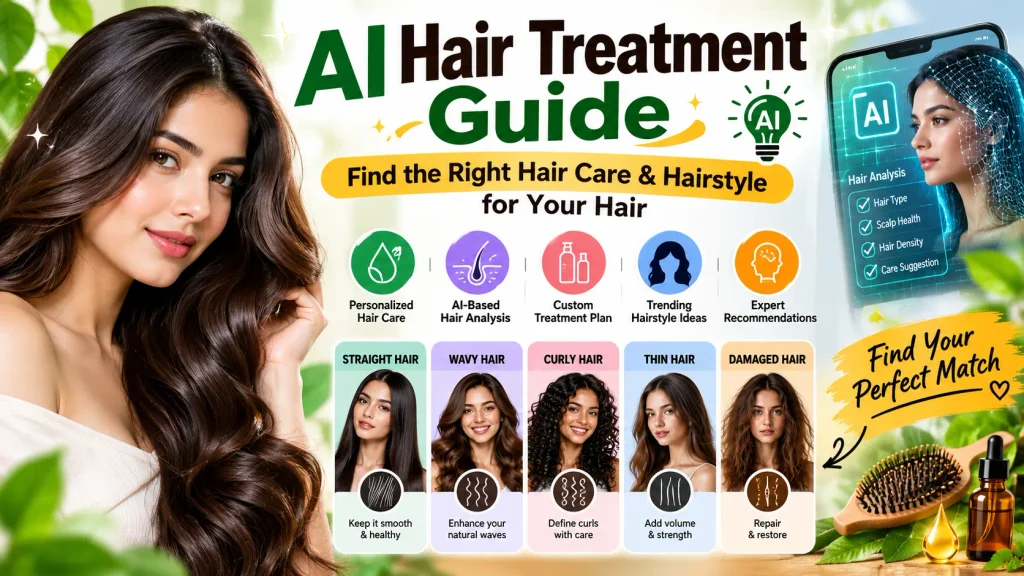
What Is an AI Hair Treatment Guide?
An AI Hair Treatment Guide uses artificial intelligence and image-analysis technology to evaluate visible characteristics of your hair from a photo or information you provide.
Depending on the app or platform, an AI tool may examine factors such as:
- Hair texture
- Hair length
- Visible dryness or frizz
- Hair volume
- Curl or wave pattern
- Face shape
- Current hairstyle
- Hair color
After analyzing these features, the tool may provide general hair-care suggestions or show hairstyles and colors that could suit your appearance.
Some apps focus mainly on virtual hairstyles and hair color try-on, while others provide broader hair-care recommendations.
How Does AI Hair Analysis Work?
Most AI hair analysis tools follow a simple process. You upload or take a clear photograph, and the software uses computer vision and trained algorithms to identify visible features.
For better results, the photograph should generally be taken in good lighting with your hair clearly visible. Heavy filters, hats, shadows, or blurry images can make the analysis less reliable.
The AI may then classify your hair into categories such as straight, wavy, curly, or coily and identify other visible characteristics.
Based on this information, the app can suggest potential hairstyles, care approaches, or cosmetic changes.
Keep in mind that an image alone cannot reveal every factor affecting hair health. Nutrition, hormones, genetics, scalp conditions, medications, stress, and other factors may influence hair and require professional evaluation.
Common Hair Types and Basic Care
Understanding your hair type is one of the first steps toward choosing an appropriate routine.
| Hair Type | Common Characteristics | General Care Approach |
|---|---|---|
| Straight Hair | Smooth texture, may become oily quickly | Lightweight products and regular cleansing |
| Wavy Hair | Loose S-shaped waves | Light conditioner and frizz control |
| Curly Hair | Defined curls, may become dry | Moisture-focused care and gentle styling |
| Coily Hair | Tight curls or coils | Deep conditioning and reduced manipulation |
| Fine Hair | Smaller strand diameter, may lack volume | Lightweight products and gentle handling |
| Thick Hair | Fuller appearance and heavier strands | Moisturizing and smoothing products may help |
| Dry Hair | Rough or dull appearance | Reduce excessive heat and focus on conditioning |
| Oily Hair | Scalp becomes greasy relatively quickly | Appropriate cleansing without excessive product buildup |
These categories provide a starting point rather than a strict rule. Two people with similar-looking hair can still require different routines.
AI Hair Treatment for Dry and Frizzy Hair
Dry and frizzy hair is a common concern. Frequent heat styling, chemical processing, environmental exposure, and unsuitable products can all contribute to a rough or frizzy appearance.
An AI hair analysis app may recognize visible frizz or dryness and recommend a more moisture-focused routine.
A simple routine could include a gentle shampoo, conditioner, leave-in product, and reduced use of high-temperature styling tools.
When using a hair dryer or styling device, limiting excessive heat can help reduce unnecessary damage. Heat-protection products may also be useful when heat styling is necessary.
For curly and wavy hair, avoiding aggressive towel rubbing and excessive brushing when dry may help preserve the natural curl pattern.
Hair Care for Oily Hair
An oily scalp does not necessarily mean that the entire hair strand is oily. Some people have oily roots but relatively dry ends.
AI-based recommendations may help users identify this combination and choose different approaches for the scalp and hair lengths.
Regular cleansing with a shampoo appropriate for your scalp can help manage excess oil and product buildup. Heavy oils, conditioners, and styling products applied directly to the scalp may make some people’s hair appear greasier.
How frequently you need to wash your hair depends on factors including scalp oil production, hair texture, activity level, and styling habits.
Hair Care for Damaged Hair
Hair can become visibly damaged because of repeated coloring, bleaching, straightening, heat styling, or mechanical stress.
Common signs may include rough texture, split ends, increased tangling, loss of shine, or breakage.
AI tools can sometimes recognize visible signs of damage, but they cannot determine the underlying medical cause of hair loss or scalp problems.
For cosmetically damaged hair, reducing chemical and heat exposure, using conditioner, handling wet hair carefully, and trimming severely split ends can be practical steps.
If you experience sudden or unexplained hair loss, bald patches, scalp pain, persistent itching, or other significant symptoms, consider consulting a qualified dermatologist rather than relying on an AI app.
Find the Right Hairstyle With AI
One of the most useful features of modern AI hair apps is virtual hairstyle try-on.
Instead of cutting your hair first and hoping that the style works, you can upload a photo and preview different looks digitally.
You may be able to experiment with:
- Short hairstyles
- Medium-length hairstyles
- Long hairstyles
- Layered cuts
- Bob cuts
- Bangs or fringes
- Curly hairstyles
- Straight hairstyles
- Different hair colors
This makes AI hairstyle tools useful for inspiration before visiting a salon.
Choosing a Hairstyle Based on Face Shape
Many virtual hairstyle apps also estimate face shape and display styles that may visually complement it.
Oval Face
Oval faces can work with many different hair lengths and styles. Layers, bobs, waves, and longer hairstyles are common options to experiment with virtually.
Round Face
People looking to create a more elongated appearance may experiment with longer layers, volume near the top, or face-framing styles.
Square Face
Soft waves, textured layers, and side-swept styles can be previewed to see how they balance stronger facial angles.
Heart-Shaped Face
Styles with volume around the lower part of the face, side-swept bangs, or medium-length cuts may be worth testing.
Long or Oblong Face
Medium-length cuts, waves, curls, or bangs can be virtually tested to see whether they create the desired visual proportions.
These are styling ideas rather than fixed rules. Personal preference should remain the most important factor.
Try Hair Colors Before Coloring Your Hair
Hair color is another area where AI can be useful.
Virtual hair-color tools allow you to preview shades such as black, brown, blonde, red, burgundy, copper, or fashion colors without actually applying dye.
Some advanced apps can adjust the simulated color according to lighting, existing hair tone, and facial features.
The virtual result will not always match the final salon result exactly, but it can help narrow down your choices.
This may be particularly useful before making a major color change.
Build a Simple Hair Care Routine
A complicated routine is not always necessary. A basic routine can often start with cleansing, conditioning, protection, and appropriate styling.
Step 1: Identify Your Hair Type
Determine whether your hair is primarily straight, wavy, curly, or coily and whether it tends to be dry, oily, or somewhere in between.
Step 2: Choose Suitable Cleansing Products
Select shampoo according to your scalp and hair needs rather than choosing products solely because they are popular.
Step 3: Use Conditioner
Conditioner can help improve manageability, softness, and smoothness, particularly through the mid-lengths and ends.
Step 4: Reduce Unnecessary Heat
Frequent exposure to very high temperatures can contribute to cosmetic hair damage. Use lower temperatures where practical.
Step 5: Handle Hair Gently
Avoid aggressive brushing, pulling, and rubbing, especially when hair is wet and more vulnerable to mechanical damage.
Step 6: Review Your Routine
Hair needs may change with weather, styling habits, chemical treatments, or length. Review your routine periodically rather than following the same products indefinitely.
AI Hair Apps vs Professional Hair Advice
AI tools are useful for convenience and visualization, but there is an important difference between an AI hairstyle app and professional medical advice.
| Feature | AI Hair App | Hair Stylist | Dermatologist |
|---|---|---|---|
| Virtual hairstyle preview | Yes | Sometimes | Usually No |
| Virtual hair color preview | Yes | Sometimes | No |
| General hair-care suggestions | Yes | Yes | Yes |
| Haircut recommendations | Yes | Yes | Usually No |
| Diagnose scalp disease | No | No | Yes |
| Evaluate unexplained hair loss | Limited/No | Limited | Yes |
| Medical treatment | No | No | Yes |
AI is therefore best used for general guidance, experimentation, and visualization rather than diagnosing or treating medical conditions.
Benefits of Using an AI Hair Treatment & Hairstyle App
AI-based hair tools can make the process of exploring hair care and styling more convenient. Instead of relying only on imagination, users can visually compare different possibilities.
For example, someone considering short hair can preview a bob, pixie cut, or layered style before committing to the haircut. Similarly, someone considering a new hair color can compare several shades using the same photograph.
AI can also make it easier to organize general hair-care suggestions based on the information users provide.
The biggest advantage is personalization. Rather than seeing the same hairstyle recommendations for everyone, AI tools can adapt suggestions based on visible characteristics and selected preferences.
Limitations of AI Hair Analysis
AI hair analysis is not perfect.
Results depend heavily on image quality, lighting, camera angle, algorithm accuracy, and the information supplied by the user.
An AI app might identify visible dryness or thinning incorrectly. It also cannot fully assess what is happening beneath the surface of the scalp or determine why hair loss is occurring.
Therefore, avoid making important medical decisions solely from an AI-generated result.
When Should You Consult a Dermatologist?
General hair-care apps may be helpful for everyday cosmetic concerns, but some situations deserve professional evaluation.
Consider seeking qualified medical advice if you notice sudden or significant hair loss, bald patches, persistent scalp redness, sores, severe itching, pain, scaling, or other unusual changes.
A dermatologist can examine your scalp and hair directly and determine whether additional tests or medical treatment may be appropriate.
Final Thoughts
An AI Hair Treatment Guide can be a convenient starting point for understanding visible hair characteristics, improving a basic hair-care routine, and discovering hairstyles that match your preferences.
AI hairstyle and hair-color try-on tools are particularly useful because they allow you to experiment with different looks without immediately changing your real hair.
For everyday care, focus on understanding your hair type, choosing appropriate products, limiting unnecessary heat or chemical damage, and handling your hair gently.
Most importantly, remember that AI provides recommendations—not a medical diagnosis. Persistent hair loss, scalp problems, or other concerning symptoms should be evaluated by a qualified healthcare professional.
With the right combination of technology, consistent hair care, and professional guidance when necessary, you can make more informed decisions about both your hair health and your next hairstyle.
Frequently Asked Questions (FAQ)
1. What is an AI Hair Treatment Guide?
An AI Hair Treatment Guide uses artificial intelligence to analyze visible hair characteristics or user-provided information and offer general hair-care and styling suggestions.
2. Can AI tell me which hairstyle suits me?
AI hairstyle apps can analyze factors such as your face shape and visible hair characteristics to show virtual hairstyle options. The final choice depends on your preferences, hair texture, and practical styling needs.
3. Can I try hairstyles without cutting my hair?
Yes. Virtual hairstyle apps can place simulated hairstyles on your photo, allowing you to preview short, medium, long, curly, straight, layered, and other styles before getting a haircut.
4. Can AI help me choose a hair color?
Yes. Many AI hair apps include virtual hair-color try-on features that allow you to preview multiple colors and shades before dyeing your hair.
5. Can AI diagnose hair loss?
AI may identify visible changes, but it should not be relied upon to diagnose the cause of hair loss. Sudden, persistent, or significant hair loss should be evaluated by a qualified medical professional.
6. What is the best routine for dry hair?
A general routine may include gentle cleansing, regular conditioning, reduced excessive heat exposure, and careful handling. The appropriate routine varies depending on your individual hair and scalp.
7. How can I reduce frizzy hair?
Conditioning, minimizing excessive heat, using appropriate leave-in products, and reducing rough handling may help manage frizz. Results vary depending on hair texture and environmental conditions.
8. Are AI hairstyle results completely accurate?
No. Virtual results are simulations. Lighting, photo quality, hair texture, facial angles, and the app’s technology can affect how realistic the preview looks.
9. Is an AI hair app a replacement for a dermatologist?
No. AI hair apps are better suited to general hair-care guidance and cosmetic hairstyle visualization. A dermatologist should evaluate medical hair or scalp concerns.
10. Who can use an AI hairstyle and hair-care app?
Anyone interested in exploring hairstyles, hair colors, or general hair-care ideas can use these tools. They can be particularly helpful for people planning a new haircut or cosmetic hair change.
Disclaimer: This article is for general informational and educational purposes only. AI-based hair analysis and hair-care suggestions should not be considered medical diagnosis or treatment. For persistent hair loss, scalp conditions, or other health concerns, consult a qualified dermatologist or healthcare professional.