Gujarat Rural Land Record Online – Check 7/12, 8A, VF6, Survey & Owner Details
Gujarat Rural Land Record Online services make it easier for farmers, landowners and property buyers to check important Record of Rights information without depending only on old paper records. Gujarat’s e-Dhara system was created to digitize village land records and support access to records such as 7/12, 8A and VF6 mutation entries.
These records can be useful for property verification, agricultural loans, mutation, inheritance, land purchase and other property-related documentation.
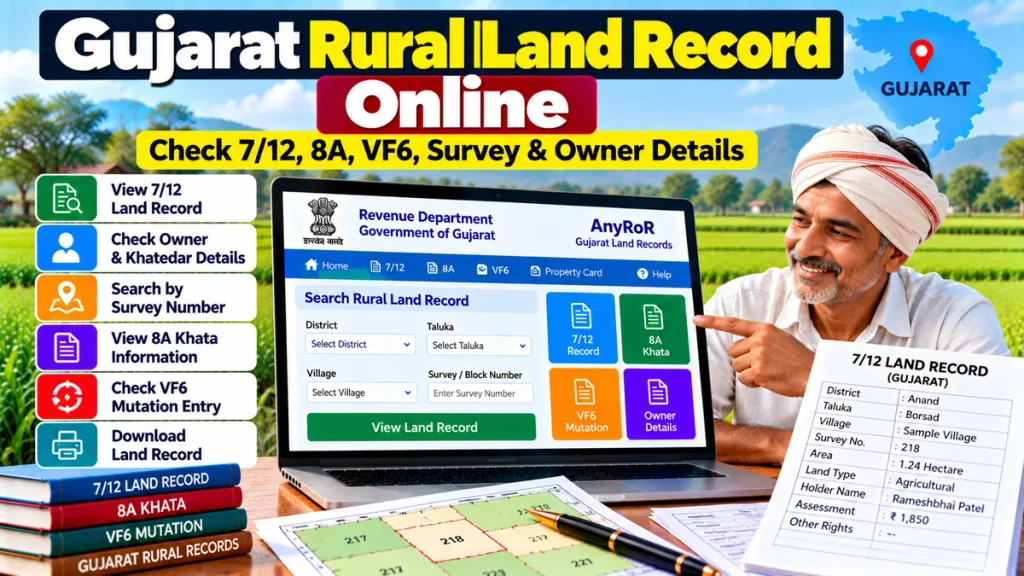
Gujarat Rural Land Record – Overview
| Details | Information |
|---|---|
| Service | Gujarat Rural Land Record |
| Main System | e-Dhara |
| Important Records | 7/12, 8A, VF6 |
| Search Options | Survey No., Khata, Khatedar Name |
| Land Type | Rural / Agricultural Land |
| Mutation Record | Village Form No. 6 |
| Useful For | Property & Ownership Verification |
| Record Type | Record of Rights |
What Is Gujarat Rural Record of Rights?
A Record of Rights (RoR) contains important information about rights connected with rural land.
Gujarat Revenue Department guidance explains that the state’s computerized land-record system uses Village Form No. 6 for mutation entries, while certified changes are incorporated into records such as 7/12 and 8A.
Together, these documents can provide a broader picture of a landholding and changes made to it over time.
What Is Gujarat 7/12 Record?
The 7/12 land record is one of the most commonly checked rural property records in Gujarat.
It can contain information connected with:
- Survey or block number
- Recorded landholder
- Land area
- Land type
- Revenue details
- Rights connected with the land
- Updates after mutation
For a property buyer, comparing the 7/12 with the registered sale deed and survey details is an important preliminary verification step.
What Is Gujarat 8A Khata?
Village Form 8A provides landholding or Khata-level information.
It can help identify multiple survey numbers connected with a particular landholding or Khatedar.
This record becomes particularly useful when a person owns more than one parcel in the same revenue area.
What Is VF6 Mutation Record?
Village Form No. 6 or VF6 is used for mutation entries.
When land rights change because of a sale, inheritance, partition or another eligible transaction, the change is recorded through the mutation process.
Gujarat Revenue Department documentation states that mutation records are maintained in Village Form No. 6 and that disputes relating to entries are examined before final confirmation.
How to Search Gujarat Rural Land Records
Gujarat’s e-Dhara system supports several ways to locate rural property records.
According to Gujarat Informatics, land-record data can be searched using:
- Khatedar name
- Khata number
- Survey number
- Farm name
- Other available land information
For a more accurate search, keep the following details ready:
District: District where the property is located.
Taluka: Relevant Taluka.
Village: Correct revenue village.
Survey / Block Number: Parcel identification number.
Khatedar Name: Recorded landholder’s name.
Khata Number: Landholding-account reference.
What Should You Verify in a Rural Land Record?
Do not rely on only one field when checking property.
Compare:
Owner or Khatedar Name: Make sure it matches the relevant documents.
Survey Number: Confirm that the land record relates to the exact parcel.
Land Area: Compare the area with the sale deed and survey documents.
8A Khata: Check the broader landholding information.
VF6 Mutation: Review recent ownership or rights changes.
7/12 Record: Check current plot-related details.
This comparison can help identify mismatches before a major land transaction.
Why Check Rural Land Records Before Buying Land?
Buying agricultural or rural land can involve substantial financial risk.
Before paying a large advance, check:
- Seller or Khatedar details
- Survey / block number
- 7/12 record
- 8A Khata
- VF6 mutation entries
- Registered sale deed
- Land area
- Physical boundaries
- Other recorded rights
A pending mutation or incorrect survey number can create difficulties later.
Gujarat e-Dhara and Mutation
The e-Dhara project was designed to computerize village land records and handle routine activities such as mutation and issuance of Record of Rights copies.
Gujarat Informatics states that e-Dhara Kendras operate at Taluka Mamlatdar offices and process land-record activities, including mutations and RoR issuance.
After a mutation is completed, checking updated 7/12 and 8A records is advisable.
Can Rural Land Records Be Obtained from eGram?
Yes. Gujarat’s eGram network also provides land-right record services, including RoR 7/12 and 8A services in rural areas.
This provides an additional access point for rural landowners who need Record of Rights copies.
Frequently Asked Questions
Can Gujarat rural land records be checked online?
Yes. Gujarat’s e-Dhara system provides computerized access to village land records.
Which records are important for rural land?
The commonly checked records include 7/12, 8A and VF6 mutation entries.
Can I search using survey number?
Yes. Survey number is one of the search options supported by e-Dhara.
Can I search by landowner name?
Yes. e-Dhara also supports searches using the Khatedar name.
What is VF6?
VF6 is the mutation register used to record changes affecting rural land rights.
Is 7/12 enough before buying land?
No. Buyers should also check 8A, VF6 mutation entries, the registered deed, survey details and physical boundaries.
Conclusion
Gujarat Rural Land Record Online services make it easier to check important property information using 7/12, 8A, VF6, survey number, Khata and Khatedar details. Before purchasing, transferring or financing rural land, comparing these records with the registered deed and actual property details can help identify discrepancies and improve property verification.