Gujarat Land Owner Name Search – Check Khatedar, 7/12, 8A & Property Details Online
Gujarat Land Owner Name Search can help landowners, farmers and property buyers locate rural land records when the exact survey or Khata number is not readily available. Gujarat’s computerized e-Dhara land-record system supports searches using the Khatedar or landholder name, along with Khata number, survey number and other property details.
Searching by owner name can be useful for property verification, inherited land checking, mutation review, agricultural loan documentation and preliminary due diligence before buying land.
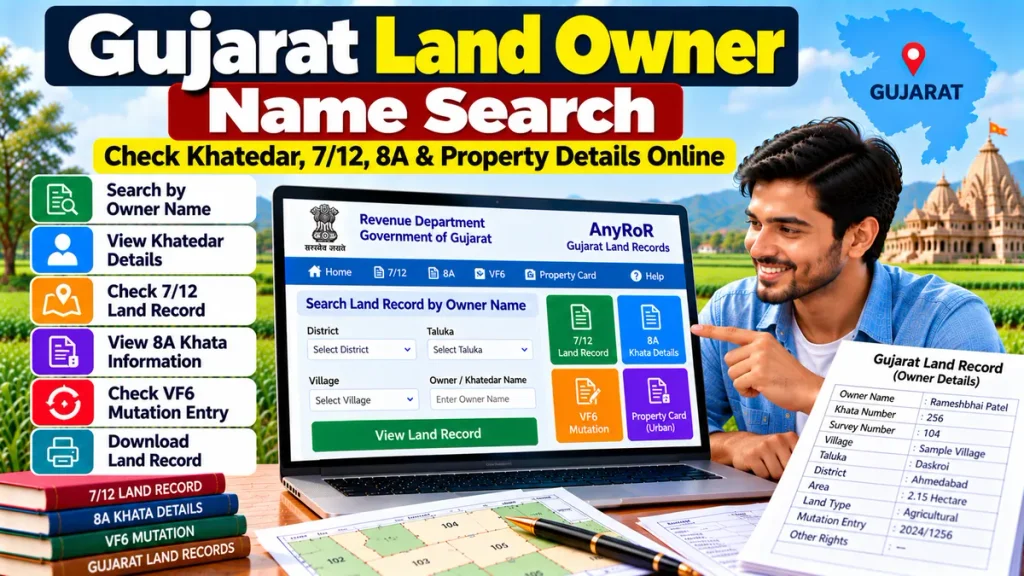
Gujarat Owner Name Search – Overview
| Details | Information |
|---|---|
| Search Type | Khatedar / Owner Name |
| Land Type | Mainly Rural Land |
| Main Records | 7/12, 8A, VF6 |
| System | e-Dhara / Gujarat Land Records |
| Other Search Options | Khata No., Survey No. |
| Useful For | Property Verification |
| Mutation Record | Village Form 6 |
| Holding Record | Village Form 8A |
Who Is a Khatedar?
In Gujarat land records, Khatedar generally refers to the person whose landholding or agricultural account is recorded in the revenue system.
Gujarat’s e-Dhara platform specifically states that computerized land-record data can be searched using Khatedar name, Khata number, survey number, farm name and other available information.
This makes an owner-name search especially useful when you know the seller or family member’s name but do not know the exact survey number.
How to Search Gujarat Land Record by Owner Name
For rural property, start with the official Gujarat land-record service.
Keep the following information ready:
District: Select the district where the land is located.
Taluka: Choose the relevant Taluka.
Village: Select the correct revenue village.
Khatedar / Owner Name: Enter or locate the recorded holder’s name where the relevant search facility is available.
The Gujarat Revenue Department officially provides an Online Viewing of Record of Right for Rural Area service, while e-Dhara maintains computerized rural Records of Rights.
After finding a possible matching record, verify it using survey number, Khata number and other property details.
What Details Should You Check?
An owner-name search should only be the starting point.
Once you locate the relevant land record, compare:
Khatedar Name: Confirm the spelling and identity of the recorded holder.
Survey / Block Number: Identify the exact parcel connected with the record.
Khata Number: Check the broader landholding account.
Land Area: Compare the recorded area with the registered documents.
7/12 Record: Review plot-related Record of Rights information.
VF6 Mutation: Check recent changes in land rights.
8A Khata: Review the consolidated holding information.
Why Owner Name Alone Is Not Enough
Many people can have the same or similar names. Therefore, finding a matching Khatedar name does not automatically prove that the record belongs to the person or property you are looking for.
Always cross-check:
- District
- Taluka
- Village
- Survey or block number
- Khata number
- Land area
- Registered sale deed
- Mutation entries
This becomes especially important during a high-value property transaction.
Owner Search and Gujarat 8A Khata
Village Form 8A is particularly useful when checking land by owner or Khatedar.
The Gujarat Revenue Department describes Village Form 8A as the Khatavahi of landholding, showing details such as the landholder’s name, holding number, survey numbers, area and assessment. It is linked with Village Form 6 and 7/12.
This means 8A can help identify multiple survey numbers connected with a particular landholding.
Owner Search and VF6 Mutation
If a property has recently been sold, inherited, partitioned or transferred, the previous owner’s name may still appear in older records until the applicable mutation is processed and certified.
The Gujarat Revenue Department explains that mutation entries are recorded in Village Form No. 6, with certified changes later incorporated into records such as 7/12 and 8A.
For this reason, property buyers should check both the current landholder information and relevant VF6 mutation entries.
Why Search Owner Details Before Buying Land?
A property buyer may know the seller’s name but still need to confirm which plots are actually connected with that person.
Searching the available land records can help compare:
- Seller or Khatedar name
- Survey number
- Khata number
- 7/12 details
- 8A holding information
- VF6 mutation entries
- Registered sale deed
- Recorded land area
These checks can help identify obvious mismatches before registration or payment.
Owner Name Search and Property Loans
Land-record information may also be relevant during agricultural loans, mortgage finance, secured property loans and other financial documentation.
Depending on the lender, documents such as 7/12, 8A, mutation records and registered title documents may be required.
Online owner-name information should therefore be treated as part of broader property-document verification.
Frequently Asked Questions
Can Gujarat land records be searched by owner name?
Yes. Gujarat’s e-Dhara system states that land-record data can be searched by Khatedar name.
What is Khatedar name?
It refers to the recorded landholder or account holder associated with rural land records.
Can I find survey numbers from the owner’s landholding?
Village Form 8A contains the holder name, holding number and survey numbers connected with the landholding.
Should I also check VF6?
Yes. VF6 mutation entries can show recent changes in land rights that may not be obvious from an older record.
Is owner-name search enough before buying property?
No. Buyers should also verify survey number, Khata, 7/12, 8A, VF6 mutation entries, registered deed and physical property details.
Conclusion
Gujarat Land Owner Name Search is a useful way to start checking rural property records when only the Khatedar or landholder name is known. By comparing the owner name with survey number, 7/12, 8A Khata, VF6 mutation entries and registered property documents, buyers and landowners can perform stronger preliminary verification before a land purchase, loan or other important transaction.