Car Insurance Claim Process – Documents and Step-by-Step Guide
A car accident, theft, fire, or unexpected vehicle damage can result in significant financial expenses. Having a valid car insurance policy can provide financial protection against covered losses, but policyholders also need to understand how the car insurance claim process works. Knowing when to inform the insurer, which documents are required, and how cashless and reimbursement claims are handled can make the process easier.
A car insurance claim is a formal request made by a policyholder to an insurance company for compensation or repair expenses following an event covered under the policy. The insurer reviews the incident, verifies the documents and policy coverage, assesses the damage, and then decides whether the claim is payable according to the policy terms.
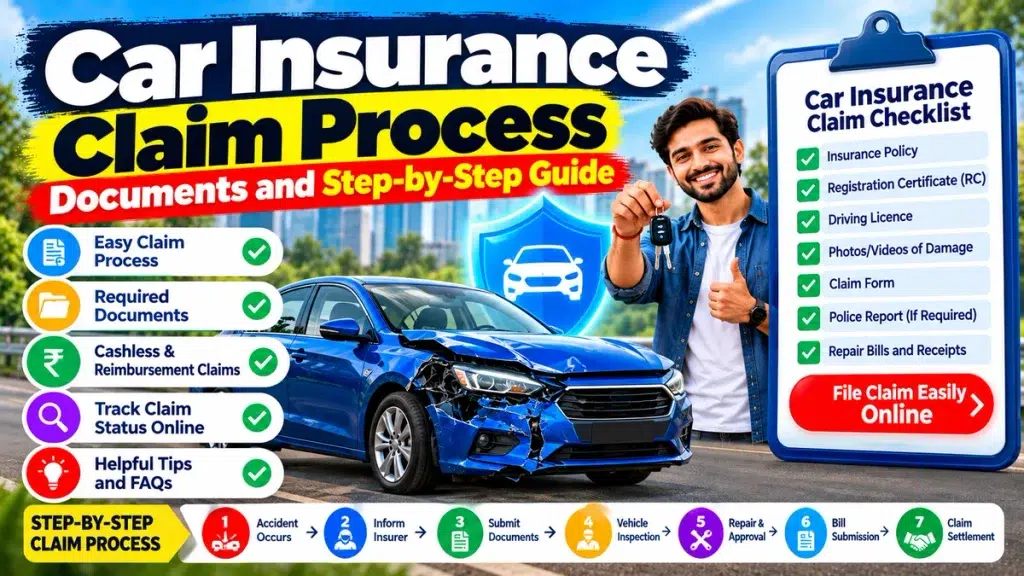
The exact process may vary depending on the insurer, type of policy, nature of damage, and claim category. This guide explains the car insurance claim process step by step, documents generally required, cashless and reimbursement claims, theft claims, common mistakes, and important points to remember.
What Is a Car Insurance Claim?
A car insurance claim is a request for financial assistance under an active motor insurance policy after an insured event occurs.
For example, if your car is damaged in an accident and the damage falls within your policy coverage, you can inform the insurance company and initiate a claim.
Depending on your policy, eligible events may include:
- Accidental vehicle damage
- Theft of the insured car
- Fire damage
- Flood or other specified natural disasters
- Certain man-made events
- Third-party liabilities
Not every type of damage is automatically covered. Claims remain subject to policy coverage, deductibles, exclusions, limits, and other conditions.
Types of Car Insurance Claims
Before filing a claim, it is useful to understand the major claim categories.
Cashless Car Insurance Claim
A cashless claim allows eligible vehicle repairs to be completed at a garage within the insurance company’s authorized network.
After approval, the insurer generally settles the covered portion of the repair bill directly with the network garage. The policyholder must pay applicable deductibles, depreciation where relevant, excluded items, and any other non-covered expenses.
Reimbursement Car Insurance Claim
In a reimbursement claim, you generally pay the repair bill first and later submit the required documents and bills to the insurance company.
The insurer evaluates the claim and reimburses the eligible amount according to policy terms.
This option can be useful when you choose a garage that is not part of the insurer’s cashless network.
Car Insurance Claim Process at a Glance
| Claim Stage | What You Should Do |
|---|---|
| Incident Occurs | Ensure safety and assess the situation |
| Inform Insurer | Notify the insurance company promptly |
| Claim Registration | Obtain the claim/reference number |
| Documentation | Submit required policy and vehicle documents |
| Vehicle Inspection | Allow surveyor/insurer inspection where required |
| Repair Approval | Wait for authorization before major repairs where applicable |
| Vehicle Repair | Use a network or chosen garage |
| Bill Submission | Submit invoices and supporting documents |
| Claim Assessment | Insurer reviews eligible expenses |
| Settlement | Approved claim is settled as per policy terms |
Car Insurance Claim Process – Step-by-Step Guide
The following steps provide a general overview of how an own-damage car insurance claim may work.
Step 1: Ensure Everyone Is Safe
Immediately after an accident, safety should be your first priority.
If anyone is injured, seek appropriate emergency or medical assistance. If it is safe and legally appropriate to do so, move the vehicle away from immediate danger.
Do not take unnecessary risks simply to document vehicle damage.
Step 2: Record the Incident
Once the situation is safe, collect basic evidence relating to the incident.
You may take photographs or videos of:
- Damage to your car
- Accident location
- Damage to another vehicle
- Registration plates
- Relevant road conditions
- Surrounding area
These records can be useful during claim assessment.
Do not intentionally alter the accident scene merely to create evidence.
Step 3: Inform Your Insurance Company
Notify your insurer as soon as reasonably possible after the incident.
Most insurers provide several claim-intimation options, such as a customer-care number, official website, mobile application, email, or branch assistance.
Provide accurate details about the incident.
These may include:
- Policy number
- Vehicle registration number
- Date and time of incident
- Location
- Type of damage
- Brief description of what happened
The insurer may then provide a claim reference number or claim registration number.
Keep this number safely because it can be used to track the claim.
Step 4: File a Police Report Where Required
A police report or First Information Report (FIR) may be necessary in certain situations.
This can include theft, serious accidents, third-party injury, major property damage, or other incidents where reporting is legally required or requested by the insurer.
The exact requirements depend on the circumstances.
Do not provide false or misleading information in a police report or insurance claim.
Step 5: Submit the Required Documents
Your insurer will tell you which documents are required for your particular claim.
Common documents can include the insurance policy, Registration Certificate (RC), driving licence, claim form, photographs, repair estimate, and other supporting records.
For reimbursement claims, original invoices and payment receipts may also be necessary.
Step 6: Vehicle Inspection and Survey
For many own-damage claims, the insurer may arrange for a surveyor or authorized representative to inspect the vehicle.
The surveyor assesses the visible damage and helps determine which repairs may be covered under the policy.
Avoid beginning major repairs before the required inspection or insurer authorization unless emergency circumstances make this necessary and your insurer permits it.
Failure to follow the required process can complicate claim assessment.
Step 7: Receive Repair Approval
After inspection, the insurer may authorize eligible repairs.
Authorization does not necessarily mean every repair expense will be paid in full.
The final payable amount can be affected by deductibles, depreciation, exclusions, policy limits, consumables, betterment, and other policy provisions.
Step 8: Get the Vehicle Repaired
For a cashless claim, take or keep the vehicle at an eligible network garage according to the insurer’s instructions.
For reimbursement claims, repairs may be carried out at another garage, subject to insurer requirements.
Keep all repair-related documents.
Step 9: Submit Final Bills and Documents
Once repairs are complete, the required invoices, receipts, and supporting documents are submitted for final claim processing.
In a cashless claim, the network garage generally coordinates much of this process with the insurer.
In a reimbursement claim, the policyholder may need to submit the documents directly.
Step 10: Claim Settlement
After reviewing the documents and repair expenses, the insurer determines the eligible claim amount.
For cashless claims, the insurer generally pays the approved amount directly to the network garage, while you pay the non-covered portion.
For reimbursement claims, the approved amount is generally paid to the policyholder through the applicable payment method.
Documents Required for a Car Insurance Claim
Documentation requirements vary according to the incident and insurer.
| Document | Why It May Be Required |
|---|---|
| Insurance Policy | Confirms applicable insurance coverage |
| Claim Form | Records formal claim information |
| Vehicle RC | Confirms vehicle registration details |
| Driving Licence | Confirms driver’s licence details |
| Claim Reference Number | Helps track the registered claim |
| Photos/Videos | Provides evidence of vehicle damage |
| Repair Estimate | Shows expected repair costs |
| Repair Invoice | Provides final repair expense details |
| Payment Receipt | May be needed for reimbursement |
| FIR/Police Report | Required in certain incidents |
| Bank Details | May be needed for reimbursement payment |
| Additional Documents | Requested depending on claim circumstances |
Always follow your insurer’s current document checklist.
How Does a Cashless Car Insurance Claim Work?
A cashless claim can simplify repair settlement when your car is taken to an eligible network garage.
First, notify the insurer and register the claim. The vehicle is then inspected where required, and the insurer provides authorization for eligible repairs.
After the work is completed, the garage submits the repair bill to the insurer.
The insurance company settles the approved portion directly with the garage.
However, “cashless” does not necessarily mean that the policyholder pays nothing.
You may still need to pay:
- Compulsory deductible
- Voluntary deductible, if applicable
- Depreciation on parts where applicable
- Non-covered repairs
- Consumables not covered by the policy
- Amounts exceeding policy limits
Review the final bill carefully before taking delivery of the vehicle.
How Does a Reimbursement Claim Work?
A reimbursement claim can be used when repairs are performed outside the insurer’s cashless garage network or where the claim is otherwise processed on a reimbursement basis.
You should still inform the insurer promptly and follow the required inspection procedure before major repairs.
After repairs, keep the original:
- Repair invoices
- Payment receipts
- Parts invoices where applicable
- Inspection-related documents
- Other documents requested by the insurer
Submit them according to the insurer’s claim procedure.
The insurer will assess the claim and reimburse the eligible amount after applying applicable deductions.
Car Insurance Claim Process for Theft
A vehicle theft claim differs from a normal accident claim.
If your insured car is stolen, report the theft to the police promptly and notify your insurance company.
The insurer may request documents such as the FIR, insurance policy, RC-related records, keys, claim form, and other documents connected with the investigation.
Additional police or transport-authority documentation may be required depending on the case.
The insurer generally processes the claim after completing the required verification and receiving necessary documentation.
The final settlement is subject to policy terms, insured value, investigation, and applicable deductions.
What Is a Deductible in a Car Insurance Claim?
A deductible is an amount that the policyholder may need to bear when an eligible claim is settled.
Motor insurance can include compulsory deductibles and, where selected, voluntary deductibles.
For example, if an approved repair expense is subject to a deductible, the insurer’s payable amount will be calculated after applying the applicable deductible and other relevant deductions.
A higher voluntary deductible may reduce the policy premium but can increase the amount you pay during a claim.
Does Zero Depreciation Affect the Claim Amount?
Depreciation may be deducted from the value of certain replaced parts under a standard own-damage claim.
A zero depreciation add-on can reduce eligible depreciation deductions on specified parts, subject to policy terms, limits, vehicle age, and other conditions.
It does not mean every repair expense will be paid completely.
Deductibles and other exclusions can still apply.
Common Reasons a Car Insurance Claim May Be Rejected
Claim approval depends on the facts of the incident and policy terms.
Possible reasons for claim rejection or reduced settlement can include:
Policy Not Active: Damage occurring outside the applicable policy period may not be covered.
Excluded Damage: The loss may fall under an exclusion stated in the policy.
Invalid Driving Licence: A claim may be affected if the person driving did not have an appropriate valid licence, depending on circumstances and applicable law.
Incorrect Information: False or materially misleading information can create serious claim problems.
Delayed Intimation: Unreasonable delays that violate policy conditions can complicate assessment.
Unauthorized Repairs: Starting major repairs before required inspection or approval can create difficulties.
Use Outside Policy Terms: Using the vehicle in a manner not permitted by the policy may affect coverage.
Every claim should be evaluated based on its specific facts and policy wording.
How to Track Car Insurance Claim Status
Many insurers provide online claim-tracking facilities.
Visit your insurer’s official website or application and look for options such as Track Claim, Claim Status, or My Claims.
You may need:
- Claim number
- Policy number
- Vehicle number
- Registered mobile number
- OTP verification
If online tracking is unavailable, contact the insurer’s official customer support.
Tips for a Smooth Car Insurance Claim
Notify the insurer promptly and provide accurate information about the incident.
Keep copies of all documents, photographs, estimates, invoices, receipts, and communications.
Follow the insurer’s instructions regarding inspection and repairs.
Do not exaggerate vehicle damage or include unrelated old damage in a claim.
Before accepting a settlement, understand how the insurer calculated the payable amount and what deductions were applied.
Frequently Asked Questions (FAQ)
1. How do I start a car insurance claim?
Contact your insurer through its official claim channel, provide the policy and incident details, and obtain a claim reference number. Follow the insurer’s instructions for documentation and inspection.
2. What documents are required for a car insurance claim?
Common documents include the policy, RC, driving licence, claim form, repair estimate, photographs, invoices, and receipts. An FIR or additional documents may be required depending on the incident.
3. What is a cashless car insurance claim?
A cashless claim allows the insurer to settle the approved portion of eligible repair expenses directly with an authorized network garage. The policyholder pays applicable deductibles and non-covered expenses.
4. Can I claim insurance at a non-network garage?
A reimbursement claim may allow repairs at a non-network garage, subject to the insurer’s terms and required claim procedure.
5. Is an FIR compulsory for every car insurance claim?
Not necessarily. It may be required for theft, certain serious accidents, third-party incidents, or other situations depending on legal and insurer requirements.
6. How long does a car insurance claim take?
There is no universal timeframe. Processing time depends on the type of claim, extent of damage, documentation, survey, repair time, investigation requirements, and insurer procedures.
7. Can my car insurance claim be rejected?
Yes. A claim can be rejected when it falls outside policy coverage or violates applicable policy conditions. The exact decision depends on the facts and policy wording.
8. What happens to my No Claim Bonus after making a claim?
An own-damage claim can affect NCB eligibility at renewal, subject to applicable rules and whether you have any relevant NCB-protection benefit.
9. Can I track my car insurance claim online?
Many insurers allow claim tracking through their official website or mobile application using a claim number, policy details, or other verification.
10. Do I have to pay anything in a cashless claim?
Possibly. You may still need to pay deductibles, depreciation where applicable, excluded items, consumables, and other non-payable expenses.
Conclusion
Understanding the car insurance claim process can make it easier to respond correctly after an accident, theft, fire, or another insured event. The most important steps are to ensure safety, document the incident, notify the insurer promptly, provide accurate information, submit the required documents, and follow the prescribed inspection and repair process.
Whether you choose a cashless or reimbursement claim, keep your policy, RC details, driving licence, photographs, repair estimates, invoices, and payment records organized. For theft and certain serious incidents, police documentation may also be required.
Remember that filing a claim does not automatically guarantee that every repair expense will be paid. The final settlement depends on your policy coverage, deductibles, depreciation, add-ons, exclusions, limits, and the circumstances of the incident.
Always check the latest claim instructions provided by your insurer and carefully read your policy wording. Following the correct procedure from the beginning can help reduce unnecessary delays and make the claim process easier to manage.
Disclaimer: This article is for general informational and educational purposes only and does not constitute insurance, legal, or financial advice. Claim procedures, documentation, coverage, deductibles, settlement rules, and exclusions vary by insurer and policy and may change over time. Always verify the latest requirements directly with your authorized insurance provider and refer to your policy documents before filing a claim.