Check Your Land Record Online – View Survey Number, Plot & Property Details
Digital land-record services have made it easier to find basic information about land and property in India. Many States and Union Territories provide official online portals where citizens can search available land records using details such as district, village, survey number, plot number, khasra number or other local identifiers.
When you check your land record online, you may be able to view the Record of Rights (RoR), survey or plot information, recorded holder details, land area, classification and other property-related entries. Some systems also provide access to cadastral maps and mutation-related information.
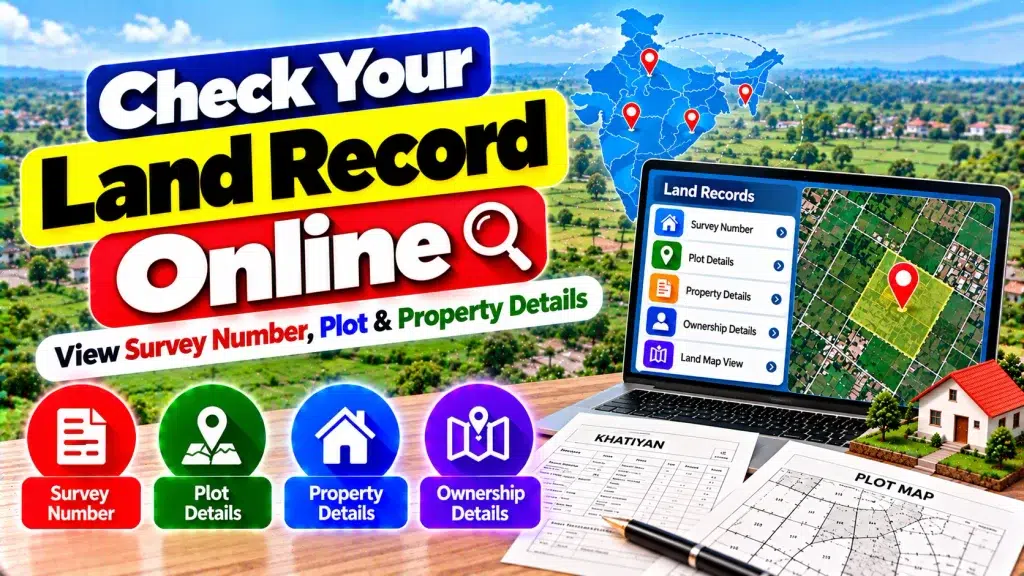
However, land-record systems are managed at the State and Union Territory level. Therefore, document names, search methods, available information and certification procedures can differ depending on where the property is located.
Online Land Record – Quick Overview
| Information | General Details |
|---|---|
| Record of Rights | Available through many State/UT systems |
| Survey Number | May identify surveyed land |
| Plot Number | Used in many parcel records |
| Recorded Holder | May appear in the land record |
| Land Area | Commonly displayed |
| Land Classification | Depends on State records |
| Khasra/Khata Details | Available in applicable systems |
| Cadastral Map | Available in some online systems |
| Mutation Information | State-specific |
| Property Location | District, tehsil/taluk, village etc. |
| Online Copy | Depends on portal |
| Certified Copy | Procedure varies by jurisdiction |
What Is a Land Record?
A land record is an official record maintained under the relevant State or Union Territory land administration system.
It can contain information relating to a particular land parcel, including the recorded rights holder, survey or plot number, area and other revenue-related details.
Land records may be known by different names in different parts of India.
Common terms include Record of Rights, RoR, RTC, Pahani, Jamabandi, Khatauni, Khasra, Patta and Khata.
Because terminology varies, users should identify the correct document used in the State where their property is located.
How to Check Your Land Record Online
Start by finding the official land-record portal for your State or Union Territory.
Once you reach the official service, select the location of the property.
Depending on the portal, you may need to choose details such as district, tehsil, taluk, block, circle and village.
The portal may then allow you to search using a survey number, plot number, khasra number, khata number or another parcel identifier.
Enter the information carefully and review the matching record.
Search options and procedures vary between States.
Check Survey Number Online
A survey number is commonly used to identify surveyed land within a particular land-record system.
The survey number can help users locate the correct parcel when checking records online.
In some areas, there may also be subdivision numbers associated with the main survey number.
Other States may use different identifiers, such as khasra or dag numbers.
Always compare the number displayed in the online record with the survey or parcel identifier appearing on your existing official property documents.
View Plot Details
Plot details can help distinguish one parcel from another.
Depending on the land-record system, a plot entry may contain the plot number, recorded area, classification and other related information.
Some systems may also connect the plot with a cadastral map.
If the property has multiple subdivisions or has undergone changes over time, additional identifiers may be necessary to find the correct record.
Check all numbers carefully before assuming that an online result relates to your property.
Check Property Information
Online land records can provide several useful property details.
Depending on the State and type of record, you may find the land area, survey number, plot number, classification, location and recorded rights information.
This information can be useful for preliminary verification.
For example, you can compare the recorded area and parcel number with the details appearing in your available documents.
If the information does not match, contact the appropriate land or revenue authority for clarification.
Check Recorded Ownership Details
A Record of Rights may contain the name of the person or persons whose rights are recorded against the relevant land parcel.
This information can help when conducting an initial property check.
However, a recorded name in a revenue record should not automatically be treated as complete proof of legal ownership.
Registered deeds, inheritance documents, court orders, mutation records and other documents may also affect property rights.
A broader title verification may therefore be necessary before an important property transaction.
What Is Record of Rights?
The Record of Rights (RoR) is an important component of the land-record system.
The document records rights-related information associated with land under the applicable State system.
The exact information and format vary between jurisdictions.
Some States use local names instead of RoR.
When checking a land record online, make sure you understand which document contains the information you need.
For formal purposes, you may also need a certified or digitally authenticated version rather than a simple online display.
Check Land Area and Classification
Land area is another common piece of information available in land records.
The units used to record land can vary by State and region.
When comparing documents, check both the numerical area and the measurement unit.
Land classification may also appear in the relevant record.
The meaning of a particular classification should be understood according to the rules and terminology used by the relevant State authority.
Do not rely on a generic interpretation when the classification affects an important transaction.
View Cadastral Maps
Cadastral maps show land parcels and their spatial boundaries.
Some State land-record systems provide online access to digitized cadastral maps.
These maps can help users locate a parcel and understand its general shape and surrounding plots.
However, viewing a cadastral map online is not necessarily the same as having land officially measured or demarcated.
If exact boundaries are required, particularly during a dispute, follow the official survey and measurement procedure available in the relevant State.
Check Mutation Information
Mutation generally refers to updating the applicable land or revenue record when a qualifying change in recorded rights needs to be reflected.
For example, mutation may become relevant after certain property transfers or inheritance events, subject to State rules.
If the land has recently changed hands, checking the latest available record can help determine whether the relevant update appears in the system.
Mutation procedures, documents and timelines vary between jurisdictions.
A mutation record and registered deed should not automatically be considered interchangeable.
Land Record vs Registered Property Document
Land revenue records and registered property documents serve different purposes.
A registered deed records a registered transaction, while land records maintain revenue and rights-related information under the applicable system.
For this reason, checking only an online land record may not be sufficient when verifying a property before purchase.
Depending on the situation, users may also need to review registered documents, mutation history, relevant maps and other legal records.
Benefits of Checking Land Records Online
Online land-record systems can make preliminary verification faster and more convenient.
Users may be able to check:
- Survey or plot number
- Record of Rights
- Recorded holder information
- Land area
- Land classification
- Khasra or Khata details
- Mutation-related information
- Cadastral maps where available
Digital access can also help users identify possible discrepancies before contacting the relevant authority.
Can You Download Land Records?
Many State and Union Territory portals provide options to view or download available land records.
However, a downloaded informational copy may not always have the same legal status as a certified or digitally signed record.
Requirements vary according to the State and purpose.
If you need a land record for registration, a loan, litigation or another formal process, check which version is accepted by the relevant authority.
Use Official Land Record Services
Always prefer the official land-record service of the State or Union Territory where the property is located.
Be careful with unknown websites promising instant ownership changes, guaranteed mutation or complete legal-title verification.
Never provide banking passwords, ATM PINs, UPI PINs, CVVs or other sensitive financial information simply to check a land record.
If an entry appears incorrect or outdated, follow the official correction procedure.
Frequently Asked Questions (FAQ)
1. Can I check my land record online?
Many States and Union Territories provide online access to digitized land records.
2. Can I check a survey number online?
Yes, many land-record portals provide searches using survey or similar parcel identifiers.
3. Can I search using a plot number?
Many systems allow plot, khasra, survey or other State-specific numbers to be used for searches.
4. Can I check the owner’s name?
The relevant land record may display the person or persons whose rights are recorded against the parcel.
5. What is RoR?
RoR means Record of Rights, an important land record containing rights-related information.
6. Can I view a land map online?
Some State systems provide online cadastral maps, depending on digitization and availability.
7. Can I download my land record?
Many portals provide download or viewing options, but certified-copy procedures vary.
8. Are online land records proof of legal ownership?
Not necessarily. Complete title verification may require registered deeds and other relevant legal documents.
9. What if my land details are incorrect?
Contact the appropriate revenue, survey or land-record authority and follow the prescribed correction process.
10. Are land-record websites the same across India?
No. Each State or Union Territory may have its own portal, terminology and procedures.
Conclusion
The ability to check your land record online provides a convenient way to review survey numbers, plot information and other available property details without beginning every enquiry with a physical visit to a revenue office.
Depending on the State or Union Territory, you may be able to view the Record of Rights, recorded holder information, land area, classification, mutation-related entries and cadastral maps.
However, online land records should be used carefully. Systems and terminology vary across India, and a digital record may not by itself provide complete legal-title verification.
Always use the official land-record portal for the location of the property, compare survey and plot information carefully, and obtain appropriate certified or registered documents when required for an important property transaction.