Ayushman Bharat Card 2026: Online Registration, Status Check, and Hospital List Guide
Medical emergencies are inherently unpredictable, and the resulting hospital bills can severely disrupt a family’s financial security. To shield citizens from these catastrophic out-of-pocket health expenditures, the Government of India actively runs the Ayushman Bharat Pradhan Mantri Jan Arogya Yojana (AB-PMJAY).
Under this landmark healthcare initiative, eligible families receive a protective health cover of up to ₹5 Lakh per year for secondary and tertiary care hospitalization. The entire process is completely cashless and paperless.
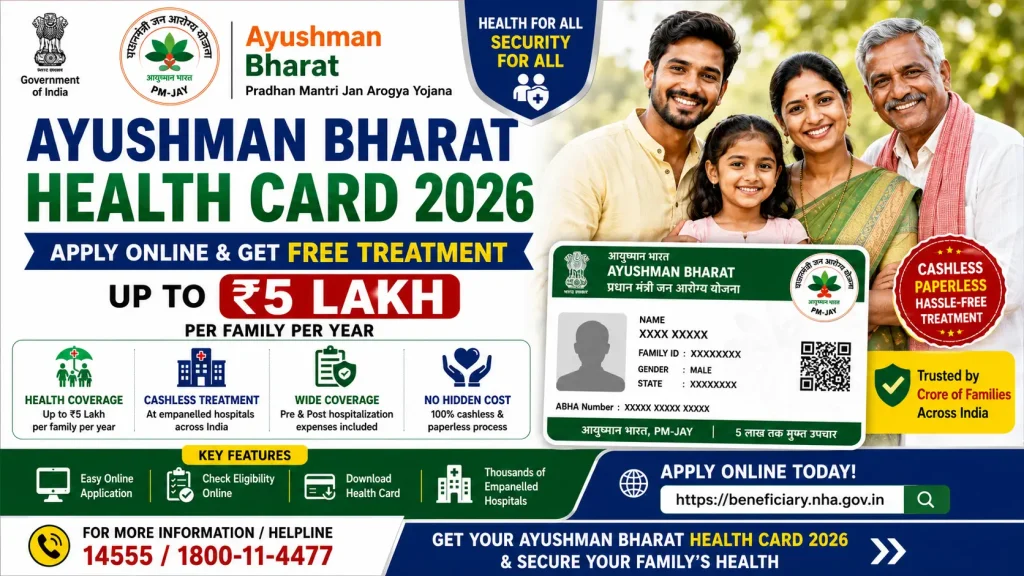
If you want to secure your family’s health infrastructure, this ultimate step-by-step guide covers the 2026 registration framework, eligibility criteria, online application status tracking, and finding network hospitals.
What is the Ayushman Bharat Card?
Administered globally by the National Health Authority (NHA), the Ayushman Bharat Card (often called the PMJAY Golden Card) acts as a digital authorization token. When presented at an empanelled medical facility, it unlocks cashless treatment configurations across thousands of medical procedures.
Alongside this treatment framework, the government encourages individuals to generate an ABHA (Ayushman Bharat Health Account) card. While the PMJAY card handles insurance payouts up to ₹5 Lakh, the 14-digit ABHA card serves as a secure, lifetime repository to store your medical histories, diagnostic reports, and digital prescriptions.
Ayushman Bharat Scheme 2026: Core Attributes
| Feature | Details |
| Scheme Name | Ayushman Bharat Pradhan Mantri Jan Arogya Yojana (AB-PMJAY) |
| Regulatory Body | National Health Authority (NHA) |
| Financial Coverage | Up to ₹5 Lakh per family, per year |
| Nature of Treatment | 100% Cashless at Empanelled Network Hospitals |
| Key Components | AB-PMJAY Health Card & ABHA Digital ID |
| Application Costs | Completely Free of Charge |
Strategic Benefits of the PMJAY Health Card
Possessing an active Ayushman Card provides several functional advantages during a medical crisis:
- Comprehensive Inpatient Cover: The scheme completely absorbs costs related to nursing care, room charges, surgeon fees, ICU fees, and operating theater expenses.
- Pre & Post Hospitalization Protection: The financial shield encompasses medical examinations, consultations, and diagnostics up to 3 days before admission and medicines/follow-up care up to 15 days after discharge.
- Immediate Pre-existing Disease Coverage: Unlike commercial health insurance instruments that enforce a 3 to 4-year waiting window, AB-PMJAY covers all pre-existing chronic conditions from day one.
- Zero Restrictions on Family Dynamics: The scheme enforces no caps on family size, gender, or individual member age, ensuring the entire household stays safe under one collective wallet.
Detailed Eligibility Criteria: Who Qualifies in 2026?
The PMJAY health card benefits are structurally targeted toward low-income, vulnerable households. The baseline tracking engine identifies target families using data from the Socio-Economic Caste Census (SECC) alongside active state food security registries:
Rural Beneficiary Groups
- Households living in single-room dwellings with makeshift (Kucha) walls and roofs.
- Families lacking adult members between the ages of 16 and 59.
- Female-headed households with no adult male member in the working age bracket.
- Landless households deriving the major chunk of their sustenance from manual casual labor.
Urban Beneficiary Groups
- Unorganized sector workers, including street vendors, ragpickers, domestic domestic help, and cobblers.
- Construction laborers, plumbers, masons, painters, and welders.
- Transport workers, drivers, conductors, cart-pullers, and delivery executives.
Note: Families holding valid BPL (Below Poverty Line) or Antyodaya Anna Yojana (AAY) Ration Cards issued by state food departments are generally pre-cleared for direct instant registration.
Mandatory Documentation for Registration
Keep digital scans or original copies of these records ready before clicking the registration module:
- Aadhaar Card: The definitive individual identification card used to run biological and demographic validations via UIDAI.
- Ration Card: The official document establishing the baseline family structural unit.
- Active Mobile Number: Required to receive transactional One-Time Passwords (OTPs) during secure portal authorization cycles.
Step-by-Step Online Registration & Card Generation Process
Eligible applicants can easily configure their identity verification and download their cards directly using the centralized NHA Beneficiary web portal.
1.Access the Central Beneficiary Portal:Step 1.
Open your secure web browser and navigate directly to the official National Health Authority (NHA) Beneficiary Identity System portal. On the landing interface, choose the ‘Beneficiary’ option rather than Operator mode.
2.Log In with Mobile OTP:Step 2.
Input your active 10-digit mobile number in the designated field and click ‘Verify’. The system will transmit a 6-digit verification code via SMS. Enter the code along with the visual Captcha, and click login.
3.Search for Family Registry Profile:Step 3.
On the tracking dashboard, select your state, select the scheme name (PMJAY), select your district, and define your search metric. Choose ‘Family ID’ (Ration Card Number) or ‘Aadhaar Number’ to locate your profile record.
4.Initiate the e-KYC Verification Process:Step 4.
The tracking engine will present a list of all recognized family members. Locate your specific name profile. If your status shows ‘Action’ or ‘Not Generated’, click the interactive e-KYC button. Select ‘Aadhaar OTP’ as your validation choice.
5.Aadhaar Authentication and Live Photo Capture:Step 5.
Enter your 12-digit Aadhaar number to trigger the secure UIDAI lookup. Input the specific verification OTP sent to your Aadhaar-linked phone number. The system will prompt you to capture a live webcam/mobile photograph to match against your Aadhaar record.
6.Final Application Review and Approval:Step 6.
Fill in minor contextual fields like your local Pin Code and your exact relationship to the head of the household. Review your details and hit ‘Submit’. If your e-KYC matching score exceeds the minimum internal baseline, your status shifts to ‘Approved’.
How to Check Your Ayushman Card Status Online
If your data profile requires secondary administrative vetting after you submit your application, you can check its processing status at a later date:
- Re-enter the NHA Beneficiary web portal using your mobile OTP credentials.
- Select your specific geographic state and input the matching Aadhaar or Family ID number.
- Look closely at the color-coded status badges sitting right next to your name profile:
- Approved (Green): The verification cycle is successful, and the card is ready for usage.
- Pending (Yellow): Your data files are waiting for secondary regional verification by local health inspectors.
- Rejected (Red): The demographic details failed to synchronize properly with the food department files or Aadhaar logs.
How to Locate the Empanelled Hospital List
The ₹5 Lakh insurance cover can only be deployed at healthcare entities explicitly contracted by the National Health Authority. To access the live empanelled directory, execute the following steps:
- Access the official hospital lookup system via the national PMJAY portal directory.
- Use the filtering engine to narrow your choices by picking your state and district.
- Select the specific medical specialty field you require (such as Cardiology, Oncology, or Orthopedics) and choose the hospital type (Public, Private, or both).
- The interface will render a list of network hospitals complete with local addresses, operational helpline metrics, and the current contact details of the dedicated institutional Arogya Mitra (helpdesk personnel).
Frequently Asked Questions (FAQs)
1. Can a private hospital refuse to offer treatment via the Ayushman Card?
Empanelled private hospitals cannot refuse treatment if the medical procedure falls under the official approved PMJAY clinical package lists and the family wallet has a sufficient balance. If a network hospital denies access, immediately approach the on-site “Arogya Mitra” helpdesk or contact the centralized helpline.
2. Is there a concrete deadline to register for the Ayushman Card in 2026?
No, the application framework operates as a continuous, rolling window throughout the year. There is no set closing date for card generation as long as your family profile remains active within the master BPL/SECC data registries.
3. What steps must I take if my bank account is not linked to Aadhaar?
The PMJAY operations deploy direct cashless electronic settlements directly with hospital accounts rather than disbursing cash refunds to your bank account. However, to receive allied state health benefits smoothly, it is still highly recommended to perform Aadhaar seeding at your personal bank branch.
4. What is the fundamental operational difference between ABHA and PMJAY?
An ABHA card is an open digital health identifier meant to securely store and share personal clinical health histories, diagnostic reports, and prescriptions electronically. A PMJAY card is a targeted, income-restricted financial insurance token that specifically pays for inpatient hospitalization up to ₹5 Lakh.
5. What are the official toll-free helpline numbers to report grievances?
For direct support regarding account creation errors, hospital transaction issues, or data mismatches, citizens can contact the NHA national toll-free helpline at 14555 or dial their state-specific public health helpline at 104 for immediate intervention.
Declaration
The information provided on this website is published for informational purposes only. While every effort is made to ensure the accuracy and timely updating of the content, we do not guarantee the completeness, reliability, or authenticity of any information. Candidates and users are strongly advised to visit the official websites of the respective departments, organizations, or authorizing bodies before applying for any job, scheme, examination, or benefit program. This website is not associated with any government organisation and does not provide any recruitment guarantee or official confirmation. We are not responsible for any loss, error, or misunderstanding arising from the use of the information available on this website.