Annadata Sukhibhava Farmer Assistance Scheme 2026: Online Registration, Eligibility, and Payment Status Guide
Agriculture is the primary engine driving our rural economy, yet farmers frequently face deep financial instability. Erratic monsoon cycles, unexpected pest outbreaks, volatile market prices, and the rising costs of agricultural inputs like high-yielding seeds, mechanical equipment, and fertilizers consistently create severe economic stress for food growers. To protect the farming community from falling into high-interest private debt traps right at the start of the sowing season, the government actively implements the premier investment support program, the Annadata Sukhibhava Farmer Assistance Scheme.
Revamped with an enhanced direct benefit structure for the 2026 fiscal year, this landmark welfare framework ensures that eligible landholding farmers receive reliable capital injections before the major cropping cycles begin. Operating on a 100% transparent digital infrastructure, the scheme deposits cash assistance directly into verified bank accounts using Aadhaar-enabled routing.
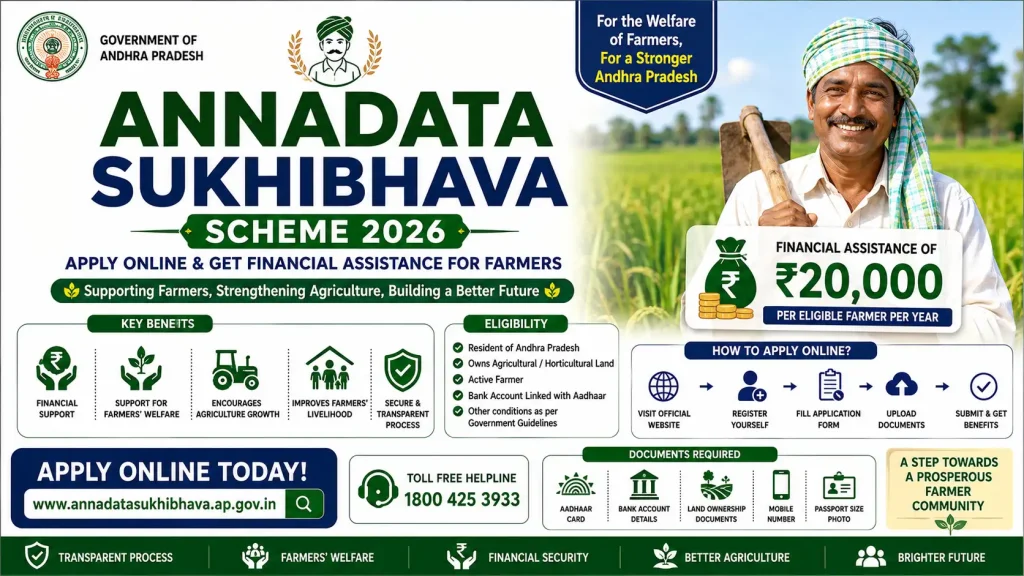
If you want to secure your family’s agricultural capital and understand the rules, this ultimate guide covers the 2026 eligibility filters, required documentation, step-by-step online registration process, and tracking your payment status.
What is the Annadata Sukhibhava Scheme?
The Annadata Sukhibhava Scheme is a direct benefit transfer (DBT) welfare initiative monitored by the Department of Agriculture in close coordination with the Land Revenue Board. The primary objective is to provide a reliable structural capital cushion to small, marginal, and large landholding farmers to manage input investment needs smoothly before the commencement of the Kharif (summer crop) and Rabi (winter crop) seasons.
Rather than relying on retroactive crop loan waivers that only resolve accumulated past debts after a harvest failure, this scheme provides direct investment support right at the beginning of the agricultural cycle. By integrating the state’s budget outlays with the central government’s structural frameworks, the platform clears financial blocks for rural families.
Scheme Overview: Annadata Sukhibhava 2026
| Operational Attribute | Official Specifications and System Rules |
| Scheme Name | Annadata Sukhibhava Farmer Assistance Scheme |
| Nodal Authority | Department of Agriculture & Land Revenue Board |
| Disbursal Mode | 100% Digital via Aadhaar-Enabled Direct Benefit Transfer (DBT) |
| Financial Assistance Layout | Structured cash tranches released per primary cropping season |
| Target Audience | Eligible landholding farmers with synchronized land records |
| Application Fee | Absolutely Free across all government channels and centers |
Primary Strategic Benefits of the Farmer Financial Grant
Enrolling in the Annadata Sukhibhava program provides several critical advantages to farming households:
1. Zero-Debt Capital Subsidies
The cash assistance provided under the scheme is a direct non-repayable capital subsidy, not an institutional bank loan. Beneficiaries are under no legal obligation to return the funds, pay interest, or match collateral requirements, saving smallholders from local money lenders.
2. Timely Input Procurement Support
Agricultural output relies heavily on sowing seeds at the precise meteorological window. A delay of even a few days due to a lack of cash can ruin crop yields. Annadata Sukhibhava distributes its cash tranches right before major plowing cycles, allowing farmers to buy high-yielding seed strains and dynamic fertilizers on time.
3. Financial Protection for Small and Marginal Farmers
The program structures its verification loops to prioritize small and marginal farmers holding limited plots. By providing equal financial support relative to basic survival needs, the state builds an effective safety net for vulnerable food growers.
4. Promotion of Digital Banking Infrastructure
Because the financial system bans physical check distribution or manual cash payouts, all beneficiaries are onboarded onto the formal banking grid. This accelerates financial literacy, opens pathways to institutional agri-loans, and links rural families to broader insurance systems.
Detailed Eligibility Criteria: Who Qualifies in 2026?
To ensure public welfare funds are directed precisely to genuine food growers, the verification committees apply strict screening parameters across land ownership, family structures, and income levels:
- Domicile Rule: The primary applicant must be a permanent resident of the state and must hold verified local identity credentials.
- Webland Sync and Land Ownership: The applicant must own cultivable agricultural land registered officially under their name. The land data must reflect accurately in the web-land electronic revenue database. Plots flagged with active ownership disputes or missing official mutation records are temporarily held.
- Food Security Indexing: The applying family must hold a valid White Ration Card, Rice Card, or Below Poverty Line (BPL) card issued by the Civil Supplies Department.
- Professional Farmer Status: The scheme strictly excludes institutional landholders, permanent government employees, high-income taxpayers, and retired individuals drawing massive institutional pensions.
Mandatory Documentation for Registration
Keep clear physical photocopies and digital scans of the following records ready before launching your registration form:
- Aadhaar Card: Compulsory individual identification proof for the primary landholder.
- Pattadar Passbook / Land Title Deeds: The core document used to verify your land ownership status, survey numbers, and exact acreage dimensions against the revenue database.
- Valid Ration Card: Used to map out the household structure and prevent multiple members of the same family from claiming independent individual benefits on shared land.
- Aadhaar-Seeded Bank Passbook: Copy of the front page displaying clear account numbers and IFSC codes. The account must be verified under the NPCI mapping system.
- Fresh Income & Residence Proofs: Documents establishing local residency status and household income parameters.
Step-by-Step Online Registration & Onboarding Process
Eligible landholders can register for a new Annadata Sukhibhava account online through the unified agricultural portal or by visiting local digital service desks. Follow these exact steps to complete your onboarding:
1.Access the Official Agriculture Portal:Step 1.
Launch your secure mobile or desktop web browser and navigate directly to the official online dashboard configured for the Annadata Sukhibhava Scheme.
2.Select Farmer Registration Module:Step 2.
Navigate the citizen services menu and click on the interactive link labeled ‘New Farmer Registration’ or ‘Apply for Annadata Sukhibhava 2026’.
3.Validate Land and Aadhaar Records:Step 3.
Type your 12-digit Aadhaar number alongside your unique Pattadar Passbook land record number into the validation engine. The system will run an automated API query against the land revenue database.
4.Perform Mobile OTP e-KYC Verification:Step 4.
Trigger the secure electronic Know Your Customer (e-KYC) process. Enter the 6-digit verification code transmitted by the server to your Aadhaar-linked mobile device to confirm your legal identity.
5.Input Banking and Sowing Details:Step 5.
Carefully enter your bank account number, bank name, and IFSC code. Fill in minor contextual fields detailing the type of crops you plan to cultivate during the upcoming season.
6.Submit Form and Collect Acknowledgement ID:Step 6.
Review all entered demographic and land parameters against your physical papers. Complete the security Captcha code check and click ‘Submit Application’. Print out the unique application reference number for tracking your payout logs.
Alternate Offline Application Route via Farmer Centers
If you face technical errors with mobile OTP authentications or lack stable internet access, you can use the smooth offline administration route:
- Visit Local Center: Walk into your nearest local Farmer Service Center (Rythu Bharosa Kendra / Agricultural Extension Office).
- Biometric Authentication: Hand your Aadhaar card and Pattadar Passbook copies to the Agriculture Extension Officer (AEO). They will run your live fingerprint or iris metrics right on the government terminal, instantly validating your land records against the webland database without an internet OTP.
How to Track Your Payout Status Online
Once your application form passes background land vetting rounds, you can easily track your installment status from your smartphone:
- Re-enter the official Annadata Sukhibhava web portal interface.
- Locate the tracking engine labeled ‘Track Payout Status’ or ‘Beneficiary Search’.
- Input your unique Application Reference Number or simply type in your Aadhaar card number.
- Click the ‘Search’ button. The platform will pull your live electronic log sheet displaying one of these status tags:
Payment Status Designations
- Application Approved: Your land records have passed all verification rounds successfully and the account is marked active.
- Payment Initiated: The government treasury has authorized the fund release and pushed the invoice to the central bank.
- Fund Disbursed / Success: The financial assistance has been wired successfully to your Aadhaar-linked bank account.
- Payment Failed / Mismatch: The transaction failed, usually pointing to a dormant bank account or mismatched name spellings between Aadhaar and bank records.
What to Do If Your Payout Shows a “Payment Failure”?
If your tracking query reveals an electronic transaction failure, the subsidy capital has rebounded back to the state account. Follow these troubleshooting steps to recover the money:
- Fix Bank Aadhaar Seeding: Visit the physical branch of your bank account immediately. Request the branch manager to check if your account is mapped properly on the central NPCI portal.
- Update Land Mutation: If the payment failed due to mismatched land records, update the land mutation documents at the local revenue office (Tahsildar desk) to synchronize your data.
- Submit Fresh Passbook to Agri Officer: Take a printout of the electronic error page along with your updated bank book to the local Agriculture Officer to trigger a manual payout request.
How to Check the Certified Beneficiary List
Following the completion of seasonal verification rounds, the government updates and publishes localized beneficiary lists. You can verify if a name has been added to the final certified directory using the following methods:
Online Method
- Log into the official agricultural database portal.
- Go to the public reports section and click on ‘Beneficiary Wise Disbursal Report’ or ‘Annadata Sukhibhava Beneficiary List 2026’.
- Select your specific District, Mandal/Zone, and respective Gram Panchayat or Ward profile.
- The system will render a list showing all approved beneficiary names, their designated land codes, and transaction reference numbers.
Offline Method
The local administration physically prints out the newly approved farmer beneficiary list and displays it publicly on the notice boards of the local Gram Panchayat offices or agricultural extension centers to maintain complete transparency.
Frequently Asked Questions (FAQs)
1. Can multiple people from the same family claim this farmer assistance grant?
No, the scheme rules restrict the financial grant to only one member per household unit, as mapped by the master Ration Card database. Even if multiple family members share a combined piece of land, the subsidy is issued directly to the primary landholder or head of the household to ensure equitable fund distribution.
2. Is there an active processing fee to submit this online form?
No, the registration process across all official agriculture offices, local gram panchayats, and digital government service portals is 100% free of cost. Farmers are highly advised not to pay money to unauthorized third-party agents or private operators.
3. Can a tenant farmer apply for the Annadata Sukhibhava Scheme?
The primary tier of the scheme is strictly designed for registered land owners listed in the official revenue web-land database. However, if the state government issues separate specialized sub-guidelines for tenant farmers (LCR cards), they can apply through designated offline counters using their official cultivation agreements.
4. What is the fundamental difference between this scheme and central farmer schemes?
The Annadata Sukhibhava Scheme is a state-funded agricultural welfare initiative. While it structurally coordinates with national goals like PM-KISAN to maximize financial outreach, the execution infrastructure, budget allocations, and verification tracking portals operate independently under the state agricultural board.
5. Whom should I contact if my payment remains pending for months?
If your online portal profile shows “Pending for Land Verification” for more than 60 days without any progression, you should visit your local Mandal Agricultural Officer (MAO) or the Revenue Inspector desk with your original acknowledgement slip to file an official escalation query.
Declaration
The information provided on this website is published for informational purposes only. While every effort is made to ensure the accuracy and timely updating of the content, we do not guarantee the completeness, reliability, or authenticity of any information. Candidates and users are strongly advised to visit the official websites of the respective departments, organizations, or authorizing bodies before applying for any job, scheme, examination, or benefit program. This website is not associated with any government organisation and does not provide any recruitment guarantee or official confirmation. We are not responsible for any loss, error, or misunderstanding arising from the use of the information available on this website.