Caller Name Announcer App – Hear Who Is Calling Without Looking at Your Phone
In today’s fast-paced digital world, smartphones have become an essential part of everyday life. We use them for communication, work, entertainment, banking, navigation, and many other daily activities. However, there are many situations when checking the phone screen every time it rings is inconvenient.
You might be cooking, exercising, cleaning, working, or completing another task that keeps your hands occupied. In such situations, a Caller Name Announcer App can provide a convenient way to know who is calling without immediately looking at the screen.
A Caller Name Announcer typically uses Text-to-Speech (TTS) technology to convert available caller information into spoken audio. If an incoming number matches a contact saved on your phone, the app can announce the contact name. Depending on the application and device, additional functions may include unknown-number announcements, SMS sender alerts, notification announcements, customizable voices, and battery alerts.
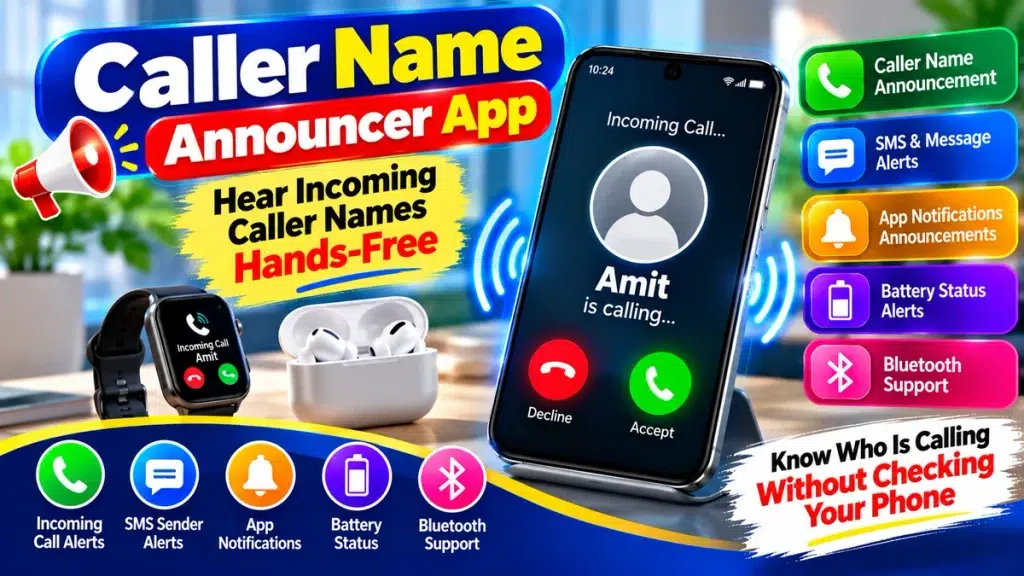
This guide explains how Caller Name Announcer apps work, their key features, benefits, setup process, privacy considerations, advantages, limitations, and frequently asked questions.
What Is a Caller Name Announcer App?
A Caller Name Announcer App is a mobile utility designed to provide spoken information about incoming calls.
Normally, when someone calls, your smartphone displays the caller’s name or phone number on the screen. With caller-name announcements enabled, compatible software can speak that information aloud.
For example, if a contact saved as Rahul calls you, the announcement might say:
“Incoming call from Rahul.”
If the number is not saved, some apps may announce the incoming phone number or provide a generic unknown-caller alert.
The exact functionality varies according to the application, smartphone model, operating system, available permissions, and Text-to-Speech engine.
Caller Name Announcer App – Quick Overview
| Feature | Details |
|---|---|
| App Category | Caller Name Announcer / Caller Speaker |
| Main Purpose | Hear incoming caller information |
| Technology | Text-to-Speech (TTS) |
| Saved Contacts | Can announce saved caller names |
| Unknown Numbers | May announce phone numbers |
| SMS Alerts | Available in selected apps |
| Message Reading | Optional where supported |
| Voice Settings | Language, speed and pitch may be adjustable |
| Bluetooth Support | Depends on app and device |
| Battery Alerts | Available in some applications |
| Offline Use | Some basic functions may work offline |
| Best For | Hands-free caller identification |
How Does a Caller Name Announcer Work?
Most Caller Name Announcer applications rely on the smartphone’s built-in or installed Text-to-Speech technology.
When a call arrives, the application uses caller information that the operating system makes available. If the incoming number matches a saved contact, the corresponding contact name can be passed to the TTS engine.
The Text-to-Speech engine then converts the name into spoken audio.
The process can be understood as:
Incoming Call → Caller Information → Contact Match → Text-to-Speech → Voice Announcement
For example, if “Amit” is saved in your contacts and Amit calls, the app may automatically announce:
“Amit is calling.”
The process happens automatically once the appropriate settings and permissions are configured.
Why Use a Caller Name Announcer App?
Although caller announcements may appear to be a simple smartphone feature, they can be useful in several everyday situations.
1. Convenient Hands-Free Caller Identification
The biggest advantage is that you don’t have to immediately pick up your smartphone just to see who is calling.
You can hear the caller’s name and then decide whether the call requires your attention.
2. Useful During Household Activities
Cooking, cleaning, gardening, and household repairs can keep your hands occupied.
If your phone rings while you’re preparing food, for example, you may not want to touch it with wet or dirty hands.
A spoken announcement provides caller information without requiring immediate physical interaction with the device.
3. Helpful During Exercise
People often keep their smartphones in a pocket, bag, or nearby while exercising.
Caller-name announcements can help you identify an incoming caller without repeatedly taking out the phone and checking its screen.
4. Useful for Accessibility
Spoken caller information can complement built-in smartphone accessibility features for people who prefer audio feedback or have difficulty reading information displayed on a screen.
It should be viewed as an additional convenience rather than a replacement for dedicated accessibility services.
5. Better Focus During Work
Repeatedly checking your phone can interrupt concentration.
If the caller’s name is announced, you can determine whether a call may require immediate attention without first stopping your current task to inspect the display.
Important Features of a Caller Name Announcer App
Not every application provides exactly the same features. Before choosing one, it is useful to understand the options commonly available.
Incoming Caller Name Announcement
This is the primary function.
When a saved contact calls, the app can speak the person’s name aloud.
Unknown Number Announcement
Some applications can announce an incoming number when it does not match a saved contact.
This feature depends on the app, device, and information available through the operating system.
SMS Sender Alerts
Selected apps can announce the name of the person who sends an SMS.
For example:
“New message from Rahul.”
Some apps may also offer full message reading, but users should consider privacy before enabling it.
Custom Announcement Text
Certain apps let users personalize the phrase spoken before or after a caller’s name.
Instead of simply hearing “Rahul,” you might configure:
“You have an incoming call from Rahul.”
Voice Speed and Pitch
The phone’s TTS engine may allow you to adjust the speech speed and pitch.
Reducing the speed can sometimes make names easier to understand.
Multiple Language Support
Depending on the installed TTS engine, different languages and voices may be available.
Choosing a suitable language can improve pronunciation, particularly when your contacts contain regional-language names.
Silent and Vibrate Mode Controls
Voice announcements may not be appropriate during meetings, classes, hospital visits, or other quiet situations.
Some apps provide controls for managing announcements when the phone is set to silent, vibrate, or Do Not Disturb.
Battery Status Alerts
Some applications extend beyond incoming calls and can provide spoken battery alerts.
For example, they may announce a low-battery condition or charging status.
This is an additional feature and should not be assumed to exist in every caller-announcement app.
App and Notification Alerts
Certain apps may provide spoken information for selected notifications when the required system permissions are available.
The exact apps and notifications supported can vary considerably.
Bluetooth and Headphone Support
Some configurations can route caller announcements through Bluetooth headphones or other connected audio devices.
This can provide additional privacy because the caller’s name does not need to play through the smartphone loudspeaker.
However, audio routing varies between phones, operating systems, apps, and accessories.
Features at a Glance
| Feature | Purpose |
|---|---|
| Caller Name Announcement | Speaks saved caller names |
| Unknown Number Alert | May read unsaved numbers |
| SMS Sender Alert | Announces who sent a message |
| Message Reading | Reads message text where supported |
| Custom Announcement | Personalizes spoken alerts |
| Voice Speed | Adjusts speech rate |
| Voice Pitch | Changes voice characteristics |
| Language Selection | Selects compatible TTS voice |
| Silent Mode Control | Reduces unwanted announcements |
| Battery Alert | Provides battery-related voice alerts where supported |
| Bluetooth Support | May route audio to a connected device |
How to Set Up a Caller Name Announcer App
Setting up a Caller Name Announcer is generally straightforward, although the exact steps vary between applications and devices.
Step 1: Check Your Phone’s Existing Features
Before installing another application, check whether your smartphone or Phone app already includes a caller-announcement feature.
If a built-in option meets your needs, an additional third-party app may not be necessary.
Step 2: Choose a Trusted Application
If you need a separate app, search your phone’s official application store.
Check the developer information, app description, recent updates, ratings, privacy information, and requested permissions before installing.
Step 3: Review Permissions
A caller-announcement application may require certain permissions to provide specific functions.
For example, access to contacts may be relevant for matching an incoming number with a saved name.
Grant only permissions that are necessary for the features you intend to use.
Step 4: Configure Text-to-Speech
Check your smartphone’s TTS settings and choose a suitable language and voice.
If necessary, download the appropriate offline voice package supported by your device.
Step 5: Customize the Announcement
Depending on the app, you may be able to adjust:
- Announcement phrase
- Voice language
- Speech speed
- Voice pitch
- Repeat frequency
- SMS announcements
- Bluetooth behavior
- Silent-mode behavior
Step 6: Test the Feature
Make a safe test call from another phone.
Check whether the contact name is announced clearly and whether the volume and speech speed are comfortable.
Using Caller Name Announcer with Bluetooth
Bluetooth support can make caller announcements more convenient, particularly when you want additional privacy.
For example, when compatible headphones are connected, some configurations may play the announcement through the headphones instead of the smartphone speaker.
This means you could hear:
“Rahul is calling”
without everyone around you hearing the caller’s identity.
However, Bluetooth behavior is device-dependent. Users should test their specific smartphone, app, and accessory combination.
Does Caller Name Announcer Work Without Internet?
Some basic caller-name announcements may work offline.
If the caller information is stored locally and the necessary Text-to-Speech voice is installed on your smartphone, the phone may be able to generate spoken announcements without an active internet connection.
However, it is not accurate to assume that every Caller Name Announcer app works entirely offline.
Cloud-based voices, advertisements, app updates, online caller-identification services, or other additional features may require internet access.
Offline support should therefore be checked for the particular app and TTS engine you use.
Caller Name Announcer While Driving
A caller-name announcement can reduce the need to look at a phone screen solely to identify an incoming caller.
However, hands-free does not mean distraction-free.
Do not manually operate a smartphone while driving where doing so is unsafe or prohibited. Follow applicable traffic laws and use an appropriate hands-free system where permitted.
Caller announcements should be used to reduce unnecessary screen interaction, not as a reason to engage with a phone while driving.
Security and Privacy Considerations
Because caller-announcement applications can interact with personal information, privacy deserves careful attention.
Download from Trusted Sources
Use your phone’s official application store and check the developer before installing an app.
Review Permissions Carefully
Consider whether every requested permission makes sense for the features you plan to use.
Avoid granting unnecessary access.
Protect Message Privacy
Full SMS announcements can expose sensitive information.
If your phone reads a private message aloud, anyone nearby may hear it.
For better privacy, consider enabling only the SMS sender’s name instead of the complete message.
Consider Caller Privacy
Even a basic caller-name announcement can reveal who is calling.
If privacy matters, use compatible headphones or disable announcements in public environments.
Review Privacy Information
Before using an app that accesses sensitive information, read its available privacy disclosures and understand how it handles your data.
Advantages and Limitations
| Advantages | Limitations |
|---|---|
| Hands-free caller identification | Features vary by device and app |
| Reduces unnecessary screen checking | Spoken names can reduce privacy |
| Useful during household activities | Relevant permissions may be required |
| Helpful while exercising or working | TTS may mispronounce some names |
| Can complement accessibility tools | Bluetooth behavior varies |
| Custom voices may be available | Not every language is equally supported |
| Some functions may work offline | Some features require internet |
| SMS sender alerts may be available | Full message reading can expose private information |
Tips for Better Caller Name Announcements
For clearer voice alerts, keep saved contact names simple and properly written.
Avoid excessive symbols or unusual abbreviations because Text-to-Speech engines may have difficulty pronouncing them.
Select a TTS language that matches the language used in your contacts whenever possible.
If the voice sounds too fast, reduce the speech rate slightly.
Avoid excessive repetition. One or two announcements are generally easier to tolerate than having a contact name repeated continuously.
Use silent or Do Not Disturb settings in meetings, classrooms, libraries, hospitals, or other quiet environments.
Most importantly, enable only the functions you actually need.
Frequently Asked Questions (FAQ)
1. What is a Caller Name Announcer App?
It is a smartphone utility that can use spoken audio to provide available information about an incoming caller, such as a saved contact name.
2. Can it announce unknown phone numbers?
Some applications can read an unsaved incoming number aloud. Availability depends on the app and device.
3. Does Caller Name Announcer require internet?
Not necessarily. Some basic announcements may work offline when the required contact information and TTS voice are stored locally. Other features may require internet access.
4. Can I use Caller Name Announcer with Bluetooth?
Some applications and devices support announcements through Bluetooth audio. Compatibility varies, so testing your specific setup is recommended.
5. Can it read SMS messages?
Some apps can announce SMS senders and may provide optional message-content reading where supported.
6. Can I disable full message reading?
Where the app provides separate settings, you can usually keep sender announcements enabled while disabling message-content reading.
7. Can I change the announcement voice?
Available voice, language, speed, and pitch settings depend on the application and your smartphone’s TTS engine.
8. Can I stop announcements at night?
Depending on the application, you may be able to disable announcements manually or use compatible quiet, silent, or Do Not Disturb settings.
9. Why does the app pronounce some names incorrectly?
Text-to-Speech engines may struggle with uncommon names, abbreviations, mixed-language contacts, or regional spellings.
10. Is a Caller Name Announcer safe to use?
It can be useful when configured appropriately, but users should choose trustworthy apps, review permissions carefully, protect message privacy, and avoid unsafe phone interaction while driving.
Conclusion
A Caller Name Announcer App is a simple yet useful smartphone tool that can help you identify incoming callers without constantly checking your screen. By using Text-to-Speech technology, compatible apps can announce saved contact names and may also provide features such as unknown-number alerts, SMS sender announcements, customizable voices, battery notifications, and Bluetooth support.
The biggest advantage is convenience. Whether you are cooking, exercising, working, cleaning, or handling another activity, spoken caller information can help you decide whether an incoming call requires your attention.
At the same time, privacy and permissions should be taken seriously. Not every application offers the same functionality, and features such as SMS reading, offline operation, Bluetooth routing, and notification announcements can vary significantly between devices.
Choose a trusted application, enable only the permissions and features you need, configure your Text-to-Speech settings carefully, and use caller announcements responsibly. With the right setup, a Caller Name Announcer can provide a practical hands-free way to stay informed about incoming calls.