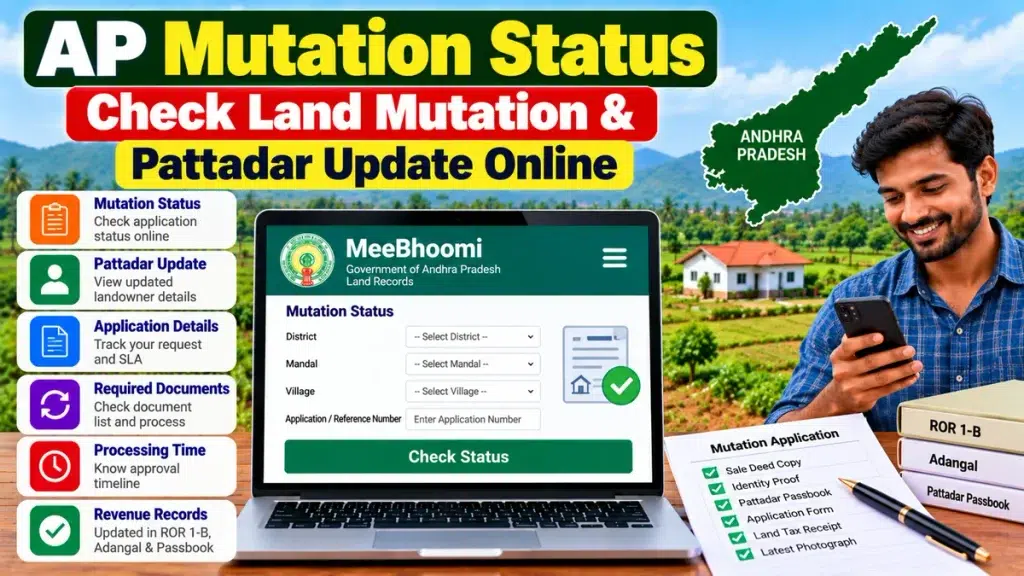
AP Mutation Status – Check Land Mutation & Pattadar Update Online
Checking AP Mutation Status is important after buying, inheriting or dividing land in Andhra Pradesh. Mutation is the process used to update the owner’s name or other relevant particulars in land revenue records after an eligible transaction.
Andhra Pradesh’s current MeeSeva documentation lists Mutation and Title Deed Cum Pattadar Passbook as an active Revenue Department service processed through the Webland workflow.
What Is Land Mutation in Andhra Pradesh?
Land mutation updates revenue records when ownership or certain particulars relating to land change.
According to Andhra Pradesh MeeSeva guidance, mutation may arise from situations such as:
- Sale through a registered deed
- Inheritance after the owner’s death
- Family division
- Pledge or release connected with a bank loan
- Court decree
- Government acquisition
- Government land grant
After mutation is approved, the updated information should be reflected in the relevant revenue records.
AP Mutation Status – Quick Overview
| Particular | Details |
|---|---|
| State | Andhra Pradesh |
| Service | Land Mutation |
| Department | Revenue Department |
| Related System | Webland |
| Approval Authority | Tahsildar |
| Current Listed SLA | 30 Days |
| Related Records | ROR 1-B, Pattadar Passbook |
| Useful For | Sale, inheritance, division and property verification |
The current GSWS service manual lists an SLA of 30 days for Mutation and Title Deed Cum Pattadar Passbook, with the Tahsildar as approving authority.
How to Check AP Mutation Status
If you have already submitted a mutation request through an authorised service channel, keep your application or transaction reference number safely.
A typical status-check process may involve:
- Open the relevant Andhra Pradesh citizen-service or MeeSeva channel.
- Find the application or request-status option.
- Enter the application/reference number.
- Complete any verification requested.
- Check whether the request is pending, under verification, approved or otherwise updated.
GSWS documentation confirms that submitted applications move through verification and approving authorities with the application status and SLA tracked in the workflow.
Documents Commonly Required for Mutation
The current MeeSeva manual lists documents such as:
- Application form
- Registered document copies
- Old Pattadar Passbook or Title Deed
- Tax receipts, if applicable
- Recent photograph
- Signature
- Additional proof where applicable
Requirements may differ depending on the transaction and applicant category.
Mutation After Buying Land
After purchasing land through a registered sale deed, buyers should check whether the revenue record has been updated in their name.
Once the process is completed, compare the latest available records with:
- Registered sale deed
- Pattadar details
- ROR 1-B
- Adangal
- Survey number
- Land extent
- FMB or survey information
The Andhra Pradesh Revenue Department maintains land records survey-number-wise and records ownership changes caused by sale and hereditary transfer under the applicable land-record procedures.
Mutation After Inheritance
Mutation may also be required when ownership changes because of the death of the recorded owner.
Depending on the circumstances, authorities may require documents supporting inheritance or succession. After approval, heirs should check whether the Pattadar and other revenue details reflect the updated ownership correctly.
Why Mutation Matters Before Selling Property
If revenue records still show the previous owner’s name, future property transactions may become more complicated.
Before selling land, it can be useful to verify:
- Current Pattadar name
- Mutation status
- ROR 1-B details
- Survey number
- Land extent
- Registered ownership documents
Remember that mutation is a revenue-record update and should be considered together with registered title documents and other applicable property records.
Mutation and Bank Loan Verification
Updated land records can also matter when applying for an agricultural loan, mortgage, land loan or loan against property.
Andhra Pradesh’s Revenue Department notes that Pattadar Passbooks and title deeds are used to help occupants seek loans against land from banks.
Banks still carry out their own legal, ownership and credit checks before approving a loan.
What If Mutation Status Is Pending?
A pending application does not automatically mean there is a problem.
The request may still be undergoing:
- Document verification
- Revenue-record checks
- Field-level verification
- Tahsildar approval
- Data updating
Keep the application receipt until the process is completed. If the application remains unresolved beyond the applicable service timeline, contact the authorised service channel or concerned Revenue Office with the reference number.
Frequently Asked Questions
What is AP land mutation?
Mutation is the process of updating ownership or related particulars in Andhra Pradesh revenue records after eligible transactions such as sale, inheritance or family division.
Who approves mutation applications?
The current GSWS manual lists the Tahsildar as the approval authority for Mutation and Title Deed Cum Pattadar Passbook.
How long does AP mutation take?
The current GSWS service listing shows an SLA of 30 days for this service. Actual completion can depend on verification and the circumstances of the application.
Is mutation required after inheritance?
Inheritance is specifically listed among the transactions for which land ownership particulars may be changed through mutation.
Is mutation the same as a sale deed?
No. A registered sale deed records the transaction, while mutation updates the relevant revenue records.
Conclusion
Checking AP Mutation Status helps buyers, heirs and landowners confirm whether ownership-related changes have been updated in Andhra Pradesh revenue records.
After mutation, compare the updated information with ROR 1-B, Pattadar details, Adangal, survey records and registered documents before completing another major property or financial transaction.