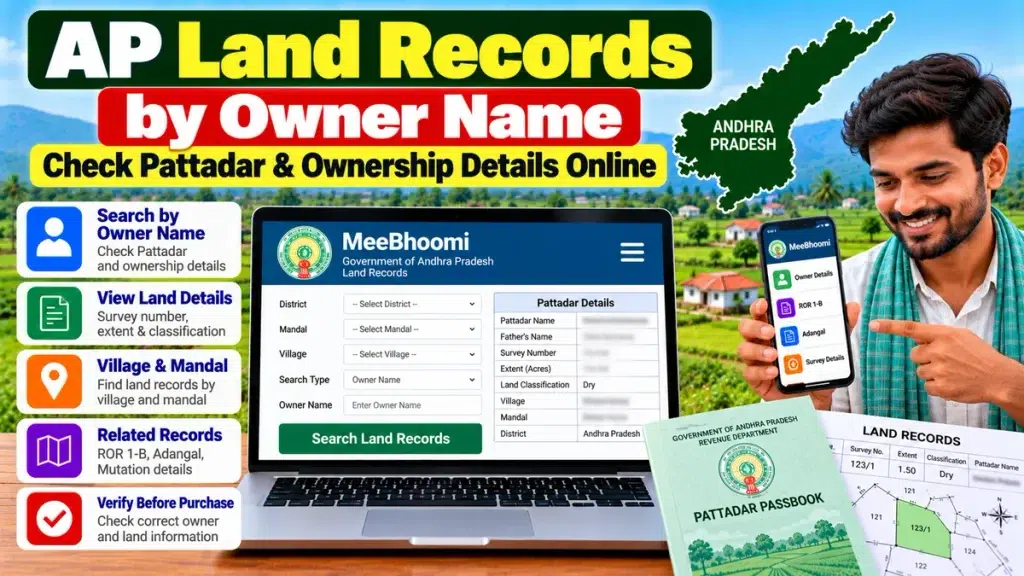
AP Land Records by Owner Name – Check Pattadar & Ownership Details Online
Checking AP Land Records by Owner Name can help landowners, buyers and family members verify Pattadar information connected with land in Andhra Pradesh. Owner-related land information is useful when checking a property before purchase, comparing inherited land records, confirming mutation updates or preparing documents for a loan or other property transaction.
Andhra Pradesh provides digital access to land records through MeeBhoomi, and official district government guidance confirms that the portal provides land-ownership details to citizens.
What Are AP Land Owner Records?
Andhra Pradesh revenue records maintain information about land holdings and changes in ownership resulting from transactions such as sale and hereditary transfer.
A land record may contain information relating to:
- Pattadar or landholder name
- Survey number
- Account or Khata details
- Land extent
- Land classification
- Adangal information
- ROR 1-B information
- Mutation-related entries
The Revenue Department maintains land records survey-number-wise, including ownership changes made through the prescribed procedures.
AP Land Records by Owner Name – Quick Overview
| Particular | Details |
|---|---|
| State | Andhra Pradesh |
| Main Portal | MeeBhoomi AP |
| Main Information | Pattadar / ownership details |
| Related Records | ROR 1-B, Adangal |
| Useful References | Owner name, survey number, Khata details |
| Useful For | Property verification |
| Other Uses | Mutation, inheritance and loan documentation |
How to Check AP Land Owner Details Online
Start with the official MeeBhoomi Andhra Pradesh land-record service. Government district pages continue to identify MeeBhoomi as the state’s online portal for checking land ownership and property records.
Depending on the search options currently available, you may need to:
- Select the district.
- Choose the Mandal.
- Select the village.
- Enter the available survey, account or Khata information.
- Open the relevant land record.
- Check the Pattadar or owner name shown in the record.
The portal interface can change, and a direct search using only a person’s name may not always be available. Having the village, survey number or account details can make the search more reliable.
What Details Should You Verify?
Once you find the relevant property record, compare important details with the documents already available to you.
Check:
- Pattadar name
- Father’s or family details, where shown
- Survey and subdivision number
- Land extent
- Village and Mandal
- ROR 1-B information
- Adangal
- Mutation information
A similar name alone is not enough to confirm that you have found the correct property. Always compare the survey number, location and land extent.
Why Check Owner Details Before Buying Land?
Property transactions can involve a significant amount of money. Buyers should therefore confirm that the person selling the property matches the available land and registered records.
Before paying an advance, consider checking:
- Pattadar details
- Registered sale deed
- ROR 1-B
- Adangal
- Survey number
- FMB sketch
- Village map
- Mutation records
- Encumbrance-related information
- Physical property boundaries
Official Andhra Pradesh survey authorities maintain FMBs, village maps and other survey records and also undertake subdivision and boundary-demarcation work.
An online Pattadar name should be treated as part of the verification process, not as the only proof of legal ownership.
Owner Name and Mutation Verification
If land has recently been sold, inherited or divided, the latest owner’s name may depend on whether the applicable revenue-record update has been completed.
After mutation, compare the updated Pattadar information with:
| Record | What to Compare |
|---|---|
| Sale Deed | Purchaser/owner name |
| ROR 1-B | Recorded rights |
| Adangal | Landholder and land details |
| Survey Record | Survey and subdivision |
| Passbook | Pattadar details |
If the previous owner’s name continues to appear, contact the appropriate revenue authority or authorised citizen-service channel to understand the status of the record update.
Pattadar Records and Bank Loans
Correct landholder information can also be important when seeking an agricultural loan, mortgage or other land-backed finance.
The Andhra Pradesh Revenue Department states that Pattadar Passbooks and title deeds are issued to eligible occupants and can facilitate applications for bank loans against land.
Banks still conduct their own legal, ownership, valuation and credit checks before approving any loan.
What If You Do Not Know the Survey Number?
If you only know the landowner’s name, check documents that may contain the survey or account number, such as:
- Registered sale deed
- Pattadar Passbook
- Old ROR 1-B
- Adangal
- Tax or revenue documents
- Previous mutation documents
Once you identify the correct survey number and village, locating the corresponding land record becomes easier.
Frequently Asked Questions
Can I check AP land ownership details online?
Yes. Andhra Pradesh’s MeeBhoomi portal provides access to land records, including ownership-related information.
Can I search land using only the owner’s name?
Search options can vary. In many cases, additional information such as district, Mandal, village, survey number or account details may be needed.
What is a Pattadar?
A Pattadar is the person whose name is recorded against a landholding in the relevant revenue records.
Does the Pattadar name prove legal ownership?
Not by itself. Buyers should also verify registered deeds and other relevant property and legal records.
What if the owner’s name is incorrect?
The appropriate mutation or correction procedure may need to be completed through the concerned Revenue Department channel.
Conclusion
Checking AP Land Records by Owner Name can help identify and verify Pattadar information before a property purchase, inheritance update, mutation or financial transaction.
For safer verification, compare the owner name with the survey number, ROR 1-B, Adangal, Pattadar Passbook, FMB, mutation details and registered property documents before making an important financial or legal decision.