Caller Name & SMS Announcer App – Get Voice Alerts for Calls and Messages
Smartphones keep us connected throughout the day through calls, text messages, and notifications. However, constantly checking the screen whenever a call or message arrives can be inconvenient. You may be cooking, exercising, cleaning, working, or handling another task that keeps your hands occupied.
A Caller Name & SMS Announcer App can make these situations easier by providing voice alerts for incoming calls and messages. Instead of immediately looking at the phone, you can hear available caller or sender information through spoken announcements.
These apps generally use Text-to-Speech (TTS) technology. When a saved contact calls, the app may speak the caller’s name. When an SMS arrives, supported apps can announce the sender’s name and, if enabled, may also read the message content aloud.
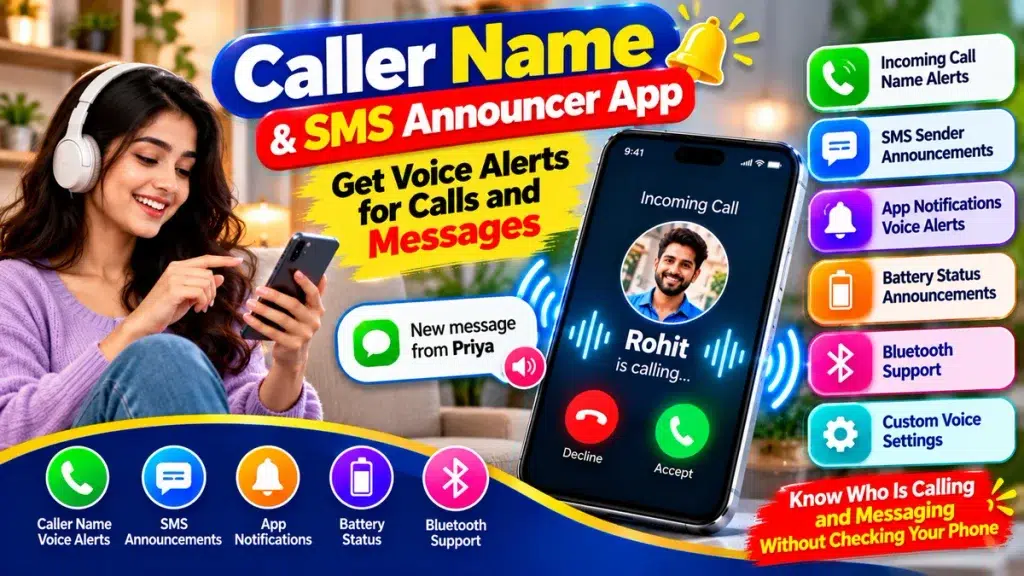
This guide explains how Caller Name & SMS Announcer apps work, their main features, benefits, setup process, privacy considerations, and how to use voice alerts effectively.
Caller Name & SMS Announcer App – Quick Overview
| Feature | Details |
|---|---|
| App Category | Caller & SMS Announcer |
| Main Purpose | Voice alerts for calls and messages |
| Technology | Text-to-Speech (TTS) |
| Caller Name | Can announce saved contact names |
| Unknown Caller | May announce the phone number |
| SMS Sender | Can announce sender where supported |
| SMS Reading | Optional in some apps |
| Custom Voice | Depends on app and TTS engine |
| Language Options | Vary by installed TTS voices |
| Bluetooth Support | Depends on device and app |
| Offline Support | Some basic functions may work offline |
| Best For | Hands-free call and message alerts |
What Is a Caller Name & SMS Announcer App?
A Caller Name & SMS Announcer App is a mobile utility designed to provide spoken information when calls and text messages arrive.
Normally, when someone calls, your smartphone displays their contact name or number. Similarly, when an SMS arrives, the sender’s information appears in a notification.
An announcer app converts available information into audio.
For example, if a contact named Rahul calls, you might hear:
“Incoming call from Rahul.”
If Rahul sends an SMS, the application might announce:
“New message from Rahul.”
Depending on the app and your settings, it may also be possible to have the message content spoken aloud.
How Does Caller Name & SMS Announcement Work?
Most of these applications rely on your smartphone’s Text-to-Speech engine.
When an incoming call or SMS is detected, the application uses information made available by the operating system. If the phone number corresponds to a saved contact, the app can use that contact’s name.
The TTS engine then converts the text into spoken audio.
The basic process looks like this:
Call or SMS → Available Contact Information → TTS Engine → Voice Alert
The exact behavior depends on your phone, operating-system version, application, permissions, and TTS settings.
Why Use Voice Alerts for Calls and Messages?
Voice alerts can be useful in many everyday situations because they reduce the need to repeatedly check the smartphone screen.
Hands-Free Caller Identification
If you’re busy, you can hear who is calling without immediately picking up your phone.
This can help you decide whether the call requires your attention.
Know Who Sent a Message
An SMS sender announcement can tell you who has sent a message without requiring you to open the notification.
If the app supports separate controls, you can enable sender announcements without allowing the full message to be read aloud.
Useful While Cooking
When preparing food, your hands may be wet or dirty.
A voice announcement can tell you who is calling or messaging without requiring you to touch your smartphone immediately.
Convenient During Exercise
Whether you’re walking, exercising at home, or working out at a gym, repeatedly checking your phone can interrupt your activity.
Spoken alerts can provide basic information while allowing you to continue what you’re doing.
Helpful During Work
Frequent calls and messages can interrupt concentration.
Hearing the caller or sender’s name can help you determine whether a notification might need immediate attention.
Main Features of Caller Name & SMS Announcer Apps
The exact features vary between apps, but several functions are commonly available.
1. Incoming Caller Name Announcement
This is one of the main features.
When a saved contact calls, a compatible app can announce the person’s name automatically.
For example:
“Amit is calling.”
2. Unknown Number Announcement
Some applications can read an incoming phone number when the caller isn’t saved in your contacts.
Other apps may simply announce that an unknown number is calling.
3. SMS Sender Announcement
When an SMS arrives, the app may speak the sender’s saved contact name.
For example:
“New message from Priya.”
This provides useful information without revealing the actual content of the message.
4. SMS Message Reading
Some applications can read the content of an SMS aloud when the necessary permissions and settings are enabled.
While convenient, this feature should be used carefully.
Messages can contain personal conversations, financial information, verification codes, appointment details, and other sensitive data.
5. Custom Announcement Phrases
Some apps allow you to change what is spoken before or after the caller or sender’s name.
For example:
“You have an incoming call from Rahul.”
or
“You received a new message from Amit.”
6. Repeat Announcement Controls
Selected applications allow you to choose how many times an announcement is repeated.
Keeping repetition low can prevent voice alerts from becoming annoying.
7. Voice Speed and Pitch
Your smartphone’s Text-to-Speech engine may provide controls for speech rate and pitch.
If announcements are difficult to understand, slowing the speech slightly may improve clarity.
8. Multiple Language Support
Depending on your TTS engine, voices may be available in multiple languages.
Language availability and pronunciation quality can vary by smartphone and installed voice package.
9. Bluetooth and Headphone Support
Some configurations may route announcements through Bluetooth headphones or other connected audio devices.
This can be useful when you want to hear caller and SMS alerts privately.
Caller & SMS Announcer Feature Comparison
| Function | What It Does |
|---|---|
| Caller Name Alert | Announces saved caller names |
| Unknown Number Alert | May read an unsaved number |
| SMS Sender Alert | Announces who sent an SMS |
| SMS Content Reading | Reads message text where supported |
| Custom Phrase | Personalizes announcements |
| Voice Speed | Adjusts speaking rate |
| Voice Pitch | Changes voice characteristics |
| Repeat Control | Controls announcement frequency |
| Language Selection | Selects compatible TTS language |
| Bluetooth Support | May route audio to connected devices |
How to Set Up Caller Name & SMS Announcer
The exact setup varies between applications, but the general process is simple.
Step 1: Check Existing Phone Features
Before installing another application, check your smartphone settings. Your device may already provide certain caller-announcement functions.
Step 2: Choose a Suitable Application
If you need additional functionality, search your phone’s official app store for a Caller Name or SMS Announcer.
Check the developer information, privacy details, recent updates, ratings, and requested permissions before installation.
Step 3: Enable Caller Announcements
Open the application and enable the incoming caller-name announcement feature.
Step 4: Configure SMS Announcements
If you want message alerts, enable the SMS sender announcement.
If the app separately offers full message reading, decide whether you actually need that function before enabling it.
Step 5: Review Permissions
Some permissions may be necessary for specific features.
For example, contact access may help the app associate a phone number with a saved contact name. SMS-related functionality may require additional access depending on the platform and app.
Only grant permissions required for the functions you intend to use.
Step 6: Configure Text-to-Speech
Choose your preferred TTS language and voice.
Adjust speech rate and other available voice settings until announcements are easy to understand.
Step 7: Test Calls and Messages
Use another phone to safely test an incoming call and SMS.
Confirm that the names are pronounced clearly and the announcement volume is appropriate.
Using Caller & SMS Announcer with Bluetooth
Bluetooth can make voice alerts more private.
When compatible headphones or another audio device are connected, some configurations may route announcements through that device instead of the smartphone loudspeaker.
For example, you could privately hear:
“New message from Rahul.”
However, Bluetooth audio routing varies between devices, operating systems, apps, and accessories. Test your particular setup before relying on it.
Does Caller Name & SMS Announcer Work Offline?
Some basic voice-announcement functions may work without an active internet connection.
If contact information is stored locally and the required Text-to-Speech voice is installed on your phone, the device may be able to generate caller and SMS sender announcements offline.
However, not every feature necessarily works offline.
Cloud-based TTS voices, online caller-identification services, advertisements, app updates, or other functions may require internet access.
Offline functionality should therefore be checked for the specific application and TTS voice you use.
Privacy and Security Considerations
Privacy is particularly important with Caller Name & SMS Announcer applications because message-related features can involve sensitive information.
Review Permissions
Understand why the app requests access to contacts, calls, SMS, or notifications.
Avoid granting permissions unrelated to the functions you intend to use.
Be Careful with Full SMS Reading
Having every message read aloud may be convenient at home but problematic in public.
An SMS could contain private conversations, financial information, delivery details, account notifications, or security-related information.
Consider using sender-only announcements if you don’t need full message reading.
Remember Audio Privacy
Even caller-name announcements can reveal personal information.
If your phone loudly says a person’s name, anyone nearby may hear who is contacting you.
Bluetooth headphones may provide more privacy where supported.
Choose Trusted Apps
Use applications from reputable developers and official app stores. Review privacy disclosures and recent user feedback before granting access to sensitive information.
Advantages and Limitations
| Advantages | Limitations |
|---|---|
| Hands-free call identification | Features vary by device |
| Hear SMS sender names | Relevant permissions may be required |
| Reduces screen checking | Announcements may disturb others |
| Useful while working or exercising | TTS can mispronounce some names |
| Custom voice settings may be available | Language support varies |
| Bluetooth may improve privacy | Audio routing varies |
| Some functions may work offline | Certain features need internet |
| Optional SMS reading may be available | Full message reading can expose private information |
Voice Alerts While Driving
A caller-name announcement may reduce the need to look at the phone screen solely to identify an incoming caller.
However, spoken alerts don’t eliminate the risks of distracted driving.
Avoid manually operating your phone while driving where doing so is unsafe or prohibited. Follow applicable traffic laws and use an appropriate hands-free system where permitted.
Full SMS reading can itself be distracting, so consider keeping message announcements limited while driving.
Tips for Better Voice Announcements
Keep saved contact names simple and clearly written because unusual abbreviations or mixed-language names can be difficult for some TTS engines to pronounce.
Choose a TTS voice suitable for the language used in your contacts.
Keep announcement repetition to a reasonable level.
Disable full SMS reading in public environments if privacy is important.
Use silent or Do Not Disturb settings during meetings, classes, hospital visits, or other quiet situations.
Most importantly, enable only the announcement features you genuinely need.
Frequently Asked Questions (FAQ)
1. What is a Caller Name & SMS Announcer App?
It is a smartphone utility that can provide spoken alerts for incoming callers and SMS senders using available caller information and Text-to-Speech technology.
2. Can the app announce saved caller names?
Yes, compatible applications can announce saved contact names when the required information and permissions are available.
3. Can it announce unknown phone numbers?
Some apps can read unsaved incoming numbers, while others may provide a generic unknown-caller announcement.
4. Can the app announce who sent an SMS?
Some applications can announce the SMS sender’s saved contact name.
5. Can it read the complete message?
Certain apps may offer optional message-content reading where supported. Consider privacy before enabling it.
6. Can I disable message reading but keep sender announcements?
If the app provides separate controls, you can generally use sender-name announcements without enabling full message reading.
7. Does Caller & SMS Announcer require internet?
Some basic functions may work offline when the required TTS voice and contact information are available locally. Other functions may need internet access.
8. Does it work with Bluetooth headphones?
It may, depending on your smartphone, operating system, application, and connected Bluetooth device.
9. Can I change the voice language?
Available languages depend on the application’s settings and your phone’s installed Text-to-Speech voices.
10. Is it safe to let an app read my messages?
It depends on the application and how it handles data. Use trusted apps, review permissions and privacy information, and avoid enabling full message reading unless you need it.
Conclusion
A Caller Name & SMS Announcer App can provide a convenient way to get voice alerts for calls and messages without repeatedly checking your smartphone screen.
Using Text-to-Speech technology, compatible apps can announce saved caller names, unknown numbers, SMS senders, and—when specifically enabled—message content. Additional features may include custom announcement phrases, multiple languages, voice-speed controls, repeat settings, and Bluetooth support.
The feature can be particularly useful while cooking, exercising, working, cleaning, or performing other activities where immediately checking your smartphone isn’t convenient.
However, privacy is especially important when SMS announcements are involved. Choose a trusted application, carefully review its permissions, and consider using sender-only announcements rather than reading complete messages aloud.
With appropriate settings, a Caller Name & SMS Announcer App can provide a practical hands-free way to stay informed about important incoming calls and messages.