SBI Credit Card Benefits – Check Cashback, Reward Points, Shopping Offers and Eligibility
Credit cards have become a popular payment option for online shopping, retail purchases, travel, dining, entertainment, utility payments, and many other everyday expenses. Apart from payment convenience, many credit cards provide additional value through cashback, reward points, merchant discounts, milestone benefits, and other card-specific privileges.
SBI Card offers multiple credit cards for different spending profiles. Some cards focus primarily on cashback, while others provide reward points, shopping benefits, travel privileges, lifestyle benefits, or category-specific advantages.
Therefore, understanding SBI credit card benefits requires comparing individual cards rather than assuming that every SBI Card provides the same rewards.
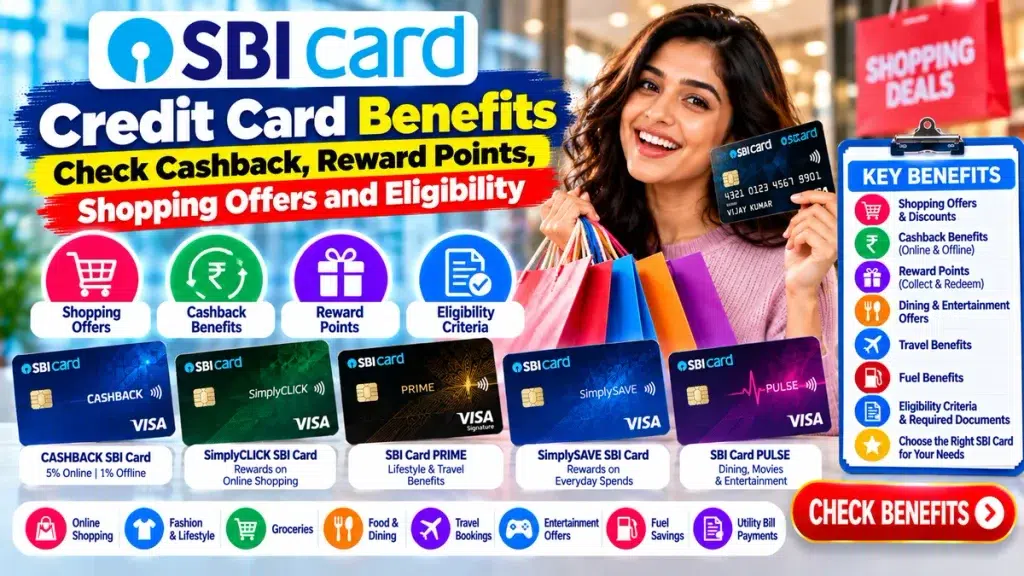
This guide explains SBI Card cashback, reward points, shopping offers, eligibility, documents, annual fees, application considerations, and other important features that consumers should review before choosing a credit card.
What Is an SBI Credit Card?
SBI Card provides credit cards that allow eligible customers to make permitted transactions within an assigned credit limit.
Depending on the card selected, benefits may include:
- Cashback
- Reward points
- Online shopping benefits
- Merchant discounts
- Dining benefits
- Travel privileges
- Fuel-related benefits
- Entertainment offers
- Milestone benefits
- Other lifestyle privileges
Features, fees, exclusions, and eligibility differ across products.
Consumers should always review the latest card-specific terms before applying.
Major SBI Credit Card Benefits
Different SBI Cards are designed around different spending patterns.
A consumer who spends heavily online may prefer a cashback-focused card, while another customer may benefit more from a rewards-oriented or lifestyle card.
The main benefit categories include the following.
Cashback
Eligible cashback cards can provide a percentage of qualifying spending back to the cardholder according to applicable terms.
Reward Points
Reward-oriented SBI Cards can earn points on eligible transactions. These points can be redeemed according to the applicable SBI Card rewards program.
Shopping Offers
Cardholders may receive promotional offers at participating online and offline merchants.
Lifestyle Benefits
Selected cards can include benefits related to dining, entertainment, travel, fuel, or other lifestyle categories.
Milestone Benefits
Some cards provide additional benefits after meeting specified spending requirements.
SBI Credit Card Benefits Comparison
The following table shows several types of SBI Cards consumers may encounter and the primary features they should compare.
| SBI Card Type | Primary Benefit | Suitable Spending Profile | Important Factor to Check |
|---|---|---|---|
| Cashback Card | Cashback | Online & everyday shopping | Cashback caps & exclusions |
| Shopping Rewards Card | Reward Points | Online shopping | Merchant-specific earning |
| Lifestyle Card | Rewards & privileges | Mixed lifestyle spending | Annual fee & benefits |
| Travel Card | Travel-oriented rewards | Frequent travellers | Redemption & travel conditions |
| Fuel Card | Fuel-related benefits | Regular fuel spending | Eligible fuel transactions |
| Premium Card | Premium rewards/privileges | Higher-spending users | Higher annual fee |
The exact benefits depend on the individual card.
CASHBACK SBI Card
The CASHBACK SBI Card is one of SBI Card’s cashback-focused products.
Under the current program, eligible online transactions can earn 5% cashback, while eligible offline spending can earn 1% cashback, subject to applicable conditions and exclusions.
This can make the card particularly relevant for consumers who regularly shop online across multiple eligible merchants rather than being tied to a single shopping platform.
5% Cashback on Eligible Online Spending
The headline feature of the CASHBACK SBI Card is its cashback on qualifying online transactions.
Eligible online spending currently earns 5% cashback, subject to the applicable monthly cashback cap and excluded categories.
For example, in a simplified scenario:
If ₹10,000 of online spending is fully eligible for 5% cashback:
₹10,000 × 5% = ₹500
The potential cashback would be ₹500.
However, this example assumes that every transaction qualifies and remains within applicable cashback limits.
Actual cashback can differ.
1% Cashback on Eligible Offline Spending
The CASHBACK SBI Card also provides 1% cashback on eligible offline spending.
This can provide some value when the card is used outside online shopping.
However, excluded categories and other terms continue to apply.
Consumers should never assume that every card transaction qualifies for cashback.
Cashback Exclusions
Understanding exclusions is essential.
According to the current CASHBACK SBI Card terms, certain transaction categories do not qualify for normal cashback benefits.
These include specified categories such as:
- Utility payments
- Insurance
- Fuel
- Rent
- Wallet-related transactions
- Education
- Jewellery
- Railways
- Other excluded merchant categories
Terms can change, so cardholders should verify the current exclusions before estimating potential cashback.
Cashback Caps
A high cashback percentage does not necessarily mean unlimited rewards.
Cashback programs can have monthly or billing-cycle caps.
Therefore, when comparing cards, consider:
Effective Cashback = Eligible Spending × Cashback Rate, subject to applicable maximum cap
A 5% cashback rate may be attractive, but the actual monthly value depends on how much spending qualifies and whether the cap is reached.
SBI Reward Points
Many SBI Cards use a reward-points system rather than direct cashback.
Eligible card transactions can earn reward points according to the specific card’s earning structure.
Different cards can offer:
- Standard reward points
- Accelerated rewards
- Merchant-specific reward points
- Category-specific rewards
- Milestone rewards
The number of points earned does not by itself indicate the actual value of a card.
Consumers must also check the redemption value.
How SBI Reward Points Work
Suppose a card provides reward points on eligible transactions.
When the cardholder makes qualifying purchases, points accumulate according to the card’s reward rate.
The practical value can be estimated as:
Reward Value = Number of Reward Points × Applicable Redemption Value
Two cards may award different numbers of points for the same spending while providing similar actual value after redemption.
Therefore, compare both earning and redemption.
SBI Reward Point Redemption
Eligible SBI Card reward points may be redeemable for available options according to the applicable rewards program.
Depending on the card and current program, redemption options can include:
- Gift vouchers
- Products
- Selected merchandise
- Other reward catalogue options
- Statement credit on eligible cards, subject to applicable conditions
Redemption values, minimum requirements, charges, and rules can differ.
Always check current redemption terms.
SBI Credit Card Shopping Offers
Shopping offers can provide additional savings beyond a card’s normal reward program.
SBI Card periodically provides promotional offers across eligible merchants and categories.
These may include:
- Instant discounts
- Online shopping promotions
- EMI-related offers
- Electronics offers
- Fashion promotions
- Travel booking offers
- Dining deals
- Entertainment offers
Promotional offers are usually temporary and subject to specific conditions.
How Shopping Offers Work
A shopping offer may specify:
- Eligible SBI Cards
- Minimum transaction amount
- Maximum discount
- Eligible merchant
- Offer period
- Payment mode
- EMI/non-EMI requirement
- Number of permitted transactions
- Other restrictions
For example, an offer advertising a percentage discount may also impose a maximum discount amount.
Consumers should read the complete offer conditions before purchasing.
Cashback vs Reward Points
Choosing between cashback and reward points depends on personal preference.
| Feature | Cashback | Reward Points |
|---|---|---|
| Benefit Type | Monetary cashback according to terms | Points |
| Value Visibility | Usually easier to understand | Depends on redemption |
| Redemption | Often more direct | May require redemption |
| Flexibility | Straightforward | Multiple options may exist |
| Expiry Concern | Depends on program | Points may have validity conditions |
| Best For | Simple savings | Consumers who actively use rewards |
Neither reward format is automatically superior.
SBI Credit Card Annual Fees
Annual fees differ between SBI Cards.
For example, the current CASHBACK SBI Card fee structure includes an annual/renewal fee of ₹999 plus applicable taxes, subject to the latest terms.
The renewal fee can currently be reversed when the specified annual spending threshold is achieved.
Other SBI Cards may have lower or higher annual fees.
Some may provide fee waivers after meeting specified spending conditions.
How to Evaluate an Annual Fee
Calculate the practical value of a card:
Net Annual Benefit = Cashback + Reward Value + Useful Additional Benefits − Annual Fee − Other Relevant Costs
Suppose a card costs ₹1,000 per year but provides ₹5,000 of benefits you would naturally use.
It may provide positive value.
However, a premium card costing several thousand rupees may provide poor value if you rarely use its benefits.
Fee-Waiver Conditions
Some SBI Cards may waive or reverse the annual renewal fee after a specified yearly spending amount.
Check:
- Required annual spending
- Spending period
- Excluded transactions
- Renewal date
- Applicable card terms
Do not overspend merely to qualify for a fee waiver.
SBI Credit Card Eligibility
Eligibility differs depending on the selected SBI Card and applicant profile.
Factors considered can include:
- Age
- Income
- Employment
- Credit history
- Existing financial obligations
- Residential location
- Documentation
- Internal credit policy
SBI Card may have different requirements for salaried and self-employed applicants.
Meeting basic eligibility requirements does not guarantee approval.
Income and Employment
Income is one factor used to evaluate repayment capacity.
Eligibility may differ depending on whether the applicant is:
- Salaried
- Self-employed
- Existing customer
- New-to-credit
- Already holding other credit facilities
There is no single universal income requirement that applies identically to every SBI Card.
Applicants should check the selected card’s current eligibility criteria.
Credit Score and Credit History
Credit profile can affect a credit card application.
The issuer may consider:
- Repayment history
- Existing loans
- Existing cards
- Credit utilization
- Outstanding balances
- Recent credit enquiries
- Overall credit history
A strong credit score can support an application but does not guarantee approval.
Similarly, there is no universal credit-score threshold that automatically approves every applicant.
Documents Required for SBI Credit Card
Documentation requirements can vary.
Applicants may be asked for applicable:
| Document Category | Possible Requirement |
|---|---|
| Identity | KYC/identity verification |
| Address | Address verification |
| PAN | PAN details |
| Income | Salary/income proof where requested |
| Bank Statement | May be required |
| Employment | Employment information |
| Photograph | Depending on process |
| Additional Documents | As requested |
Applicants should provide personal information only through SBI Card’s official or authorized application channels.
How to Apply for an SBI Credit Card
The general application process can include the following steps.
Step 1: Choose a Card
Compare SBI Cards according to your spending habits.
Step 2: Check Benefits
Review cashback, rewards, shopping offers, and additional privileges.
Step 3: Check Fees
Review joining fee, annual fee, fee-waiver conditions, and other applicable charges.
Step 4: Check Eligibility
Review applicable age, income, employment, and other requirements.
Step 5: Complete the Application
Provide accurate personal, employment, and financial information.
Step 6: Complete KYC
Complete applicable identity and verification requirements.
Step 7: Credit Assessment
SBI Card may review the applicant’s credit profile and repayment capacity.
Step 8: Application Decision
The application is approved or declined according to the issuer’s assessment and policies.
Approval is not guaranteed.
SBI Credit Card Limit
Credit limits can differ substantially between applicants.
The assigned limit may depend on:
- Income
- Credit history
- Existing debt
- Repayment record
- Existing credit limits
- Card type
- Internal assessment
A higher salary does not automatically guarantee a specific credit limit.
EMI Facility
Eligible purchases may sometimes be converted into EMI according to applicable SBI Card terms.
Before using EMI, review:
- Interest/applicable cost
- Processing charges
- Tenure
- Total repayment
- Taxes
- Reward eligibility
- Foreclosure/cancellation conditions
An EMI facility can make repayment easier to manage, but it can also increase the total cost of a purchase.
Finance Charges and Late Payments
Cashback and reward points should never distract consumers from credit-card borrowing costs.
If outstanding balances attract finance charges, the resulting cost can exceed the value of rewards.
Consumers should understand:
- Billing cycle
- Payment due date
- Total amount due
- Minimum amount due
- Finance charges
- Late-payment charges
Paying only the minimum amount due does not necessarily prevent finance charges on the remaining balance.
How to Choose the Right SBI Credit Card
Start with your actual spending.
For Online Shoppers
Compare cashback-oriented products and online shopping reward cards.
For Reward Seekers
Compare earning rates, point values, redemption choices, and annual fees.
For Travellers
Look at cards offering useful travel-related privileges.
For Fuel Spending
Compare eligible fuel-related cards and transaction conditions.
For Premium Lifestyle Users
Compare premium rewards, travel, dining, and milestone benefits against the higher annual fee.
Tips to Maximize SBI Card Benefits
Use the card strategically rather than spending more.
Good practices include:
- Use the card for planned eligible purchases.
- Understand cashback exclusions.
- Track monthly cashback caps.
- Redeem reward points before applicable expiry.
- Use merchant offers only for products you actually need.
- Review statements regularly.
- Pay dues on time.
- Avoid unnecessary revolving balances.
- Keep spending within your budget.
Credit Card Security
Never share:
- OTP
- PIN
- CVV
- Online banking password
- Card verification codes
Be cautious of messages promising guaranteed SBI Card approval, cashback, credit-limit increases, or reward redemption in exchange for sensitive information.
Use official SBI Card channels.
Frequently Asked Questions (FAQ)
1. What are the main SBI credit card benefits?
Benefits vary by card and may include cashback, reward points, shopping offers, dining, travel, fuel-related benefits, milestone rewards, and other privileges.
2. Does SBI Card provide cashback?
Yes. Cashback-focused products such as the CASHBACK SBI Card provide cashback on eligible transactions according to current terms.
3. How much cashback does the CASHBACK SBI Card provide?
Current terms provide 5% cashback on eligible online spending and 1% on eligible offline spending, subject to caps and exclusions.
4. Do all transactions earn SBI cashback?
No. Excluded transaction categories apply. Always check the latest card terms.
5. Can SBI reward points be redeemed?
Eligible reward points can be redeemed according to the applicable SBI Card rewards program and card-specific terms.
6. Does SBI Card offer shopping discounts?
SBI Card periodically provides merchant-specific shopping offers, subject to eligibility, transaction conditions, and offer validity.
7. What is the eligibility for an SBI credit card?
Eligibility varies by card and can depend on age, income, employment, credit profile, documentation, and internal policies.
8. Does a good credit score guarantee SBI Card approval?
No. A good score can support an application, but approval depends on the complete applicant profile and SBI Card’s assessment.
9. What documents are required?
Applicants may need applicable KYC, PAN, address, income, employment, and other supporting documents depending on the application.
10. Which SBI credit card is best?
There is no single best SBI Card for everyone. The right card depends on spending habits, preferred rewards, annual fees, eligibility, and the benefits the cardholder will actually use.
Conclusion
SBI credit card benefits can include cashback, reward points, shopping discounts, merchant offers, travel privileges, dining benefits, fuel-related advantages, and other card-specific features.
Consumers who prefer straightforward savings may consider cashback-focused options. For example, the current CASHBACK SBI Card provides 5% cashback on eligible online spending and 1% cashback on eligible offline spending, subject to exclusions and applicable cashback limits.
Consumers who prefer points can compare SBI Cards offering reward points and accelerated earning opportunities.
However, the card with the highest advertised reward rate is not necessarily the best choice.
Before applying, compare cashback caps, reward-point value, annual fees, fee-waiver conditions, shopping offers, excluded transactions, eligibility, documents, finance charges, and other applicable costs.
Most importantly, use credit responsibly. Cashback and rewards provide real value only when normal spending remains within budget and repayment obligations are managed properly.
Choose a card that complements your existing spending habits rather than encouraging unnecessary purchases.
Disclaimer: This article is for general educational and informational purposes only and does not constitute financial, credit, investment, tax, or legal advice. SBI Card cashback rates, reward programs, annual fees, fee-waiver thresholds, merchant offers, eligibility criteria, exclusions, redemption rules, charges, and other features can change. Credit card approval and credit limits are subject to SBI Card’s applicable eligibility, documentation, credit assessment, verification, and internal policies. Always verify the latest card-specific terms and Most Important Terms and Conditions directly with SBI Card before applying or making a financial decision.