Credit Card Eligibility by Credit Score – Check Your Approval Chances
Your credit score can be an important factor when you apply for a credit card. Banks and other eligible card issuers may review your credit history, repayment behaviour, existing loans, outstanding balances, recent credit enquiries, income, employment profile, and other information before deciding whether to approve an application.
However, credit card eligibility by credit score is not as simple as reaching one specific number. A higher credit score may indicate stronger historical credit behaviour, but it does not guarantee that a credit card application will be approved. Similarly, having a lower score does not automatically mean that every credit card application will be rejected.
Each issuer can have its own eligibility requirements and internal credit-risk policies.
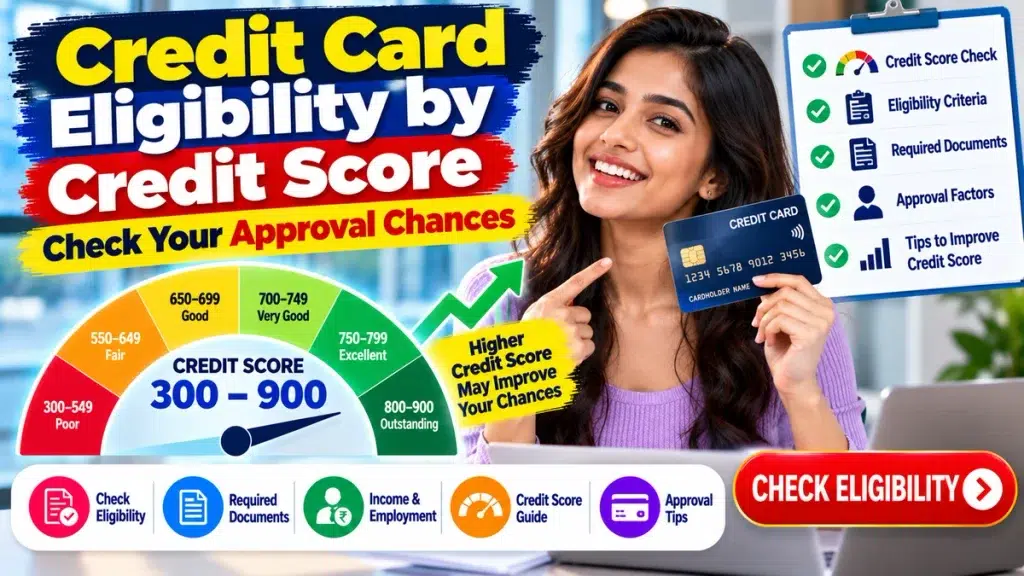
This guide explains how credit scores can affect credit card approval chances, what different score ranges may indicate, which other factors issuers can consider, and how responsible credit behaviour may help improve your overall credit profile.
What Is a Credit Score?
A credit score is a numerical representation derived from information in your credit history and credit report.
In India, credit information companies maintain credit information relating to borrowers and provide credit reports and scores according to applicable frameworks.
A credit report can contain information relating to:
- Credit cards
- Personal loans
- Home loans
- Auto loans
- Other reported credit facilities
- Repayment history
- Outstanding balances
- Credit enquiries
- Account status
Lenders and card issuers may use credit information as one of the inputs when evaluating an application.
Credit Score Range Explained
Credit scores are commonly presented on a scale where a higher score generally indicates a stronger historical credit profile.
The following table is only a general educational illustration. It is not an approval standard used universally by all card issuers.
| Credit Score Range | General Interpretation | Possible Credit Card Position |
|---|---|---|
| 300–549 | Weak Credit Profile | Approval May Be More Difficult |
| 550–649 | Fair/Developing Profile | Options May Be Limited |
| 650–699 | Moderate Profile | Some Cards May Be Available |
| 700–749 | Relatively Strong Profile | Broader Options May Be Possible |
| 750–799 | Strong Profile | May Support Eligibility for More Cards |
| 800–900 | Very Strong Profile | Strong Credit Profile, Subject to Other Criteria |
Important: These ranges should not be treated as guaranteed approval or rejection thresholds. Individual issuers determine eligibility according to their own policies.
Is There a Minimum Credit Score for a Credit Card?
There is no single universal credit score that guarantees eligibility for every credit card.
Different issuers and different card products can have different risk criteria.
A premium card, for example, may be assessed differently from an entry-level card.
Issuers may evaluate:
- Credit score
- Credit history
- Income
- Employment
- Existing loans
- Existing credit cards
- Repayment obligations
- Credit utilization
- Recent applications
- Age
- Location
- KYC information
- Internal credit policy
Therefore, a person with a relatively high score can still be declined if other eligibility conditions are not satisfied.
Does a 750 Credit Score Guarantee Credit Card Approval?
No.
A score around 750 is often discussed as a relatively strong credit profile, but it should never be treated as a guarantee of approval.
For example, an applicant could have a strong credit score but:
- Insufficient income for the selected card
- High existing debt
- Significant monthly repayment obligations
- Inconsistent application information
- Employment that does not meet applicable criteria
- Too many recent credit applications
- Other factors that do not satisfy the issuer’s internal policy
The issuer evaluates the overall application.
How Credit Score Affects Credit Card Approval
A credit score can help the issuer understand an applicant’s historical credit behaviour.
Generally, stronger repayment behaviour can support a healthier credit profile.
A credit score may influence:
Application Assessment
The issuer may consider credit information when evaluating whether the applicant fits its risk criteria.
Credit Limit
If approved, credit information may be one of several factors considered when deciding an appropriate credit limit.
Card Eligibility
Some applicants may qualify for different card categories based on their overall financial and credit profile.
Additional Verification
Depending on the application and issuer policy, additional information or documentation may be requested.
None of these outcomes is determined by credit score alone.
Factors That Can Affect Your Credit Score
Understanding the factors associated with your credit profile can help you manage credit more responsibly.
Payment History
Repayment behaviour is an important part of a credit history.
Late or missed payments on reported credit accounts can negatively affect your credit profile.
Try to pay applicable loan EMIs and credit card bills on time.
Credit Utilization
Credit utilization generally refers to the proportion of available revolving credit that you are using.
For example, consistently using a very large portion of available card limits may indicate greater dependence on credit.
Keeping balances manageable and avoiding unnecessary utilization can support responsible credit management.
Credit History Length
A longer history of responsibly managed credit can provide lenders with more information about repayment behaviour.
Closing old accounts solely to change a score may not always produce the expected result, so financial decisions should be based on overall needs rather than score optimization alone.
Credit Mix
A credit report may contain different types of credit facilities.
However, you should never take a loan or open a new credit account simply to create a particular credit mix.
Borrow only when it serves a genuine financial need.
Recent Credit Enquiries
When you apply for a credit facility, an issuer or lender may access your credit report as part of the assessment.
Multiple applications within a short period can create multiple enquiries.
Rather than applying for many cards at once, research eligibility and select cards that fit your profile.
Credit Card Eligibility Beyond Credit Score
Credit score is only one part of the process.
| Eligibility Factor | Why It May Matter |
|---|---|
| Credit Score | Indicates aspects of historical credit behaviour |
| Income | Helps assess repayment capacity |
| Employment | Provides information about income stability |
| Existing Debt | Shows current financial obligations |
| Repayment History | Reflects past payment behaviour |
| Credit Utilization | Indicates use of available revolving credit |
| Recent Enquiries | Shows recent credit applications |
| KYC | Required for identity/address verification as applicable |
| Internal Policy | Determines issuer-specific risk criteria |
Applicants should consider the entire profile instead of focusing on a single number.
Income and Credit Card Approval
Even a strong credit score does not replace income eligibility.
Credit cards are borrowing facilities, so issuers generally need to assess repayment capacity.
Income requirements vary according to:
- Card type
- Issuer
- Applicant profile
- Employment status
- Location
- Existing financial obligations
- Other internal criteria
There is no universal salary amount that guarantees approval for every credit card.
Existing Loans and EMIs
Existing financial obligations can affect an application.
Suppose two applicants have similar incomes and credit scores.
One has minimal existing debt, while the other has several large monthly EMIs.
Their applications may be assessed differently because repayment capacity is not identical.
This is why credit score should not be considered in isolation.
Credit Utilization and Credit Cards
Responsible utilization can be an important part of credit management.
For example, suppose a person has multiple credit cards with a combined available limit and consistently uses most of that available credit.
Even if payments are made, very high reliance on available revolving credit may affect how the overall profile is viewed.
A practical approach is to spend within your budget and avoid using credit limits as additional income.
What If You Have a Low Credit Score?
A lower score does not mean you should immediately submit applications to multiple issuers.
First, consider reviewing your credit report.
Check for:
- Incorrect account information
- Unrecognized credit accounts
- Incorrect payment records
- Outdated information
- Other potential reporting errors
If you identify an error, use the applicable dispute process with the relevant credit information company and/or credit institution.
If the information is accurate, focus on responsible financial behaviour over time.
What If You Have No Credit Score?
Some people may have little or no established credit history because they have never used formal credit or have insufficient reported credit information.
This does not necessarily mean they can never get a credit card.
Possible options may include:
- Entry-level cards, subject to issuer criteria
- Cards based on an existing banking relationship where offered
- Secured credit cards backed by eligible deposits where available
- Other products designed for applicants with limited credit history
Always compare fees and conditions before applying.
Secured Credit Cards
A secured credit card may be issued against an eligible fixed deposit or similar security, depending on the issuer’s product.
Such cards can be useful for some applicants with limited or weak credit history.
However, secured cards still have terms, fees, credit limits, and repayment obligations.
Using a secured card responsibly does not mean spending unnecessarily. Make purchases within your budget and pay according to the applicable billing terms.
How to Check Your Credit Score
Consumers can obtain their credit information through authorized credit information companies and available official channels.
When reviewing your report, check:
- Personal information
- Credit accounts
- Outstanding balances
- Payment history
- Enquiries
- Account status
Be cautious of websites or messages asking for unnecessary sensitive information while promising instant credit approval.
Use trusted and authorized sources.
How to Improve Your Credit Profile
There is no legitimate instant method that guarantees a dramatic credit-score increase.
Building a stronger credit profile generally requires responsible behaviour over time.
1. Pay Bills on Time
Make applicable loan and credit card payments on or before their due dates.
2. Keep Outstanding Debt Manageable
Avoid borrowing beyond your repayment capacity.
3. Manage Credit Utilization
Try not to depend excessively on available revolving credit.
4. Avoid Unnecessary Credit Applications
Research eligibility before applying.
5. Review Your Credit Report
Check periodically for inaccurate information.
6. Resolve Genuine Outstanding Accounts Responsibly
If you have overdue obligations, contact the relevant lender through official channels to understand available repayment options.
7. Maintain Accurate Information
Ensure your details with financial institutions are accurate and updated through appropriate processes.
How to Check Your Credit Card Approval Chances
No online tool or credit score alone can guarantee approval.
However, you can assess whether a card appears suitable by checking:
- Your current credit profile.
- The card’s income eligibility.
- Employment requirements.
- Existing monthly debt obligations.
- Recent credit applications.
- Required documentation.
- Card fees and benefits.
- Issuer-specific eligibility criteria.
Some issuers may provide eligibility or pre-approved offer checks. A displayed offer should still be read carefully because final approval can remain subject to verification and applicable conditions.
How to Apply for a Credit Card
Once you identify a suitable card:
- Visit the issuer’s official website, app, branch, or authorized channel.
- Review eligibility requirements.
- Read applicable fees and card terms.
- Complete the application accurately.
- Provide required KYC and income information.
- Complete applicable verification.
- Allow the issuer to perform its credit assessment.
- Review the final terms carefully if approved.
Never provide false income or employment information to increase perceived eligibility.
Common Reasons for Credit Card Rejection
Applications can be declined for many reasons, including:
- Weak credit history
- Insufficient income for the selected card
- High existing debt
- Significant repayment obligations
- Multiple recent applications
- Incomplete documentation
- Incorrect information
- KYC or verification issues
- Card-specific eligibility conditions
- Internal credit policy
A rejection does not necessarily mean that your credit score alone caused the decision.
Avoid Guaranteed Approval Claims
Be cautious of advertisements or messages promising:
- “100% guaranteed credit card approval”
- “No rejection possible”
- “Pay money to instantly fix your credit score”
- “Guaranteed premium card with any score”
Credit decisions are made by issuers based on applicable eligibility and assessment.
Never pay unknown individuals or share sensitive financial credentials in exchange for guaranteed approval.
Frequently Asked Questions (FAQ)
1. What credit score is required for a credit card?
There is no universal credit score that guarantees credit card eligibility. Requirements vary by issuer, card, and applicant profile.
2. Is a 750 credit score good for a credit card?
A score around this level may indicate a relatively strong credit profile, but it does not guarantee approval.
3. Can I get a credit card with a 700 credit score?
It may be possible depending on the card, issuer, income, credit history, existing obligations, and other eligibility criteria.
4. Can I get a credit card with a low credit score?
Options may be more limited. Some applicants may consider suitable entry-level or secured products where available and subject to issuer criteria.
5. Can I get a credit card without a credit score?
It may be possible depending on issuer policies. Secured cards or products for applicants with limited credit history may be available.
6. Does a high credit score guarantee a high credit limit?
No. Credit limits are determined by issuers using multiple factors, which can include income, existing obligations, credit history, and internal policies.
7. Does applying for a credit card affect my credit report?
A lender’s credit enquiry associated with an application may be recorded in your credit history.
8. Can paying bills on time improve my credit profile?
Consistent timely repayment is an important component of responsible credit behaviour and can support a healthier credit history over time.
9. Why was my credit card rejected despite a good credit score?
Possible reasons include income requirements, existing debt, documentation, employment criteria, recent applications, or the issuer’s internal credit policy.
10. How can I improve my credit card approval chances?
Maintain responsible repayment behaviour, manage debt and credit utilization, avoid unnecessary applications, check your credit report for errors, and apply for cards suited to your financial profile. Approval is never guaranteed.
Conclusion
Understanding credit card eligibility by credit score can help you make more informed decisions before submitting an application.
A stronger credit score can be a positive part of your financial profile, but there is no universal score that guarantees credit card approval. Issuers may evaluate credit history, income, employment, existing loans, repayment obligations, credit utilization, recent enquiries, KYC information, and internal risk criteria alongside the score.
Instead of applying for multiple cards simply because your score appears high, compare each card’s eligibility requirements, fees, benefits, and suitability for your financial situation.
If your credit profile needs improvement, focus on long-term responsible habits such as timely repayments, manageable debt, appropriate credit utilization, accurate credit-report information, and avoiding unnecessary applications.
Most importantly, treat a credit card as a borrowing facility rather than additional income. Responsible use can help you manage credit more effectively while reducing the risk of expensive debt.
Disclaimer: This article is for general educational and informational purposes only and does not constitute financial, credit, investment, legal, or tax advice. Credit scores, eligibility requirements, approval criteria, credit limits, fees, and card benefits vary by issuer and applicant profile and may change. The score ranges shown are general educational illustrations and are not guaranteed approval thresholds. Always verify current eligibility and terms with the relevant card issuer and obtain credit information through authorized sources before making financial decisions.