Two-Wheeler Insurance Premium Calculator – Check Price and Compare Plans
Buying or renewing two-wheeler insurance involves more than simply selecting the cheapest policy. The premium can vary depending on your motorcycle or scooter, policy type, vehicle age, Insured Declared Value (IDV), location, claim history, add-ons, and several other factors. A two-wheeler insurance premium calculator can help you estimate the insurance price and compare policy options before making a decision.
An online bike insurance calculator generally asks for basic vehicle and policy information and then provides an estimated or available premium based on the details entered. This makes it easier to compare third-party, comprehensive, and eligible own-damage insurance options.
However, a calculator result should not be considered the only factor when choosing insurance. Coverage, deductibles, IDV, exclusions, add-ons, cashless garages, and claim support should also be reviewed.
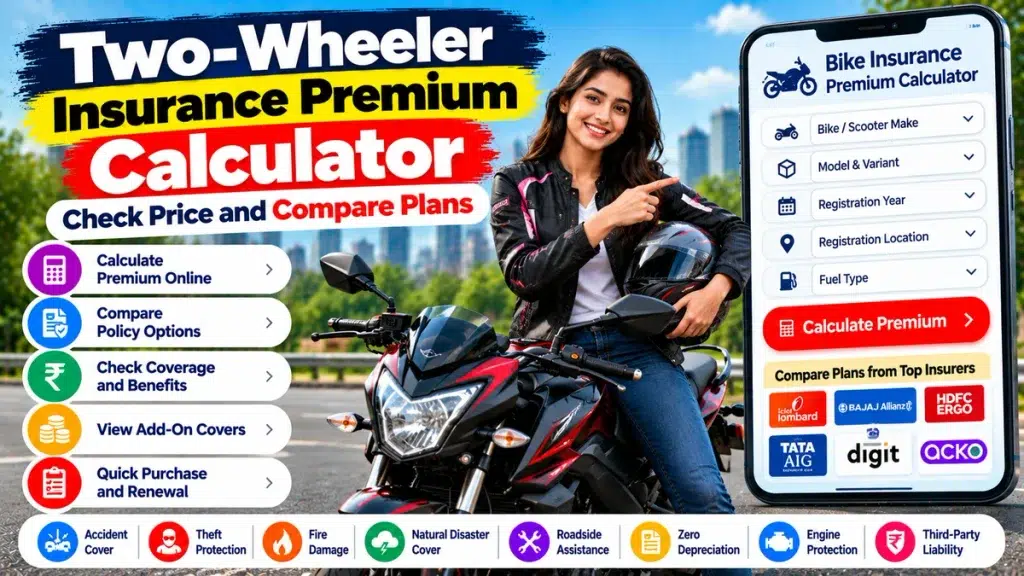
This guide explains how a two-wheeler insurance premium calculator works, what affects bike insurance prices, how to compare plans, and how to select suitable coverage for your motorcycle or scooter.
What Is a Two-Wheeler Insurance Premium Calculator?
A two-wheeler insurance premium calculator is an online tool that helps estimate the premium for motorcycle or scooter insurance based on the information provided.
Insurance companies and authorized insurance platforms may offer these calculators online.
Depending on the calculator, you may need to enter details such as:
- Bike or scooter make
- Model and variant
- Registration year
- Registration location
- Fuel type
- Existing policy information
- Previous claim details
- No Claim Bonus information
- Required policy type
After entering the information, the calculator can provide an estimated or available insurance premium.
The final payable premium may vary depending on insurer verification, taxes, selected coverage, and policy conditions.
Why Use a Bike Insurance Premium Calculator?
A calculator can simplify insurance research by giving you an idea of potential costs before purchasing a policy.
Compare Insurance Prices
You can review different policy options and understand how changes in coverage may affect the premium.
Check Coverage Options
Depending on the service, you may be able to compare third-party, comprehensive, or standalone own-damage options.
Understand Add-On Costs
Adding optional covers can increase the premium. A calculator can help you understand how selected add-ons affect the total price.
Review IDV
For eligible own-damage coverage, you may be able to review the available Insured Declared Value and its impact on the premium.
Plan Your Insurance Budget
An estimated premium can help you plan the cost of purchasing or renewing two-wheeler insurance.
Two-Wheeler Insurance Premium Comparison
| Factor | Third-Party Insurance | Comprehensive Insurance | Standalone Own Damage |
|---|---|---|---|
| Third-Party Liability | Yes | Generally Included/Applicable | No |
| Own Vehicle Damage | No | Yes* | Yes* |
| Theft Protection | No | Yes* | Yes* |
| Fire Damage | No | Yes* | Yes* |
| Natural Disaster Cover | No | Yes* | Yes* |
| Add-On Options | Limited | Usually Available | Usually Available |
| IDV Consideration | Not for Own Damage | Yes | Yes |
| Premium Level | Generally Lower | Usually Higher | Depends on Coverage |
| Suitable For | Basic liability protection | Broader protection | Own-damage protection |
*Subject to applicable policy terms, exclusions, deductibles, and limits.
How Does a Two-Wheeler Insurance Premium Calculator Work?
The exact process varies between insurance providers, but most calculators follow similar steps.
Step 1: Enter Vehicle Details
Start by entering accurate information about your motorcycle or scooter.
You may need the vehicle’s manufacturer, model, variant, registration year, and registration location.
Some services may allow you to start with the registration number.
Step 2: Provide Existing Policy Information
If you are renewing insurance, you may be asked about your existing policy.
Information can include:
- Current insurer
- Policy expiry date
- Previous policy type
- Previous claims
- NCB eligibility
Provide accurate information because incorrect claim or NCB details can affect policy issuance and future claims.
Step 3: Select Coverage Type
Choose the type of policy you want to explore.
Depending on eligibility, options can include third-party insurance, comprehensive insurance, or standalone own-damage insurance.
Step 4: Review IDV
If you are purchasing eligible own-damage coverage, check the IDV offered for your vehicle.
IDV can influence both the premium and the amount considered in certain total-loss or theft claims.
Step 5: Select Add-On Covers
You may be able to add optional protections such as zero depreciation or roadside assistance.
Each selected add-on can affect the premium.
Step 6: Calculate the Premium
After entering the required details, the calculator provides an estimated or available premium.
Review the quotation carefully.
Step 7: Compare Plans
If multiple insurance options are available, compare them using similar coverage, IDV, deductibles, and add-ons.
A policy that appears cheaper may not necessarily provide the same protection as another policy.
Factors Affecting Two-Wheeler Insurance Premium
Several factors can determine how much you pay for bike insurance.
1. Make and Model
The manufacturer, model, variant, value, repair cost, and technical specifications of the vehicle can influence insurance pricing.
A higher-value motorcycle may have a different own-damage premium than a basic commuter bike.
2. Engine Capacity
Engine capacity can be relevant to motor insurance pricing, particularly for applicable third-party premium categories.
Always check the current premium applicable to your vehicle.
3. Vehicle Age
The age of your motorcycle or scooter affects its insured value.
As a vehicle gets older, its IDV generally changes, which can influence the own-damage premium.
4. Registration Location
The location where the vehicle is registered can affect the premium based on applicable rating factors.
5. Policy Type
The type of insurance selected significantly affects the total price.
A comprehensive policy generally costs more than basic third-party insurance because it offers broader protection.
6. IDV
The Insured Declared Value broadly represents the insured value of the vehicle for certain claims, such as eligible theft or total loss.
A higher IDV can increase the own-damage premium, while selecting a lower IDV can reduce it.
However, choosing an unnecessarily low IDV solely to reduce the premium can affect the amount considered during certain eligible claims.
What Is IDV in Bike Insurance?
IDV stands for Insured Declared Value.
It is an important factor when calculating the premium for policies that include own-damage protection.
IDV is broadly based on the vehicle’s value after considering applicable depreciation and other factors according to the insurer’s methodology and policy terms.
For example, if a vehicle is stolen and remains unrecovered, or is considered a total loss under the policy, the IDV can play an important role in determining the claim settlement, subject to policy conditions.
Therefore, do not compare premiums without also checking the IDV.
What Is No Claim Bonus?
No Claim Bonus (NCB) is a discount that may be available on the own-damage premium when an eligible policyholder does not make a claim during the previous policy period.
The discount can increase over consecutive claim-free periods up to applicable limits.
NCB can reduce the own-damage component of your renewal premium.
If you switch insurance providers, eligible NCB may generally be transferred subject to verification and documentation.
Never enter an incorrect NCB percentage simply to obtain a cheaper quotation.
Popular Add-Ons That Can Affect Premium
Add-ons increase the scope of protection but also increase the total premium.
Zero Depreciation Cover
Under a standard claim, depreciation may apply to certain replaced parts.
Zero depreciation cover can reduce eligible depreciation deductions according to the add-on terms.
Roadside Assistance
This add-on may provide assistance when the two-wheeler breaks down.
Services can include towing, battery assistance, flat tyre support, and other specified emergency services.
Engine Protection
Engine protection can provide additional coverage for certain types of engine-related damage that may not be covered under a standard policy.
Consumables Cover
Consumables used during eligible repairs may not always be covered under a standard claim.
This add-on can cover specified consumable items according to its terms.
Return to Invoice
Return-to-invoice protection may provide additional financial protection for eligible newer vehicles in specified total-loss or theft situations.
Eligibility varies between insurers.
Sample Bike Insurance Premium Calculation
The following example is only for understanding how different components can affect a premium. It is not an actual insurance quotation.
| Premium Component | Example Impact |
|---|---|
| Basic Own-Damage Premium | Base own-damage cost |
| Third-Party Premium | Applicable liability premium |
| Add-On Covers | Increases premium |
| No Claim Bonus | May reduce eligible OD premium |
| Voluntary Deductible | May reduce premium |
| Taxes | Added as applicable |
| Final Premium | Total after applicable adjustments |
Actual premiums should always be checked directly with an authorized insurance provider.
Third-Party vs Comprehensive Bike Insurance Premium
Third-party insurance generally costs less because it does not provide standard own-damage protection for your motorcycle or scooter.
Comprehensive insurance generally costs more because it offers wider coverage.
The correct choice depends on the protection you need.
For a newer or higher-value bike, the financial risk of accidental damage or theft may make broader coverage worth considering.
For an older vehicle, you may want to compare the premium with the vehicle’s current insured value and your financial risk tolerance.
How to Compare Bike Insurance Plans Online
Comparing insurance correctly requires more than placing premiums side by side.
Compare the Same Policy Type
Do not directly compare a third-party premium with a comprehensive premium as if the coverage were identical.
Compare Similar IDV
If two comprehensive policies have significantly different IDVs, their premiums are not directly comparable.
Check Deductibles
A cheaper policy may have a higher voluntary deductible.
This means you may have to pay more yourself during an eligible claim.
Compare Add-Ons
Check whether the quotations include the same optional covers.
Review Exclusions
Read what the policy does not cover.
A lower price may not compensate for missing protection that you consider important.
Check Cashless Garages
Review whether the insurer has convenient network garages in locations useful to you.
Review Claim Facilities
Check available claim registration, tracking, survey, and customer-support facilities.
How to Reduce Two-Wheeler Insurance Premium
There are several ways to manage the premium without automatically sacrificing essential coverage.
Use Your Eligible NCB
Make sure the correct No Claim Bonus is applied during renewal.
Compare Policies
Compare equivalent coverage from multiple authorized insurers.
Choose Add-Ons Carefully
Buy add-ons that are genuinely useful for your vehicle and usage.
Consider the Deductible
A voluntary deductible can sometimes reduce the premium.
However, you will need to bear a larger portion of an eligible claim yourself, so consider this carefully.
Renew on Time
Renewing before expiry can help avoid complications associated with a coverage break.
Is the Cheapest Bike Insurance Plan the Best?
Not necessarily.
Suppose Policy A has a lower premium than Policy B. Policy A may also have a lower IDV, fewer add-ons, different deductibles, or a less convenient garage network.
In that situation, the cheapest premium does not automatically represent better value.
A useful comparison should consider both price and protection.
How to Buy Two-Wheeler Insurance After Calculating Premium
Once you find a suitable policy, review all information before purchasing.
Confirm:
- Vehicle registration details
- Make and model
- Policy type
- IDV
- Premium
- NCB
- Add-ons
- Deductibles
- Policy start date
- Policy expiry date
- Personal information
Complete payment only through an authorized and secure platform.
After successful policy issuance, download the digital insurance document and check all details again.
Using a Premium Calculator During Renewal
A two-wheeler insurance calculator can also be useful when your existing policy is approaching expiry.
Instead of automatically renewing the same policy, calculate and compare available options.
Your vehicle’s age and IDV may have changed since the previous policy period.
Your NCB eligibility may also have increased if you remained claim-free.
Review your existing add-ons and decide whether they are still useful.
Renewal is an opportunity to adjust your coverage based on your current requirements.
Frequently Asked Questions (FAQ)
1. What is a two-wheeler insurance premium calculator?
It is an online tool that helps estimate the premium for motorcycle or scooter insurance based on vehicle, policy, and coverage information.
2. Is a bike insurance calculator free to use?
Many insurers and authorized insurance platforms provide online premium calculators without a separate calculator fee.
3. Is the premium shown by the calculator final?
Not always. The result may be an estimate or quotation based on the information entered. The final payable amount can change after verification, coverage selection, applicable taxes, and underwriting requirements.
4. What information is needed to calculate bike insurance premium?
You may need the vehicle’s make, model, variant, registration year, registration location, previous policy details, claim history, and NCB information.
5. Does IDV affect bike insurance premium?
Yes. IDV can influence the own-damage premium and plays an important role in certain eligible total-loss or theft claims.
6. Can NCB reduce my bike insurance premium?
Yes. Eligible No Claim Bonus can reduce the own-damage portion of the premium according to applicable rules.
7. Do add-ons increase the premium?
Yes. Optional add-ons generally increase the total premium because they provide additional protection.
8. Which is cheaper: third-party or comprehensive insurance?
Third-party insurance is generally cheaper because it offers more limited protection. Comprehensive insurance normally costs more because it includes broader coverage.
9. Can I compare different insurers using a premium calculator?
Depending on the platform, you may be able to compare multiple available policy options. Always ensure the coverage, IDV, deductibles, and add-ons are comparable.
10. Should I choose the policy with the lowest calculated premium?
Not automatically. Compare coverage, IDV, deductibles, exclusions, add-ons, claim facilities, and garage network along with the price.
Conclusion
A two-wheeler insurance premium calculator can be a useful tool for estimating bike insurance costs and comparing available policy options. By entering accurate vehicle and insurance information, you can understand how policy type, IDV, NCB, add-ons, deductibles, and other factors influence the premium.
However, the lowest calculated price should not be the only consideration.
Compare equivalent policies based on coverage, IDV, deductibles, exclusions, cashless garages, claim facilities, and optional benefits. A policy that costs slightly more may provide protection that is more suitable for your motorcycle or scooter.
For renewal, use the calculator to review whether your existing policy still offers an appropriate balance of premium and coverage. Check your updated IDV and eligible NCB and remove add-ons that are no longer useful.
Before purchasing any policy, verify all vehicle and personal information and review the latest policy wording from the insurer.
Disclaimer: This article is for general informational and educational purposes only and does not constitute insurance, financial, or legal advice. Premium calculations, IDV, NCB, add-ons, discounts, taxes, coverage, and policy terms vary between insurers and can change over time. Calculator results may be estimates. Always verify the final premium and policy terms directly with an authorized insurance provider before purchasing or renewing insurance.