Two-Wheeler Insurance Online – Compare Coverage, Premium and Policy Benefits
Two-wheelers are one of the most convenient ways to travel, particularly for daily commuting. However, motorcycles and scooters are also exposed to risks such as road accidents, theft, fire, floods, storms, and third-party liabilities. Having suitable two-wheeler insurance can help protect a vehicle owner from the financial impact of covered events.
Today, bike and scooter owners can explore two-wheeler insurance online, compare premiums, understand coverage, review optional add-ons, and purchase or renew eligible policies digitally. The online process can also make it easier to compare different insurance options before making a decision.
The cheapest policy, however, is not necessarily the best choice. Policy type, Insured Declared Value (IDV), deductibles, exclusions, claim facilities, add-ons, and insurer services should also be considered.
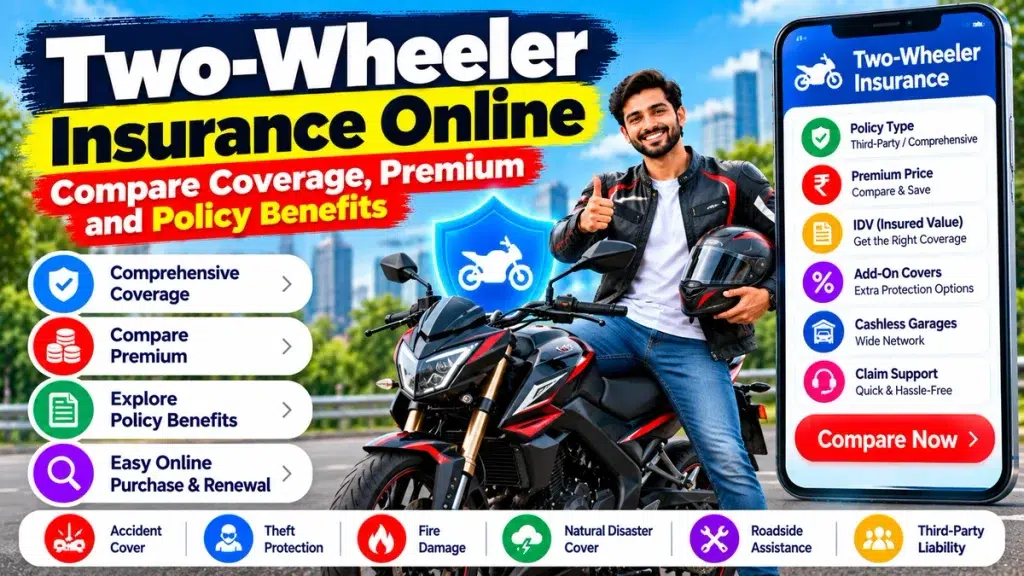
This guide explains how two-wheeler insurance works, the difference between third-party and comprehensive policies, factors affecting premiums, policy benefits, add-on covers, and important points to check before buying or renewing insurance.
What Is Two-Wheeler Insurance?
Two-wheeler insurance is a motor insurance policy designed for vehicles such as motorcycles and scooters.
The vehicle owner pays a premium to an insurance provider. In return, the insurer provides financial protection for specified risks according to the policy’s terms, conditions, exclusions, and coverage limits.
Depending on the type of insurance selected, coverage may include third-party liabilities, accidental damage to the insured vehicle, theft, fire, and specified natural or man-made events.
The exact protection varies between policies and insurers.
Types of Two-Wheeler Insurance
Before comparing premiums, understand the main types of two-wheeler insurance.
1. Third-Party Two-Wheeler Insurance
Third-party insurance primarily covers legal liabilities arising from injury, death, or property damage involving a third party, subject to applicable terms and laws.
For vehicles used on public roads in India, third-party motor insurance is generally mandatory under applicable motor vehicle laws.
However, basic third-party insurance generally does not cover accidental damage to your own motorcycle or scooter.
2. Comprehensive Two-Wheeler Insurance
Comprehensive insurance offers broader financial protection.
In addition to applicable third-party liability protection, it can cover eligible damage to your insured two-wheeler resulting from events such as:
- Road accidents
- Theft
- Fire
- Flood
- Cyclone
- Storm
- Earthquake
- Certain natural disasters
- Specified man-made incidents
The exact coverage depends on the policy wording.
Optional add-on covers may also be available.
3. Standalone Own-Damage Insurance
Standalone own-damage insurance is designed to protect the insured two-wheeler itself against eligible losses.
It may be suitable when an applicable third-party policy is already in place but the owner wants additional protection for their own vehicle.
Two-Wheeler Insurance Coverage Comparison
| Feature | Third-Party Insurance | Comprehensive Insurance | Standalone Own Damage |
|---|---|---|---|
| Third-Party Liability | Yes | Generally Included/Applicable | No |
| Own Vehicle Accident Damage | No | Yes* | Yes* |
| Theft Protection | No | Yes* | Yes* |
| Fire Damage | No | Yes* | Yes* |
| Natural Disaster Cover | No | Yes* | Yes* |
| Add-On Covers | Limited | Usually Available | Usually Available |
| Own Vehicle Protection | No | Yes | Yes |
| Premium | Usually Lower | Usually Higher | Depends on Coverage |
| Suitable For | Basic legal requirement | Broader protection | Own-damage protection |
*Coverage is subject to policy terms, deductibles, exclusions, and applicable limits.
What Does Comprehensive Two-Wheeler Insurance Cover?
A comprehensive policy can provide wider protection than basic third-party insurance.
Accidental Damage
If your motorcycle or scooter is damaged in a covered road accident, eligible repair expenses may be payable according to the policy.
Theft
If the insured two-wheeler is stolen and cannot be recovered, an eligible theft claim may be settled according to the policy’s insured value and terms.
Fire Damage
Specified losses caused by fire, explosion, or related covered events may be included.
Natural Disasters
Comprehensive insurance can provide protection against specified natural events such as floods, storms, cyclones, earthquakes, and landslides.
Third-Party Liability
The policy can also provide applicable third-party liability protection for covered incidents.
What Is a Two-Wheeler Insurance Premium?
A two-wheeler insurance premium is the amount paid to an insurance provider for the selected insurance coverage.
The premium is not the same for every motorcycle or scooter.
Several factors can affect the final amount.
Factors That Affect Two-Wheeler Insurance Premium
Make and Model
The manufacturer, model, variant, engine capacity, value, and repair cost of the two-wheeler can influence the premium.
Age of the Vehicle
The age of the motorcycle or scooter can affect its insured value and own-damage premium.
Registration Location
The location where the vehicle is registered may influence insurance pricing based on applicable rating factors.
Policy Type
A comprehensive policy generally costs more than basic third-party insurance because it offers wider coverage.
Insured Declared Value
IDV or Insured Declared Value broadly represents the insured value of the vehicle for certain types of claims, including eligible theft or total-loss claims.
The applicable IDV can affect the own-damage premium.
Add-On Covers
Selecting optional add-ons increases protection but can also increase the total premium.
Claim History
Previous claims and eligibility for a No Claim Bonus can influence the renewal premium.
What Is No Claim Bonus in Bike Insurance?
No Claim Bonus (NCB) is a discount that may be available on the own-damage premium when an eligible policyholder does not make a claim during the previous policy period.
The discount may increase over consecutive claim-free periods up to applicable limits.
NCB can therefore help reduce the cost of eligible insurance renewal.
If you switch insurance companies, eligible NCB may generally be transferable subject to verification and applicable conditions.
Always provide accurate information regarding your claim history.
Popular Add-On Covers for Two-Wheeler Insurance
Optional add-ons can provide additional protection beyond standard coverage.
Availability depends on the insurer, vehicle, and policy.
Zero Depreciation Cover
During a standard own-damage claim, depreciation may be applied to certain replaced parts.
A zero depreciation add-on can reduce eligible depreciation deductions according to its terms.
This may be useful for newer motorcycles and scooters, subject to eligibility.
Roadside Assistance
Roadside assistance may provide support if your vehicle breaks down.
Depending on the plan, assistance can include towing, battery support, flat tyre assistance, minor repairs, or emergency fuel-related services.
Engine Protection
Standard insurance may not cover every type of engine damage.
Engine protection can provide additional coverage for specified circumstances, subject to policy terms.
Consumables Cover
Certain consumable items used during eligible repairs may not be fully covered under a standard claim.
Consumables cover can provide protection for specified items according to the add-on conditions.
Return to Invoice
For eligible newer vehicles, return-to-invoice coverage may provide additional protection in specified total-loss or theft situations.
Vehicle-age restrictions and other conditions usually apply.
Benefits of Buying Two-Wheeler Insurance Online
Buying or renewing two-wheeler insurance online can provide several practical advantages.
Easy Policy Comparison
You can compare coverage, premiums, IDV, add-ons, deductibles, and policy benefits before purchasing.
Convenient Access
Insurance options can be reviewed from a mobile phone or computer without visiting multiple offices.
Digital Policy Documents
After successful issuance, the policy document can generally be accessed digitally.
Easy Renewal
Existing policyholders can often renew coverage online after verifying the required details.
Premium Comparison
Online quotations can make it easier to compare insurance costs, provided you compare policies with similar coverage.
How to Compare Two-Wheeler Insurance Online
Do not compare policies using premium alone.
Step 1: Enter Correct Vehicle Details
Provide accurate information about your motorcycle or scooter, including its make, model, variant, registration year, and registration number where required.
Step 2: Select the Policy Type
Choose between third-party, comprehensive, or eligible standalone own-damage insurance.
Step 3: Compare Premiums
Review premium quotations from authorized insurers.
Make sure the coverage and IDV are comparable.
Step 4: Check IDV
Review the applicable IDV rather than automatically choosing the policy with the lowest price.
Step 5: Review Add-Ons
Choose optional add-ons according to your vehicle’s age, usage, and requirements.
Step 6: Check Deductibles
Understand how much you may need to pay yourself during an eligible claim.
Step 7: Review Exclusions
Check the exclusions section carefully to understand what the insurance policy does not cover.
Step 8: Check Claim Facilities
Look at available cashless repair facilities, online claim registration, claim tracking, and insurer support.
How to Buy Two-Wheeler Insurance Online
The exact process differs between insurers, but the general steps are straightforward.
Visit the official website or application of an authorized insurance provider.
Enter the required vehicle information and select the appropriate policy type.
Review the available IDV, premium, coverage, deductibles, and add-ons.
Provide the requested personal and vehicle details.
Carefully verify all information before payment.
After successful payment and policy issuance, download the digital insurance document and check that the registration number, coverage dates, policy type, and personal details are correct.
Two-Wheeler Insurance Renewal Online
Insurance coverage is valid only for the applicable policy period.
Before renewal, check your current policy’s expiry date.
Do not simply renew the existing plan without reviewing it.
Check:
- Current premium
- IDV
- NCB eligibility
- Add-ons
- Deductibles
- Policy type
- Exclusions
- Claim facilities
Renewal can also be an opportunity to compare another insurer if you find a policy that better matches your requirements.
What Happens If Bike Insurance Expires?
If the applicable insurance policy expires, you can experience a break in coverage.
This can create financial risks and, where mandatory third-party insurance is not valid, legal issues if the vehicle is used on public roads.
An expired own-damage policy may also require additional verification or vehicle inspection before new coverage is issued.
The exact procedure depends on the insurer and length of the coverage break.
Renewing before expiry is generally easier.
Cashless Two-Wheeler Insurance Claims
Some insurers have networks of authorized garages that can provide eligible cashless repairs.
When a cashless claim is approved, the insurer generally settles the covered portion of the repair bill directly with the network garage.
However, cashless does not always mean zero payment.
The policyholder may still have to pay applicable deductibles, depreciation, excluded repairs, consumables, or other non-covered expenses.
Before purchasing insurance, check whether convenient network garages are available near the areas where you normally use the vehicle.
How to Choose the Right Two-Wheeler Insurance
There is no single insurance plan that is best for every rider.
A newer or higher-value motorcycle may benefit from broader own-damage coverage and selected add-ons.
An older motorcycle may require a different balance between premium and vehicle value.
Consider:
- Vehicle age
- Current value
- Daily usage
- Driving environment
- Repair costs
- Premium budget
- Financial risk tolerance
Then select appropriate coverage.
What Is Usually Not Covered?
Every insurance policy has exclusions.
Common exclusions may include normal wear and tear, certain mechanical or electrical failures, damage outside the applicable coverage period, intentional damage, and use of the vehicle outside permitted policy conditions.
Claims may also be affected by driving without an appropriate valid licence or other serious policy violations.
The exact exclusions differ between policies.
Always read the policy wording.
Tips to Reduce Two-Wheeler Insurance Premium
If eligible, use your correct No Claim Bonus during renewal.
Compare similar policies from multiple authorized insurers.
Choose add-ons according to actual requirements rather than purchasing every available option.
You may also consider a voluntary deductible, but understand that this can increase the amount you need to pay during a claim.
Do not reduce essential coverage simply to obtain a lower premium.
Important Details to Check Before Payment
Before purchasing or renewing a policy online, verify:
- Owner details
- Vehicle registration number
- Make and model
- Policy type
- IDV
- Premium
- NCB
- Deductibles
- Add-ons
- Policy start date
- Policy expiry date
Incorrect information can cause problems later, especially when filing a claim.
Frequently Asked Questions (FAQ)
1. Can I buy two-wheeler insurance online?
Yes. Many authorized insurers provide facilities to purchase eligible bike and scooter insurance online through their official websites or applications.
2. Which type of two-wheeler insurance is better?
It depends on your requirements. Third-party insurance primarily provides legally required liability protection, while comprehensive insurance offers broader protection that can include eligible own-vehicle damage.
3. Is two-wheeler insurance mandatory in India?
Third-party motor insurance is generally mandatory for two-wheelers used on public roads in India under applicable motor vehicle laws.
4. How is a bike insurance premium calculated?
The premium can depend on the vehicle’s make, model, age, engine capacity, IDV, registration location, policy type, add-ons, claim history, and applicable discounts.
5. What is IDV in two-wheeler insurance?
IDV stands for Insured Declared Value. It broadly represents the insured value considered for certain types of claims, such as eligible total loss or theft, subject to policy terms.
6. What is zero depreciation bike insurance?
Zero depreciation is an optional add-on that can reduce eligible depreciation deductions on specified replaced parts during an own-damage claim.
7. Can I renew expired bike insurance online?
In many cases, you can initiate the process online. However, an expired own-damage policy may require additional verification or inspection before coverage is issued.
8. Can I change my insurer during renewal?
Generally, yes. You can compare available policies and switch insurers at renewal, subject to applicable requirements.
9. Does making a claim affect my No Claim Bonus?
An own-damage claim can affect NCB eligibility at renewal, subject to applicable rules and any relevant NCB protection benefit.
10. Is the cheapest two-wheeler insurance policy the best?
Not necessarily. Compare coverage, IDV, deductibles, add-ons, exclusions, claim facilities, and policy benefits along with the premium.
Conclusion
Buying two-wheeler insurance online makes it easier to compare coverage, premiums, IDV, add-ons, deductibles, and policy benefits before making a decision.
Third-party insurance provides essential liability protection and is generally required for vehicles used on public roads in India. Comprehensive insurance can provide broader protection by including eligible damage to your own motorcycle or scooter, while standalone own-damage insurance can be useful when applicable third-party coverage is already available.
Before selecting a plan, consider the age and value of your two-wheeler, how frequently you use it, your budget, available cashless garages, claim facilities, and the financial risks you want the policy to cover.
Do not choose insurance based solely on the lowest premium. A suitable policy should provide an appropriate balance between price and protection.
Always verify the IDV, NCB, deductibles, exclusions, policy dates, add-ons, and vehicle information before completing the purchase or renewal.
Disclaimer: This article is for general informational and educational purposes only and does not constitute insurance, legal, or financial advice. Premiums, coverage, IDV, add-ons, discounts, legal requirements, and policy terms vary by insurer and may change over time. Always review the latest policy wording and verify information directly with an authorized insurance provider before purchasing or renewing two-wheeler insurance.