Complete Hair Care Guide – Hair Treatment, Hair Color & Virtual Hairstyle Ideas
Healthy-looking hair is not only about choosing an expensive shampoo or following the latest beauty trend. Your natural hair texture, scalp condition, styling habits, chemical treatments, environment, and everyday routine can all influence how your hair looks and feels. A person with fine, straight hair may need a very different routine from someone with thick, curly, dry, or color-treated hair.
At the same time, modern technology has made experimenting with your appearance much easier. AI hairstyle apps, virtual hairstyle tools, and hair color try-on platforms allow you to explore different haircuts, lengths, textures, and colors before making a permanent change.
The key is to combine practical hair care with realistic styling choices.
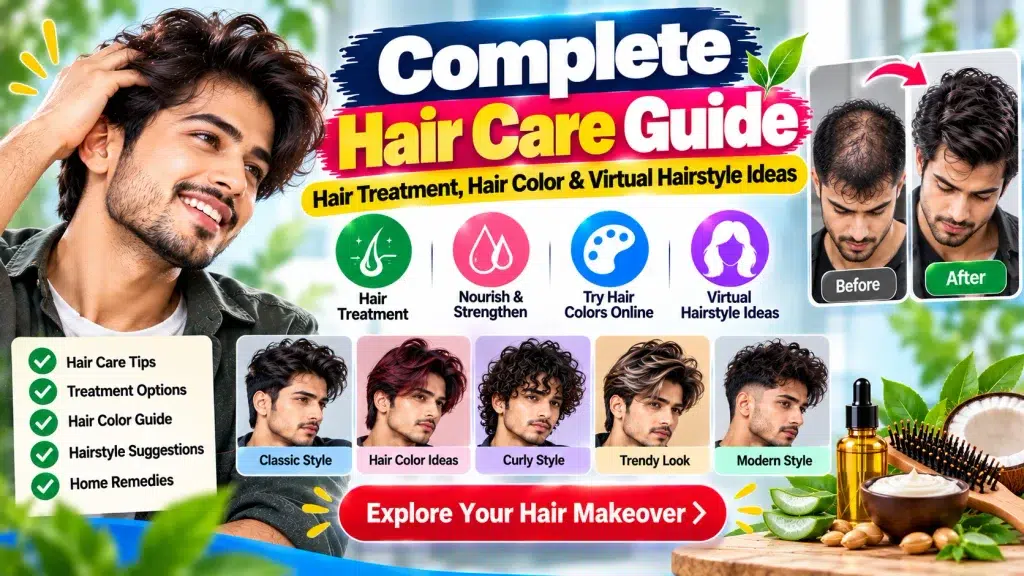
This Complete Hair Care Guide covers hair treatments for different hair types, dry and frizzy hair care, damaged and color-treated hair, everyday styling practices, virtual hair color, AI hairstyle ideas, and tips for building a personalized routine.
Understanding Your Hair Type
Before choosing a hair treatment, it helps to understand your natural hair characteristics.
Hair is commonly grouped into straight, wavy, curly, and coily textures. However, texture is only one part of the picture.
You should also consider strand thickness, overall density, scalp oil production, dryness, chemical-treatment history, and how easily your hair becomes tangled or frizzy.
For example, two people may both have wavy hair, but one may have fine, oily hair while the other has thick, dry hair. Their ideal routines may therefore be completely different.
Understanding these characteristics gives you a better starting point for selecting hair care products and hairstyles.
Hair Types and General Care Ideas
| Hair Type or Concern | Common Characteristics | General Hair Care Approach |
|---|---|---|
| Straight Hair | Smooth and may become oily quickly | Lightweight care and suitable cleansing |
| Wavy Hair | Loose S-shaped texture | Light conditioning and frizz management |
| Curly Hair | Defined curls, often prone to dryness | Moisture and gentle detangling |
| Coily Hair | Tight curls or coils | Conditioning and reduced manipulation |
| Fine Hair | Smaller strand diameter | Lightweight products |
| Thick Hair | Dense or fuller appearance | Conditioning and sectioned styling |
| Dry Hair | Rough, dull or difficult to manage | Moisture-focused care |
| Frizzy Hair | Flyaways or uneven texture | Gentle handling and suitable styling |
| Damaged Hair | Breakage, roughness or split ends | Reduced heat and chemical stress |
| Color-Treated Hair | Chemically processed | Gentle cleansing and regular conditioning |
This table provides general guidance rather than fixed rules. Your routine may need to combine several approaches.
Build a Simple Hair Care Routine
A good hair care routine does not need to include a large number of products.
Start with cleansing, conditioning, gentle handling, and styling practices appropriate for your hair.
Step 1: Cleanse Your Scalp
Choose shampoo according to your scalp and hair needs.
Some people need relatively frequent cleansing because their scalp becomes oily quickly. Others may follow a different schedule because of their natural texture and lifestyle.
There is no single washing frequency that works for everyone.
Focus on keeping the scalp comfortable and reducing unwanted buildup without making the hair unnecessarily difficult to manage.
Step 2: Use Conditioner
Conditioner can improve softness, manageability, and detangling.
People with dry, curly, long, chemically processed, or easily tangled hair may particularly benefit from regular conditioning.
If you have fine or oily hair, use an appropriate amount and concentrate the product where it is needed rather than automatically applying heavy conditioner to the roots.
Step 3: Dry and Detangle Gently
Avoid aggressively rubbing wet hair with a towel.
Gently remove excess water and work through tangles gradually.
Forceful brushing and pulling can contribute to hair breakage, particularly when hair is already fragile from chemical treatments or excessive heat.
Hair Treatment for Dry Hair
Dry hair may feel rough, appear dull, or become difficult to style.
Natural texture can influence dryness, but heat styling, chemical processing, environmental exposure, and hair care practices may also contribute.
Regular conditioning can help improve softness and manageability. Depending on your hair type, you may also use an appropriate leave-in conditioner or moisturizing styling product.
Review your heat-styling habits as well.
If you use a straightener, curling iron, or high-temperature hair dryer frequently, reducing the temperature or frequency may help limit additional cosmetic damage.
The goal should be to protect your hair while finding a routine you can realistically maintain.
Hair Treatment for Frizzy Hair
Frizz can occur with straight, wavy, curly, or coily hair.
Humidity, natural texture, dryness, friction, and styling practices can all influence how frizzy hair appears.
Conditioning and gentle handling are useful starting points.
Avoid rough towel drying and excessive brushing that disrupts the natural pattern of textured hair.
Depending on your hair type, leave-in conditioners, creams, gels, mousses, or other styling products may help create the appearance you prefer.
Remember that frizz does not automatically mean that hair is unhealthy. For some people, it is simply part of their natural texture.
Hair Care for Curly and Wavy Hair
Curly and wavy hair can benefit from routines that respect the natural pattern.
Some people with curls find it easier to detangle while the hair is damp and conditioned instead of aggressively brushing it when completely dry.
Wavy hair may require a balance between conditioning and lightweight products because overly heavy formulas can reduce volume.
Experiment with techniques that enhance your natural texture.
Choosing a hairstyle that works with your waves or curls may also reduce the amount of straightening or heat styling required every day.
Hair Treatment for Damaged Hair
Hair can become damaged from repeated bleaching, permanent coloring, chemical straightening, high-temperature styling, and mechanical stress.
Common visible signs can include split ends, brittleness, rough texture, tangling, or breakage.
If your hair is already fragile, focus on reducing additional stress.
Condition regularly, detangle carefully, and reconsider how frequently you use high-temperature tools or intensive chemical treatments.
Severely split ends may need trimming to improve the overall appearance of your hair.
Hair products can make damaged hair feel smoother and easier to manage, but they should not be expected to permanently restore every severely damaged strand to its original condition.
Hair Care for Oily Roots and Dry Ends
Many people have combination hair—an oily scalp with dry lengths or ends.
In this situation, you do not necessarily need to treat your entire hair in the same way.
Cleanse the scalp according to its needs and concentrate conditioner on drier areas.
Avoid applying excessive heavy oils or styling products directly to the roots if they make your hair feel greasy or contribute to buildup.
This targeted approach can be more practical than choosing products based only on whether your hair is labeled “oily” or “dry.”
Hair Color and Chemical Treatment Care
Changing your hair color can create a dramatic makeover, but permanent coloring and bleaching involve chemical processing.
If your hair is already dry or damaged, consider its current condition before making another major color change.
After coloring, maintain a gentle routine and condition regularly.
Repeatedly combining bleaching, chemical straightening, and frequent high-temperature styling can increase cosmetic stress on the hair.
For major transformations, an experienced hairstylist can help you understand what may be achievable based on your existing color and hair condition.
Try Hair Colors Virtually Before Coloring
If you want to change your color but are unsure which shade to choose, a virtual hair color try-on tool can help.
Depending on the platform, you may be able to preview:
- Black
- Dark brown
- Chocolate brown
- Light brown
- Blonde
- Golden blonde
- Copper
- Burgundy
- Red
- Silver or grey
- Pink
- Purple
- Blue
You can compare several colors using the same photograph before deciding which direction you prefer.
This can be particularly helpful before a dramatic change that may require bleaching.
However, virtual colors are digital simulations. Your natural color, previous treatments, hair condition, lighting, and dye formulation can affect the actual result.
What Is an AI Virtual Hairstyle?
An AI virtual hairstyle tool uses artificial intelligence or image-processing technology to place different hairstyles on your photograph.
You typically upload a clear selfie and select the hairstyle you want to explore.
The software may analyze your face position, hairline, and other visible features before creating a digital preview.
Depending on the platform, you can experiment with short hairstyles, long hair, bobs, layers, bangs, waves, curls, and different hair colors.
The advantage is that you can compare multiple looks without immediately cutting your real hair.
Find a Hairstyle for Your Face Shape
Face shape can be useful for generating hairstyle ideas, although it should not be treated as a strict rule.
Oval Face
Experiment with short cuts, bobs, long layers, waves, bangs, and longer hairstyles.
Round Face
Try longer layers, side parts, or styles with additional height if you prefer an elongated visual effect.
Square Face
Soft waves, layers, textured hairstyles, and side-swept looks can be previewed.
Heart-Shaped Face
Try shoulder-length cuts, side-swept bangs, waves, or styles with fullness around the lower part of the face.
Long or Oblong Face
Bangs, waves, curls, and medium-length hairstyles can be useful options to explore.
Ultimately, choose a hairstyle based on your preferences, natural texture, lifestyle, and maintenance requirements.
Try Short and Long Hairstyles Online
Virtual hairstyle technology is especially useful when considering a major length change.
If you have long hair and are thinking about a bob, you can preview several short styles before getting a haircut.
You can compare shoulder-length hair, layered bobs, short textured styles, or bangs.
Similarly, people with short hair can use virtual tools to visualize longer hairstyles.
The preview will not perfectly predict how your natural hair will behave at a different length, but it can provide useful inspiration.
Choose a Hairstyle Based on Your Natural Texture
One of the most important factors in a practical makeover is maintenance.
A virtual hairstyle may look attractive but require substantial daily styling if it is very different from your natural texture.
For example, someone with naturally curly hair may need frequent heat styling to maintain a completely straight look.
Someone with fine hair may also find that a very high-volume virtual hairstyle behaves differently in reality.
Consider choosing a style that works with your natural texture if you want to simplify your routine and reduce excessive manipulation.
Can AI Provide Personalized Hair Care Ideas?
Some AI hair analysis tools go beyond hairstyle simulation.
They may attempt to identify visible characteristics such as texture, volume, length, frizz, or apparent dryness and then provide general care suggestions.
This can be useful for discovering new ideas, but AI analysis has limitations.
Photograph quality, lighting, camera angle, styling products, and environmental conditions can influence results.
AI cannot reliably determine every medical cause of hair loss or scalp problems from a photograph.
Use AI hair analysis for general cosmetic guidance and inspiration rather than medical diagnosis.
Hair Growth and Breakage
People sometimes assume that hair is not growing when the real issue is repeated breakage.
Hair may continue growing from the scalp while damaged ends snap or split, making it difficult to retain length.
Reducing unnecessary breakage can therefore be an important part of maintaining longer-looking hair.
Gentle detangling, conditioning, sensible heat styling, and reducing repeated chemical stress may help protect the hair shaft.
However, significant shedding from the root is a different concern and may require professional evaluation.
Everyday Hair Care Mistakes to Avoid
Using more products does not automatically create healthier hair.
Too many heavy products can cause buildup or weigh down some hair types.
Other common issues include rough detangling, very high-temperature styling, repeatedly bleaching fragile hair, and wearing hairstyles that create constant strong tension.
Another mistake is assuming that one shampoo, oil, serum, or online recommendation can solve every hair concern.
Different problems can have different causes.
A simpler routine based on your actual hair characteristics can often be easier to evaluate and maintain.
When to Consult a Professional
Hair care and virtual makeover tools are primarily useful for cosmetic decisions.
A professional hairstylist can help with haircut selection, color planning, damaged ends, and understanding the maintenance required for a particular look.
A dermatologist or qualified healthcare professional is more appropriate for unexplained or concerning hair and scalp changes.
Seek professional medical evaluation if you experience sudden or significant hair loss, bald patches, progressive thinning, persistent itching, scalp pain, redness, sores, scaling, or other unusual symptoms.
AI analysis and cosmetic products should not be used as substitutes for medical evaluation in these situations.
Final Thoughts
A complete hair care routine should be based on your natural texture, scalp needs, current hair condition, and everyday styling habits.
Appropriate cleansing, regular conditioning, gentle detangling, reduced excessive heat, and careful use of chemical treatments can help maintain softer, more manageable, healthy-looking hair.
When you want a makeover, modern technology gives you more options than ever before.
AI hairstyle and virtual hair color try-on tools let you experiment with short hair, long layers, bobs, bangs, waves, curls, and multiple colors directly on your photograph before making a permanent change.
Use these tools to discover ideas and narrow down your preferences while remembering that virtual results are simulations.
By combining sensible hair care with virtual experimentation and professional guidance when necessary, you can make more informed decisions about your hair treatment, hair color, and next hairstyle.
Frequently Asked Questions (FAQ)
1. What is the best basic hair care routine?
A basic routine generally includes appropriate cleansing, conditioning, gentle drying and detangling, and styling methods suited to your natural hair texture and condition.
2. How do I choose the right hair treatment?
Consider your hair texture, scalp condition, dryness or oiliness, chemical-treatment history, and main concerns. There is no single treatment that is best for everyone.
3. What can help dry and frizzy hair?
Appropriate conditioning, gentle handling, reduced excessive heat, and suitable styling products may improve softness and manageability.
4. Can I try hairstyles online before cutting my hair?
Yes. AI virtual hairstyle tools can display different cuts, lengths, bangs, curls, waves, and other styles on your photograph.
5. Can I try different hair colors virtually?
Yes. Virtual hair color tools allow you to compare shades such as brown, blonde, copper, red, burgundy, silver, and creative colors without immediately dyeing your real hair.
6. Are virtual hair color results completely accurate?
No. They are simulations. Your natural color, existing dye, hair condition, lighting, bleaching requirements, and application method can affect the real result.
7. Can AI tell me which hairstyle suits my face?
Some AI tools can estimate facial proportions and suggest or display hairstyles accordingly. These recommendations are best used for inspiration rather than as fixed rules.
8. Can AI recommend hair treatment?
AI may provide general cosmetic hair care suggestions based on visible features or information you provide. It cannot reliably diagnose medical hair or scalp conditions.
9. Is hair breakage the same as hair loss?
No. Breakage happens along the hair shaft, while hair loss may involve shedding from the follicle. Persistent or significant hair loss may require professional evaluation.
10. When should I see a dermatologist about my hair?
Consider professional evaluation for sudden or severe hair loss, bald patches, progressive thinning, persistent scalp itching, pain, redness, sores, scaling, or other concerning symptoms.
Disclaimer: This article is intended for general informational and educational purposes only. Hair care suggestions, AI hair analysis, virtual hairstyles, and hair color previews are not substitutes for professional medical diagnosis or treatment. Consult a qualified dermatologist or healthcare professional for persistent hair loss, scalp conditions, or other concerning symptoms.