Hair Makeover Guide – Try Hair Colors, Hairstyles & Hair Care Ideas Online
Changing your hairstyle or hair color can give you a completely different look, but deciding what will actually suit you is not always easy. You may like a short haircut in a photo but wonder how it will look with your face shape. You may also want to try brown, blonde, burgundy, copper, or another hair color without immediately applying permanent dye. This is where online hair makeover tools can be useful.
Modern AI hairstyle apps, virtual hair color tools, and online hair makeover platforms allow you to upload a photo and experiment with different hairstyles, hair lengths, colors, bangs, curls, and other looks digitally. Instead of relying entirely on imagination, you can create a virtual preview before visiting a salon.
A successful makeover is not only about choosing a new style. Your natural hair texture, current hair condition, maintenance preferences, and everyday hair care routine should also be considered.
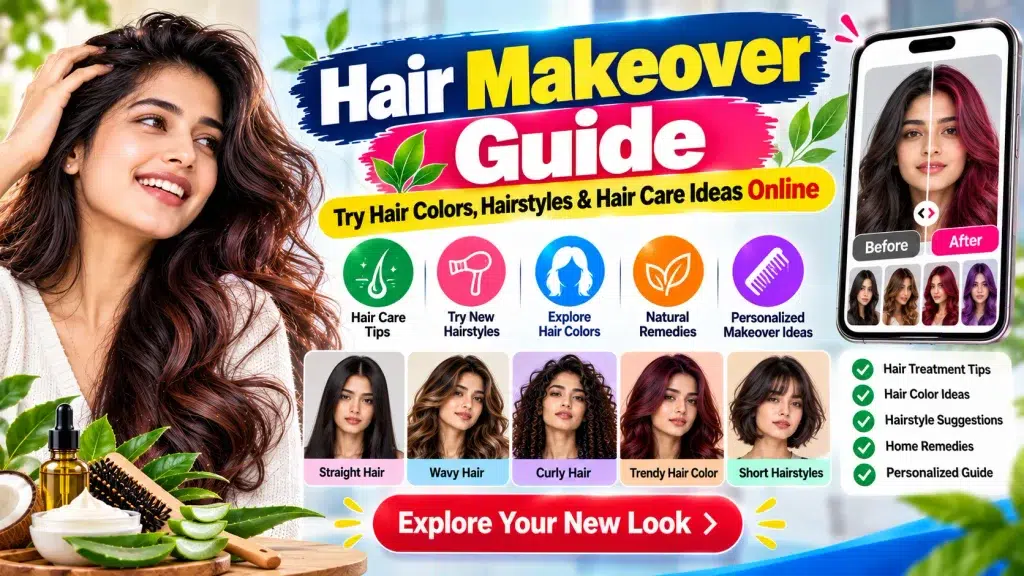
This Hair Makeover Guide explains how to try hair colors and hairstyles online, how AI virtual hairstyle technology works, what to consider before changing your look, and how to build a practical hair care routine.
What Is an Online Hair Makeover?
An online hair makeover is a digital way to experiment with different hairstyles and hair colors using your photograph.
Depending on the platform, artificial intelligence, image processing, or augmented reality technology may be used to identify your face and existing hair before applying a virtual hairstyle.
You may be able to explore options such as short hair, long hair, layered cuts, bobs, bangs, curls, waves, straight hairstyles, and multiple hair colors.
Some AI-powered tools may also analyze visible characteristics such as face shape or hair texture to provide hairstyle suggestions.
The result is a simulation rather than an exact prediction, but it can provide useful inspiration before making a real-world change.
Online Hair Makeover Features at a Glance
| Feature | What You Can Try | Why It May Be Useful |
|---|---|---|
| AI Hairstyle Try-On | Short, medium and long styles | Preview haircuts before cutting |
| Virtual Hair Color | Brown, blonde, red and more | Compare colors before dyeing |
| Bangs & Fringe | Different front-hair styles | Test a noticeable change |
| Curly Hair Preview | Curls and textured styles | Explore a different appearance |
| Hair Length Preview | Short to long hair | Compare different lengths |
| Face Shape Ideas | Styles based on facial proportions | Discover hairstyle inspiration |
| Hair Care Suggestions | General routine ideas | Improve everyday maintenance |
| Before & After Preview | Current and virtual looks | Compare makeover options |
These features vary between apps and websites, so not every tool will provide all of them.
How Does an AI Hairstyle Tool Work?
Most AI hairstyle tools begin with a photograph.
You upload a clear selfie, and the system uses computer vision or image-processing technology to detect visible facial and hair features. It can then place a selected hairstyle over your photograph.
More advanced tools may adjust the virtual hair according to the position of your head and face.
For the most useful preview, choose a clear, front-facing photograph with good lighting. Your face and current hairline should be visible.
Avoid photographs with heavy beauty filters, hats, or objects covering large parts of the hair.
Remember that virtual hairstyle technology cannot perfectly reproduce real hair movement, density, texture, or salon technique.
Try Different Hairstyles Online
One of the biggest advantages of a virtual hair makeover is the ability to experiment freely.
Suppose you currently have long hair but are considering a shoulder-length cut. Instead of immediately cutting it, you can preview several shorter styles online.
You can compare a bob with layers, bangs, waves, or a straight finish.
Someone with short hair may use the same technology to visualize longer styles.
Virtual hairstyle tools can also be useful when you are unsure about a dramatic change such as bangs. Since bangs significantly alter the appearance of the face, previewing them can help you decide whether you like the general look.
Explore Short Hairstyles Virtually
Cutting long hair short can feel like a major commitment because growing it back takes time.
AI hairstyle tools allow you to preview short styles first.
You can experiment with bob cuts, pixie-inspired looks, short layers, shoulder-length styles, or textured cuts.
Pay attention not only to how the hairstyle frames your face but also to whether it suits your natural texture.
For example, a sleek virtual bob may require additional styling if your natural hair is highly curly or wavy.
Consider how much daily maintenance you are willing to do before choosing the real haircut.
Try Long and Layered Hairstyles
Long and layered hairstyles remain popular because they can create movement while maintaining length.
If your hair is already long, virtual makeover tools can help you compare different types of layers, face-framing sections, bangs, and styling options.
If your hair is currently short, an AI tool can provide an approximate preview of how you might look with longer hair.
However, a digital preview cannot predict exactly how your natural hair will behave at a different length.
Hair density, curl pattern, thickness, and styling methods will influence the final appearance.
Try Hair Colors Online Before Coloring
Changing hair color can be one of the most noticeable parts of a makeover.
A virtual hair color try-on tool allows you to experiment with shades without immediately applying dye.
Depending on the tool, you may be able to try:
- Black
- Dark brown
- Chocolate brown
- Light brown
- Blonde
- Golden blonde
- Copper
- Burgundy
- Red
- Silver or grey
- Pink
- Purple
- Blue
Using the same photograph for every color can make comparisons easier.
Virtual color previews can help you narrow down your preferences before visiting a salon, especially if you are considering a dramatic color change.
Remember That Virtual Hair Color Is a Simulation
Digital hair color does not guarantee an identical real-world result.
Your existing hair color, previous dye, hair condition, lighting, dye formulation, bleaching requirements, and application technique can all influence the final shade.
For example, achieving a very light color on naturally dark hair may require a different process from simply applying the same shade digitally.
Therefore, use virtual hair color as an inspiration and planning tool.
If you are considering significant bleaching or color correction, discuss your goals and existing hair condition with an experienced hair professional.
Find Hairstyles Based on Face Shape
Face shape can provide useful inspiration when exploring a makeover, although it should never be treated as a strict beauty rule.
Oval Face
Oval faces can be experimented with using many styles, including short cuts, bobs, layers, bangs, waves, and longer hairstyles.
Round Face
If your goal is to create the visual impression of additional length, try longer layers, side parts, or styles with volume near the top.
Square Face
Soft waves, layered hairstyles, textured cuts, and side-swept styles can be virtually tested to see which appearance you prefer.
Heart-Shaped Face
Shoulder-length hair, side-swept bangs, waves, and styles with volume around the lower part of the face can be explored.
Long or Oblong Face
Medium-length cuts, waves, curls, and bangs are among the options you can preview.
Face shape is only one consideration. Your natural hair texture and personal preference are equally important.
Consider Your Natural Hair Type
A virtual hairstyle may look attractive in a photograph but require considerable maintenance if it is very different from your natural hair texture.
Straight, wavy, curly, and coily hair behave differently.
If you have naturally curly hair but select a very straight virtual hairstyle, think about whether you are comfortable regularly straightening your hair.
Likewise, people with fine hair should remember that some high-volume virtual hairstyles may look different with their natural density.
Choosing a haircut that works with your existing texture can make everyday styling easier and potentially reduce unnecessary heat and manipulation.
Hair Care Before a Makeover
Before getting a haircut, color, or chemical treatment, consider the current condition of your hair.
If it feels dry, brittle, or severely damaged, immediately adding another intensive chemical process may not be ideal.
Start with a simple hair care routine.
Choose shampoo based on your scalp and hair needs and use conditioner where appropriate, particularly on dry mid-lengths and ends.
Detangle carefully and avoid aggressively rubbing wet hair with a towel.
If your hair is already fragile, reduce unnecessary heat styling while deciding on your next makeover.
Hair Care for Dry and Frizzy Hair
Dry and frizzy hair can benefit from appropriate conditioning and gentle handling.
Depending on your texture, you may also consider a suitable leave-in conditioner or styling product to improve manageability.
Avoid using extremely high heat simply to make frizzy hair appear smoother.
If your hair is naturally wavy or curly, explore virtual hairstyles that highlight your natural texture. You may discover a style that requires less straightening and daily manipulation.
Frizz itself does not always mean that hair is unhealthy. Natural texture, humidity, products, and styling techniques can all influence its appearance.
Hair Care for Colored Hair
If your virtual makeover inspires you to color your real hair, aftercare becomes important.
Permanent coloring and bleaching involve chemical processing and can affect the feel and condition of the hair.
Use a gentle routine appropriate for chemically treated hair and condition regularly.
Avoid repeatedly combining bleaching, high-temperature styling, and other intensive processes without considering your hair’s condition.
If you want another major color change soon after coloring, consult an experienced stylist about what is realistically achievable.
Hair Care for Curly and Wavy Hair
Curly and wavy hair can be particularly versatile for virtual makeovers.
You can experiment with different curl lengths, layers, bangs, and shapes without physically changing your hair.
For everyday care, gentle detangling can help reduce unnecessary breakage.
Some people find it easier to detangle curls while the hair is damp and conditioned rather than aggressively brushing completely dry hair.
Styling products designed for your texture may also help enhance the natural pattern.
The objective should be to find a routine and hairstyle that are manageable for your individual hair.
How to Build a Simple Hair Care Routine
A useful routine does not need to contain a large number of products.
Step 1: Identify Your Hair Type
Determine whether your hair is primarily straight, wavy, curly, or coily.
Step 2: Understand Your Scalp
Consider whether your scalp tends to become oily quickly, feels dry, or is generally balanced.
Step 3: Cleanse Appropriately
Choose shampoo and washing frequency according to your individual needs.
Step 4: Condition Your Hair
Use conditioner to improve softness and manageability, particularly where your hair tends to become dry.
Step 5: Handle Hair Gently
Avoid aggressive towel drying, forceful detangling, and unnecessary pulling.
Step 6: Control Heat Exposure
Use heated tools thoughtfully and avoid unnecessarily high temperatures.
Step 7: Review Chemical Treatments
Consider the condition of your hair before bleaching, coloring, straightening, or perming it again.
AI Hair Analysis and Personalized Ideas
Some AI makeover platforms go beyond hairstyle simulation and attempt to analyze visible hair characteristics.
For example, an app may estimate your hair texture, length, volume, face shape, or visible dryness and then suggest hairstyles or general care ideas.
This can make the makeover process feel more personalized.
However, AI analysis has limitations. Results can be affected by lighting, photograph quality, hairstyle, products, and camera angle.
AI also cannot diagnose medical hair or scalp conditions from a photograph with complete reliability.
Use these features for cosmetic inspiration rather than medical decisions.
Hair Makeover Without Permanent Changes
One of the best things about virtual makeover technology is that experimentation does not require commitment.
You can try a blonde bob in one preview, long dark waves in another, and burgundy layers in a third.
If you dislike a style, simply select another one.
This makes online hair makeover tools particularly useful for people who frequently search for new style ideas but are hesitant about making dramatic changes.
You can save your favorite virtual look and use it as a reference when discussing your haircut or color with a stylist.
Common Hair Makeover Mistakes
Avoid choosing a hairstyle solely because it looks good on another person.
Hair texture, density, face shape, maintenance requirements, and personal preferences all influence the result.
Another mistake is expecting the virtual preview to exactly match the finished salon look.
Digital tools are useful for visualization, but they cannot perfectly reproduce real-world hair.
Also consider hair condition before making a major chemical change. If your hair is already severely damaged, adding more bleach or chemical processing can increase cosmetic stress.
When Hair Concerns Need Professional Attention
Hair makeover apps are intended mainly for cosmetic experimentation.
They should not be used to diagnose unexplained hair loss or scalp problems.
If you notice sudden or significant hair loss, bald patches, progressive thinning, persistent itching, scalp pain, redness, sores, or other unusual changes, consider consulting a qualified dermatologist or healthcare professional.
A hairstylist can help with haircut and color decisions, while a dermatologist is better suited to evaluating medical hair and scalp concerns.
Final Thoughts
An online Hair Makeover Guide can help you explore a new appearance with less guesswork. AI hairstyle and virtual hair color tools allow you to preview short cuts, long hairstyles, layers, bangs, curls, waves, and multiple hair colors directly on your photograph.
These tools are especially useful when you are planning a significant haircut or color change but want to visualize several options first.
At the same time, remember that a successful makeover involves more than choosing an attractive digital style. Consider your natural texture, hair condition, maintenance preferences, and daily routine.
Gentle cleansing, appropriate conditioning, careful detangling, sensible heat styling, and thoughtful chemical processing can help maintain manageable, healthy-looking hair.
Use AI and virtual makeover technology for inspiration and planning, then combine those ideas with practical hair care and professional advice when necessary.
Frequently Asked Questions (FAQ)
1. What is an online hair makeover?
An online hair makeover uses digital technology to show different hairstyles, hair lengths, textures, or colors on your photograph before you make a real change.
2. Can I try hairstyles online using my own photo?
Yes. Many virtual hairstyle tools allow you to upload a clear photograph and digitally preview different haircuts and styles.
3. Can I try different hair colors without dyeing my hair?
Yes. Virtual hair color tools can simulate shades such as black, brown, blonde, copper, red, burgundy, silver, and creative colors without changing your real hair.
4. Are virtual hairstyles completely accurate?
No. They are digital simulations. Real results depend on hair texture, density, haircut technique, styling, lighting, and other factors.
5. Can AI suggest hairstyles based on face shape?
Some AI tools estimate facial proportions and display hairstyles based on the detected face shape. These suggestions should be considered inspiration rather than strict rules.
6. Can I preview short hair before cutting long hair?
Yes. Virtual hairstyle tools can be particularly useful for comparing bobs, shoulder-length cuts, short layers, and other shorter hairstyles before committing to a haircut.
7. Can I virtually try bangs?
Yes. Depending on the app, you may be able to preview different bangs and fringe styles before cutting your real hair.
8. Can AI provide hair care ideas?
Some AI platforms provide general suggestions based on visible hair characteristics or information you enter. These recommendations are intended for general cosmetic guidance and are not medical advice.
9. How should I choose between several virtual hairstyles?
Consider your natural hair texture, face shape, hair density, preferred maintenance level, lifestyle, and personal taste. A professional stylist can also help determine how realistically a virtual look can be achieved.
10. Can a hair makeover app diagnose hair loss?
No. A virtual makeover or AI hair app should not be relied upon to diagnose the cause of hair loss or scalp conditions. Persistent or concerning symptoms should be evaluated by a qualified healthcare professional.
Disclaimer: This article is intended for general informational and educational purposes only. Virtual hairstyle, hair color, and AI hair-analysis tools provide digital simulations and general cosmetic suggestions. They are not substitutes for professional medical diagnosis or treatment. Consult a qualified dermatologist or healthcare professional for persistent hair loss, scalp problems, or other concerning symptoms.