Hair Growth & Hair Care Guide – Explore Treatment and Hairstyle Ideas
Healthy-looking hair depends on more than choosing a popular shampoo or applying a new product. Hair growth, scalp condition, hair texture, daily styling habits, nutrition, genetics, age, and overall health can all influence how your hair looks and feels. Building a practical hair care routine can help protect existing hair, reduce unnecessary breakage, and make it easier to manage your natural texture.
At the same time, modern technology has changed how people explore new hairstyles. AI hairstyle apps, virtual hairstyle tools, and hair color try-on features allow you to experiment with different looks before cutting or coloring your real hair.
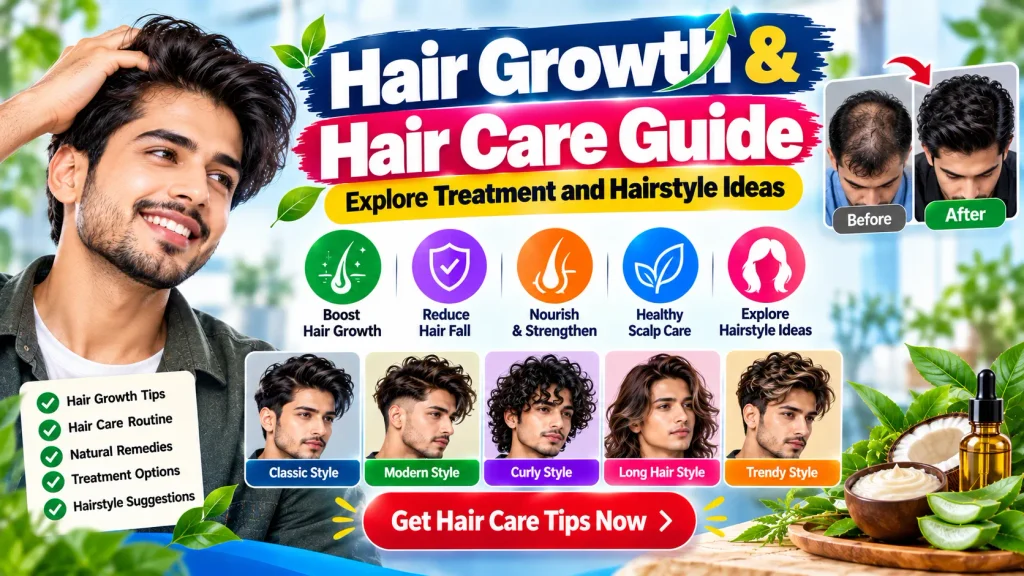
This Hair Growth & Hair Care Guide covers the basics of the hair growth cycle, everyday hair care, ways to reduce cosmetic damage, treatment considerations, and virtual hairstyle ideas that can help you plan your next look.
Understanding the Hair Growth Cycle
Hair does not grow continuously forever. Each hair follicle goes through a natural cycle that includes periods of growth, transition, rest, and shedding.
Because individual follicles are at different stages at any given time, some daily shedding is normal.
Hair growth can vary considerably from person to person. Genetics, age, health, hormones, nutrition, medications, and other factors can influence the growth cycle.
For this reason, products that promise extremely fast or guaranteed hair growth should be approached carefully.
A healthy hair care routine can support scalp and hair maintenance, but cosmetic products cannot change every factor responsible for hair growth.
Hair Growth and Hair Care at a Glance
| Hair Concern | General Care Approach | What to Consider |
|---|---|---|
| Dry Hair | Conditioning and gentle handling | Reduce excessive heat |
| Oily Scalp | Cleanse according to scalp needs | Avoid excessive buildup |
| Frizzy Hair | Moisture and gentle styling | Work with natural texture |
| Hair Breakage | Careful detangling | Avoid rough handling |
| Heat-Damaged Hair | Reduce heat exposure | Use appropriate protection |
| Color-Treated Hair | Gentle care and conditioning | Limit repeated processing |
| Thinning or Hair Loss | Seek appropriate evaluation | Cause determines treatment |
| Hairstyle Change | Use virtual hairstyle tools | Consider texture and maintenance |
This table provides general guidance. Individual needs can differ significantly.
Build a Healthy Hair Care Routine
A good routine does not have to include many different products. Start with the basics and adjust them according to your scalp and hair type.
1. Cleanse According to Your Scalp
Choose a shampoo suitable for your scalp condition and styling habits.
People with oily scalps may prefer more frequent cleansing, while others may need a different schedule. There is no single washing frequency that is ideal for everyone.
Focus shampoo primarily where cleansing is needed, especially around the scalp.
2. Use Conditioner Appropriately
Conditioner can help improve softness, manageability, and detangling.
If your hair is dry, curly, long, chemically treated, or prone to tangles, regular conditioning may be particularly useful.
Fine or easily weighed-down hair may require lighter products.
3. Dry Hair Gently
Hair can be vulnerable to mechanical stress when wet.
Instead of aggressively rubbing it with a towel, gently remove excess water. When detangling, work gradually through knots rather than pulling forcefully.
Small changes in everyday handling can help reduce unnecessary breakage.
Hair Growth vs. Hair Breakage
Hair growth and hair length are not exactly the same issue.
Hair may continue growing from the scalp while the ends repeatedly break because of heat, chemicals, friction, or rough handling. In this situation, it can appear that the hair is “not growing” even though new growth is occurring.
Reducing breakage can therefore be an important part of maintaining longer-looking hair.
Regular conditioning, gentle detangling, reducing excessive heat, and avoiding unnecessary chemical processing can help protect the hair shaft.
Trimming split or severely damaged ends may also improve the overall appearance of your hair.
Hair Care for Dry and Frizzy Hair
Dry and frizzy hair may benefit from a routine focused on conditioning and gentle handling.
Choose products appropriate for your natural texture and avoid using excessive heat simply to make the hair look smoother.
Depending on your hair type, a leave-in conditioner or suitable styling product may help improve manageability.
People with naturally curly or wavy hair may find that working with their natural texture reduces the need for daily straightening.
Frizz itself does not automatically mean that your hair is unhealthy. Natural texture, weather, humidity, and styling techniques can all affect frizz.
Hair Care for an Oily Scalp
An oily scalp can coexist with dry hair ends.
If your roots become greasy quickly, cleanse according to your scalp’s needs and be mindful of heavy products applied directly to the roots.
Conditioner can still be useful, particularly on dry mid-lengths and ends.
Product buildup can sometimes make hair look flat or greasy, so adjust the amount of styling products you use if necessary.
The objective is to find a routine that keeps your scalp comfortable without making the hair unnecessarily dry.
Reduce Excessive Heat Styling
Straighteners, curling irons, and hair dryers make it easy to change your hairstyle, but repeated high-temperature exposure can contribute to hair-shaft damage.
If you regularly use heated tools, consider reducing the temperature or frequency.
Avoid repeatedly applying a hot tool to the same section of hair.
When practical, allow hair to partially air-dry before blow drying.
Using an appropriate heat-protection product can also be part of a heat-styling routine.
These steps are primarily intended to reduce cosmetic damage and breakage; they are not treatments for medical hair loss.
Be Careful With Chemical Treatments
Hair coloring, bleaching, permanent straightening, relaxing, and perming can dramatically change your appearance, but these processes can also affect the condition of your hair.
If your hair already feels dry, brittle, or severely damaged, consider its current condition before undergoing another chemical procedure.
Spacing treatments and discussing your hair history with an experienced stylist can help you make more informed decisions.
If you are considering a dramatic color change, a virtual hair color try-on tool can help you preview different shades before using permanent dye or bleach.
Nutrition and Hair Growth
Nutrition plays a role in overall health, including normal hair function. A balanced diet that provides adequate protein, vitamins, minerals, and other essential nutrients is generally important.
However, taking large amounts of hair supplements does not automatically produce faster hair growth.
Specific nutritional deficiencies can contribute to hair changes, but supplementation should ideally be based on an actual need rather than assumptions.
If you are concerned about a nutritional deficiency or unexplained hair loss, discuss it with a qualified healthcare professional.
Avoid relying on supplements marketed with guaranteed or unusually rapid hair-growth claims.
Can Hair Oils Increase Hair Growth?
Hair oils are widely used as part of grooming routines. Depending on the product and hair type, oil can help reduce friction, improve manageability, or make dry lengths feel smoother.
However, applying oil does not automatically address the underlying causes of hair loss.
If you enjoy using hair oil and it works well for your scalp and hair, it can be incorporated into your routine. Avoid assuming that using larger amounts will necessarily produce faster growth.
If a product causes irritation or scalp discomfort, stop using it and seek professional advice if symptoms persist.
Explore Hairstyles That Work With Your Hair
Hair care and hairstyle choice are closely connected.
A haircut that complements your natural texture may require less daily manipulation than one that needs constant straightening, curling, or intensive styling.
For example, someone with naturally wavy hair may explore layered hairstyles that enhance waves. Someone with curly hair may choose a cut designed to create shape and movement while maintaining the natural curl pattern.
People with damaged ends may consider shorter hairstyles that remove some of the affected length.
Before making a major change, you can preview different options virtually.
Use AI to Try Hairstyles Virtually
AI-powered virtual hairstyle tools can analyze a photograph and display different hairstyles over your image.
Depending on the app, you may be able to explore:
- Short hairstyles
- Medium-length hairstyles
- Long hairstyles
- Layered haircuts
- Bob hairstyles
- Bangs and fringes
- Curly styles
- Wavy hairstyles
- Straight hairstyles
- Different hair colors
This can be useful if you are unsure whether a particular haircut will match your overall look.
Virtual results are simulations rather than guarantees, but they can provide useful inspiration before visiting a hairstylist.
Find a Hairstyle Based on Face Shape
Face shape can provide additional inspiration when exploring hairstyles, although it should not be treated as a strict rule.
People with oval faces can experiment with many different lengths and textures. For round faces, longer layers or styles with additional height can be previewed. Square faces can be tested with soft waves, layers, and side-swept styles.
Heart-shaped faces can experiment with shoulder-length styles or side-swept bangs, while people with longer face shapes may want to preview bangs, waves, or medium-length cuts.
Personal preference, natural hair texture, maintenance requirements, and lifestyle are ultimately more important than following rigid face-shape rules.
Can AI Recommend Hair Treatments?
Some AI hair analysis tools attempt to identify visible features such as texture, volume, frizz, dryness, or apparent density from a photograph.
They may then provide general hair care recommendations.
These features can be useful for exploring ideas, but AI cannot diagnose every cause of hair loss or scalp problems from an image.
Lighting, camera angle, hair products, hairstyle, and image quality can also influence results.
Use AI as a hair care and hairstyle inspiration tool, not as a substitute for medical diagnosis.
Common Hair Care Mistakes to Avoid
Overcomplicating your routine is a common mistake. Using many products simultaneously does not guarantee better results.
Other practices that may contribute to cosmetic damage include aggressive detangling, repeated high-temperature styling, frequent bleaching, and constantly wearing very tight hairstyles.
Another mistake is expecting one shampoo, oil, serum, or supplement to solve every form of hair loss.
Hair loss can have different causes, so treatment should be based on the underlying issue.
When to Consult a Dermatologist
General hair care can help maintain appearance and reduce avoidable breakage, but some concerns require professional evaluation.
Consider consulting a qualified dermatologist or healthcare professional if you experience sudden or significant hair loss, bald patches, progressive thinning, persistent scalp itching, pain, redness, sores, or unusual scaling.
Professional evaluation is also appropriate when hair loss continues and you do not know the cause.
A healthcare professional can assess your individual situation and determine whether further investigation or treatment may be needed.
Final Thoughts
A practical hair growth and hair care routine starts with understanding your scalp, natural hair texture, styling habits, and individual concerns.
Gentle cleansing, appropriate conditioning, careful detangling, reduced excessive heat, and sensible use of chemical treatments can help protect your hair from unnecessary damage and breakage.
At the same time, AI hairstyle and virtual makeover tools can help you explore a completely new appearance without immediately changing your real hair. Try different lengths, layers, curls, waves, bangs, and hair colors virtually before deciding on your next makeover.
Remember that cosmetic hair care can support healthier-looking, more manageable hair, but it cannot treat every cause of hair loss.
For persistent or concerning hair and scalp changes, seek advice from a qualified healthcare professional.
Frequently Asked Questions (FAQ)
1. What is the best way to support healthy hair growth?
A balanced diet, appropriate scalp and hair care, gentle handling, and limiting unnecessary damage can support overall hair health. Hair growth itself is also influenced by genetics, age, health, and other factors.
2. Can shampoo make hair grow faster?
Shampoo primarily cleanses the scalp and hair. It should not be expected to dramatically accelerate the natural hair growth cycle.
3. How can I reduce hair breakage?
Condition regularly, detangle gently, reduce excessive heat, avoid unnecessary chemical processing, and limit hairstyles that place excessive tension on the hair.
4. Does cutting hair make it grow faster?
Cutting the ends does not change the rate of hair growth from the follicles. However, trimming split or damaged ends can improve appearance and reduce further splitting.
5. Can hair oil help with hair care?
Hair oil can help improve lubrication, smoothness, and manageability for some hair types. It should not be considered a guaranteed treatment for hair loss.
6. Can I use AI to find the right hairstyle?
Yes. AI hairstyle tools can help you preview different haircuts, lengths, textures, bangs, and colors using your photograph.
7. Can I try a new hair color virtually?
Yes. Virtual hair color tools can simulate various shades before you decide whether to color your real hair.
8. Can AI diagnose hair loss?
No. AI may analyze visible characteristics, but it cannot reliably diagnose all causes of hair loss or scalp conditions.
9. Which hairstyle is best for healthy hair?
There is no single best hairstyle. Generally, choosing manageable styles that do not require constant excessive heat, chemical processing, or strong tension can help reduce avoidable damage.
10. When should I seek professional advice for hair loss?
Seek professional evaluation for sudden, persistent, severe, or patchy hair loss, progressive thinning, or hair loss accompanied by scalp pain, itching, redness, sores, or other unusual symptoms.
Disclaimer: This article is for general informational and educational purposes only and is not a substitute for medical diagnosis or treatment. Hair growth and hair loss can be influenced by many factors. Consult a qualified dermatologist or healthcare professional for persistent hair loss, scalp conditions, or other concerning symptoms.