Hair Fall Treatment & Hair Care – Explore Hairstyles That Suit Your Look
Hair fall is a common concern that can affect people at different ages and for many different reasons. At the same time, choosing the right hairstyle can influence how your hair looks, how easy it is to manage, and how confident you feel about your overall appearance. With modern hair care methods and AI-powered virtual hairstyle tools, it has become easier to explore hair care ideas while also discovering hairstyles that may suit your face shape and hair type.
However, hair fall is not always simply a cosmetic issue. Temporary shedding may occur because of changes in routine or other factors, while persistent or sudden hair loss can have underlying causes that require professional evaluation.
A practical approach therefore combines gentle hair care, appropriate styling habits, understanding possible causes of hair fall, and professional advice when needed.
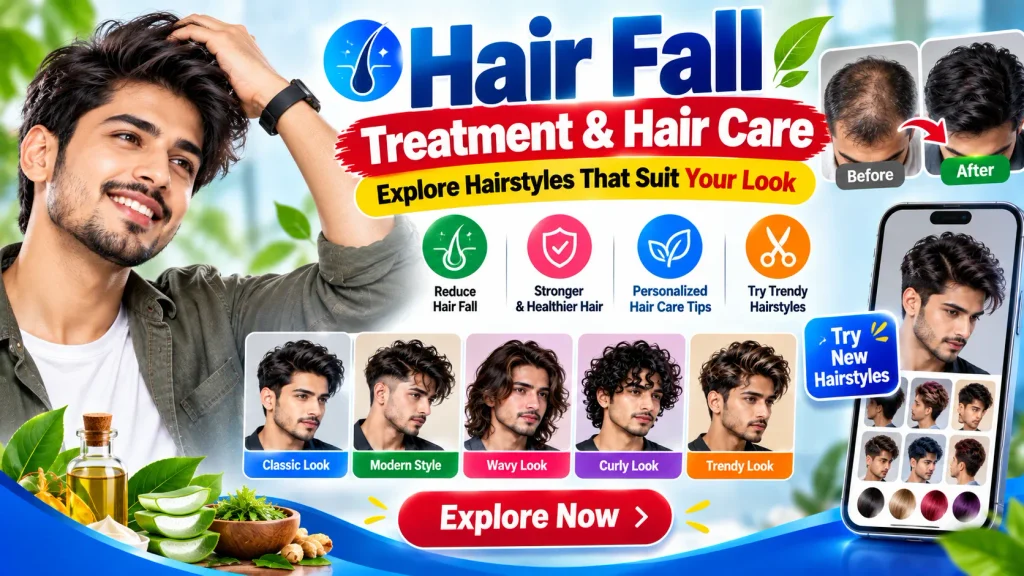
This guide covers general hair fall care, routines for different hair types, styling practices, and ways to use virtual hairstyle technology to explore a new look before getting a haircut.
What Is Hair Fall?
People naturally shed some hair as part of the normal hair growth cycle. Individual hairs move through growth, transition, resting, and shedding phases.
Because of this cycle, finding some hair on a brush, pillow, or during washing does not automatically indicate a serious problem.
The concern becomes more important when you notice a significant change from your usual pattern, visible thinning, bald patches, a widening part, or continued excessive shedding.
There are many possible reasons for hair loss, and appearance alone may not reveal the underlying cause.
Common Factors Associated With Hair Fall
Hair fall can occur for different reasons. Some may be temporary, while others require medical assessment.
Possible factors can include genetics, age, nutritional deficiencies, hormonal changes, illness, certain medications, stress, scalp conditions, and physical or chemical damage to the hair.
Repeated bleaching, coloring, straightening, and excessive heat can contribute to hair breakage, which may sometimes be mistaken for hair loss from the root.
Tight hairstyles can also place repeated tension on the hair.
Because different causes require different approaches, there is no single hair fall treatment that is suitable for everyone.
Hair Fall Care at a Glance
| Hair Concern | Possible Care Approach | What to Avoid |
|---|---|---|
| Dry & Brittle Hair | Gentle cleansing and conditioning | Excessive heat |
| Oily Scalp | Cleanse according to scalp needs | Heavy product buildup |
| Frizzy Hair | Conditioning and gentle styling | Rough towel drying |
| Heat-Damaged Hair | Reduce heat and use careful styling | Frequent high temperatures |
| Color-Treated Hair | Gentle care and conditioning | Repeated chemical processing |
| Hair Breakage | Gentle detangling and handling | Aggressive brushing |
| Tension From Hairstyles | Use looser styles | Constant tight ponytails or braids |
| Sudden Hair Loss | Seek professional evaluation | Self-diagnosing the cause |
The appropriate approach depends on whether you are dealing with hair breakage, normal shedding, or an underlying form of hair loss.
Hair Fall Treatment Starts With Understanding the Cause
When people search for the best hair fall treatment, they often expect a single shampoo, oil, serum, or home remedy to solve the problem. In reality, effective management depends on the cause.
For example, hair that is breaking because of repeated heat styling requires a different approach from hair loss related to a scalp condition or hereditary pattern.
If your concern is mainly cosmetic breakage, reducing damaging styling practices and improving conditioning may help protect the remaining hair shaft.
If the hair is falling from the root or there is visible thinning, professional evaluation can be more important.
Avoid starting medical hair-loss treatments based solely on an app, online article, advertisement, or social media recommendation.
Build a Gentle Hair Care Routine
A complicated hair routine is not necessarily better. For many people, consistency and gentle handling are more useful than constantly changing products.
Begin with a shampoo appropriate for your scalp. The ideal washing frequency varies depending on oil production, hair texture, physical activity, styling products, and individual preference.
Follow with conditioner where appropriate, particularly through dry mid-lengths and ends.
After washing, handle wet hair carefully. Avoid aggressive towel rubbing or forcefully pulling through tangles.
If you use a hair dryer, straightener, or curling tool, keep unnecessary high-temperature exposure to a minimum.
Hair Care for Dry and Brittle Hair
Dry hair can become rough, difficult to manage, and more vulnerable to breakage.
Conditioning is an important part of caring for dry hair. Depending on your texture, you may also benefit from a leave-in conditioner or another suitable moisturizing styling product.
Try to identify practices that may be increasing dryness.
Frequent bleaching, chemical straightening, repeated coloring, and high-temperature styling can affect the hair shaft.
Reducing the frequency of these procedures may make the hair easier to manage and help limit additional cosmetic damage.
Trimming severely split ends can also improve the appearance of damaged lengths, although trimming does not treat hair loss occurring at the root.
Hair Care for an Oily Scalp
An oily scalp and dry hair can occur at the same time. This is especially common when the roots become greasy relatively quickly but the longer sections have been colored, heat styled, or exposed to environmental damage.
Cleanse your scalp according to its needs.
If heavy oils or styling products make your roots feel greasy, reduce the amount applied directly to the scalp.
Conditioner can still be used where necessary, particularly on the mid-lengths and ends.
There is no universal rule requiring everyone to wash their hair on exactly the same schedule.
Hair Care for Curly and Wavy Hair
Curly and wavy hair can require different handling compared with naturally straight hair.
Because curls can tangle easily, aggressive dry brushing may contribute to breakage for some people. Gentle detangling, often while the hair is damp and conditioned, can make the process more manageable.
Use products appropriate for your curl pattern without applying so much that the hair becomes unnecessarily weighed down.
If you regularly straighten naturally curly hair, consider how frequently you expose it to heat.
Embracing your natural texture occasionally may reduce the amount of daily manipulation required.
Avoid Hairstyles That Pull Too Tightly
Your hairstyle can affect more than your appearance.
Repeatedly wearing hairstyles that pull strongly on the hair can place tension on the follicles. Examples can include very tight ponytails, buns, braids, extensions, or similar styles.
Choosing looser hairstyles and varying your style can reduce continuous tension.
If a hairstyle feels painful or creates strong pulling around the hairline, consider loosening it.
Persistent hair loss in areas exposed to tension should be discussed with a dermatologist.
Reduce Excessive Heat Styling
Hair dryers, straighteners, curling irons, and other heated tools are useful for styling, but repeated high-temperature exposure can damage the hair shaft.
You do not necessarily need to eliminate all heat styling. Instead, use it thoughtfully.
Allow hair to partially air-dry when practical, use appropriate temperature settings, and avoid repeatedly passing a heated tool over the same section.
An appropriate heat-protection product may also help reduce some styling-related damage.
Remember that reducing heat can help with hair breakage, but it will not necessarily address medical causes of hair loss.
Be Careful With Chemical Hair Treatments
Hair color, bleach, permanent straightening, relaxing, and perming can dramatically change your appearance. They can also place additional stress on the hair.
If your hair already feels brittle or severely damaged, consider its condition before scheduling another intensive chemical procedure.
Spacing treatments and discussing your hair history with an experienced stylist can help you make more informed cosmetic decisions.
Before making a dramatic color change, you can also use a virtual hair color try-on tool to preview the look without immediately applying chemicals.
Explore Hairstyles That Suit Your Look
Hair care and hairstyle selection often go together.
A suitable haircut can make hair easier to manage and may help you achieve the appearance you want without excessive daily styling.
Modern AI hairstyle apps and virtual hair makeover tools allow you to upload a photograph and experiment with different looks digitally.
Depending on the tool, you may be able to preview:
- Short hairstyles
- Medium-length hairstyles
- Long layered cuts
- Bob hairstyles
- Bangs and fringes
- Straight hairstyles
- Wavy and curly looks
- Different hair colors
- Men’s hairstyles
- Women’s hairstyles
This can be useful if you want a makeover but are uncertain about making a permanent change.
Find Hairstyles Based on Face Shape
Face shape is one factor you can consider when choosing a hairstyle, although it should never be treated as a strict rule.
Oval Face
Oval faces can be tested with a wide range of styles, including bobs, layers, long hair, short cuts, waves, and bangs.
Round Face
If you want to visually create additional length, you can experiment with longer layers, side parts, or styles that add volume toward the top.
Square Face
Soft layers, waves, textured cuts, and side-swept styles are options you can preview virtually.
Heart-Shaped Face
Shoulder-length styles, side-swept bangs, and hairstyles that create volume around the lower part of the face can be explored.
Long or Oblong Face
Bangs, waves, curls, and medium-length hairstyles can be virtually tested to see which proportions you prefer.
The best hairstyle is ultimately the one that fits your personal taste, natural hair texture, maintenance preferences, and lifestyle.
Can AI Help You Choose a Hairstyle?
AI can make hairstyle selection more interactive.
A virtual hairstyle tool may analyze visible facial features and place digital hairstyles over your photograph. Some tools can also estimate face shape, hair texture, or other visible characteristics.
This makes it possible to compare several styles without actually cutting your hair.
For example, someone with long hair can preview a short bob before visiting a salon. Another person can test bangs or a different hair color without making an immediate commitment.
However, AI previews are simulations. Real hair thickness, texture, movement, haircut technique, and styling can make the actual result look different.
Can AI Detect Hair Fall?
Some AI-powered hair analysis tools claim to assess visible characteristics such as hair density, scalp visibility, or changes in appearance.
Such tools may be useful for organizing observations or tracking photographs over time, but they should not be considered a medical diagnosis.
A photo cannot reliably identify every possible cause of hair loss.
If you are experiencing persistent or significant hair fall, consult a qualified healthcare professional rather than relying entirely on an AI-generated result.
Healthy Lifestyle and Hair Care
Overall health and hair are connected, but simplistic claims that one particular food or supplement will stop hair loss should be treated cautiously.
A balanced diet that provides adequate nutrients supports general health. Nutritional deficiencies can contribute to certain hair problems, but taking supplements without knowing whether you have a deficiency is not always appropriate.
If you suspect a nutritional issue, a healthcare professional can determine whether evaluation or testing is needed.
Similarly, sleep, stress management, and general health habits can be important parts of overall well-being, but they should not replace appropriate evaluation for persistent hair loss.
Common Hair Fall Mistakes to Avoid
One common mistake is trying multiple treatments simultaneously without understanding the reason for the hair fall. This can make it difficult to know what is helping and may sometimes irritate the scalp.
Another mistake is assuming that every type of hair fall can be solved with oils, shampoos, or cosmetic serums.
Also avoid aggressive brushing, excessive heat, frequent chemical treatments, and hairstyles that constantly pull on the hair.
Most importantly, do not delay professional evaluation when hair loss is sudden, severe, patchy, or accompanied by scalp symptoms.
When Should You Consult a Dermatologist?
Consider consulting a qualified dermatologist or healthcare professional if you experience sudden or significant hair loss, bald patches, noticeable progressive thinning, persistent scalp itching, redness, pain, sores, scaling, or other unusual changes.
You should also seek professional advice if hair loss continues and you are unsure of the cause.
A dermatologist can examine the scalp, review your history, consider possible contributing factors, and determine whether further investigation or treatment is appropriate.
Final Thoughts
Hair fall treatment and hair care should begin with understanding that not every type of shedding or thinning has the same cause. Gentle cleansing, conditioning, careful detangling, reduced excessive heat, and avoiding constant tension can help protect hair from unnecessary cosmetic damage and breakage.
At the same time, AI-powered hairstyle and virtual makeover tools can help you explore a fresh look without immediately cutting or coloring your hair.
You can preview different lengths, layers, bangs, curls, and hair colors and then discuss your preferred option with a professional stylist.
Use technology as a tool for inspiration and planning, not as a substitute for medical diagnosis.
When hair fall is persistent, sudden, severe, or accompanied by scalp problems, professional evaluation is the appropriate next step.
With sensible hair care, careful styling choices, and the right professional support when needed, you can make better-informed decisions about both your hair health and your overall look.
Frequently Asked Questions (FAQ)
1. What is the best treatment for hair fall?
There is no single treatment that works for every type of hair fall. The appropriate approach depends on the cause. Persistent or significant hair loss should be evaluated by a qualified healthcare professional.
2. Can changing my hair care routine reduce hair fall?
A gentler routine may help reduce hair breakage caused by aggressive brushing, excessive heat, chemical processing, or other damaging practices. It may not treat hair loss caused by medical or hereditary factors.
3. Can tight hairstyles cause hair problems?
Repeated tension from very tight hairstyles can contribute to hair loss in affected areas. Choosing looser styles and reducing constant pulling can help limit unnecessary tension.
4. Can I use AI to find a hairstyle that suits me?
Yes. AI hairstyle tools can place different virtual hairstyles on your photo, allowing you to explore cuts, lengths, textures, bangs, and colors before making a real change.
5. Can I try a short hairstyle before cutting my hair?
Yes. Virtual hairstyle apps can help you preview bobs, short layered cuts, and other styles using your photograph.
6. Can AI diagnose the cause of my hair fall?
AI tools may analyze visible features, but they cannot reliably diagnose all causes of hair loss. Medical concerns should be evaluated by a qualified professional.
7. How can I reduce hair breakage?
Gentle detangling, appropriate conditioning, reducing excessive heat, limiting repeated chemical processing, and avoiding unnecessary tension may help reduce cosmetic breakage.
8. Should I stop using heat styling tools completely?
Not necessarily. Using them less frequently, avoiding unnecessarily high temperatures, and following appropriate protective styling practices can help reduce heat-related damage.
9. Which hairstyle is best for thinning hair?
There is no single hairstyle suitable for everyone. Hair density, texture, thinning pattern, face shape, and personal preference all matter. Virtual hairstyle tools and a professional stylist can help you explore suitable cosmetic options.
10. When should I seek professional help for hair fall?
Seek professional advice if hair loss is sudden, severe, persistent, patchy, progressively worsening, or accompanied by scalp pain, redness, itching, sores, or other concerning symptoms.
Disclaimer: This article is for general informational and educational purposes only. It does not provide medical diagnosis or treatment. Hair loss can have many causes, and AI hair analysis or cosmetic hair care should not replace professional medical evaluation. Consult a qualified dermatologist or healthcare professional for persistent, sudden, or significant hair loss or scalp concerns.