West Bengal Land Mutation Status – Track Your Application From Your Mobile
Land records should be updated when applicable rights or possession details change after a property transaction or another legally recognized event. In West Bengal, the process of recording such changes in the revenue records is commonly known as land mutation.
Mutation may become relevant after the sale of land, inheritance, gift, partition, exchange, a court order or another qualifying transfer. Once an application is submitted, applicants naturally want to know whether their case is pending, under verification, approved or requires further action.
The official Banglarbhumi portal provides online services for mutation applications and status tracking. This allows applicants to access applicable information using a mobile phone without depending entirely on offline enquiries.
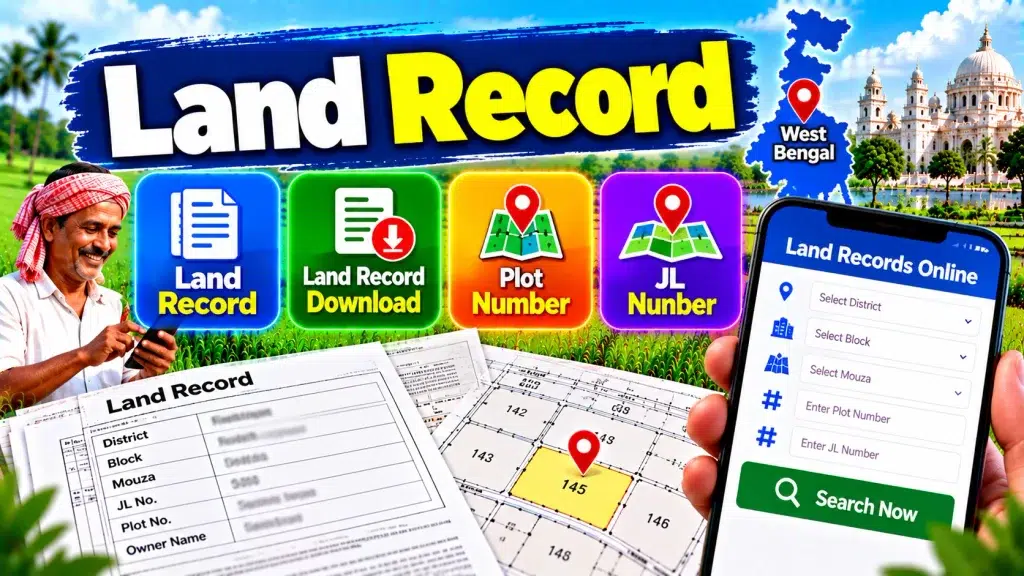
This guide explains West Bengal Land Mutation Status, how to track your application from your mobile, what information you should keep ready and what to check after the mutation process is completed.
West Bengal Land Mutation Status – Quick Overview
| Particular | Details |
|---|---|
| State | West Bengal |
| Official Land System | Banglarbhumi |
| Service | Land Mutation |
| Online Application | Available |
| Mutation Status | Available |
| Plot-Khatian Status | Available |
| Main Record | Khatian / Record of Rights |
| Parcel Reference | Plot Number |
| Revenue Area | Mouza |
| Common Reasons | Sale, inheritance, gift, partition |
| Application Reference | Keep acknowledgement/application number |
| ROR Request | Available |
| Plot Information | Available |
| RS-LR Information | Available |
| Access Device | Mobile, Tablet or Computer |
| Main Purpose | Update applicable revenue records |
What Is Land Mutation in West Bengal?
Land mutation is the process through which applicable changes in ownership or possession details are recorded in government land revenue records.
For example, if land is transferred through a registered sale deed, the buyer may need the applicable revenue records updated.
Mutation can also arise after inheritance, gift, partition, exchange or a relevant court order.
After verification and approval by the competent authority, the applicable land record can be updated with the relevant information.
However, mutation should not be confused with the document or event that created or transferred the underlying right.
Why Is Land Mutation Important?
Mutation helps keep revenue records aligned with applicable changes affecting a property.
An updated land record can be useful for land-revenue administration, future property transactions and accessing updated land documents.
It can also help reduce confusion where an earlier landholder’s name continues to appear in the revenue record after a qualifying transfer.
After mutation, the applicant may be able to obtain an updated Record of Rights, Khatian or other applicable land information.
However, mutation itself does not create ownership independently of the underlying legally recognized transaction or right.
When Can You Apply for Mutation?
Different circumstances can lead to a mutation application.
A buyer may apply after acquiring property through a registered sale deed.
Legal heirs may need mutation after the death of a recorded landholder.
A person receiving land through a valid gift can also require the revenue record to be updated.
Partition, family settlement, exchange and applicable court orders can also result in mutation-related changes.
The documents required depend on the reason for mutation and the circumstances of the property.
West Bengal Mutation Application Online
The Banglarbhumi portal currently lists Mutation Application under its online citizen services.
Applicants should enter property and transfer-related information accurately.
Important land references can include the Mouza, Khatian Number, Plot Number and area.
Supporting documents applicable to the particular case may also need to be provided.
After submission, preserve the acknowledgement or application number generated by the system.
This reference can be important when you later want to track the application.
How to Check West Bengal Land Mutation Status
Start by opening the official Banglarbhumi website on your mobile browser.
Find the Mutation Status service under the available online status options.
Use the search method currently provided by the portal.
Enter the requested application, case or other reference details accurately.
Submit the information and review the status displayed on the screen.
If the system provides remarks or additional instructions, read them carefully.
The interface can be updated over time, so follow the options currently displayed on the official portal rather than relying on an old screenshot.
How to Track Mutation From Your Mobile
You can use a smartphone browser to access the Banglarbhumi web services.
Before starting, keep the mutation acknowledgement or application details nearby.
Use a stable internet connection and enter the reference information carefully.
If location or property details are required, confirm them against your existing documents.
Save the acknowledgement and any official status information you may need for future reference.
Avoid unknown third-party websites that promise guaranteed mutation approval or unofficial changes to government land records.
What Details Are Required for Mutation?
The exact requirements depend on the type of mutation.
Generally, applicants should keep the relevant property and identity documents ready.
These can include the registered deed or transfer document, previous Record of Rights/Khatian, Plot and Mouza details, identity and address documents, and applicable land-revenue records.
For inheritance cases, documents such as a death certificate and succession or legal-heir-related records may become relevant.
A court order or other supporting document may be necessary where the mutation is based on that type of legal event.
What Is Mutation Plot Khatian Status?
Banglarbhumi currently provides a Mutation Plot Khatian Status service in addition to the general Mutation Status facility.
Understanding the two land references is important.
A Khatian is associated with the broader landholding or Record of Rights, while a Plot Number identifies an individual parcel.
When checking mutation-related information, verify that the correct Plot Number is connected with the intended Khatian and Mouza.
This becomes particularly important when a Khatian contains several plots.
What Does Pending Mutation Status Mean?
A pending mutation status generally means that the application has not yet completed the applicable administrative process.
The competent revenue authority may need to verify the application, deed information, existing land records and supporting documents.
Depending on the circumstances, a field enquiry, hearing or notice may also be required.
Do not assume that every mutation application will follow exactly the same processing path.
Check the official status and any remarks displayed for your particular case.
What Happens During Mutation Verification?
After an application is submitted, the relevant authority can examine the existing land record and supporting documents.
Property references such as the Mouza, Khatian, Plot Number and area may be checked.
Where necessary, additional verification, enquiry, notice or hearing can take place.
If the required conditions are satisfied and the mutation is approved, the applicable revenue record can then be updated.
Applicants should subsequently verify the updated land record rather than relying only on an application-status message.
What If the Mutation Application Is Rejected?
If your application shows a rejected status, check whether the official record or order explains the reason.
Do not immediately submit another identical application without identifying the problem.
Compare the information you submitted with the registered deed, Khatian, Plot Number, Mouza and other supporting records.
The appropriate next step depends on the reason for rejection.
Follow the applicable correction, fresh application, review or other procedure provided by the competent authority.
Mutation After a Land Sale
A registered sale deed and land mutation are different.
The registered deed records the applicable legal transaction, while mutation updates the relevant revenue record.
After purchasing land, check the applicable mutation status and subsequently verify the updated Khatian or RoR.
Compare the landholder information with the registered deed.
Also verify the exact Plot Number and land area.
If several plots were purchased, check each relevant parcel instead of relying on only one plot entry.
Mutation After Inheritance
Mutation is also important when land rights change because of inheritance.
Legal heirs may need to submit applicable inheritance-related documents along with the land details.
After the process is completed, check how the names and applicable shares are reflected in the updated revenue record.
Where several legal heirs exist, the resulting entries depend on the applicable documents and legal position.
Do not assume that the entire property will automatically be recorded against only one heir.
Khatian and Plot Number After Mutation
After mutation approval, check the updated Khatian or Record of Rights.
Make sure you are looking at the correct Mouza.
Verify the recorded landholder information.
Then check the individual Plot Numbers connected with the relevant transaction.
Compare the recorded area with your property documents.
If the transaction involved only one plot from a larger Khatian, make sure you are checking that particular parcel rather than treating the entire Khatian as transferred.
Mutation and RS-LR Plot Information
Older West Bengal property documents may contain RS Plot Numbers, while later land records may contain LR Plot references.
Banglarbhumi provides an RS-LR Information service.
If the plot reference in an old deed differs from the later land record, use the applicable RS-LR information and compare the Mouza and Khatian details.
Do not assume that an RS Plot and an LR Plot have a simple one-to-one relationship in every case.
Settlement, subdivision and other record changes can affect parcel references.
How to Check Updated RoR After Mutation
Once the mutation has been completed, checking the updated Record of Rights (RoR) is an important final step.
Banglarbhumi provides ROR Request and Plot Information services.
Locate the correct property using the applicable land-record references.
Check the recorded name, Khatian, Plot Number and land details.
Where an officially issued document is required, use the applicable signed or certified document service rather than treating an ordinary screenshot as an official copy.
Mutation vs Land Record Correction
Mutation and correction should not automatically be treated as the same process.
Mutation generally deals with updating revenue records following an applicable change in rights or possession.
Correction deals with errors in existing land-record information.
If the problem is a spelling error, incorrect record entry or another genuine mistake rather than a property transfer, the applicable correction process may be more relevant.
Identify the nature of the problem before selecting a service.
Does Mutation Prove Property Ownership?
Mutation is an important revenue-record update, but it does not independently create ownership.
Legal rights can arise from documents or events such as registered sale deeds, inheritance, gift deeds, partition deeds and court orders.
Therefore, property verification should not rely only on a mutation status or Khatian entry.
For important transactions, compare the updated revenue record with the underlying deed and other legally relevant documents.
Frequently Asked Questions (FAQ)
1. Can I check West Bengal mutation status online?
Yes. Banglarbhumi currently provides an online Mutation Status service.
2. Can I track my mutation application from a mobile?
Yes. The Banglarbhumi web portal can be accessed through a suitable smartphone browser.
3. What should I keep ready for status tracking?
Keep your mutation application, acknowledgement or other requested reference details ready.
4. What is Mutation Plot Khatian Status?
It is a Banglarbhumi service for checking applicable mutation-related information connected with Plot and Khatian records.
5. Can mutation be done after purchasing land?
A registered property transfer can require the applicable revenue records to be updated through mutation.
6. Can legal heirs apply for mutation?
Yes. Inheritance is one of the circumstances in which mutation may be applicable.
7. What does pending mutation mean?
It generally indicates that the application has not yet completed the applicable verification and approval process.
8. Is mutation the same as property registration?
No. Registration and mutation are separate processes serving different purposes.
9. What should I check after mutation approval?
Check the updated RoR/Khatian, recorded landholder, Plot Number and applicable land area.
10. Does mutation alone prove ownership?
No. Mutation records a change in revenue records and should be considered with the underlying legally relevant property documents.
Conclusion
West Bengal Land Mutation Status can be checked online through the official Banglarbhumi land-record system, making it easier to track your application from your mobile.
Banglarbhumi currently provides services for Mutation Application, Mutation Status and Mutation Plot Khatian Status, along with ROR, Plot Information and RS-LR Information.
Keep your application reference and correct Mouza, Khatian and Plot Number details available while checking the status.
After the mutation is completed, verify the updated Record of Rights and compare it with the registered deed, inheritance documents or other supporting records. This helps ensure that you understand both the mutation status and the land information currently reflected in the official revenue record.