West Bengal RS and LR Plot Information – How to Check Plot Records Online
Understanding old and current plot references is an important part of checking land records in West Bengal. Property documents may contain terms such as RS Plot, LR Plot, RS Khatian, LR Khatian, Mouza and JL Number. These references can become particularly important when comparing an older deed with later land records.
West Bengal’s digital land-record system, Banglarbhumi, provides several online services that can help citizens access property-related information. One of these is the RS-LR Information service. The portal also provides Plot Information, Record of Rights, Plot Map, Mouza Map and mutation-related services.
However, an RS Plot and an LR Plot should not automatically be assumed to have a simple one-to-one relationship. Settlement, subdivision, amalgamation or other land-record changes may affect parcel references.
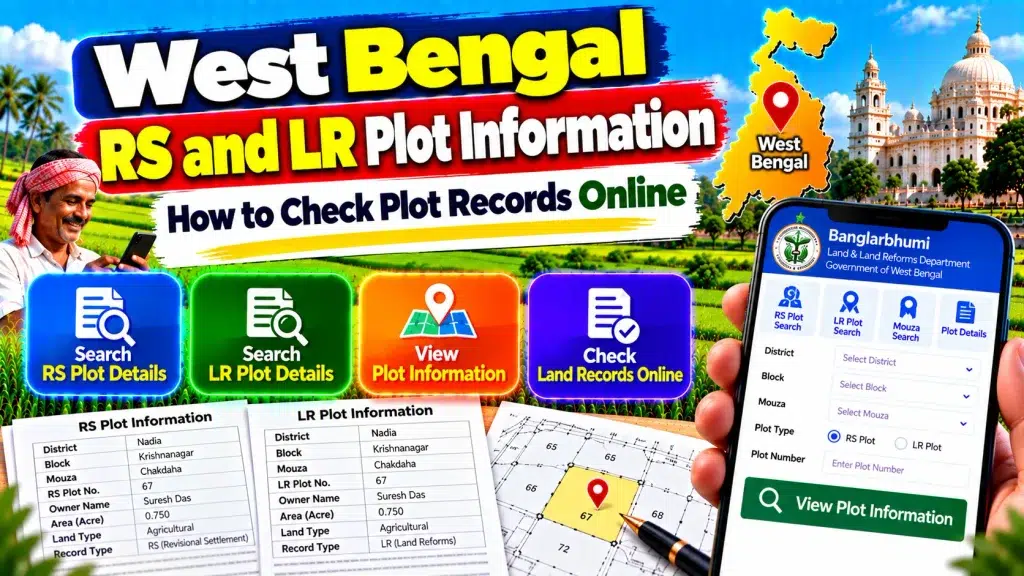
This guide explains West Bengal RS and LR Plot Information, how to check plot records online, and how to compare old and newer land references correctly.
West Bengal RS and LR Plot Information – Quick Overview
| Details | Information |
|---|---|
| State | West Bengal |
| Land Record System | Banglarbhumi |
| RS | Revisional Settlement |
| LR | Later land-record reference commonly used in West Bengal |
| Parcel Reference | Plot Number |
| Holding Reference | Khatian Number |
| Revenue Area | Mouza |
| Mouza Reference | JL Number |
| RS-LR Information | Available on Banglarbhumi |
| Plot Information Request | Available |
| ROR Request | Available |
| Plot Map Request | Available |
| Mouza Map Request | Available |
| Mutation Status | Available |
| Land Classification | Available |
| Device | Mobile, Tablet or Computer |
What Is an RS Plot in West Bengal?
RS generally refers to Revisional Settlement in the context of West Bengal land records.
An RS Plot Number is a parcel reference associated with the relevant settlement record. Older registered deeds, inheritance papers and land documents may contain an RS Plot Number.
The RS reference can be useful when researching the historical identity of a property.
However, if the land record has subsequently changed, the current or later record may contain a different plot reference.
This is why checking only an old RS Plot Number may not always provide the complete current picture of the property.
What Is an LR Plot?
LR Plot is a later land-record reference commonly encountered in West Bengal property records.
A current or comparatively recent land document may contain an LR Plot Number even when an older document refers to an RS Plot.
When verifying land, it may therefore be necessary to compare the older RS reference with the applicable LR record.
Do not assume that an RS Plot Number and LR Plot Number will always be identical.
The relationship should be checked through official records.
RS Plot vs LR Plot
The main difference relates to the land-record or settlement stage from which the parcel reference originates.
An RS Plot is connected with the Revisional Settlement record.
An LR Plot is associated with the later land-record reference used in applicable records.
For property verification, both can be important.
An old sale deed may contain the RS Plot, while a later Khatian or revenue record may contain an LR Plot. Comparing them helps establish whether you are examining the intended parcel across different records.
Why Can RS and LR Plot Numbers Be Different?
Land records can change over time.
A parcel may be subdivided into smaller plots. Multiple parcels may also be affected by settlement or record revision.
Because of these changes, an older parcel reference may not always correspond to one later parcel in a simple way.
One old plot can potentially be associated with more than one later parcel depending on the applicable record history.
For this reason, never select an LR Plot simply because its number looks similar to the RS Plot.
Use the official RS-LR information and supporting property records.
How to Check RS-LR Plot Information Online
Open the official Banglarbhumi portal using your smartphone or computer.
Locate the RS-LR Information service.
Select the location information requested by the current portal.
Identify the correct District and other local revenue details.
Choose the relevant Mouza.
Enter or select the applicable plot information according to the service.
Review the RS-LR information displayed.
Compare the result with your deed, Khatian and other property documents.
Because government portal interfaces can change, follow the options displayed on the current Banglarbhumi service.
Why Is the Mouza Important?
A Mouza provides the revenue-area context for land records.
A Plot Number without the correct Mouza may not be enough to identify the intended property.
The same numerical plot reference can potentially appear in different revenue areas.
Therefore, before checking an RS or LR Plot, confirm the Mouza mentioned in your deed or Khatian.
Older records may also include a JL Number, which can help identify the relevant Mouza more accurately.
What Is a JL Number?
JL Number, commonly understood as Jurisdiction List Number, is a reference associated with a Mouza in West Bengal’s land and survey records.
It can appear in registered deeds, Khatian records and other property papers.
When matching an old RS Plot with later records, keeping the correct Mouza and JL information can reduce the chance of checking the wrong parcel.
Do not rely only on the Plot Number if additional location information is available.
RS Khatian and LR Khatian
Along with RS and LR Plot references, property documents may contain RS Khatian and LR Khatian references.
A Khatian is connected with the broader landholding or Record of Rights, whereas the Plot Number identifies an individual parcel.
One Khatian can be associated with multiple plots.
When comparing old and later records, review both the Khatian and Plot references.
This is particularly important when only part of a larger holding has been sold, inherited, gifted or partitioned.
How to Check Plot Information
Banglarbhumi currently provides a Plot Info Request service.
After identifying the applicable RS-LR relationship, users can check the relevant plot information through the available services.
Verify the correct Mouza and parcel before reviewing the record.
Compare the Plot Number with the relevant Khatian, land area and property documents.
Where an official document is required, note that Banglarbhumi separately lists signed ROR, Plot Information and Plot Map copies among its service-delivery options.
How to Check Record of Rights
The Record of Rights (RoR) provides important textual information related to the landholding.
Banglarbhumi provides an ROR Request service.
When checking an RS or LR Plot, compare the parcel with the applicable RoR/Khatian.
Review the recorded landholder details, parcel references and other available information.
An RoR is an important revenue record, but property verification should not rely only on one online entry.
Registered deeds and other legally relevant documents should also be examined.
How to Check Land Area
After identifying the correct LR or applicable current plot reference, verify the recorded land area.
Do not estimate official area from a visual map.
Use the applicable land record or Plot Information.
If an old deed contains one RS Plot that is connected with several later parcels, check the area of each relevant parcel separately.
Compare the total applicable area with the deed and other supporting documents.
A substantial mismatch may require further examination of the land records.
How to View Plot Maps
Banglarbhumi currently lists a Plot Map Request service as well as a Mouza Map Request service.
These can provide spatial context for the property.
After identifying the correct plot, compare it with the available cadastral map.
Look at the surrounding parcel references and the general shape of the plot.
However, a digital map should not automatically be treated as a final physical demarcation of boundaries.
An official survey or demarcation procedure may be needed where exact boundaries are disputed.
RS-LR Information and Mutation
Mutation updates applicable revenue records after qualifying changes such as sale, inheritance, gift or partition.
Banglarbhumi provides Mutation Application and Mutation Status services.
It also lists a Mutation Plot Khatian Status facility.
If a property has recently changed hands, check whether the applicable mutation has been completed and whether the current Khatian and Plot information reflect the change.
Remember that mutation and registration are separate processes serving different purposes.
What If the RS and LR Records Do Not Match?
First confirm the Mouza and JL information.
Next, check whether the property has undergone subdivision or another record change.
Compare the RS and LR Plot information with old and current Khatian records.
Review the registered deed and mutation history where applicable.
Do not assume that a mismatch automatically means the land record is incorrect.
The difference may reflect changes in parcel references across settlement or record stages.
If the connection cannot be established confidently, further verification from the appropriate land-record authority may be necessary.
RS-LR Check Before Buying Property
RS-LR verification can be useful before purchasing land, especially when the seller’s title documents are old.
Start with the deed and identify the Mouza, JL Number, Khatian and Plot references.
Compare the old RS Plot with applicable later records.
Check the current Khatian/RoR.
Verify the land area and land classification.
Review mutation information.
Check available Plot or Mouza Maps.
Where the property has passed through inheritance, gift, partition or court proceedings, examine the relevant supporting documents as well.
Does RS-LR Information Prove Ownership?
No. RS-LR Information helps users understand parcel references across different land-record stages.
It does not by itself establish complete legal ownership.
Ownership verification may involve the registered sale deed, current Record of Rights, mutation history, inheritance or succession documents, gift or partition deeds, court orders and other applicable records.
RS-LR information is therefore best used as an important part of a broader property-document verification process.
Frequently Asked Questions (FAQ)
1. What does RS mean in West Bengal land records?
RS generally refers to Revisional Settlement and is associated with an applicable stage of land records.
2. What is an LR Plot?
LR Plot is a later land-record parcel reference commonly encountered in West Bengal property records.
3. Can RS and LR Plot Numbers be different?
Yes. Changes in land records, settlement or parcel configuration can result in different references.
4. Can I check RS-LR Information online?
Yes. Banglarbhumi currently lists RS-LR Information among its citizen services.
5. Can I check RS-LR Plot information from my phone?
Yes. The Banglarbhumi web portal can be accessed through a suitable mobile browser.
6. Why is Mouza required for a plot search?
Mouza provides the revenue-area context needed to identify the intended parcel accurately.
7. Is Khatian Number the same as Plot Number?
No. Khatian relates to a landholding/RoR, while Plot Number identifies an individual parcel.
8. Can I request Plot Information online?
Yes. Banglarbhumi currently provides a Plot Info Request service.
9. Can I view a map after finding the LR Plot?
Banglarbhumi provides applicable Plot Map and Mouza Map request services.
10. Does an RS-LR match confirm legal ownership?
No. Complete ownership verification can require registered deeds, RoR/Khatian, mutation history and other legally relevant documents.
Conclusion
West Bengal RS and LR Plot Information can help landowners, buyers and legal heirs understand how older and later parcel references relate to property records.
RS generally refers to Revisional Settlement, while LR refers to later land-record references commonly encountered in West Bengal. Because parcel references can change through settlement, subdivision and other record processes, an old RS Plot should not automatically be assumed to correspond to an identical LR Plot Number.
Banglarbhumi provides useful services including RS-LR Information, Plot Information, ROR Request, Plot Map, Mouza Map, Land Classification and Mutation Status.
For better property verification, compare the RS-LR information with the correct Mouza, JL Number, Khatian, registered deed, recorded land area and mutation history. Using these records together provides a clearer understanding of the property’s land-record history.