Land Mutation Status Online – How to Track Land Record Updates Using Your Phone
Land records may need to be updated when rights in a property change after a sale, inheritance, gift, partition or another qualifying event. The revenue-record process used to record such changes is commonly known as land mutation, although the exact terminology and procedure vary across Indian states.
Today, many State and Union Territory land-record systems provide digital services for mutation applications, case information or status tracking. This means landowners and applicants can often use a smartphone to check whether a mutation request is pending, processed or requires further action.
However, mutation is a state-administered revenue process. There is no single identical mutation procedure or portal for every property in India.
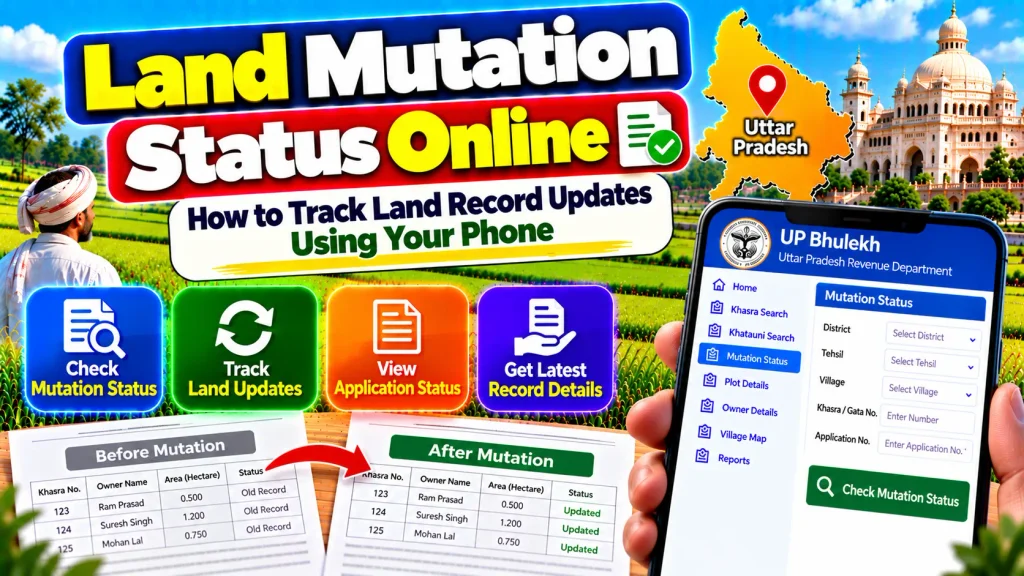
This guide explains Land Mutation Status Online, how to track land record updates using your phone, what information may be required and what to do if the updated details are not reflected in the Record of Rights.
Land Mutation Status Online – Quick Overview
| Details | Information |
|---|---|
| Service | Land Mutation / Revenue Record Update |
| Common Term | Mutation / Namantaran |
| Device | Smartphone, Tablet or Computer |
| Main Purpose | Update applicable land/revenue records |
| Common Reasons | Sale, inheritance, gift, partition |
| Status Tracking | Available in many state systems |
| Important Record | Record of Rights (RoR) |
| Parcel Reference | Plot / Survey / Khasra / Gata / Dag Number |
| Holding Reference | Khata / Khatian or state equivalent |
| Application Reference | May be required for tracking |
| Landholder Details | Updated after applicable approval/process |
| Map Information | Separate from mutation record |
| Registered Deed | Different from mutation |
| Main Authority | State/UT Revenue Department |
What Is Land Mutation?
Land mutation is the applicable revenue-record process through which changes in recorded land rights or landholding details are entered in the relevant revenue records.
The process is known by different names across India. In several states, users may encounter terms such as Namantaran, Dakhil Kharij, Intkal or other regional expressions.
For example, when property is transferred through a registered sale, the revenue record may need to be updated to reflect the applicable change.
Similarly, mutation can become relevant after inheritance, gift or partition.
The exact procedure, documents and authority depend on the state where the property is situated.
Why Is Mutation Important?
Mutation helps keep the government’s revenue records aligned with applicable changes affecting land.
If a property has changed hands but the relevant revenue record still displays an earlier landholder, the land record may not reflect the latest applicable update.
An updated record can be useful when checking landholding information, revenue entries and future property-related applications.
However, mutation should not be confused with the underlying legal document that caused the change.
A registered deed and a mutation entry serve different functions.
When May Land Mutation Be Required?
Mutation may become relevant after several types of qualifying events.
A common example is the sale of land through a registered deed.
It may also be required after inheritance following the death of a recorded landholder.
Gift, partition or certain court or administrative orders can also lead to changes that need to be reflected in the revenue record.
Because state laws and procedures differ, applicants should check the exact mutation category available on the official Revenue Department portal for their property location.
How to Check Land Mutation Status Online
Start by identifying the State or Union Territory where the land is located.
Open the official Revenue Department, land-record or mutation portal.
Choose the available mutation, Namantaran, Dakhil Kharij, Intkal or equivalent service.
Select the District and other required local revenue details.
Enter the application, case, transaction or reference number if the portal asks for it.
Provide the required parcel or holding information where applicable.
Submit the search and review the current status displayed by the official system.
Portal interfaces can change, so follow the current instructions shown on the government website.
How to Track Mutation Status Using Your Phone
A smartphone browser can be sufficient where the state portal supports online status tracking.
Keep the acknowledgement or application details available before starting.
Open the official portal rather than following an unknown third-party link.
Enter the exact reference number carefully.
If location details are required, verify the District, Tehsil/Taluk, Village/Mouza and parcel information.
After opening the status, note whether any action or document requirement is displayed.
Save your official acknowledgement or reference number for future tracking.
What Details May Be Needed to Track Mutation?
Requirements vary between states and services.
The most useful information is usually the mutation application or case reference number.
Some systems may also use a registered-deed reference, transaction number, Khata/Khatian, Survey Number, Khasra Number, Plot Number or other parcel details.
Location information can also be important.
Keep the District, Tehsil/Taluk and Village/Mouza information ready so that you do not accidentally check a similarly numbered parcel in another location.
Mutation After Sale of Land
A registered sale and mutation should not be treated as the same process.
Registration records the applicable transaction through the registration system, while mutation deals with updating the relevant revenue record.
After purchasing land, check whether the applicable revenue record reflects the change.
Where a separate mutation application or process is required, follow the procedure provided by the concerned Revenue Department.
Once the process is completed, verify the updated Record of Rights rather than relying only on a status message.
Mutation After Inheritance
When a recorded landholder dies, eligible successors may need to follow the applicable inheritance-related mutation process.
The required documents can vary by state and circumstances.
After the mutation is processed, review the updated land record carefully.
Check the names of the persons recorded, their applicable shares and the parcels connected with the holding.
If several legal heirs are involved, do not assume that the complete property will automatically appear against only one person’s name.
Mutation After Gift or Partition
Gift and partition can also affect land records.
If land is transferred through a valid gift transaction, the applicable revenue record may need to reflect the resulting change.
Similarly, partition can affect how shares or individual parcels are recorded.
After the relevant process is completed, compare the updated Record of Rights with the gift, partition or other supporting document.
Also check whether parcel references or sub-divisions have changed.
What Does Pending Mutation Status Mean?
A pending status generally indicates that the mutation process has not yet reached its final stage.
The application may be undergoing an applicable entry, verification, notice, objection, hearing, approval or other revenue procedure depending on the state’s workflow.
Do not assume that every pending case follows the same stages or processing time.
Read any remarks displayed by the official portal.
If the case remains pending and the portal does not explain the next step, contact the appropriate Revenue office using the application reference.
What If Mutation Is Rejected?
A rejected mutation does not automatically tell you the complete reason unless you review the relevant order or remarks.
Check the official status page for the rejection reason where available.
Possible issues can depend on the application and applicable state rules.
There may be a document discrepancy, parcel mismatch, objection, incomplete information or another issue requiring attention.
Follow the remedy, correction or appeal process prescribed by the concerned authority rather than repeatedly submitting inaccurate information.
How to Check Updated Land Records After Mutation
A mutation status showing completion should be followed by checking the applicable Record of Rights.
Open the official state land-record service.
Select the correct location.
Search using the Khata/Khatian, Plot, Survey, Khasra, Gata, Dag or other available reference.
Check whether the applicable landholder details have been updated.
Also compare the land area and parcel numbers.
This final verification is important because the objective is not merely to close an application but to ensure the relevant revenue record reflects the applicable update.
Mutation and Record of Rights (RoR)
The Record of Rights or RoR is an important revenue record containing information about recorded rights and landholdings.
Different states use different names for their RoR-related records.
You may encounter Khatauni, Khatian, Jamabandi, RTC, Pahani, Patta, 7/12, B-1 or other regional records.
After mutation, the applicable change should be checked against the current record used by the state.
Always verify the correct parcel rather than checking only the person’s name.
Mutation and Plot or Survey Number
A mutation can relate to one or more specific parcels.
Therefore, check the complete Plot, Survey, Khasra, Gata or Dag references included in the transaction or inheritance.
If a registered deed contains three Survey Numbers, do not assume that checking one parcel confirms the status of all three.
Review each applicable parcel and compare it with the updated land record.
This is especially important where land has been subdivided or partitioned.
Mutation and Land Maps
Mutation records and cadastral maps serve different purposes.
Mutation deals with changes in applicable revenue entries.
A cadastral map shows the spatial arrangement of parcels.
After a transaction, the recorded landholder information may change without altering the physical shape of the parcel.
Where a transaction involves subdivision or partition, however, map or survey updates may also become relevant under the applicable procedure.
Use the map and revenue record together when necessary.
Does Mutation Prove Ownership?
Mutation is an important revenue-record process, but it should not automatically be treated as standalone conclusive proof of legal title.
The legal basis for a property right may arise from documents such as a registered sale deed, inheritance or succession documents, gift deed, partition deed, court order or another legally recognized instrument.
Mutation helps reflect the applicable change in revenue records.
For important property verification, examine both the underlying legal documents and the current revenue records.
Common Problems While Checking Mutation Status
One common problem is entering the wrong application number.
Another is selecting an incorrect Village or parcel.
Recently submitted cases may also not immediately display the final updated RoR.
If the portal does not return a result, verify your acknowledgement and location details.
Avoid repeatedly creating new applications without understanding the status of the existing case.
If necessary, contact the concerned Revenue authority with the official reference number.
Safety Tips for Online Mutation Tracking
Use only the official State or Union Territory Revenue Department or land-record portal.
Do not share OTPs, banking PINs or passwords with unknown people offering to check mutation status.
Keep the acknowledgement and transaction details secure.
If an official fee applies to a service, use the payment method provided by the government portal.
Be cautious of websites that imitate government services or promise guaranteed mutation approval.
Frequently Asked Questions (FAQ)
1. What is land mutation?
Land mutation is the applicable process for updating revenue records after a qualifying change affecting land rights.
2. Can I check mutation status online?
Many state land-record systems provide applicable online mutation or case-status services.
3. Can I track mutation using a mobile phone?
Yes, where the official state portal supports browser-based status tracking.
4. What number is required to track mutation?
An application, case, transaction or other official reference number may be required, depending on the state.
5. Is mutation required after a land sale?
A sale can require the applicable revenue record to be updated according to the state’s mutation procedure.
6. Can mutation be done after inheritance?
Yes, inheritance-related mutation processes are available under applicable state procedures.
7. What does pending mutation mean?
It generally means the application has not completed the applicable revenue process.
8. What should I do after mutation is completed?
Check the current Record of Rights to verify that the applicable landholder and parcel information has been updated.
9. Is mutation the same as property registration?
No. Registration and mutation are distinct processes serving different purposes.
10. Does mutation alone prove legal ownership?
No. Mutation is a revenue-record update; title verification can also require the underlying registered or legally recognized documents.
Conclusion
Land Mutation Status Online services make it easier to track land record updates using your phone.
Depending on the state, the process may be known as mutation, Namantaran, Dakhil Kharij, Intkal or another regional term. Applicants can use applicable official portals to check the progress of a mutation case and later verify the updated Record of Rights.
Always keep the application reference, property location and Plot/Survey/Khasra/Gata details ready when tracking a case.
After completion, check the current RoR and compare the landholder, parcel and area information with the underlying registered or inheritance documents. Mutation is an important part of keeping revenue records current, but it should be understood together with registration, inheritance, partition and other relevant legal documents.