Land Record Documents Online – Understand Khatian, Khatauni, Jamabandi and RoR
Understanding land records can be confusing because different Indian states use different names for revenue and property-related documents. Terms such as Khatian, Khatauni, Jamabandi and Record of Rights (RoR) frequently appear when people search for landholder names, plot details, agricultural land information or property records online.
Although these documents serve related purposes, their exact format, terminology and legal significance can vary from one State or Union Territory to another. In many cases, they contain information about recorded landholders, land parcels, survey or plot numbers, land area and other revenue details.
India’s digital land-record modernization efforts have made many such records available online through state-specific portals. Citizens can often access available records using a mobile phone or computer.
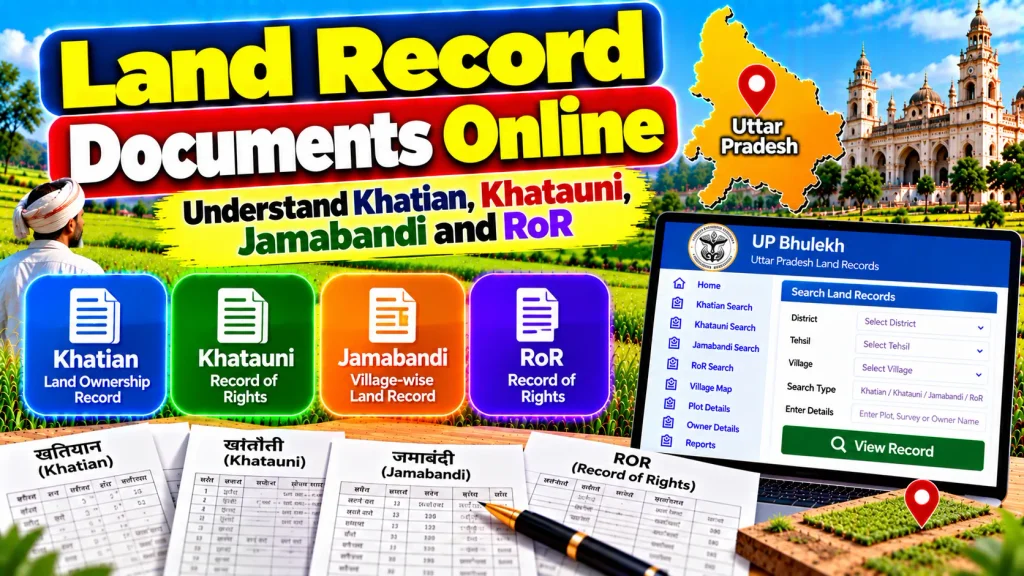
This guide explains Land Record Documents Online, including Khatian, Khatauni, Jamabandi and RoR, and how these records can be used for preliminary land verification.
Land Record Documents Online – Quick Overview
| Document / Term | General Purpose |
|---|---|
| Record of Rights (RoR) | Records applicable rights and landholding information |
| Khatian | Holding/RoR-related record used in certain states |
| Khatauni | Record of Rights/landholding record used in states such as Uttar Pradesh |
| Jamabandi | Revenue/landholding record commonly used in several northern states |
| Khasra Number | Parcel/field reference in applicable states |
| Survey Number | Identifies a surveyed land parcel |
| Plot Number | Parcel reference used in several land systems |
| Khata Number | Holding/account reference in applicable states |
| Landholder Name | Available in applicable RoR/revenue records |
| Land Area | Usually linked with parcel details |
| Mutation | Updates applicable revenue records after qualifying changes |
| Cadastral Map | Shows spatial layout of land parcels |
| Certified Copy | Official/authenticated copy where state service provides it |
| Main Authority | State/UT Revenue Department |
What Is a Record of Rights (RoR)?
The Record of Rights, commonly called RoR, is one of the most important categories of land revenue records in India.
According to the Department of Land Resources, an RoR generally contains information about persons who have acquired rights in land, the nature and limits of those rights, and applicable revenue or rent information.
The terminology and format are not identical across India because land administration is handled primarily by State and Union Territory authorities.
As a result, documents known as Khatian, Khatauni, Jamabandi, RTC, Pahani, Patta and other regional records may perform RoR-related functions within their respective systems.
What Is Khatian?
Khatian is a land-record term used in states such as West Bengal and in some other regional revenue systems.
It is generally associated with a holding or Record of Rights and can help identify the persons recorded against the land along with related parcel information.
A Khatian can be linked with one or more Plot Numbers depending on the applicable record.
When checking a Khatian, users should compare the recorded landholder, Khatian Number, Plot Number, land area and Mouza or village details.
A Khatian Number should not automatically be confused with a Plot Number because the holding and individual parcel references serve different purposes.
What Is Khatauni?
Khatauni is an important Record of Rights used particularly in states such as Uttar Pradesh.
It provides information connected with the landholding and persons recorded against it.
An applicable Khatauni may contain a Khata reference, landholder information, Gata/Khasra Numbers and parcel area.
One landholding can be associated with multiple individual parcels.
Therefore, Khatauni is useful when you want to understand the relationship between the recorded landholder and the different parcels included in the holding.
What Is Jamabandi?
Jamabandi is another widely used land-revenue term, particularly in several northern states.
Its exact format and contents depend on the state concerned.
A Jamabandi record can provide information connected with landholding, recorded rights, parcel references and other revenue details.
For example, Punjab’s digital land-record system allows Jamabandi searches using different references such as owner name, Khewat Number, Khasra Number and Khatouni Number.
When checking Jamabandi online, always use the official portal for the state where the property is located because search options and record formats can differ.
Khatian vs Khatauni vs Jamabandi vs RoR
These terms should not be treated as four universally identical documents.
RoR is the broader concept of a Record of Rights.
Khatian, Khatauni and Jamabandi are state-specific or regional land-record terms that can contain RoR or landholding-related information.
Their exact fields, preparation process and administrative significance can vary.
Therefore, instead of asking which document is universally “better,” identify which record is officially used by the Revenue Department in the state where the property is located.
What Information Can Land Records Contain?
The information available depends on the state and record type.
Common details can include the recorded landholder or right-holder name, Khata/Khatian or account reference, Plot/Khasra/Survey/Gata Number, land area, revenue information and other applicable land particulars.
Some records may also contain cultivation, tenancy, classification or possession-related entries depending on the state’s revenue system.
Always read the complete record rather than relying only on the landholder’s name.
What Is a Khasra or Survey Number?
A Khasra or Survey Number generally identifies an individual land parcel within the applicable revenue or survey system.
Other states may use terms such as Plot Number, Gata Number or Dag Number.
These references help distinguish one parcel from another.
Because the same numerical parcel reference can potentially appear in different villages, always verify the location together with the number.
District, Tehsil/Taluk, Village/Mouza and other local revenue details are important when identifying the correct property.
What Is a Khata Number?
A Khata Number generally represents a holding or account reference in applicable state land-record systems.
It should not automatically be confused with a Khasra, Survey or Plot Number.
One Khata can sometimes include multiple parcels.
For example, if a landholding contains three agricultural fields, those fields may have separate parcel references while being connected with the broader holding/account record.
Understanding this distinction helps prevent errors when reading digital land records.
How to Check Land Record Documents Online
Start by identifying the State or Union Territory where the land is located.
Open the official Revenue Department or land-record portal.
Choose the relevant RoR, Khatian, Khatauni, Jamabandi or equivalent service.
Select the correct District.
Choose the Tehsil, Taluk, Block, Mandal or other applicable revenue unit.
Select the Village or Mouza.
Search using the available landholder name, Khata/Khatian, Khasra, Survey, Gata, Dag or Plot Number.
Open the matching record and compare all relevant information carefully.
Can You Check Land Records on Mobile?
Many state land-record portals can be accessed through a smartphone browser.
This makes it possible to perform preliminary land-record searches without a computer.
Keep the location and property references ready before starting.
A clear mobile browser and stable internet connection are usually sufficient for basic record viewing where the portal supports mobile access.
However, downloading digitally signed documents or completing certain services may require additional steps depending on the state portal.
What Is Mutation in Land Records?
Mutation is the applicable revenue-record process used to update land records after a qualifying change in rights.
It can become relevant after a sale, inheritance, gift, partition or another legally recognized event, subject to state rules.
If a property has recently changed hands but the old landholder still appears in the RoR, check the applicable mutation status or mutation entries.
A mutation record and a registered sale deed serve different purposes and should not be treated as the same document.
Online Record vs Certified Copy
A normal online view is useful for preliminary verification, but it may not have the same status as an officially issued certified or digitally signed copy.
Many states provide separate services for authenticated land-record copies.
For example, users may be able to view basic information online and separately request a digitally signed or certified RoR through the prescribed service.
When a document is required for an official, financial or legal purpose, check whether a certified version is required.
Land Records and Cadastral Maps
Textual land records and cadastral maps provide different types of information.
RoR-related records focus on recorded rights and landholding details.
A cadastral map focuses on the spatial layout of land parcels.
The Digital India Land Records Modernization Programme includes digitization of cadastral maps and integration of textual RoRs with spatial records.
When available, comparing both can help users better understand a parcel.
However, an online map is not automatically a substitute for official physical demarcation in a boundary dispute.
What If the Landholder Name Is Wrong?
First confirm that you selected the correct Village and parcel.
Compare the online record with the registered deed, previous RoR and mutation information.
If the property was recently sold, inherited, gifted or partitioned, determine whether the applicable revenue-record update has been completed.
If the entry genuinely requires correction, use the procedure provided by the concerned Revenue Department.
Do not rely on unauthorized agents promising unofficial changes to land records.
Land Records Before Buying Property
Before purchasing land, identify the exact parcel numbers included in the transaction.
Check the current RoR or state-specific landholding record.
Compare the recorded landholder and land area.
Review the relevant Khasra, Survey, Plot, Gata or Dag Number.
Check applicable mutation information and cadastral maps.
Compare these details with the registered deed and other relevant documents.
Where inheritance, partition or litigation is involved, additional legal documents may need to be examined.
Do Khatian, Khatauni or Jamabandi Prove Ownership?
These are important revenue records, but a single revenue entry should not automatically be treated as conclusive standalone proof of legal title.
Property verification can also involve registered sale deeds, inheritance or succession documents, gift or partition deeds, mutation history, court orders, survey records and other relevant documents.
The exact evidentiary value of a particular revenue record depends on applicable law and circumstances.
For an important property transaction, examine the complete document chain.
Frequently Asked Questions (FAQ)
1. What is RoR in land records?
RoR means Record of Rights and contains applicable information about recorded rights and landholding.
2. What is Khatian?
Khatian is a holding/RoR-related land record used in certain state revenue systems.
3. What is Khatauni?
Khatauni is an important Record of Rights or landholding record used in states such as Uttar Pradesh.
4. What is Jamabandi?
Jamabandi is a revenue and landholding record commonly used in several northern states.
5. Are Khatian and Khatauni the same?
Not universally. They are terms used in different state land-record systems, and their exact contents can vary.
6. Can I check these records online?
Many States and Union Territories provide applicable digital land-record services through official portals.
7. Can I search land by owner name?
Many portals provide owner or landholder-name search, although available options vary by state.
8. What is a Khasra or Survey Number?
It is a reference used to identify an individual land parcel within the applicable revenue or survey system.
9. Is an online screenshot a certified RoR?
Not necessarily. A certified or digitally signed copy may need to be obtained separately through the prescribed service.
10. Does an RoR alone prove legal ownership?
RoR is an important revenue record, but complete title verification can require registered deeds and other relevant legal documents.
Conclusion
Understanding Land Record Documents Online becomes easier once you recognize that Khatian, Khatauni, Jamabandi and RoR belong to state-specific land administration systems.
RoR is the broader Record of Rights concept, while Khatian, Khatauni and Jamabandi are commonly used regional terms for landholding and revenue records.
These documents can help users check recorded landholders, holding references, Khasra/Survey/Plot Numbers, land area and other property information.
Because land-record terminology varies across India, always use the official portal for the State or Union Territory where the property is located. For important property verification, compare the current revenue record with cadastral maps, mutation information, registered documents and other legally relevant records rather than relying on a single online entry.