Expired Vehicle Registration Philippines – Check LTO Penalties & Renewal Information
Keeping your motor vehicle registration current is an important responsibility for every vehicle owner in the Philippines. If your registration has already expired, continuing to use the vehicle on public roads can expose you to penalties and additional complications when you eventually complete the renewal.
The Land Transportation Office (LTO) administers motor vehicle registration and related services in the Philippines. Vehicle owners generally need to follow the applicable registration schedule and complete current requirements before their vehicle registration can be renewed.
Motorists often search for questions such as “How much is the penalty for expired vehicle registration?”, “Can I renew an expired registration?”, and “What documents do I need for LTO vehicle renewal?”
The answer can depend on the vehicle, how long the registration has been expired, applicable LTO rules, and whether the vehicle was operated while unregistered. Late-registration charges and a citation for operating an unregistered vehicle should not automatically be treated as the same thing.
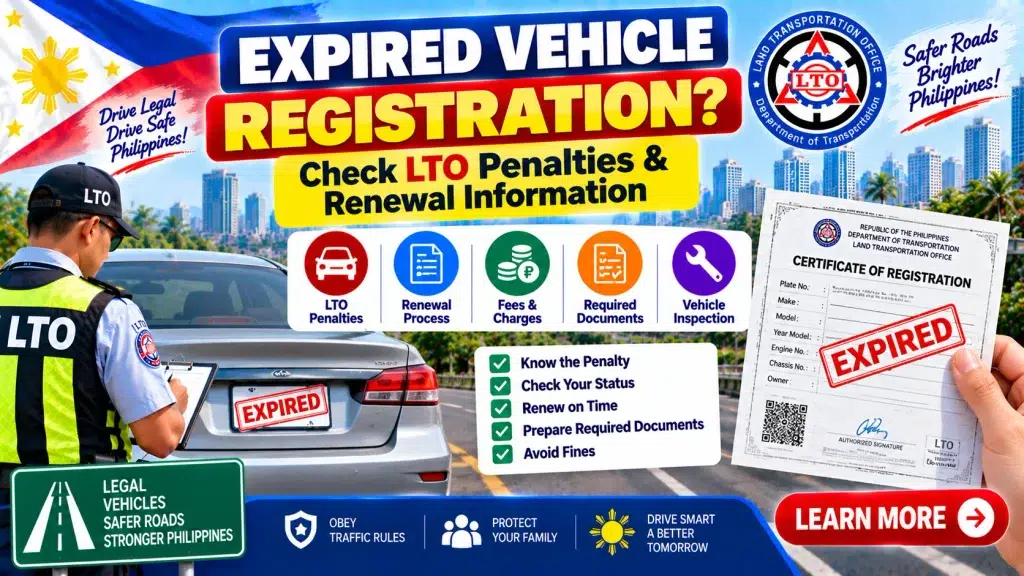
This guide explains expired vehicle registration in the Philippines, LTO penalties, commonly required renewal documents, vehicle inspection, insurance, OR/CR, LTMS services, and important checks before driving.
Important: LTO registration rules, fees, inspection requirements, schedules, and penalties may be updated. Always confirm the current requirements and exact amount applicable to your vehicle through official LTO channels before paying or completing a renewal.
Expired Vehicle Registration – Quick Overview
| Topic | What Vehicle Owners Should Know |
|---|---|
| Vehicle Registration | Must comply with applicable LTO requirements |
| Expired Registration | Should be renewed as soon as possible |
| Driving While Unregistered | Can result in a substantial penalty |
| Late Renewal | Applicable late charges may apply |
| OR | Official Receipt |
| CR | Certificate of Registration |
| Insurance | Applicable compulsory coverage/documentation is generally part of registration requirements |
| Inspection | Applicable inspection requirements must be completed |
| LTMS | LTO’s digital platform for various services |
| Registration Schedule | Follow the applicable LTO schedule |
| Payment | Use authorized channels |
| Proof of Renewal | Keep official transaction records |
What Does Expired Vehicle Registration Mean?
Vehicle registration is not permanent.
A motor vehicle must be renewed according to the applicable LTO registration requirements and schedule.
When the applicable registration period has passed without renewal, the vehicle can have an expired registration status.
The owner should address this promptly.
An expired registration can potentially create problems involving:
- Road enforcement
- Penalties
- Vehicle transactions
- Sale or transfer
- Insurance/documentation
- Future registration processing
Ignoring the issue generally does not make it disappear.
Can You Drive With Expired Registration?
Vehicle owners should not assume they can continue driving normally after registration has expired.
Operating a motor vehicle without meeting applicable registration requirements can result in enforcement action.
If you discover that your vehicle registration is expired, check the current LTO renewal procedure and complete the necessary requirements before returning to normal road use.
This can be much less expensive and inconvenient than receiving a citation while driving.
How Much Is the LTO Penalty?
There are different concepts that motorists sometimes combine under the phrase “expired registration fine.”
These can include:
- Late registration charges or penalties during renewal.
- A violation for operating an unregistered motor vehicle.
- Other penalties connected with additional vehicle violations.
Commonly referenced LTO penalty schedules have listed a ₱10,000 fine for applicable violations involving driving an unregistered motor vehicle.
However, this does not mean every late-renewal situation automatically results in exactly ₱10,000.
The actual amount depends on the applicable violation and current LTO rules.
Late Registration vs Driving an Unregistered Vehicle
Understanding the difference is important.
| Situation | General Issue |
|---|---|
| Renewal completed late | Late registration charges may apply |
| Vehicle operated while registration is not valid | Separate violation may apply |
| Vehicle has never been properly registered | Serious registration issue |
| Registration documents contain incorrect information | Correction may be necessary |
| Fake registration documents used | Serious administrative/legal issue |
| Other vehicle violations present | Separate penalties can apply |
If you receive a citation, use the exact offense shown on the citation when checking the penalty.
Check Your Vehicle Registration Schedule
LTO vehicle registration follows an applicable scheduling system.
Depending on the vehicle and current rules, plate information can be relevant to determining the registration schedule.
Vehicle owners should confirm their actual renewal period rather than waiting for a reminder.
A simple yearly reminder on your phone or calendar can help prevent missed registration deadlines.
Do not rely exclusively on a social media chart, particularly if it is old or does not come from an official source.
What Documents Should You Check?
Before beginning the renewal process, organize your vehicle records.
Important documentation can include:
Certificate of Registration – CR
The CR contains important registered vehicle details.
Check information such as:
- Registered owner
- Vehicle make/model
- Engine number
- Chassis number
- Vehicle classification
- Other identifying information
Official Receipt – OR
The OR provides information relating to the applicable LTO transaction/payment.
Keep both digital and physical copies where practical.
If the details on your records do not match the vehicle, address the discrepancy through legitimate LTO procedures.
General LTO Vehicle Renewal Process
The exact procedure can vary, but vehicle owners can generally expect several important stages.
Step 1: Check Your Registration
Review your OR/CR and determine whether the registration is already expired and what renewal requirements apply.
Step 2: Prepare Required Documents
Collect the current documents needed for your vehicle category.
Step 3: Complete Applicable Insurance Requirements
Applicable compulsory motor vehicle insurance documentation is generally part of the registration process.
Use legitimate providers and verify documentation.
Step 4: Complete Required Vehicle Inspection
Your vehicle may need to satisfy the applicable inspection process.
Step 5: Resolve Existing Registration Issues
Incorrect vehicle details, undocumented changes, or other problems may need to be addressed.
Step 6: Complete the LTO Renewal Transaction
Follow the applicable official LTO procedure.
Step 7: Pay the Assessed Amount
Pay registration charges and applicable penalties through authorized channels.
Step 8: Keep Your Updated Records
Save the official transaction receipt and registration documents.
Vehicle Inspection Before Renewal
Roadworthiness is an important part of responsible vehicle ownership.
Before inspection, check your vehicle’s:
- Headlights
- Tail lights
- Brake lights
- Turn signals
- Tires
- Brakes
- Mirrors
- Windshield
- Wipers
- Seat belts
- Exhaust
- Other required components
Repair known problems before presenting the vehicle for an applicable inspection.
This can reduce delays and make the vehicle safer to operate.
Insurance and Registration
Applicable compulsory insurance requirements are an important part of motor vehicle registration.
Vehicle owners should verify:
- Policy/document authenticity
- Correct vehicle information
- Valid coverage period
- Applicable LTO requirements
Do not purchase suspiciously cheap “insurance documents” solely to complete registration.
Fraudulent documentation can create serious problems.
What Is LTMS?
The Land Transportation Management System (LTMS) is LTO’s digital platform supporting various driver and motor vehicle services.
Depending on available services, motorists may use LTMS for applicable transactions and information.
When using an online account:
- Protect your password.
- Never share OTPs.
- Avoid unknown login links.
- Verify payment pages.
- Save transaction records.
A legitimate LTO transaction should not require giving your account password to a fixer.
Can You Renew a Registration That Expired Long Ago?
An old or long-expired registration may require additional attention.
The owner may need to address:
- Outstanding registration periods
- Applicable penalties
- Current inspection requirements
- Insurance
- Vehicle record discrepancies
- Changes made to the vehicle
- Other documentary requirements
Do not assume that simply paying the current year’s standard registration charge will resolve every old registration issue.
Ask for an official assessment based on the vehicle’s record.
What if the Vehicle Is Not Being Used?
Owners sometimes keep a vehicle in storage, under repair, or off the road for a long period.
Do not assume that non-use automatically eliminates every future registration requirement or charge.
Before putting an expired vehicle back on the road, verify its registration status and complete the applicable LTO procedure.
Buying a Vehicle With Expired Registration
A used vehicle with expired registration deserves additional scrutiny.
Before paying, check:
| Item | Why It Matters |
|---|---|
| Registered Owner | Confirm ownership information |
| OR/CR | Verify official vehicle details |
| Registration Status | Determine renewal issue |
| Engine Number | Compare with records |
| Chassis Number | Compare with records |
| Plate Details | Verify applicable information |
| Vehicle Condition | Identify repair needs |
| Modifications | May affect compliance |
| Ownership Transfer | Check required process |
| Outstanding Issues | Can increase total cost |
A low purchase price may not be attractive after adding repairs, registration problems, and other expenses.
Vehicle Modifications and Renewal
If a vehicle has undergone major changes, those modifications can potentially affect registration compliance.
Changes can involve:
- Engine
- Body configuration
- Vehicle classification
- Dimensions
- Other regulated details
Check whether the change requires documentation or an update to vehicle records.
Do not attempt to hide a modification during registration.
What Happens if You Are Caught Driving With Expired Registration?
If you receive a citation:
- Remain calm.
- Read the ticket carefully.
- Identify the violation.
- Check the issuing authority.
- Verify the penalty.
- Determine what registration action is required.
- Follow the authorized payment procedure.
- Keep your receipt.
- Complete the registration correction or renewal.
Paying a citation does not necessarily renew the vehicle automatically.
The underlying registration problem may still need to be resolved.
Other Violations Can Increase the Problem
A driver stopped for a registration issue may also have separate violations.
Examples can include:
- Invalid driver’s license
- Plate violations
- Unauthorized modifications
- Defective equipment
- Reckless driving
- Distracted driving
- Safety-equipment violations
Each issue can have separate consequences.
Keep both the driver and vehicle compliant.
Avoid Registration Fixers and Scams
Be cautious if someone promises:
- Instant registration without requirements
- No inspection when one is required
- Fake OR/CR
- Removal of penalties
- Registration through a personal payment account
- Special access to LTO records
- Renewal after receiving your LTMS password or OTP
Use legitimate government processes.
A fake document can create far more serious problems than an ordinary late renewal.
How to Avoid Expired Registration
A few simple habits can help:
Set a Reminder
Add the renewal period to your phone calendar.
Check Documents Regularly
Review OR/CR and other vehicle documents.
Prepare Early
Do not wait until the last possible day.
Maintain the Vehicle
Keep safety equipment in working condition.
Keep Important Records Together
Store registration, insurance, and other relevant documents securely.
Follow Official Updates
Requirements can change, so check current LTO information before renewal.
Vehicle Renewal Checklist
| Before Renewal | Check |
|---|---|
| OR/CR | Review vehicle details |
| Renewal Schedule | Confirm applicable period |
| Insurance | Prepare current required documentation |
| Inspection | Complete applicable requirement |
| Tires | Check condition |
| Brakes | Ensure proper operation |
| Lights | Confirm all are working |
| Vehicle Records | Correct discrepancies |
| Modifications | Confirm compliance |
| Payment | Use authorized channels |
| Receipt | Save after transaction |
Frequently Asked Questions (FAQ)
1. What happens if my vehicle registration expires in the Philippines?
You may face applicable late-registration charges, and driving the vehicle while it is unregistered can result in a separate violation.
2. How much is the penalty for an unregistered vehicle?
Common LTO penalty references have listed ₱10,000 for applicable driving-an-unregistered-motor-vehicle violations. Verify the current penalty for your specific case.
3. Is late registration automatically a ₱10,000 fine?
No. Late registration charges and a citation for operating an unregistered vehicle are not necessarily the same issue.
4. Can I renew an expired vehicle registration?
Generally, an expired registration can be addressed through the applicable LTO renewal process, subject to current requirements and penalties.
5. What documents should I prepare for renewal?
Requirements vary, but relevant records can include OR/CR, applicable insurance documentation, inspection requirements, and other LTO-required documents.
6. What is OR/CR?
OR refers to Official Receipt, while CR means Certificate of Registration.
7. Do I need vehicle inspection for renewal?
Applicable inspection requirements depend on current LTO rules and the vehicle. Verify the requirements before starting the transaction.
8. Can I renew through LTMS?
LTMS supports various LTO services, but the availability and steps for a particular vehicle transaction should be checked through current official LTO procedures.
9. What if I buy a vehicle with expired registration?
Verify the ownership, OR/CR, registration history, vehicle condition and total cost of resolving outstanding issues before purchasing.
10. Does paying a traffic fine automatically renew my registration?
No. Settling a citation and completing vehicle registration are separate processes. You may still need to complete the applicable renewal requirements.
Final Words
An expired vehicle registration in the Philippines should be addressed as soon as possible. Continuing to drive without meeting applicable registration requirements can expose you to a significant penalty and additional complications.
Remember that a late-renewal charge is not automatically the same as the penalty for being caught operating an unregistered motor vehicle. The exact amount depends on the violation and current LTO rules.
Before renewal, review your OR/CR, confirm your registration schedule, prepare applicable insurance and inspection requirements, check your vehicle’s condition, and resolve any discrepancies in its records.
If your registration has been expired for a long time, obtain an official assessment rather than guessing the amount from an old online fine chart.
Most importantly, avoid fake OR/CR documents, unofficial payment links, fixers, and anyone requesting your LTMS password or OTP.
Renewing your vehicle registration on time can help you avoid penalties, simplify future LTO transactions, and keep your vehicle properly documented for safer and more responsible driving.
Declaration
The information provided on this website is published for informational purposes only. While every effort is made to ensure the accuracy and timely updating of the content, we do not guarantee the completeness, reliability, or authenticity of any information. Candidates and users are strongly advised to visit the official websites of the respective departments, organizations, or authorizing bodies before applying for any job, scheme, examination, or benefit program. This website is not associated with any government organisation and does not provide any recruitment guarantee or official confirmation. We are not responsible for any loss, error, or misunderstanding arising from the use of the information available on this website.