LTO Vehicle Penalties Philippines – Check Common Violations & Fine Amounts
Owning and driving a vehicle in the Philippines involves more than keeping fuel in the tank and following traffic lights. Motorists are also responsible for maintaining valid registration, using proper vehicle identification, keeping required equipment in roadworthy condition, and following regulations administered by the Land Transportation Office (LTO) and other authorized traffic authorities.
Vehicle-related violations can lead to fines and, depending on the offense, additional consequences involving registration, driver’s licenses, vehicle impoundment or other administrative action. Some violations may have relatively straightforward penalties, while serious or repeated offenses can result in significantly greater consequences.
Common concerns include unregistered motor vehicles, unauthorized vehicle modifications, plate-related violations, defective accessories or equipment, reckless driving, driver’s license issues, and other registration-related offenses
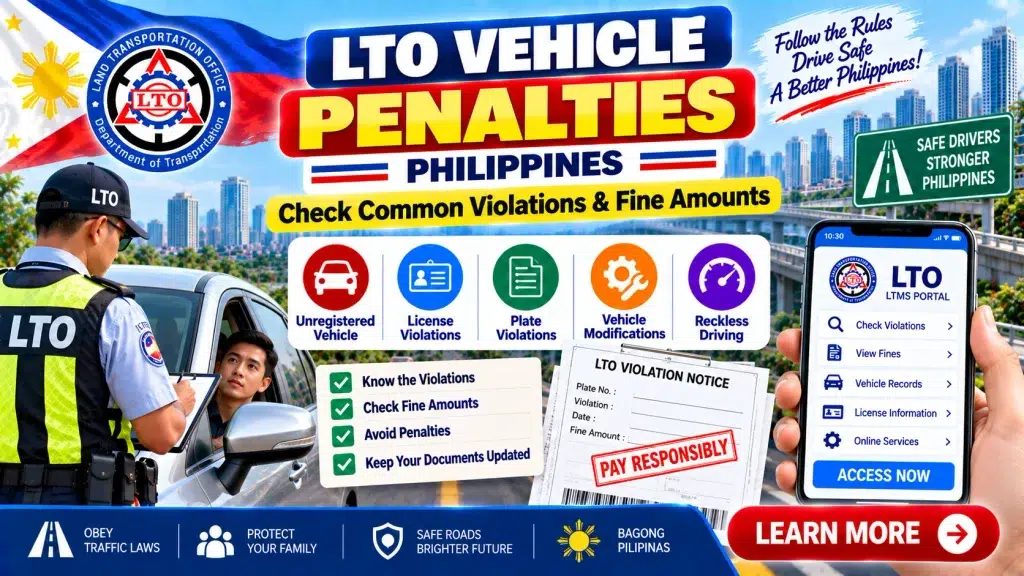
.
This guide explains common LTO vehicle penalties in the Philippines, examples of fine amounts motorists may encounter, how to check an actual violation, and practical ways to reduce the risk of receiving a citation.
Important: LTO regulations, fine schedules and enforcement procedures can change. Penalties may also depend on the specific circumstances, offense history, applicable law and issuing authority. Always verify the exact violation and current amount through official LTO/LTMS information or the authority that issued the citation before paying.
LTO Vehicle Penalties – Quick Overview
| Common Issue | Possible Consequence |
|---|---|
| Unregistered Motor Vehicle | Fine and possible vehicle-related action |
| Invalid Driver’s License | Fine and licensing consequences |
| Reckless Driving | Fine, demerit points and other action |
| Plate Violations | Fine/registration consequences |
| Unauthorized Modification | Fine or corrective action |
| Defective Vehicle Equipment | Applicable penalty |
| Improper Vehicle Operation | Citation and possible fine |
| Fake Documents | Serious administrative/legal consequences |
| Distracted Driving | Escalating penalties |
| DUI | Serious legal and licensing consequences |
| Repeat Violations | Higher/additional penalties may apply |
| Outstanding Violation | May affect applicable LTO transactions |
What Are LTO Vehicle Penalties?
LTO vehicle penalties are administrative consequences imposed for violations of applicable land transportation laws, rules and regulations.
Some violations primarily concern the vehicle itself, while others involve the person operating it.
For example:
Vehicle-related issues can include:
- Registration
- Plates
- Vehicle equipment
- Modifications
- Roadworthiness
Driver-related issues can include:
- Driver’s license
- Reckless driving
- Distracted driving
- Impaired driving
- Other prohibited road behavior
A single incident can sometimes involve more than one issue.
Driving an Unregistered Motor Vehicle
Vehicle registration is one of the most important responsibilities of a vehicle owner.
Under commonly referenced LTO penalty schedules, driving an unregistered motor vehicle can carry a ₱10,000 fine in applicable circumstances.
However, registration-related violations can differ depending on what actually occurred.
For example, there can be differences between:
- Expired registration
- Never-registered vehicle
- Improper registration
- Misrepresentation in registration
- Other registration irregularities
Therefore, check the exact violation written on the citation.
Why Vehicle Registration Matters
Registration helps establish important information about a motor vehicle in the government’s transportation records.
Depending on the transaction, registration records can include information related to:
- Vehicle identity
- Registered owner
- Engine/chassis details
- Vehicle classification
- Registration status
When buying a used vehicle, verify its documentation before completing the purchase.
Do not rely only on a seller saying:
“Updated lahat, no problem.”
Review the applicable official records.
Driving Without a Valid License
Although this is primarily a driver violation, it frequently appears alongside vehicle enforcement issues.
Common LTO penalty references have listed a ₱3,000 fine for applicable driving-without-a-valid-license violations.
Circumstances can include:
- Driving without a license
- Driving with an expired license
- Driving while suspended or revoked
- Operating outside applicable licensing authority
Additional licensing consequences may apply depending on the situation.
Always verify the current status of your driver’s license before driving.
Reckless Driving Penalties
Reckless driving can endanger everyone on the road.
Commonly referenced LTO schedules have listed the following administrative fines:
| Reckless Driving Offense | Common Reference Fine |
|---|---|
| First Offense | ₱2,000 |
| Second Offense | ₱3,000 |
| Subsequent Offense | ₱10,000 |
Additional consequences can apply to repeat offenders.
These amounts should be treated as general references and checked against the current rule applicable to the actual citation.
If reckless driving results in injury, death, or significant property damage, the consequences can extend beyond a standard LTO administrative fine.
Plate-Related Violations
Vehicle plates are an important identification feature.
Potential plate-related problems can include:
- Improper plate display
- Deliberate obstruction
- Unauthorized alteration
- Fake plates
- Misuse of plates
- Improper attachment
- Other prohibited practices
Do not cover, repaint, modify, or use unofficial vehicle identification simply for appearance.
A plate violation can potentially lead to fines or additional vehicle-related consequences depending on the offense.
Fake or Unauthorized Vehicle Documents
Using fake vehicle documents is far more serious than forgetting to carry an ordinary piece of paperwork.
Drivers and vehicle owners should never use:
- Fake registration documents
- Falsified certificates
- Fake plates
- Altered vehicle records
- Fraudulent official documents
Such conduct can lead to serious administrative and potentially legal consequences.
If there is a legitimate problem with your registration, resolve it through authorized channels rather than buying “replacement documents” from social media sellers.
Unauthorized Vehicle Modifications
Many motorists enjoy customizing cars and motorcycles.
However, vehicle modifications can create compliance problems when they affect regulated equipment, dimensions, identification, safety or other requirements.
Areas that may require attention include:
- Lighting
- Exhaust
- Body configuration
- Vehicle dimensions
- Engine-related changes
- Identification details
- Other regulated equipment
Before spending money on a major modification, check whether it is permitted and whether records need to be updated.
Vehicle Lights and Equipment
Vehicle safety equipment should remain functional.
Depending on the vehicle, important items can include:
- Headlights
- Tail lights
- Brake lights
- Turn signals
- Mirrors
- Brakes
- Tires
- Windshield
- Wipers
- Other required equipment
Defective equipment can create both safety risks and potential compliance problems.
A simple pre-drive inspection can prevent many avoidable issues.
Improper or Unauthorized Accessories
Accessories should not interfere with safe operation, vehicle identification, or other road users.
Be careful with equipment that:
- Blocks the driver’s view
- Obscures plates
- Creates excessive glare
- Interferes with required lights
- Creates unsafe projections
- Violates applicable vehicle requirements
Something being sold in an automotive shop does not automatically mean it is legal for every road vehicle.
Distracted Driving
A vehicle can be fully registered and roadworthy while its driver still commits a serious violation.
Under the Anti-Distracted Driving Act, commonly cited penalties include:
| Offense | Fine |
|---|---|
| First | ₱5,000 |
| Second | ₱10,000 |
| Third | ₱15,000 plus applicable license consequences |
| Subsequent | ₱20,000 plus applicable license consequences |
Drivers should follow the specific rules and exceptions under applicable law.
Avoid prohibited handheld device use while operating a vehicle.
Seat Belt Violations
Seat belts are important safety equipment for drivers and applicable passengers.
Philippine law provides penalties for violations of applicable seat-belt requirements, with consequences that can increase for repeat offenses.
Rather than thinking only about the fine, make fastening seat belts a routine before every trip.
The same applies even when driving a short distance.
Motorcycle Helmet Violations
Motorcycle riders and passengers should follow applicable helmet requirements.
Helmet violations can involve escalating penalties for repeat offenses.
Use an appropriate compliant helmet and wear it correctly.
Never use a damaged helmet merely to satisfy the appearance of compliance.
Driving Under the Influence
Driving under the influence of alcohol or dangerous drugs can carry serious consequences.
Depending on the circumstances, these can include:
- Monetary fines
- License suspension
- License revocation in applicable cases
- Criminal liability
- Imprisonment
- Greater consequences if injury or death occurs
This is not a violation where a single simple “LTO fine” tells the full story.
Never drive impaired.
LTO vs Local Traffic Violations
Not every citation received while driving is necessarily an LTO violation.
Local government traffic authorities can enforce applicable local ordinances.
For example, local rules may cover matters such as:
- Parking
- Traffic routing
- Loading and unloading
- Local road restrictions
- Certain traffic-scheme violations
Therefore:
Always identify the issuing authority before paying.
A local citation may have a different settlement procedure from an LTO violation.
How to Check an LTO Vehicle Violation
If you receive a citation, use this general process.
Step 1: Read the Citation
Identify:
- Violation
- Citation number
- Date
- Vehicle information
- Issuing authority
Step 2: Verify the Authority
Confirm whether it is an LTO citation or another traffic authority’s ticket.
Step 3: Check Official Records
For applicable LTO services, use legitimate LTO/LTMS channels.
Step 4: Confirm the Penalty
Verify the current fine rather than relying on an old online chart.
Step 5: Check Additional Consequences
Determine whether the violation involves:
- Demerit points
- Registration action
- License action
- Vehicle-related requirements
Step 6: Follow the Official Procedure
Pay or resolve the citation through the authorized process.
Step 7: Keep the Receipt
Save proof that the transaction was completed.
What Is LTMS?
The Land Transportation Management System (LTMS) is the LTO’s online platform supporting various driver and motor vehicle services.
Depending on the transaction and available service, motorists may use LTMS for relevant LTO information and processes.
Always access the legitimate service directly.
Do not give your LTMS password or OTP to a “fixer.”
Understanding Demerit Points
A driver should not evaluate a violation only by asking:
“How much is the fine?”
Applicable traffic violations can also involve demerit points.
Demerit points can affect:
- Driver records
- License renewal
- Repeat-offense consequences
- Other licensing matters
Repeated violations can therefore become much more costly than the initial peso amount suggests.
Can Vehicle Violations Affect Registration?
Depending on the issue, unresolved vehicle-related violations or documentation problems can complicate applicable LTO transactions.
Before registration or renewal, check:
- Vehicle records
- Registration status
- Outstanding issues
- Required inspection/compliance
- Vehicle information
- Applicable documents
Correct problems early instead of waiting until the final day.
Buying a Used Vehicle? Check These Details
Before buying a second-hand car or motorcycle, review:
| Item | Why Check It? |
|---|---|
| Registration | Verify current status |
| Registered Owner | Compare with seller information |
| OR/CR Records | Check vehicle documentation |
| Engine Number | Should correspond with records |
| Chassis Number | Important vehicle identifier |
| Plate | Check applicable details |
| Vehicle Condition | Identify mechanical/safety problems |
| Modifications | Check compliance concerns |
| Outstanding Issues | Avoid unexpected problems |
Do not make a substantial payment before verifying important vehicle information.
What if You Believe the Violation Is Incorrect?
If you believe a citation contains an error, use the official contest or review procedure.
Gather:
- Citation
- Vehicle records
- Driver’s license
- Photos or videos where relevant
- Other supporting evidence
Contact the issuing authority and ask about the proper process.
Do not pay an unofficial intermediary to “delete” the violation.
Beware of Fake LTO Penalty Messages
Scammers may send fake notices claiming that a vehicle has a violation.
Be suspicious if a message asks you to:
- Click an unknown payment link
- Enter your LTMS password
- Provide an OTP
- Send money to a personal account
- Pay immediately to avoid “automatic cancellation”
- Pay someone to erase a violation
Independently verify the information through legitimate channels.
Vehicle Compliance Checklist
Before driving, check:
- Driver’s license validity
- Vehicle registration
- Plates/identification
- Tires
- Brakes
- Headlights
- Brake lights
- Turn signals
- Mirrors
- Seat belts
- Motorcycle helmet, if applicable
- Major modifications
- Required vehicle documents
A roadworthy vehicle is safer and less likely to create avoidable compliance problems.
Frequently Asked Questions (FAQ)
1. What are common LTO vehicle violations?
Common issues include unregistered vehicles, plate problems, unauthorized modifications, defective equipment, licensing violations and unsafe driving behavior.
2. What is the commonly referenced fine for an unregistered motor vehicle?
Common LTO penalty references have listed ₱10,000 for applicable unregistered-motor-vehicle violations. Verify the current rule for your specific case.
3. How much is the commonly referenced fine for driving without a valid license?
Common LTO schedules have listed ₱3,000 in applicable cases, subject to current rules and additional consequences.
4. What are commonly referenced reckless-driving fines?
Common references list ₱2,000 for the first offense, ₱3,000 for the second and ₱10,000 for subsequent offenses, with possible additional consequences.
5. Can vehicle modifications result in a penalty?
Yes. Modifications that violate applicable vehicle, safety, registration or equipment rules can create compliance problems.
6. Can I check LTO information online?
Relevant driver and vehicle services may be available through the official LTO/LTMS platform.
7. Are all vehicle-related traffic tickets issued by LTO?
No. Local governments and other authorized authorities can issue traffic citations under applicable rules.
8. Can violations affect vehicle registration?
Depending on the issue, unresolved registration, documentation or vehicle compliance problems can affect applicable transactions.
9. What should I do if an LTO penalty message looks suspicious?
Do not immediately pay or provide personal information. Independently verify the violation through legitimate official channels.
10. How can I avoid vehicle penalties?
Keep your license and registration current, maintain your vehicle, use proper plates and safety equipment, avoid unauthorized modifications, and follow traffic laws.
Final Words
Understanding LTO Vehicle Penalties in the Philippines can help motorists avoid unnecessary fines and keep their vehicles compliant with applicable transportation rules.
Common issues can involve expired or improper registration, driver’s license problems, reckless driving, plates, unauthorized modifications, defective equipment, distracted driving and other road-safety violations.
Some commonly referenced fines can reach thousands of pesos, and repeat or serious violations can involve additional consequences such as demerit points or licensing action.
However, motorists should not rely solely on old fine lists circulating online. Always identify the exact violation, check who issued the citation and verify the current penalty through legitimate LTO/LTMS or issuing-authority channels.
Before driving, take a few minutes to check your license, vehicle registration, tires, brakes, lights, mirrors, plates and safety equipment.
Most importantly, remember that vehicle compliance is not only about avoiding a fine. A properly registered, well-maintained vehicle operated by a responsible driver helps protect you, your passengers and everyone else using Philippine roads.
Declaration
The information provided on this website is published for informational purposes only. While every effort is made to ensure the accuracy and timely updating of the content, we do not guarantee the completeness, reliability, or authenticity of any information. Candidates and users are strongly advised to visit the official websites of the respective departments, organizations, or authorizing bodies before applying for any job, scheme, examination, or benefit program. This website is not associated with any government organisation and does not provide any recruitment guarantee or official confirmation. We are not responsible for any loss, error, or misunderstanding arising from the use of the information available on this website.