Property Tax Philippines – How to Check Real Property Tax & Payment Information
Owning land, a house, condominium, or other taxable real property in the Philippines can involve an ongoing responsibility to pay Real Property Tax (RPT) to the appropriate local government unit. For property owners, buyers, sellers, and investors, understanding how property tax works is an important part of managing real estate and avoiding unexpected liabilities.
Real Property Tax is generally administered at the local government level rather than through one nationwide property-tax payment system. This means the exact assessment, payment channels, online services, deadlines, discounts, penalties, and documentary requirements can vary depending on the city, municipality, or province where the property is located.
Property owners should know how to review their Tax Declaration, assessed value, RPT records, official receipts, outstanding balances, and applicable payment information. Buyers should also check the tax status of a property before completing a purchase.
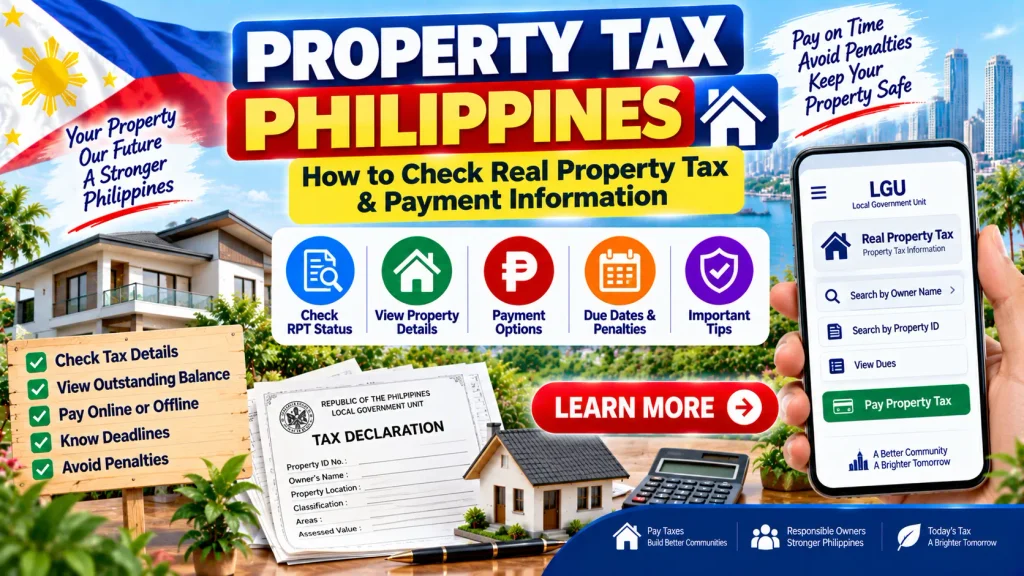
This guide explains how to check Real Property Tax in the Philippines, where to find property tax information, how RPT is generally calculated, how to pay, and what to do if there are unpaid property taxes.
Important: Local tax rates, discounts, penalties, deadlines, assessment procedures, and online payment options can change and differ between LGUs. Always verify the current amount and payment instructions directly with the relevant local government assessor’s or treasurer’s office before making a payment.
Property Tax Philippines – Quick Overview
| Item | General Information |
|---|---|
| Common Name | Real Property Tax (RPT) |
| Applies To | Taxable real property |
| Administration | Local government units |
| Assessment Records | Local Assessor’s Office |
| Payment/Collection | Local Treasurer’s Office |
| Important Document | Tax Declaration |
| Tax Basis | Assessed value and applicable local tax rates |
| Payment Frequency | Generally annual, with installment options under applicable rules |
| Online Payment | Available in some LGUs |
| Official Receipt | Keep as proof of payment |
| Late Payment | Interest/penalties may apply |
| Property Sale | Tax status should be checked |
| Tax Clearance | Can be relevant to property transactions |
What Is Real Property Tax in the Philippines?
Real Property Tax, commonly called RPT, is a local tax imposed on taxable real property under applicable Philippine law and local ordinances.
Depending on the property and applicable rules, real property can include:
- Land
- Buildings
- Houses
- Certain improvements
- Machinery in applicable situations
- Other taxable real property
The property is assessed for taxation purposes, and the applicable local tax is determined based on the property’s assessed value and relevant rates.
RPT should not be confused with taxes arising from selling or transferring property.
It is an ongoing property-related tax obligation.
Who Collects Real Property Tax?
Real Property Tax is administered through local government units.
Two local offices are particularly important.
Local Assessor’s Office
The Assessor’s Office handles property assessment information and Tax Declarations.
It can maintain details relating to:
- Property owner/declarant
- Property location
- Classification
- Fair market value for assessment purposes
- Assessment level
- Assessed value
- Land and improvements
Local Treasurer’s Office
The Treasurer’s Office generally handles the collection of Real Property Tax and can provide payment-related information.
If you need to determine whether property taxes are unpaid, this is an important office to check with.
What Is a Tax Declaration?
A Tax Declaration is an important local government record used for property assessment and taxation.
It can contain information such as:
- Tax Declaration number
- Name of the declared owner
- Property location
- Lot or property information
- Property classification
- Land area
- Fair market value
- Assessed value
- Improvement details
A property can have separate assessment records for land and improvements depending on the circumstances.
However, buyers should remember that a Tax Declaration is not automatically equivalent to a registered Torrens title or conclusive evidence of registered ownership.
For ownership verification, title records should also be checked when applicable.
How Is Real Property Tax Calculated?
The exact tax depends on the applicable local rules and property assessment.
A simplified concept is:
Real Property Tax = Assessed Value × Applicable RPT Rate
However, the assessed value itself is generally determined using factors such as the property’s fair market value for assessment purposes and the applicable assessment level.
Therefore, a simplified sequence can be viewed as:
Property Value for Assessment → Assessment Level → Assessed Value → Applicable Tax Rate → RPT
Other local levies can also affect the total amount payable.
For an exact bill, rely on the official assessment or statement from the relevant LGU.
Sample RPT Calculation
The following example is illustrative only and should not be treated as an official tax quotation.
| Calculation Item | Illustrative Amount |
|---|---|
| Property Value for Example | ₱2,000,000 |
| Illustrative Assessment Level | 20% |
| Illustrative Assessed Value | ₱400,000 |
| Illustrative RPT Rate | 2% |
| Illustrative Basic RPT | ₱8,000 |
Actual classification, valuation, assessment levels, tax rates, additional levies, discounts, and penalties depend on applicable law and the relevant LGU.
How to Check Property Tax Information
Property owners can follow a general process.
Step 1: Identify the Correct LGU
Determine the city or municipality where the property is located.
Do not try to pay through another LGU simply because the owner’s current residence is there.
Property tax is connected to the property’s location.
Step 2: Prepare the Property Information
Useful information can include:
- Owner or declarant name
- Property address
- Tax Declaration number
- Property identification details
- Previous RPT official receipt
- Title information, when relevant
The exact information required can vary.
Step 3: Check With the Assessor’s Office
If you need assessment information, verify the current Tax Declaration and property assessment through the appropriate Assessor’s Office.
Check whether the information corresponds with the property.
Step 4: Check With the Treasurer’s Office
Request information about:
- Current RPT due
- Previous unpaid taxes
- Applicable penalties
- Payment schedule
- Accepted payment methods
- Available discounts
- Official online payment options
Step 5: Verify Before Paying
Confirm the property details and amount before completing the payment.
This is particularly important when using an online payment channel.
Can You Check Real Property Tax Online?
Some Philippine local governments provide online property-tax services.
Depending on the LGU, digital services can allow users to:
- View assessment information
- Check outstanding balances
- Generate payment information
- Pay RPT online
- Review transaction status
- Access certain electronic records
However, there is no guarantee that every LGU offers exactly the same online service.
Search for the official website or payment portal of the LGU where the property is located.
Avoid websites claiming to be a universal Philippine RPT checker unless they are officially authorized.
How to Pay Real Property Tax
The general payment process can involve the following steps.
1. Confirm the Property Record
Verify the Tax Declaration or other required property information.
2. Request the Amount Due
Check the current RPT, applicable levies, and any outstanding balance.
3. Review Discounts or Penalties
Depending on the LGU and payment date, an applicable discount or late-payment charge may affect the amount.
4. Choose an Authorized Payment Channel
Payment methods can include in-person payment and, in some LGUs, authorized online channels.
5. Complete Payment
Pay the exact amount through the approved method.
6. Obtain an Official Receipt
Keep your official payment record.
7. Check the Updated Status
If necessary, confirm that the payment has been properly posted to the property account.
Annual vs Installment Payments
Real Property Tax is generally an annual obligation, although applicable rules can allow installment payment schedules.
Property owners should check the relevant LGU’s current schedule.
Paying early can sometimes qualify for discounts where authorized.
Late payments can result in additional charges.
Instead of relying on last year’s payment date or discount, verify the current year’s schedule.
What Happens if Property Tax Is Not Paid?
Ignoring RPT can create significant problems.
Unpaid property taxes can result in:
- Interest or penalties
- Increasing outstanding balance
- Difficulty obtaining tax clearance
- Complications during a property sale
- Collection or enforcement procedures under applicable law
The longer a delinquent tax remains unresolved, the more complicated the situation can become.
Property owners who discover unpaid RPT should contact the relevant Treasurer’s Office to determine the official amount and available procedure.
How to Check Unpaid Property Tax
To investigate possible tax delinquency:
- Identify the correct LGU.
- Prepare the Tax Declaration details.
- Gather previous receipts if available.
- Contact the local Treasurer’s Office.
- Request the current statement or amount due.
- Check the years covered by the unpaid balance.
- Verify applicable interest or penalties.
- Follow official payment instructions.
Do not pay an unofficial intermediary who claims to be able to erase tax penalties from the government system.
Real Property Tax When Buying Property
Buyers should investigate property taxes before completing a purchase.
Ask the seller for:
- Latest Tax Declaration
- Recent RPT receipts
- Relevant tax clearance
- Property assessment information
Then independently verify important information with the relevant local government office when necessary.
This can help identify unpaid obligations before ownership transfer.
Property Tax Buyer Checklist
| Item | What to Check |
|---|---|
| Tax Declaration | Does it correspond with the property? |
| Declared Owner | Does the information make sense? |
| Property Location | Is it the correct property? |
| Land Area | Does it match relevant records? |
| Assessment | Review current assessment information |
| RPT Receipts | Check recent payment records |
| Outstanding RPT | Determine whether taxes are unpaid |
| Penalties | Check delinquency charges |
| Tax Clearance | Obtain when applicable |
| Seller Responsibility | Clarify who pays outstanding amounts |
Tax Declaration vs Land Title
The difference between these documents is extremely important.
Land Title
A registered title, such as an OCT or TCT, is associated with registered property ownership under the Philippine land registration system.
Tax Declaration
A Tax Declaration is primarily an assessment and taxation record maintained by the local government.
Therefore:
Tax Declaration ≠ Registered Land Title
When buying titled property, check both where relevant.
Real Property Tax for Houses and Improvements
If land contains a house or another taxable improvement, the assessment can involve more than the land itself.
The local Assessor’s Office can maintain assessment information for improvements.
Owners should ensure relevant property information is properly declared and updated according to applicable rules.
Changes to the property can potentially affect its assessment.
Real Property Tax for Condominium Owners
Condominium owners should understand which property-related charges are government taxes and which are private condominium expenses.
For example:
- Real property-related tax obligations
- Association dues
- Special assessments
- Parking charges
- Utility expenses
are not necessarily the same thing.
Review the CCT, condominium corporation information, billing statements, and applicable local tax records.
Property Tax After Buying a Property
After completing a legitimate property transfer, the new owner should ensure that applicable local assessment records are properly updated.
This can involve submitting relevant documents to the local Assessor’s Office after title-transfer requirements are completed.
Keeping old owner information indefinitely can create confusion.
Store copies of:
- New title
- Deed of Sale
- Tax Declaration
- RPT receipts
- Tax clearance
- Transfer documents
Updating a Tax Declaration
A Tax Declaration may need updating when ownership or property information changes.
Depending on the situation, supporting documents can include:
- New title information
- Registered Deed of Sale
- Previous Tax Declaration
- Identification
- Transfer-related documents
- Other LGU requirements
The exact checklist varies by local government.
Common Property Tax Mistakes
Assuming RPT Is Automatically Paid
Do not assume a seller, developer, lender, or another party has paid it unless you verify.
Losing Official Receipts
Keep payment records organized.
Paying the Wrong Property Account
Check the Tax Declaration and property information before paying.
Ignoring Old Unpaid Taxes
Previous unpaid amounts can become a serious issue.
Confusing Tax Declaration With Title
They serve different purposes.
Using Unofficial Online Payment Links
Use only authorized LGU payment channels.
How to Avoid Property Tax Scams
Scammers can create fake tax-payment pages or claim to represent government offices.
Protect yourself by:
- Checking the official LGU source
- Verifying the payment recipient
- Reviewing property details
- Avoiding suspicious payment links
- Keeping official receipts
- Never sharing unnecessary banking credentials
- Avoiding “tax fixer” offers
A government-looking logo does not automatically prove a website is legitimate.
Tips for Property Owners
A simple yearly routine can make RPT easier to manage:
- Check your property assessment.
- Verify the annual amount due.
- Note payment deadlines.
- Ask about authorized early-payment discounts.
- Pay through official channels.
- Keep receipts digitally and physically.
- Confirm posting when necessary.
- Update records after ownership changes.
If you own multiple properties in different LGUs, maintain separate records for each property.
Frequently Asked Questions (FAQ)
1. What is Real Property Tax in the Philippines?
Real Property Tax is a local tax imposed on taxable real property and administered by the appropriate local government unit.
2. Where can I check my property tax?
Check with the relevant local Assessor’s Office for assessment information and the local Treasurer’s Office for tax billing and payment information.
3. Can I check RPT online?
Some LGUs offer online RPT services, but availability and functionality vary by location.
4. How is RPT calculated?
RPT generally depends on the property’s assessed value and applicable local tax rate, together with other relevant levies or rules.
5. Is a Tax Declaration proof of land ownership?
A Tax Declaration is an important assessment record but is not automatically equivalent to a registered land title or conclusive proof of registered ownership.
6. Can I pay property tax online?
Online payment is available in some LGUs through authorized services. Verify the official payment channel for the property’s location.
7. What happens if I pay RPT late?
Applicable interest or penalties can be added to delinquent property taxes.
8. Should I check RPT before buying a property?
Yes. Buyers should investigate the property’s current tax status and any outstanding obligations before completing a purchase.
9. Can I get a discount for paying early?
Applicable early-payment discounts may be available under current local rules. Check directly with the relevant LGU.
10. What should I keep after paying RPT?
Keep the official receipt and relevant Tax Declaration, assessment, and payment records for future reference.
Final Words
Understanding Property Tax in the Philippines is an important responsibility for homeowners, landowners, condominium owners, and real estate investors.
Start by identifying the local government unit where the property is located. Check the current Tax Declaration and assessment information through the appropriate Assessor’s Office, then verify the amount due and payment status with the Treasurer’s Office.
Before paying, confirm the property details, outstanding balance, applicable penalties, current payment schedule, and any authorized discounts. If online payment is available, use only an official or authorized LGU service.
Property buyers should also investigate Real Property Tax before completing a purchase. Review recent receipts and determine whether there are unpaid obligations that could complicate the transaction.
Most importantly, remember that a Tax Declaration and a registered land title are different records. When verifying a property purchase, review both title and tax information where applicable.
Keeping accurate records, paying through authorized channels, and checking your RPT status regularly can help prevent penalties and make future property sales, transfers, and registration procedures easier.
Declaration
The information provided on this website is published for informational purposes only. While every effort is made to ensure the accuracy and timely updating of the content, we do not guarantee the completeness, reliability, or authenticity of any information. Candidates and users are strongly advised to visit the official websites of the respective departments, organizations, or authorizing bodies before applying for any job, scheme, examination, or benefit program. This website is not associated with any government organisation and does not provide any recruitment guarantee or official confirmation. We are not responsible for any loss, error, or misunderstanding arising from the use of the information available on this website.