Land Registration Philippines – Requirements, Documents & Step-by-Step Process
Land registration is an important part of protecting and documenting property rights in the Philippines. Whether property is being purchased, sold, donated, inherited, or transferred through another legal transaction, the parties may need to complete specific documentary, tax, and registration requirements before the transaction can be properly recorded.
The Land Registration Authority (LRA) plays a central role in the Philippine land registration system, while the appropriate Registry of Deeds (RD) handles registration transactions within its territorial jurisdiction. Other government offices, including the Bureau of Internal Revenue (BIR) and relevant local government offices, can also become involved depending on the type of transaction.
The exact process is not identical for every property. A straightforward sale of already titled land is different from original land registration, estate settlement, donation, mortgage registration, or transfer of a condominium unit.
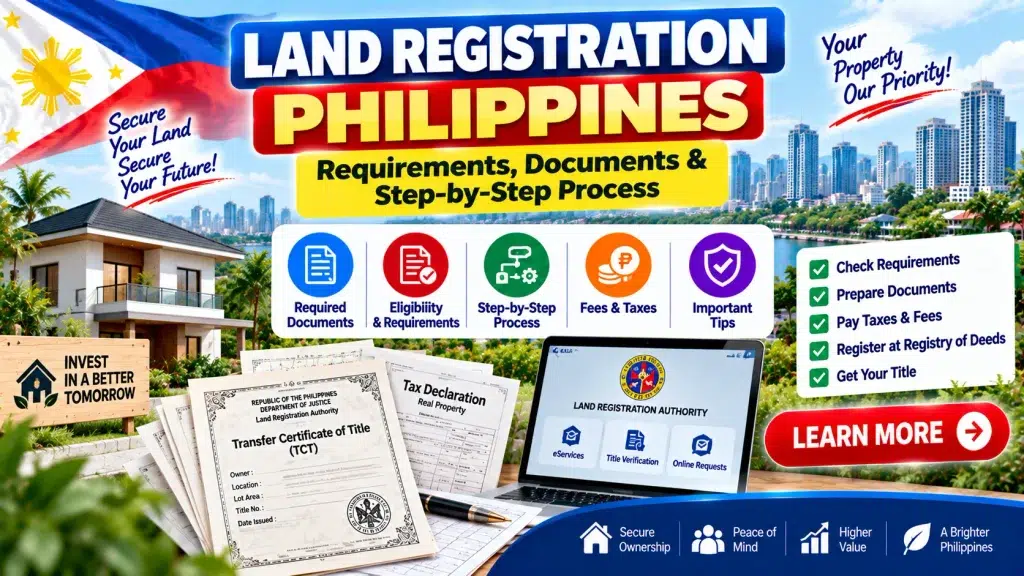
This guide explains the general land registration requirements in the Philippines, important documents, taxes and fees, title verification, Registry of Deeds procedures, and step-by-step registration process.
Important: Requirements, taxes, fees, forms, and procedures can change and may vary according to the property and transaction. Always confirm the latest requirements with the appropriate LRA/Registry of Deeds, BIR, and local government offices. Seek qualified legal or tax advice for complicated transactions.
Land Registration Philippines – Quick Overview
| Item | General Information |
|---|---|
| Main Land Registration Agency | Land Registration Authority (LRA) |
| Local Registration Office | Registry of Deeds |
| Common Land Title | TCT or OCT, depending on the property |
| Condominium Title | CCT |
| Key Transfer Document | Appropriate deed/instrument |
| Title Verification | Certified True Copy may be useful |
| Tax Processing | BIR requirements can apply |
| eCAR | Relevant to applicable property transfers |
| Tax Declaration | Common supporting property record |
| Real Property Tax | Clearance may be required |
| Transfer Tax | Applicable to qualifying transfers |
| Registration Fees | Assessed according to transaction |
| Final Result | Registration/update of applicable property records |
What Is Land Registration in the Philippines?
Land registration generally refers to the legal process through which rights, transactions, and interests involving real property are recorded under the Philippine land registration system.
Registration can involve many different transactions, including:
- Sale of property
- Transfer of ownership
- Donation
- Inheritance
- Mortgage
- Cancellation of mortgage
- Adverse claims
- Court-ordered transactions
- Consolidation or subdivision
- Other registrable instruments
For ordinary property buyers, “land registration” often refers to registering a completed property transfer and processing the title into the new owner’s name.
However, this should not be confused with original registration of previously untitled land, which can involve a substantially different legal process.
What Is the Land Registration Authority?
The Land Registration Authority is an agency under the Philippine Department of Justice responsible for functions connected with land registration.
The LRA works with Registries of Deeds throughout the country.
Its land registration system helps preserve records involving property ownership and registered interests.
Property owners and buyers may also use supported LRA services for certain title-related requests, including obtaining a Certified True Copy of a title through available procedures.
What Is the Registry of Deeds?
A Registry of Deeds is the office where applicable real estate instruments and transactions are registered for properties within its jurisdiction.
Depending on the transaction, the Registry of Deeds can process documents involving:
- Transfer of ownership
- Sale
- Donation
- Mortgage
- Cancellation of mortgage
- Estate settlement
- Court orders
- Other registrable transactions
For a property transfer, applicants generally need to deal with the Registry of Deeds that has jurisdiction over the property.
Understanding OCT, TCT and CCT
Before beginning registration, understand the type of title involved.
Original Certificate of Title – OCT
An Original Certificate of Title (OCT) is associated with the original registration of titled land.
Transfer Certificate of Title – TCT
A Transfer Certificate of Title (TCT) is commonly issued following an applicable transfer of registered land.
A buyer purchasing titled land or a house and lot will often encounter a TCT.
Condominium Certificate of Title – CCT
A Condominium Certificate of Title (CCT) relates to ownership of an individual condominium unit.
Title Types at a Glance
| Document | General Purpose |
|---|---|
| OCT | Original registration of titled land |
| TCT | Registered ownership following applicable transfer |
| CCT | Ownership of an individual condominium unit |
| Tax Declaration | Local assessment/tax record, not the same as a title |
Verify the Title Before Registration
Before processing a transfer, verify the existing title information.
This is particularly important when buying property.
Review:
- Registered owner’s name
- Title number
- Registry of Deeds
- Property location
- Land area
- Technical description
- Annotations
Buyers should not rely exclusively on a photocopy provided by the seller.
An appropriate official title verification or Certified True Copy can help compare the seller’s documents with registered information.
Why Title Annotations Matter
A property title can contain annotations that affect the proposed transaction.
These may involve:
- Mortgage
- Adverse claim
- Easement
- Restrictions
- Notices related to litigation
- Other registered interests
An annotation does not always prevent registration or transfer, but its legal effect needs to be understood.
For example, an existing mortgage may require settlement and appropriate cancellation procedures before or as part of the intended transaction.
Basic Documents for Land Registration
Requirements depend on the transaction, but important document categories can include:
| Document | General Purpose |
|---|---|
| Original Deed/Instrument | Establishes the registrable transaction |
| Owner’s Duplicate Title | Relevant for titled property |
| Tax Declaration | Property assessment information |
| BIR eCAR/CAR | Supports applicable tax compliance |
| Tax Clearance | Evidence relating to property tax status |
| Transfer Tax Receipt | Proof of applicable local transfer tax |
| Valid IDs | Identify transaction parties |
| SPA | Used when an authorized representative acts |
| Supporting Civil Documents | May apply depending on ownership |
| Other RD Requirements | Depend on transaction type |
Applicants should obtain the latest checklist for their particular transaction rather than assuming that one list applies to every registration.
What Is a Deed of Absolute Sale?
For a typical property sale, the Deed of Absolute Sale is an important transaction document.
It generally identifies:
- Seller
- Buyer
- Property
- Agreed consideration
- Terms of sale
- Other relevant declarations
The document must satisfy applicable legal and notarization requirements.
Before signing, verify that the property description and parties’ information are accurate.
Never sign a blank Deed of Sale.
Step 1: Verify the Seller and Property
Before executing a transaction, verify the identity of the registered owner.
Compare:
Seller’s valid identification → Registered owner → Title information → Actual property
If someone other than the registered owner is acting, verify the person’s legal authority.
A representative may need an appropriate Special Power of Attorney.
Inherited, co-owned, corporate, and estate properties can require additional documentation.
Step 2: Inspect the Physical Property
Registration documents do not replace physical due diligence.
Visit the land and check:
- Location
- Boundaries
- Access
- Occupants
- Structures
- Encroachments
- Neighboring properties
- Actual use
If boundaries are uncertain, consider using an appropriately qualified geodetic engineer or other suitable professional.
Step 3: Prepare and Execute the Appropriate Instrument
Once due diligence and transaction terms are complete, prepare the appropriate legal document.
For a sale, this can be a Deed of Absolute Sale.
Other transactions can require different instruments.
Examples include:
- Deed of Donation
- Estate settlement documents
- Mortgage documents
- Court orders
- Other registrable instruments
The correct document depends on the nature of the transaction.
Step 4: Complete Applicable BIR Requirements
Property transfers can trigger national tax obligations.
The appropriate BIR requirements depend on whether the transaction is a:
- Sale
- Donation
- Estate transfer
- Other taxable transfer
Applicants may need to submit applicable tax returns, property documents, title information, tax declarations, and proof of payment.
Once applicable requirements are satisfied, the relevant Certificate Authorizing Registration, commonly handled electronically as an eCAR for applicable transactions, becomes important for the registration process.
What Is an eCAR?
eCAR means Electronic Certificate Authorizing Registration.
It is associated with the BIR process for authorizing registration of applicable property transfers after relevant tax requirements have been addressed.
The Registry of Deeds can require the appropriate CAR/eCAR information as part of applicable title-transfer registration.
An eCAR is not itself a new land title.
It is part of the tax and registration documentation supporting the transfer.
Step 5: Check Real Property Taxes
Verify the property’s applicable real property tax status through the relevant local government offices.
If there are unpaid property taxes, they may need to be settled.
A real property tax clearance may form part of the documentation required for applicable registration or transfer procedures.
Keep official receipts and clearances.
Step 6: Pay Applicable Transfer Tax
A local transfer tax can apply to property transfers.
The amount and procedure depend on current law, the relevant local government unit, and the transaction.
After payment, keep the official proof because it can be required when completing the registration.
Step 7: Organize the Registry of Deeds Documents
Before going to the Registry of Deeds, organize the complete document package.
For a typical sale, this may include:
- Appropriate deed
- Owner’s duplicate title
- Applicable eCAR/CAR
- Latest Tax Declaration
- Real property tax clearance
- Transfer tax receipt
- Required identification
- Other supporting documents
Check names, title numbers, property descriptions, and dates carefully.
Small discrepancies can cause delays.
Step 8: Submit Documents to the Registry of Deeds
Submit the registration documents to the appropriate Registry of Deeds.
The office will examine the documents and determine whether the transaction satisfies applicable registration requirements.
If something is missing or inconsistent, additional documentation or correction may be necessary.
Step 9: Pay Registration Fees
Applicants need to pay applicable registration-related fees.
Registration costs depend on the nature and value of the transaction and current rules.
Do not rely on an unofficial fixed amount from social media posts because fees can differ.
Use the official assessment for your transaction.
Keep the official receipt.
Step 10: Registry of Deeds Processing
After submission and payment, the Registry of Deeds processes the transaction.
For an applicable ownership transfer, the existing title and submitted documents are reviewed and the appropriate registration action is completed.
If everything is in order, title records can be updated and the applicable title issued or processed according to the transaction.
Processing can take longer when documents are incomplete or when the property involves unusual legal issues.
Step 11: Receive and Check the New Title
When the title is released, immediately review its information.
Check:
- New owner’s name
- Title number
- Property description
- Land area
- Relevant annotations
Report important errors through the appropriate procedure rather than ignoring them.
Keep the title securely.
Step 12: Update the Tax Declaration
Title registration is not necessarily the final administrative step.
The new owner may also need to update relevant local government assessment records and process a new or updated Tax Declaration.
Keep both title and local property records organized.
Complete Registration Process at a Glance
| Stage | Main Action |
|---|---|
| 1 | Verify owner and title |
| 2 | Inspect property |
| 3 | Execute appropriate deed/instrument |
| 4 | Complete BIR requirements |
| 5 | Obtain applicable eCAR/CAR |
| 6 | Settle property tax requirements |
| 7 | Pay applicable transfer tax |
| 8 | Prepare Registry of Deeds documents |
| 9 | Submit documents |
| 10 | Pay registration fees |
| 11 | Complete RD processing |
| 12 | Check title and update local records |
How Long Does Land Registration Take?
There is no single processing period for every transaction.
Time can depend on:
- Type of transaction
- Completeness of documents
- Tax processing
- Local government processing
- Registry of Deeds workload
- Existing annotations
- Estate issues
- Property disputes
- Errors in documents
Prepare documents carefully before submission to reduce avoidable delays.
Registration of Inherited Property
Inherited property can involve additional requirements.
Depending on the circumstances, these may include:
- Estate settlement
- Estate tax requirements
- Extrajudicial settlement documents
- Publication requirements where applicable
- Court documents
- Heir information
- Other supporting records
Do not treat an inherited property transaction as an ordinary sale without checking the applicable estate requirements.
Registration of Donated Property
A donation follows a different legal and tax process.
Documentation can involve:
- Deed of Donation
- Acceptance where applicable
- Donor’s tax requirements
- BIR documentation
- Local government requirements
- Registry of Deeds registration
The correct procedure should be followed instead of disguising a donation as another type of transaction.
Common Reasons for Registration Delays
Incomplete Documents
Missing requirements can stop or delay processing.
Name Discrepancies
Different spellings across IDs, titles, deeds, and tax records may need correction.
Unpaid Taxes
Outstanding property obligations can interfere with obtaining required clearances.
Existing Mortgage
A mortgage may need to be properly discharged and cancelled.
Deceased Owner
Estate settlement may be necessary.
Incorrect Property Description
Errors involving lot numbers, areas, or technical descriptions can create complications.
How to Avoid Land Registration Scams
Use legitimate government channels for land registration and title-related transactions.
Be cautious of people claiming they can:
- Create an instant title without legal requirements
- Remove a mortgage secretly
- Delete an adverse claim for cash
- Change an owner’s name without documentation
- Guarantee registration through an unofficial payment
Government-style logos on a website or Facebook page do not automatically make it official.
Protect your personal information and property documents.
Land Registration Safety Checklist
Before registration:
- Verify the title.
- Confirm seller identity.
- Read all annotations.
- Check property boundaries.
- Use the correct legal instrument.
- Complete applicable tax requirements.
- Obtain official receipts.
- Check the latest RD requirements.
- Avoid unofficial fixers.
- Keep copies of all submitted documents.
For high-value or complicated transactions, professional legal assistance can provide additional protection.
Frequently Asked Questions (FAQ)
1. What agency handles land registration in the Philippines?
The Land Registration Authority oversees the land registration system, while Registries of Deeds process applicable registration transactions within their jurisdictions.
2. What documents are required for land registration?
Requirements depend on the transaction but can include the deed or instrument, owner’s title copy, Tax Declaration, applicable eCAR/CAR, tax clearance, transfer tax proof, IDs, and additional supporting documents.
3. What is a TCT?
A Transfer Certificate of Title is commonly issued in connection with registered ownership after an applicable transfer of titled land.
4. What is an OCT?
An Original Certificate of Title is associated with the original registration of titled land.
5. What is an eCAR?
An eCAR is an Electronic Certificate Authorizing Registration associated with BIR tax processing for applicable property transfers.
6. Is a Tax Declaration a land title?
No. A Tax Declaration is a local assessment and taxation record and is different from a registered land title.
7. Do I need to pay a transfer tax?
Applicable property transfers can be subject to local transfer tax. Confirm the current requirements with the relevant local government unit.
8. How long does title registration take?
Processing time varies depending on the transaction, documents, taxes, local government processing, Registry of Deeds workload, and any legal or title issues.
9. Can inherited land be registered in the heirs’ names?
Yes, subject to applicable estate settlement, tax, documentary, and registration requirements.
10. Where should I check the latest registration requirements?
Verify the latest requirements through the appropriate Land Registration Authority/Registry of Deeds, Bureau of Internal Revenue, and relevant local government offices.
Final Words
Understanding the Land Registration Philippines process is essential when transferring, purchasing, donating, inheriting, or otherwise dealing with real property.
For a typical property transfer, begin by verifying the registered owner and title information. Review the title number, property description, land area, and annotations before completing the transaction.
Next, prepare and execute the appropriate legal instrument, comply with applicable BIR tax requirements, secure the relevant eCAR/CAR, settle local property and transfer-tax requirements, and organize all supporting documents.
Submit the complete package to the appropriate Registry of Deeds and pay the officially assessed registration fees. After processing, review the resulting title information carefully and update applicable local property assessment records.
Remember that original land registration, inherited property, donations, mortgages, and disputed properties can require different or additional procedures.
Most importantly, avoid shortcuts and unofficial “title fixers.” Proper documentation, official registration, tax compliance, and careful title verification are essential for a safer and more transparent property transaction in the Philippines.
Declaration
The information provided on this website is published for informational purposes only. While every effort is made to ensure the accuracy and timely updating of the content, we do not guarantee the completeness, reliability, or authenticity of any information. Candidates and users are strongly advised to visit the official websites of the respective departments, organizations, or authorizing bodies before applying for any job, scheme, examination, or benefit program. This website is not associated with any government organisation and does not provide any recruitment guarantee or official confirmation. We are not responsible for any loss, error, or misunderstanding arising from the use of the information available on this website.