Property Title Verification Philippines – How to Check Land Title Information
Buying land, a house, or another residential property in the Philippines is a major financial decision. Before paying a reservation fee, down payment, or purchase price, one of the most important steps is property title verification. Checking the title can help a buyer understand who the registered owner is, identify the property described in the records, and discover annotations that may affect the transaction.
A photocopy of a land title supplied by a seller should not automatically be treated as sufficient proof that everything about the property is clear. Buyers should compare the seller’s documents with information obtained through appropriate official channels.
The Philippine land registration system involves the Land Registration Authority (LRA) and the relevant Registry of Deeds (RD). Depending on the property, buyers may encounter an Original Certificate of Title (OCT), Transfer Certificate of Title (TCT), or Condominium Certificate of Title (CCT).
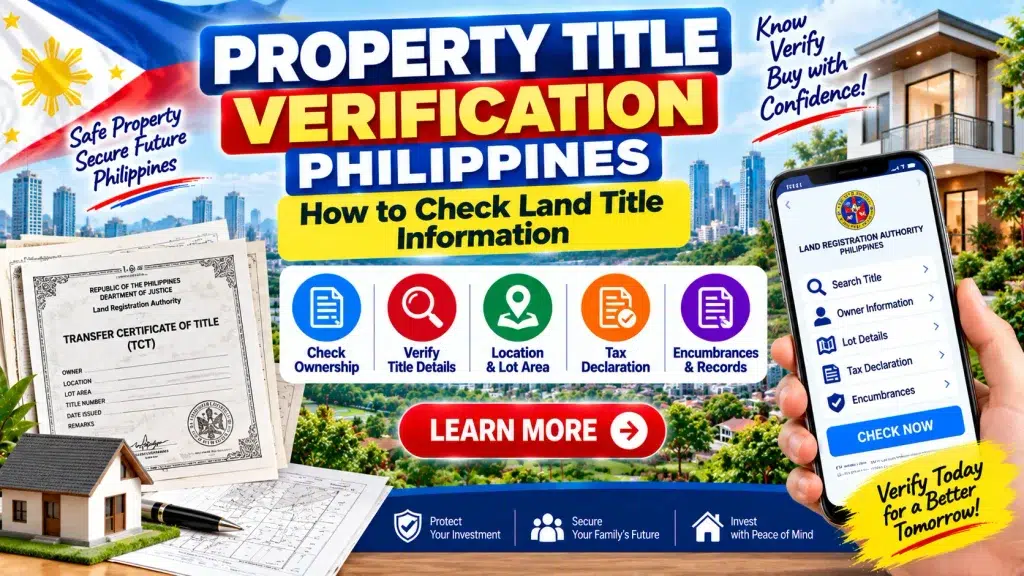
This guide explains how to check land title information in the Philippines, what details to review, how to identify possible encumbrances, and what to do before purchasing property.
Important: Property transactions can involve complex legal issues. This guide provides general information and is not a substitute for professional legal advice. For expensive, disputed, inherited, mortgaged, or otherwise complicated properties, consider consulting a qualified Philippine real estate lawyer.
Property Title Verification Philippines – Quick Overview
| Information to Check | Why It Matters |
|---|---|
| Registered Owner | Helps identify the registered titleholder |
| Title Number | Identifies the particular title record |
| Property Location | Helps confirm the correct property |
| Land Area | Should correspond with the transaction |
| Technical Description | Describes boundaries and measurements |
| Registry of Deeds | Maintains relevant registered title records |
| Annotations | Can disclose registered interests or restrictions |
| Mortgage | Can affect a property transaction |
| Adverse Claim | Requires careful investigation |
| Tax Declaration | Useful for local assessment/tax information |
| Seller Identity | Should correspond with legal authority to sell |
| Survey | Can help verify physical boundaries |
| Legal Review | Recommended for complex transactions |
What Is Property Title Verification?
Property title verification is the process of examining relevant official land registration information to determine whether the documents presented in a property transaction correspond with registered records.
The process can help answer questions such as:
- Who is listed as the registered owner?
- What is the title number?
- Where is the property located?
- What land area is described?
- Are there mortgages or other annotations?
- Does the seller have authority to sell?
- Does the title information correspond with the actual property?
Title verification should be completed before a buyer commits a substantial amount of money.
Why Is Land Title Verification Important?
Real estate transactions often involve large sums accumulated over many years.
Failing to verify the property can expose a buyer to serious problems.
Potential issues include:
- Fake or altered titles
- Unauthorized sellers
- Existing mortgages
- Adverse claims
- Ownership disputes
- Inheritance problems
- Incorrect property boundaries
- Multiple owners
- Restrictions or other annotations
- A property different from the one shown to the buyer
Verification does not eliminate every possible risk, but it is a fundamental part of property due diligence.
Understanding Philippine Land Titles
Buyers can encounter several important title types.
Original Certificate of Title (OCT)
An Original Certificate of Title is associated with the original registration of titled land under the land registration system.
An OCT contains information about the registered property and titleholder.
Transfer Certificate of Title (TCT)
A Transfer Certificate of Title is commonly encountered when registered land has been transferred from one owner to another through an applicable registration process.
For many house-and-lot or land purchases, buyers will encounter a TCT.
Condominium Certificate of Title (CCT)
A Condominium Certificate of Title relates to ownership of an individual condominium unit.
Condominium buyers should review not only the CCT but also relevant condominium corporation, developer, parking, association-dues, and project information.
OCT vs TCT vs CCT
| Document | General Description |
|---|---|
| OCT | Associated with original registration of titled land |
| TCT | Issued in connection with a registered transfer of land |
| CCT | Relates to ownership of an individual condominium unit |
| Tax Declaration | Local assessment/tax record; not the same as a land title |
Understanding which document applies to the property is the first step in conducting a proper check.
Role of the Land Registration Authority
The Land Registration Authority is an important government agency within the Philippine land registration system.
The LRA works with the Registries of Deeds and supports the registration and preservation of land records under applicable law and procedures.
When verifying property information, buyers should rely on legitimate government processes rather than websites that simply claim they can reveal any person’s complete property holdings instantly.
What Is the Registry of Deeds?
The Registry of Deeds maintains registered property records for its applicable territorial jurisdiction.
A property buyer may need to deal with the Registry of Deeds that has jurisdiction over the property.
The RD is important for activities involving:
- Registered titles
- Property transfers
- Mortgages
- Cancellation or registration of certain interests
- Annotations
- Other land registration transactions
The exact process depends on the transaction and current requirements.
How to Check Land Title Information in the Philippines
Here is a practical step-by-step approach for buyers.
Step 1: Obtain a Copy of the Seller’s Title
Ask the seller for a readable copy of the title.
Review the basic information before proceeding further.
Look for:
- Registered owner’s name
- Title number
- Property location
- Land area
- Technical description
- Annotations
Do not stop at this step.
A photocopy can be altered, outdated, or incomplete.
Step 2: Verify the Seller’s Identity
Ask for valid identification and compare the seller’s name with the registered owner’s name.
If the names do not match, determine why.
Possible legitimate situations include:
- The seller is an authorized attorney-in-fact
- The property belongs to a corporation
- The registered owner has died
- The property is part of an estate
- Multiple individuals own the property
Each situation can require additional legal documents.
Step 3: Identify the Correct Registry of Deeds
Determine which Registry of Deeds has jurisdiction over the property.
Use the title and property location as your starting information.
Step 4: Request Appropriate Official Verification
Follow the current official procedure for obtaining or verifying relevant title information.
Requirements, fees, delivery options, and digital services can change, so check current LRA or Registry of Deeds instructions.
Compare the official information with the copy supplied by the seller.
Step 5: Compare the Title Number
The title number on the seller’s document should correspond with the relevant official record.
Unexpected differences should be investigated.
Step 6: Check the Registered Owner
Verify the exact registered owner or owners.
Pay attention to spelling, middle names, and other identifying details where relevant.
Step 7: Review the Property Description
Check:
- Location
- Lot number where applicable
- Land area
- Technical description
Make sure the property described is the property you actually intend to purchase.
Step 8: Read the Annotations
Annotations can be one of the most important parts of a title.
Do not ignore them merely because the front portion of the document appears correct.
What Title Annotations Should You Check?
A title can contain annotations relating to interests, restrictions, or transactions affecting the property.
Examples can include:
- Mortgage
- Adverse claim
- Easement
- Restrictions
- Notice of legal proceedings
- Other registered interests
An annotation does not necessarily make a transaction impossible.
However, the buyer needs to understand its legal effect and determine whether it needs to be cancelled, satisfied, accepted, or otherwise addressed.
For unclear annotations, obtain professional legal advice.
How to Check if Property Has a Mortgage
A mortgage is particularly important because the property may serve as security for a debt.
Review relevant title annotations and supporting records.
If a mortgage exists, ask:
- Who is the mortgagee?
- Is the loan still outstanding?
- How will the mortgage be settled?
- Who will process the cancellation?
- When will the title become clear for the intended transfer?
Do not simply hand money to the seller based on a promise that a mortgage will be “removed later.”
The settlement and transfer process should be properly documented.
What Is an Adverse Claim?
An adverse claim can indicate that another party is asserting an interest in the property.
This is a significant issue that should not be casually ignored.
If you encounter an adverse claim, understand:
- Who filed it
- The nature of the claimed interest
- Its current legal status
- Whether it affects the proposed sale
Professional legal review is strongly advisable in such situations.
Check the Technical Description
The technical description provides information used to identify the property’s boundaries.
It can include measurements, directions, and reference points.
A buyer does not need to personally interpret complex surveying data.
When boundaries are uncertain, hire an appropriately qualified geodetic engineer or other suitable professional to help verify the property.
Why Physical Inspection Is Still Necessary
A clean title does not tell you everything about the property’s physical condition.
Visit the site and inspect:
- Boundaries
- Access
- Occupants
- Buildings
- Neighboring properties
- Roads
- Utilities
- Encroachments
- Visible boundary disputes
- General condition
Confirm that the property being shown corresponds with the documents.
Land Title vs Tax Declaration
A common source of confusion is the difference between a land title and a tax declaration.
A tax declaration is primarily related to local property assessment and taxation.
It can provide useful information about:
- Declared owner
- Property classification
- Assessed value
- Location
- Improvements
- Other assessment details
However, a tax declaration should not automatically be considered equivalent to a registered Torrens title or conclusive proof of registered ownership.
Check Real Property Tax Information
Buyers should also investigate applicable real property tax status through the appropriate local government offices.
Ask for relevant tax records and receipts.
Check whether there are unpaid obligations and clarify who will settle them.
This step is separate from checking the title itself but forms an important part of overall property due diligence.
Can You Check a Land Title Online?
Some Philippine land-related services have become increasingly digital, but the exact services, eligible documents, payment procedures, and delivery methods can change.
Use only current services provided or recognized by the relevant government authority.
Avoid websites promising:
“Enter any person’s name and instantly see all land they own.”
Such claims may be misleading, privacy-invasive, or fraudulent.
For a specific property, title number and property information can be much more useful than relying on an unofficial name-search website.
Can You Verify a Title Using a Mobile Phone?
A mobile device can help you access supported official online services, check agency instructions, make eligible requests, or communicate with relevant offices.
However, using a phone does not change the legal significance of the verification process.
A screenshot from an unknown website is not a substitute for appropriate official documentation.
What if the Seller Is Not the Registered Owner?
Do not automatically reject the transaction, but do not proceed without understanding the situation.
Authorized Representative
Ask to see the appropriate authority, such as a valid Special Power of Attorney where applicable.
Deceased Owner
Estate settlement, inheritance, tax, and transfer requirements may need to be completed.
Multiple Owners
The participation or consent of all legally required parties may be necessary.
Corporate Owner
Verify the company and the authority of the person signing for it.
These transactions can be more complicated, so legal assistance is useful.
What to Check Before Paying the Seller
Use this basic checklist:
| Check | Recommended Action |
|---|---|
| Seller Identity | Compare with valid identification |
| Registered Owner | Verify through appropriate records |
| Title Number | Compare seller copy and official information |
| Property Location | Confirm actual site |
| Land Area | Compare documents and property |
| Annotations | Investigate every relevant entry |
| Mortgage | Confirm status and cancellation process |
| Tax Declaration | Review local assessment information |
| Property Tax | Check applicable payment status |
| Boundaries | Survey when necessary |
| Authority to Sell | Verify if seller is a representative |
| Contract | Review before signing or paying |
Common Land Title Scams
Fake Title Documents
A document can look official while still being fake or altered.
Seller Pretending to Be Owner
Verify identity rather than relying on social media profiles.
Selling the Same Property to Multiple Buyers
Urgent payment demands can be a warning sign.
Fake Property Agents
Scammers sometimes copy photographs from genuine listings.
Fake Government Websites
A website using government colors or logos is not automatically an official government service.
Unofficial “Title Clearing”
Be cautious of individuals promising to remove legitimate annotations or change ownership records for an unofficial fee.
Before Signing a Contract to Sell or Deed of Sale
Read every clause carefully.
Confirm:
- Property description
- Purchase price
- Payment schedule
- Parties to the transaction
- Taxes and expenses
- Transfer responsibilities
- Possession or turnover date
- Conditions for cancellation
- Existing encumbrances
- Required supporting documents
Never sign blank documents.
Keep copies of everything you sign.
After Buying the Property
Completing payment does not necessarily mean the title has automatically transferred into the buyer’s name.
The transaction generally requires applicable tax, documentary, local government, and Registry of Deeds processes.
Depending on the transaction, this can include:
- Executed sale documents
- Applicable tax processing
- Required clearances
- Registration of transfer
- Issuance of updated title records
- Updating local tax records
Follow the current procedures for your particular transaction.
Frequently Asked Questions (FAQ)
1. How can I verify a property title in the Philippines?
Obtain the relevant title information from the seller and compare it with records verified through appropriate official Land Registration Authority or Registry of Deeds procedures.
2. What information should I check on a land title?
Review the registered owner, title number, property description, land area, technical description, and relevant annotations.
3. What is a TCT?
A Transfer Certificate of Title is a title issued in connection with registered ownership following an applicable transfer.
4. What is an OCT?
An Original Certificate of Title is associated with the original registration of titled land.
5. What is a CCT?
A Condominium Certificate of Title relates to ownership of an individual condominium unit.
6. Is a tax declaration the same as a land title?
No. A tax declaration is an important local assessment and taxation record but should not automatically be treated as equivalent to a registered land title.
7. How do I know whether the property is mortgaged?
Review applicable annotations and official title information. If a mortgage appears, investigate its current status and the process for satisfying and cancelling it.
8. What if the seller’s name is different from the title?
Ask for documents proving the seller’s legal authority. Estate, representative, co-ownership, or corporate issues may require additional verification.
9. Can I check a Philippine land title online?
Supported digital services may be available for certain title-related transactions. Check current official LRA and Registry of Deeds procedures rather than relying on unofficial property-search sites.
10. Should I hire a lawyer before buying land?
Legal assistance is particularly useful for high-value transactions or properties involving mortgages, inheritance, adverse claims, multiple owners, unclear documents, or other complications.
Final Words
Property Title Verification in the Philippines is one of the most important steps a buyer can take before purchasing land, a house, or a condominium.
Begin with the title copy provided by the seller, but do not stop there. Verify the seller’s identity, title number, registered owner, land area, technical description, and annotations through appropriate official channels.
Pay special attention to mortgages, adverse claims, restrictions, and other annotations. Also review the property’s tax declaration and real property tax status, inspect the actual site, and consider a professional survey when boundaries are unclear.
If the seller is not the registered owner, determine exactly what legal authority allows that person to sell the property.
Most importantly, do not allow a low price or urgent sales pitch to replace proper due diligence.
A careful title check before payment can help reduce the risk of fraud, ownership disputes, unexpected debts, and costly legal problems after the purchase.
Declaration
The information provided on this website is published for informational purposes only. While every effort is made to ensure the accuracy and timely updating of the content, we do not guarantee the completeness, reliability, or authenticity of any information. Candidates and users are strongly advised to visit the official websites of the respective departments, organizations, or authorizing bodies before applying for any job, scheme, examination, or benefit program. This website is not associated with any government organisation and does not provide any recruitment guarantee or official confirmation. We are not responsible for any loss, error, or misunderstanding arising from the use of the information available on this website.