Non-Professional Driver’s License – Requirements & Application Guide
Getting a Non-Professional Driver’s License in the Philippines is an important milestone for people who want to legally operate eligible private motor vehicles. After learning the basics of driving, obtaining a student permit, and completing the applicable training requirements, qualified applicants can proceed to the next stage of the Land Transportation Office (LTO) licensing process.
Applying for an LTO non-professional driver’s license requires preparation. Applicants need to meet eligibility conditions, complete the required driving education, satisfy medical requirements, prepare documents, and pass the applicable theoretical and practical driving examinations.
This comprehensive guide explains the Non-Professional Driver’s License requirements, eligibility, application process, LTMS registration, Practical Driving Course (PDC), examinations, fees, and important tips for applicants in the Philippines.
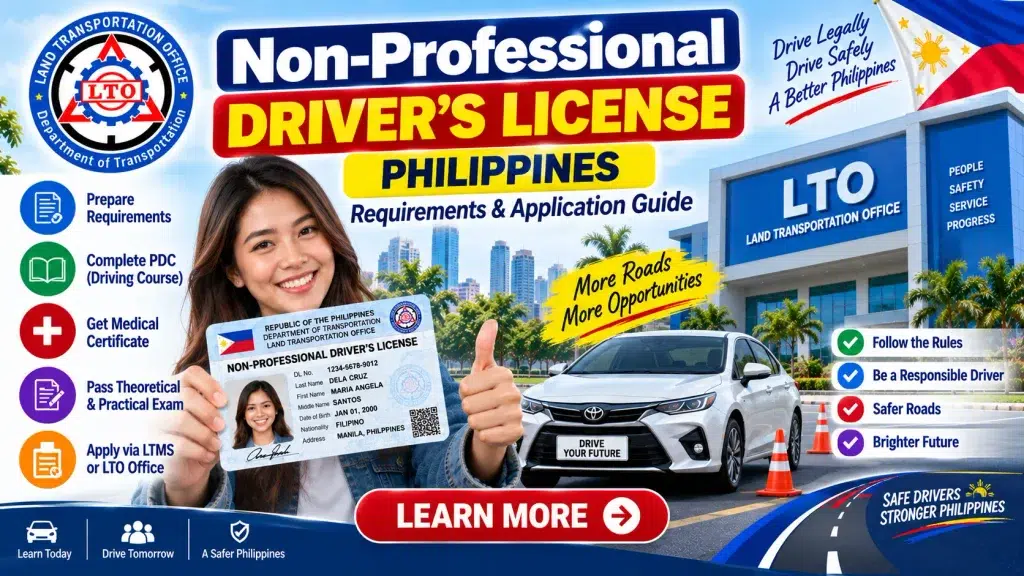
Important: LTO requirements, fees, age limits, license classifications, and application procedures can change. Always verify the latest information through the official Land Transportation Office and LTMS Portal before applying.
Non-Professional Driver’s License – Quick Overview
| Information | Details |
|---|---|
| License | Non-Professional Driver’s License |
| Government Agency | Land Transportation Office (LTO) |
| Country | Philippines |
| Primary Use | Driving authorized private vehicles |
| Previous Requirement | Student Permit, where applicable |
| Online Platform | LTMS Portal |
| Driving Training | Practical Driving Course (PDC), as applicable |
| Medical Requirement | Applicable LTO medical certification |
| Theoretical Exam | Required under applicable procedure |
| Practical Driving Test | Required |
| Fees | Depend on current LTO fee schedule |
| Approval | Subject to LTO evaluation and examination results |
What Is a Non-Professional Driver’s License?
A Non-Professional Driver’s License, often called a non-pro license, is an LTO-issued driver’s license that allows a qualified holder to operate motor vehicles covered by the categories or conditions authorized on the license.
It is commonly associated with individuals driving eligible vehicles for private or personal use rather than professional driving activities.
However, applicants should not assume that the term “non-professional” means they can drive every type of vehicle.
The vehicle categories or codes authorized on the license determine what the holder is permitted to operate.
Always check the information displayed on your license and follow current LTO rules.
Student Permit vs Non-Professional Driver’s License
A student permit and a non-professional driver’s license serve different purposes.
A Student Permit is intended for eligible people who are learning how to drive under applicable conditions.
A Non-Professional Driver’s License is issued after the applicant has satisfied the required eligibility, training, documentation, and examination standards.
| Student Permit | Non-Professional License |
|---|---|
| Intended for learner drivers | Intended for qualified drivers |
| Subject to learner conditions | Allows driving according to authorized categories |
| First stage of licensing | Later stage after applicable requirements |
| Driving supervision rules apply | Different driving privileges apply |
| Used to gain driving experience | Used for authorized independent driving |
A student permit should therefore not be treated as a full driver’s license.
Who Can Apply for a Non-Professional Driver’s License?
Eligibility depends on current LTO regulations and the applicant’s circumstances.
General eligibility considerations may include:
- Meeting the applicable minimum age requirement
- Holding a valid student permit for the required period
- Being physically and mentally fit to drive
- Completing applicable driver education requirements
- Completing the required Practical Driving Course
- Having an appropriate LTMS client record
- Satisfying identification and documentation requirements
- Passing the required theoretical examination
- Passing the practical driving examination
- Meeting citizenship or applicable residency conditions
Foreign nationals may have additional immigration or residency requirements.
Applicants should verify the exact criteria that apply to their circumstances.
Non-Professional Driver’s License Requirements
The required documents can vary according to the applicant and current LTO procedure.
Common requirements may include:
- Properly accomplished driver’s license application information
- Valid Student Permit
- Appropriate valid identification
- Medical certificate from an appropriately accredited or authorized clinic
- Practical Driving Course certificate or electronic record
- LTMS client information
- Supporting identity documents where required
- Parent or guardian documentation where applicable
- Immigration or residency documents for applicable foreign applicants
- Other documentation required by LTO
Applicants should make sure all information is consistent.
For example, your name and date of birth should match across your identification, Student Permit, LTMS profile, medical information, and training records.
Practical Driving Course (PDC)
The Practical Driving Course, commonly called PDC, is an important part of preparing for an applicable driver’s license application.
While theoretical driving education teaches traffic laws, road signs, and safe-driving principles, the PDC focuses on actual vehicle operation.
Practical training can include:
- Starting and stopping the vehicle
- Steering and vehicle control
- Proper braking
- Lane positioning
- Turning safely
- Parking
- Reversing
- Observation and mirror use
- Road awareness
- Interaction with other vehicles
- Defensive driving techniques
Applicants should complete the required training through an authorized or recognized provider.
The vehicle category used during training should also correspond to the type of driving privilege the applicant intends to obtain.
Medical Certificate Requirement
Driving requires adequate physical and mental fitness.
Applicants must satisfy the current LTO medical requirements before obtaining a driver’s license.
Where a medical certificate is required, the examination should be completed through an appropriately LTO-accredited or authorized medical clinic.
The assessment can include factors relevant to safe vehicle operation, such as vision and general fitness.
Medical examination costs are normally separate from LTO licensing fees.
Applicants should therefore include this expense when estimating the total cost of the application.
LTMS Portal for Non-Professional License Applicants
The Land Transportation Management System (LTMS) is the LTO’s online platform for various transportation services.
Applicants should have the appropriate LTMS client information according to current procedures.
Through LTMS, users may be able to access services and information related to:
- Driver’s license applications
- Student permits
- Driver education
- Client profiles
- Transaction information
- Licensing resources
- Other supported LTO services
Make sure your LTMS profile contains accurate information.
Avoid creating duplicate accounts if you already have an existing LTO client record.
How to Apply for a Non-Professional Driver’s License
The following general steps can help applicants understand the process.
Step 1: Check Your Eligibility
Before visiting an LTO office, confirm that you meet the current eligibility requirements.
Check your age, Student Permit status, required holding period, PDC completion, medical requirements, and documentation.
If your Student Permit does not yet satisfy the applicable period requirement, wait until you become eligible.
Step 2: Review Your LTMS Account
Log in to your LTMS account and check your personal information.
Verify:
- Full legal name
- Date of birth
- Contact information
- Student Permit information
- Driver education records where displayed
Resolve major discrepancies through the appropriate official procedure.
Step 3: Complete the Practical Driving Course
Complete the required PDC through an authorized provider if you have not already done so.
Use the course to develop genuine driving competence.
Do not focus only on obtaining the certificate because you will need to demonstrate practical driving ability during the application process.
Step 4: Obtain the Medical Certificate
Complete the required medical examination through an authorized or accredited provider according to LTO rules.
Check that your name and other information are entered correctly.
Step 5: Prepare the Required Documents
Collect all documents applicable to your application.
Organize them before going to the licensing office.
Bring originals and copies according to the current LTO checklist.
Incomplete documents can result in delays or a return visit.
Step 6: Visit an Authorized LTO Licensing Office
Proceed to an LTO licensing office or appropriate service facility that handles non-professional driver’s license applications.
Follow current appointment or transaction procedures if applicable.
Avoid fixers or people outside the official process promising guaranteed approval.
Step 7: Submit the Application
Submit your documents and application information for evaluation.
LTO personnel may verify your:
- Identity
- Student Permit
- PDC information
- Medical information
- LTMS record
- Other supporting documents
You may be asked to correct or provide additional information if something cannot be verified.
Step 8: Pay Applicable Fees
After the application has been evaluated, pay the applicable government fees through an authorized payment channel.
Keep your official receipt or transaction confirmation.
Remember that government fees are different from separate costs such as medical examinations or driving-school charges.
Step 9: Take the Theoretical Examination
Applicants need to demonstrate knowledge of road rules and responsible driving according to the applicable licensing procedure.
The examination can cover topics such as:
- Traffic laws
- Road signs
- Road markings
- Right-of-way rules
- Defensive driving
- Driver responsibilities
- Emergency situations
- Road safety
Study properly before taking the exam.
The goal should be to understand the rules rather than memorize random answers.
Step 10: Take the Practical Driving Test
After satisfying the applicable theoretical requirements, you may need to demonstrate actual driving competence.
The practical examination can evaluate skills such as:
- Vehicle control
- Starting and stopping
- Turning
- Braking
- Parking
- Observation
- Lane discipline
- Following instructions
- Safe driving behavior
Stay calm and apply the skills you learned during legitimate practical training.
Step 11: Complete Final Processing
After successfully satisfying the required examinations and evaluation, follow LTO instructions for final processing.
Depending on current procedures, this may include:
- Data verification
- Photograph capture
- Signature
- Biometrics
- Final payment verification
- License information confirmation
Check your personal information carefully.
Step 12: Receive Your Driver’s License
Once your application has been successfully approved and processed, follow the instructions for receiving your license or applicable official licensing documentation.
Before leaving, check the information displayed on your record.
If you notice an error, report it through the proper LTO procedure.
Non-Professional Driver’s License Fees
Applicants often ask: How much does a non-professional driver’s license cost?
There is an important distinction between LTO government fees and the total cost of becoming a licensed driver.
| Possible Cost | Description |
|---|---|
| LTO Application Fee | Official application-related charge |
| License Fee | Government charge for license issuance |
| Medical Examination | Separate provider charge |
| Practical Driving Course | Depends on training provider and vehicle category |
| Vehicle Rental | May apply for practical testing in some circumstances |
| Other Authorized Charges | Depend on the transaction |
Fees and third-party service costs can change.
Check the current LTO fee schedule and ask authorized providers about their charges before applying.
How Long Does the Application Take?
There is no guaranteed universal processing time.
The amount of time required can depend on:
- Number of applicants at the office
- Completeness of documents
- Verification requirements
- Examination schedules
- Whether the applicant passes the tests
- System availability
- Additional document requirements
Arriving prepared can help reduce avoidable delays.
What Happens if You Fail an Exam?
Failing an examination does not mean you should seek an unofficial shortcut.
Follow the current LTO rules regarding retaking the theoretical or practical examination.
Use the additional time to study or improve your driving skills.
Never pay someone who claims they can change your examination result or issue a legitimate license without meeting official requirements.
Tips for Passing the LTO Application Process
Preparation is the most important factor.
Study traffic rules and road signs before the theoretical examination.
During practical training, focus on safe vehicle control rather than simply passing the test.
Before the practical examination, understand how to use:
- Mirrors
- Turn signals
- Brakes
- Seat belts
- Parking brake
- Basic vehicle controls
Follow instructions carefully and demonstrate safe habits throughout the test.
Common Mistakes to Avoid
Several mistakes can make a driver’s license application unnecessarily difficult.
Avoid:
- Applying before satisfying the Student Permit holding requirement
- Using an unauthorized PDC provider
- Submitting incomplete documents
- Entering inconsistent personal information
- Creating duplicate LTMS accounts
- Using fake medical certificates
- Paying unofficial fixers
- Attempting to bypass examinations
- Providing false information
Always use legitimate LTO and authorized service channels.
Driving Responsibly After Getting Your License
Passing the tests is only the beginning.
Once you receive your non-professional driver’s license, you are responsible for operating your vehicle safely.
Always wear your seat belt and ensure passengers use appropriate restraints.
Follow speed limits and traffic signals.
Avoid using your phone while driving.
Never drive under the influence of alcohol or drugs.
Maintain a safe distance from other vehicles and pay particular attention to pedestrians, cyclists, motorcycles, and road users who may be more vulnerable in a collision.
Your driving behavior affects everyone around you.
Frequently Asked Questions (FAQ)
1. What is a Non-Professional Driver’s License?
It is an LTO-issued driver’s license that allows an eligible holder to operate vehicles covered by the categories or conditions authorized on the license, commonly for private driving purposes.
2. Do I need a Student Permit first?
Applicable first-time applicants generally progress through the Student Permit stage before qualifying for a non-professional driver’s license. Current holding-period and eligibility requirements must be satisfied.
3. Is a Practical Driving Course required?
PDC requirements apply to eligible driver’s license applications according to current LTO rules. Applicants should complete training through an authorized or recognized provider.
4. Do I need a medical certificate?
Applicants must satisfy LTO medical fitness requirements. Use an appropriately accredited or authorized medical provider where certification is required.
5. Is there a written examination?
Applicants must satisfy applicable theoretical examination requirements covering traffic laws, road signs, road safety, and driver responsibilities.
6. Do I have to take a practical driving test?
A practical driving examination is part of applicable non-professional driver’s license applications and assesses whether the applicant can operate a vehicle safely.
7. Can I apply completely online?
LTMS can support digital aspects of the application, but physical requirements such as medical examination, identity verification, biometrics, and driving tests can still require in-person attendance.
8. How much does a non-professional driver’s license cost?
The total cost varies because it can include official LTO fees plus separate expenses such as medical examination, PDC, and other legitimate services. Verify current fees before applying.
9. What if I fail the LTO examination?
Follow the official rules regarding examination retakes. Study or practice before trying again rather than seeking an unofficial shortcut.
10. Where can I check the latest requirements?
Use the official Land Transportation Office (LTO) and LTMS Portal for current eligibility, requirements, fees, and application procedures.
Final Words
Applying for a Non-Professional Driver’s License in the Philippines requires more than filling out a form. Applicants need to demonstrate that they meet the eligibility conditions and have the knowledge and practical skills necessary to drive safely.
Begin by checking your Student Permit and eligibility status. Review your LTMS account, complete the applicable Practical Driving Course, satisfy the medical requirements, and prepare all necessary documents.
After submitting your application through an authorized LTO facility, complete the required theoretical and practical examinations and follow the instructions for final license processing.
Because LTO rules, fees, and documentary requirements can change, always verify current information before applying.
Most importantly, avoid fixers and services promising instant or guaranteed licenses without proper examinations. Earning your license through legitimate training and testing helps prepare you for the responsibility that comes with driving on Philippine roads.
Declaration
The information provided on this website is published for informational purposes only. While every effort is made to ensure the accuracy and timely updating of the content, we do not guarantee the completeness, reliability, or authenticity of any information. Candidates and users are strongly advised to visit the official websites of the respective departments, organizations, or authorizing bodies before applying for any job, scheme, examination, or benefit program. This website is not associated with any government organisation and does not provide any recruitment guarantee or official confirmation. We are not responsible for any loss, error, or misunderstanding arising from the use of the information available on this website.