Vehicle Registration Renewal Philippines – Requirements & Process
Keeping a motor vehicle properly registered is an important responsibility for vehicle owners in the Philippines. Registration helps establish that a vehicle is recorded with the Land Transportation Office (LTO) and has complied with applicable requirements for legal road use. When a registration approaches its renewal period, owners should prepare the necessary documents and complete the required procedures on time.
The Vehicle Registration Renewal Philippines process can involve several steps, including checking the registration schedule, preparing vehicle documents, securing the required insurance coverage, completing applicable inspection or emissions requirements, paying LTO fees, and obtaining updated registration records.
This guide explains the general LTO vehicle registration renewal requirements, process, documents, schedule, fees, online services, and common considerations for private vehicle owners.
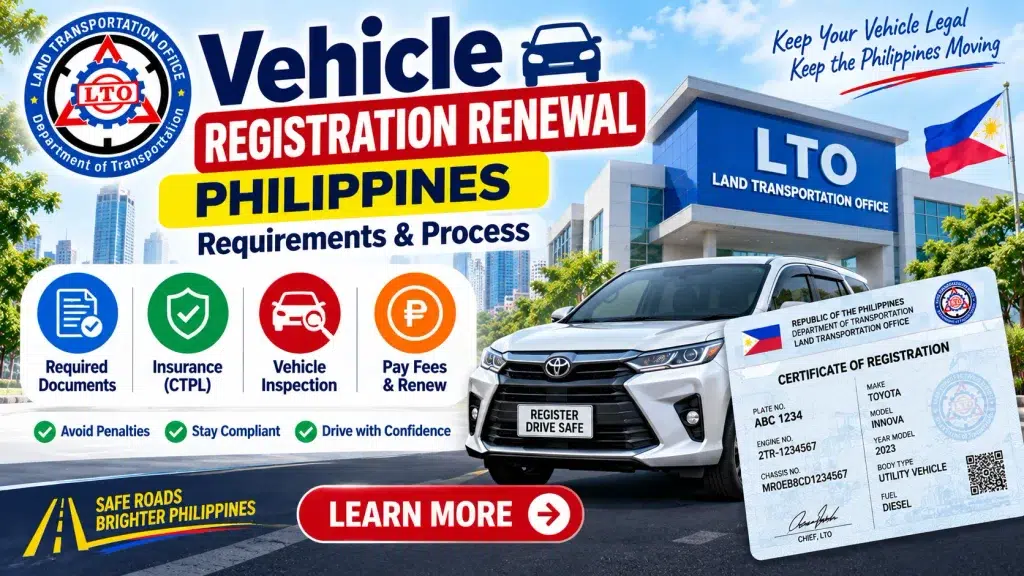
Important: LTO rules, fees, inspection procedures, insurance requirements, registration schedules, and online services can change. Always verify the latest requirements through the official LTO and Land Transportation Management System (LTMS) before completing a transaction.
Vehicle Registration Renewal Philippines – Quick Overview
| Information | Details |
|---|---|
| Service | Motor Vehicle Registration Renewal |
| Government Agency | Land Transportation Office (LTO) |
| Country | Philippines |
| Main Applicants | Registered vehicle owners |
| Vehicle Types | Cars, motorcycles and other eligible vehicles |
| Online System | LTMS Portal / authorized LTO systems |
| Basic Documents | Existing registration and applicable supporting documents |
| Insurance | Required coverage according to current rules |
| Inspection | May be required depending on vehicle and procedure |
| Emissions Compliance | Required where applicable |
| Fees | Depend on vehicle and transaction |
| Late Renewal | Penalties may apply |
| Final Approval | Subject to LTO verification |
What Is LTO Vehicle Registration Renewal?
Vehicle registration renewal is the process of updating an existing motor vehicle’s registration with the LTO.
A vehicle’s initial registration does not necessarily allow it to remain registered indefinitely. Owners must comply with applicable renewal requirements and schedules.
During renewal, the LTO can verify the vehicle’s registration information and whether applicable regulatory requirements have been satisfied.
The procedure is intended to help ensure that vehicles using public roads are properly documented and meet applicable legal and safety requirements.
Owners should distinguish vehicle registration renewal from other LTO transactions such as transfer of ownership, change of vehicle information, new vehicle registration, or driver’s license renewal.
Why Is Vehicle Registration Renewal Important?
Driving or operating a vehicle without valid registration can expose the owner or driver to penalties and other legal complications.
Timely renewal can help you:
- Keep the vehicle registration current
- Avoid applicable late-registration penalties
- Maintain updated vehicle records
- Demonstrate compliance with required procedures
- Reduce complications during roadside verification
- Prepare proper documentation for future vehicle transactions
Owners planning to sell a vehicle should also keep registration records organized because incomplete or outdated documents can complicate a future transfer.
LTO Vehicle Registration Renewal Requirements
Requirements can differ depending on the type, age, classification, ownership status, and condition of the vehicle.
Common requirements can include:
- Existing Certificate of Registration or applicable vehicle registration record
- Latest Official Receipt or applicable payment/registration record
- Valid Compulsory Third Party Liability insurance documentation
- Emissions compliance documentation where applicable
- Motor vehicle inspection documentation where required
- Vehicle identification information
- Valid identification or owner information when requested
- Authorization documents if the transaction is being handled under an authorized arrangement
- Other supporting documents required for special vehicle categories
Always obtain the latest checklist for your particular vehicle before starting.
Certificate of Registration and Official Receipt
Vehicle owners commonly encounter the terms Certificate of Registration (CR) and Official Receipt (OR).
The Certificate of Registration contains important information about the registered vehicle and its ownership record.
The Official Receipt or applicable LTO transaction record provides evidence concerning registration-related payment or processing.
Owners should keep these documents secure and ensure that the information matches the vehicle.
If documents are missing, damaged, or contain incorrect information, address the issue through an authorized LTO procedure rather than using altered or unofficial copies.
Compulsory Third Party Liability Insurance
Motor vehicle registration generally involves the required Compulsory Third Party Liability (CTPL) insurance coverage.
CTPL is different from comprehensive motor insurance.
Its purpose is connected to legally required third-party protection under applicable rules, whereas comprehensive vehicle insurance can provide broader protection depending on the policy.
When obtaining insurance for registration purposes, use a legitimate and appropriately authorized insurance provider.
Check that the vehicle and owner information shown in the policy or certificate is accurate.
Vehicle Inspection Requirements
Depending on current LTO rules and the vehicle involved, a motor vehicle may need to undergo an authorized inspection as part of the registration process.
Inspection is intended to assess applicable roadworthiness or compliance items.
Vehicle owners should prepare their vehicles before inspection.
Common areas worth checking include:
- Headlights
- Brake lights
- Turn signals
- Braking system
- Tires
- Windshield
- Wipers
- Horn
- Mirrors
- Seat belts where applicable
- Vehicle identification information
- Other safety-related equipment
Inspection requirements can vary, so follow the instructions applicable to your vehicle category.
Emissions Compliance
Emissions compliance is another important consideration for applicable vehicles.
Depending on the vehicle and current procedure, owners may need to obtain the required emissions-related documentation through an authorized facility or satisfy the emissions component of an approved inspection process.
Do not purchase fake emissions certificates.
Using fraudulent documents can result in serious problems and does not demonstrate that the vehicle meets applicable standards.
How to Renew Vehicle Registration in the Philippines
Although individual cases vary, the following general steps explain how owners can prepare for LTO vehicle registration renewal.
Step 1: Check Your Registration Schedule
Start by determining when your vehicle registration is due for renewal.
The applicable schedule can be connected to the vehicle’s registration records and plate information under LTO rules.
Do not wait until the final day.
Starting early provides time to correct document problems or vehicle issues discovered during inspection.
Step 2: Review Your Vehicle Records
Check your CR, previous registration information, owner details, plate number, chassis information, engine information, and other important records.
If you notice a discrepancy, determine whether it needs to be corrected before renewal.
Step 3: Check Current LTO Requirements
Registration procedures can change.
Before paying for insurance, inspection, or another service, check the current official LTO requirements for your particular vehicle.
This is especially important for older vehicles, motorcycles, commercial vehicles, vehicles with modifications, or cases involving special documentation.
Step 4: Obtain the Required Insurance
Secure valid CTPL coverage according to current registration requirements.
Check the information carefully before accepting the insurance documentation.
Incorrect plate, engine, chassis, or owner information may create unnecessary complications.
Step 5: Complete Emissions or Inspection Requirements
Take the vehicle to an authorized facility where required.
Complete the applicable inspection or emissions compliance process.
If your vehicle fails a required inspection, address the identified issues and follow the proper reinspection procedure.
Step 6: Prepare Your Documents
Organize all required documentation before proceeding with the LTO transaction.
This may include your existing registration documents, insurance documentation, inspection or emissions records, and additional supporting information.
Keeping everything together can make processing easier.
Step 7: Access the Applicable LTO Service
Follow the current LTO instructions regarding where and how your renewal should be processed.
Certain services may involve the LTMS Portal or other digital facilities, while some transactions still require a physical visit.
Do not assume that every registration renewal can be completed entirely online.
Step 8: Submit the Requirements
Present or submit the required vehicle documentation for evaluation.
The LTO can verify the vehicle’s records, insurance information, inspection or emissions compliance, and other applicable details.
Additional documentation may be requested if the records are incomplete or inconsistent.
Step 9: Pay the Applicable Registration Fees
Once instructed, pay the official registration charges through an authorized payment method.
The total cost depends on the vehicle and transaction.
Late renewal can result in additional penalties.
Keep your official payment confirmation or receipt.
Step 10: Obtain Updated Registration Documentation
After successful processing, follow LTO instructions for obtaining the applicable updated registration record or documentation.
Review the information carefully.
Store your documents securely and retain appropriate copies for your records.
LTO Vehicle Registration Renewal Fees
There is no single renewal amount that applies to every motor vehicle.
Registration costs can depend on factors such as vehicle classification, weight, transaction type, penalties, and other applicable charges.
Owners can also incur legitimate expenses outside the basic LTO registration fee.
| Possible Cost | Description |
|---|---|
| LTO Registration Fee | Government charge applicable to the vehicle |
| CTPL Insurance | Required insurance-related expense |
| Inspection | Cost of applicable authorized vehicle inspection |
| Emissions Requirement | Cost where separately applicable |
| Late Penalty | May apply to overdue registration |
| Other Fees | Depend on vehicle and transaction |
Before paying, separate official LTO fees from legitimate third-party charges.
Ask for proper receipts and avoid unofficial payments.
What Happens if Vehicle Registration Is Late?
Failure to renew on time can lead to additional fees or penalties.
The exact amount depends on the vehicle and applicable LTO rules.
Continuing to use an unregistered or improperly registered vehicle can also create enforcement issues.
Therefore, owners should check their renewal schedule before the registration becomes overdue.
If your registration has already been expired for a significant period, contact or visit the appropriate LTO facility to determine the current requirements rather than assuming it will be treated as a standard renewal.
Can You Renew Vehicle Registration Online?
Digital LTO services can make parts of motor vehicle transactions more convenient.
The LTMS Portal provides access to supported transportation services and client information.
However, the extent to which a vehicle registration renewal can be completed digitally depends on current LTO systems, vehicle eligibility, inspection requirements, and transaction circumstances.
Physical processes may still be necessary.
These can include vehicle inspection, emissions testing, submission of original documents, identity verification, or resolution of record discrepancies.
Tips to Make LTO Registration Renewal Easier
Start preparing before your renewal deadline.
Check the vehicle’s lights, brakes, tires, horn, wipers, and other safety equipment before taking it for inspection.
Keep your CR and previous registration documents organized.
Purchase insurance only from legitimate providers and verify that the details match your vehicle.
Use authorized inspection or emissions facilities where required.
Most importantly, do not rely on fixers who claim they can renew a vehicle without satisfying official requirements.
Common Registration Renewal Mistakes
One common mistake is waiting until the registration is already overdue.
Another is arriving without complete documentation.
Owners should also avoid ignoring inconsistencies in engine, chassis, plate, or ownership information.
Using unauthorized insurance, fake emissions documents, or unofficial inspection records can create much more serious problems than a normal processing delay.
If you purchased a used vehicle, verify that ownership and registration records have been handled correctly instead of assuming that possession of the vehicle is sufficient.
Vehicle Registration Online Safety
Be cautious when searching for registration services online.
Fraudulent pages may imitate government websites or advertise “instant LTO registration.”
Never provide sensitive vehicle or identity information to an unknown social media account.
Do not share account passwords or verification codes.
When making an online payment, verify that the payment method is officially authorized for the transaction.
Keep copies of legitimate receipts and transaction references.
Frequently Asked Questions (FAQ)
1. Who handles vehicle registration in the Philippines?
The Land Transportation Office (LTO) is responsible for motor vehicle registration and related transportation services.
2. What documents are needed for vehicle registration renewal?
Requirements depend on the vehicle, but commonly involve existing registration records, CTPL insurance, applicable inspection or emissions documentation, and other supporting documents required by LTO.
3. Is CTPL insurance required for vehicle registration?
Motor vehicle registration generally requires applicable compulsory third-party liability insurance coverage. Verify the current insurance requirements for your vehicle before renewal.
4. Do I need an emissions test?
Emissions or inspection requirements depend on the vehicle and current LTO procedures. Check the latest requirements before visiting a testing or inspection facility.
5. Can I renew my LTO vehicle registration online?
Some stages or eligible transactions may be supported digitally. However, physical inspection, document verification, and other in-person requirements can still apply.
6. How much does LTO vehicle registration renewal cost?
There is no universal amount for every vehicle. Costs depend on vehicle classification, applicable registration fees, insurance, inspection requirements, penalties, and other charges.
7. Is there a penalty for late vehicle registration renewal?
Late renewal can result in applicable penalties. The exact charge depends on the circumstances and current LTO fee rules.
8. What happens if my vehicle fails inspection?
You may need to correct the identified problems and comply with the applicable reinspection procedure before completing registration.
9. Can someone guarantee registration without inspection?
Vehicle owners should avoid anyone offering to bypass mandatory LTO requirements. Use only legitimate LTO and authorized service channels.
10. Where can I check official vehicle registration information?
Check the official Land Transportation Office and LTMS Portal for current registration procedures, requirements, fees, and announcements.
Final Words
Completing Vehicle Registration Renewal in the Philippines is an important responsibility for motorists who want to keep their vehicles properly documented for road use.
Start by checking your renewal schedule and reviewing your existing registration records. Prepare the required CTPL insurance, complete applicable emissions or inspection requirements, organize your documents, and process the renewal through authorized LTO channels.
Remember that registration costs vary by vehicle and transaction, and overdue registration can result in additional penalties.
The LTMS Portal and other digital LTO services can make certain parts of the process more convenient, but some vehicle transactions still require physical inspection or verification.
Because requirements and fees can change, verify current information directly with LTO before starting your renewal.
Avoid fixers, fake insurance, fraudulent inspection documents, and websites claiming guaranteed registration. Following the official process can help protect your vehicle records and reduce unnecessary problems.
Declaration
The information provided on this website is published for informational purposes only. While every effort is made to ensure the accuracy and timely updating of the content, we do not guarantee the completeness, reliability, or authenticity of any information. Candidates and users are strongly advised to visit the official websites of the respective departments, organizations, or authorizing bodies before applying for any job, scheme, examination, or benefit program. This website is not associated with any government organisation and does not provide any recruitment guarantee or official confirmation. We are not responsible for any loss, error, or misunderstanding arising from the use of the information available on this website.