LTO Driver’s License Application – Requirements & Step-by-Step Process
Getting a driver’s license is an important step for anyone who wants to drive legally in the Philippines. The Land Transportation Office (LTO) is the government agency responsible for issuing driver’s licenses and administering licensing requirements for motorists in the country.
For first-time applicants, understanding the LTO Driver’s License Application process can make preparation much easier. Depending on the type of license you are applying for, you may need to complete a driving course, obtain a student permit, meet minimum holding periods, undergo medical examination, submit documents, and pass theoretical and practical driving examinations
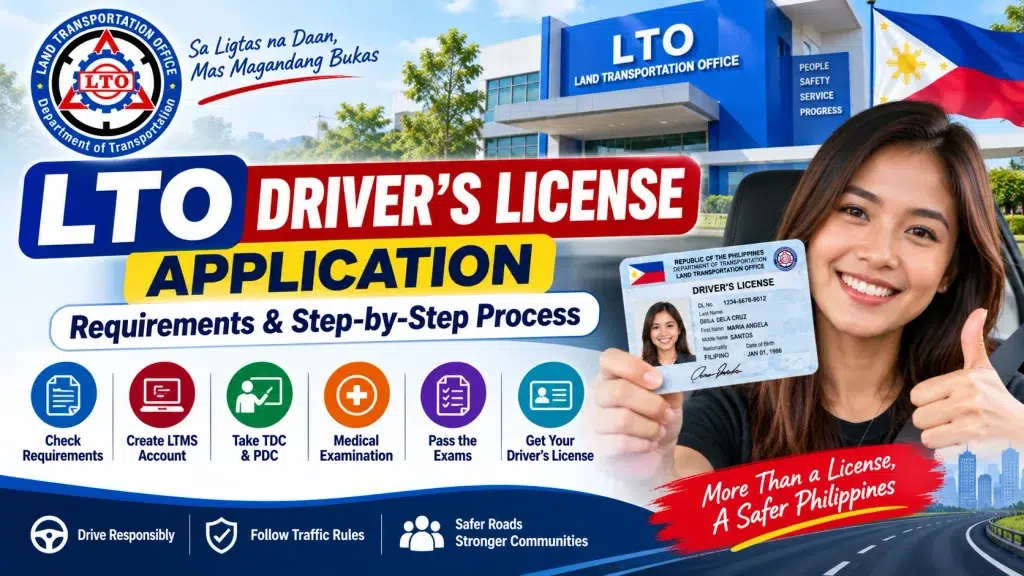
.
This guide explains the general LTO driver’s license requirements, eligibility rules, application steps, fees and examinations to help prospective drivers understand what to expect.
Important: LTO requirements, fees, application procedures and eligibility rules can change. Always verify current information through the official LTO and Land Transportation Management System (LTMS) before applying.
LTO Driver’s License Application – Quick Overview
| Information | Details |
|---|---|
| Service | Driver’s License Application |
| Government Agency | Land Transportation Office (LTO) |
| Country | Philippines |
| Online Platform | LTMS Portal |
| Main Categories | Student Permit, Non-Professional & Professional |
| Basic Requirements | Depend on license category |
| Medical Examination | Required where specified by LTO |
| Driving Course | Required for applicable applications |
| Written/Theoretical Exam | Required for applicable license transactions |
| Practical Driving Test | Required for applicable applications |
| Fees | Depend on license/service type |
| Approval | Subject to LTO evaluation |
| Official Information | LTO and LTMS Portal |
What Is an LTO Driver’s License?
An LTO driver’s license is an official authorization that allows a qualified individual to operate appropriate motor vehicles on public roads in the Philippines according to the license classification and applicable restrictions or vehicle categories.
A driver’s license should not simply be viewed as an identification card. Holding one comes with legal and safety responsibilities.
Drivers are expected to understand traffic laws, road signs, safe driving practices, proper vehicle operation and responsibilities toward other road users.
Applicants therefore need to satisfy both documentary and competency requirements before obtaining the appropriate driver’s license.
Types of LTO Driver’s License
Before applying, it is important to understand which type of license or permit is appropriate.
1. Student Permit
A student permit is generally the starting point for new drivers learning to operate a motor vehicle.
It allows the holder to practice driving under the conditions established by LTO regulations.
A student permit is not equivalent to a full driver’s license, and applicants should follow the rules governing its use.
2. Non-Professional Driver’s License
A non-professional driver’s license is generally intended for qualified individuals who drive eligible motor vehicles for private or personal purposes, subject to the vehicle categories and conditions authorized on the license.
Applicants usually need to satisfy the applicable student permit, training, medical, theoretical and practical examination requirements.
3. Professional Driver’s License
A professional driver’s license applies to qualified motorists whose driving activities fall within professional or commercial driving requirements under applicable rules.
Eligibility and application requirements can differ from those for a non-professional license.
Always check your intended driving activity and vehicle category before selecting a license application.
Basic Eligibility for an LTO Driver’s License
Eligibility varies according to the permit or license being requested.
Factors considered by the LTO may include:
- Applicant’s age
- Citizenship or applicable residency status
- Physical and mental fitness to drive
- Ability to read and understand relevant road information
- Completion of required driving education
- Valid student permit where applicable
- Required holding period
- Driving competency
- Successful completion of required examinations
- Compliance with documentary requirements
Applicants should use the current LTO eligibility checklist for the specific license category they want.
LTO Driver’s License Requirements
The exact documents vary according to whether you are applying for a student permit, non-professional license, professional license, or another licensing transaction.
Common documentation and requirements may include:
- Properly completed driver’s license application
- Valid identification
- Birth or identity-related documentation where applicable
- Medical certificate issued through an authorized process
- Student permit for applicable applications
- Theoretical Driving Course documentation
- Practical Driving Course documentation where required
- LTMS client information
- Other documents required for the applicant’s specific category
Foreign applicants can be subject to additional immigration or residency documentation requirements.
Do not rely on an old checklist when preparing an application because requirements can be updated.
Theoretical Driving Course (TDC)
For many first-time applicants, driving education begins with the Theoretical Driving Course.
The purpose of theoretical training is to teach prospective motorists the fundamental knowledge required for safe and responsible driving.
Topics can include:
- Philippine traffic laws
- Road signs and markings
- Defensive driving
- Driver responsibilities
- Road courtesy
- Vehicle safety
- Emergency situations
- Rights and responsibilities of road users
Applicants should complete the course through an authorized provider or applicable official program and retain the required documentation or electronic record.
The goal should be to understand the material—not merely obtain a certificate.
Practical Driving Course (PDC)
Practical driving instruction focuses on actual vehicle operation.
Depending on the license application, applicants may need to complete the required Practical Driving Course through an authorized driving school or other recognized provider.
Practical training helps applicants develop skills such as vehicle control, proper turning, parking, lane discipline, observation, braking, safe maneuvering and responsible interaction with other road users.
The vehicle category used for training should be relevant to the license category the applicant intends to obtain.
How to Apply for an LTO Driver’s License
The following general process explains how an eligible applicant can prepare for a driver’s license application.
Step 1: Determine the License Type You Need
Start by deciding whether you need a student permit, non-professional driver’s license or professional driver’s license.
Your intended use of the vehicle and the applicable LTO classification will determine the correct transaction.
Choosing the wrong application category can result in unnecessary delays.
Step 2: Create or Access Your LTMS Account
The Land Transportation Management System (LTMS) is LTO’s online platform for various licensing-related services.
Create an account if required or sign in to your existing account.
Enter your personal information accurately. Your name, date of birth and other details should match your supporting documents.
Avoid creating duplicate records unless instructed by LTO.
Step 3: Complete the Required Driving Education
First-time applicants should complete the applicable theoretical training requirements.
For applications requiring practical driving education, complete the required practical course as well.
Make sure the training provider is authorized or recognized according to current LTO requirements.
Keep any certificates or electronic records generated after successful completion.
Step 4: Obtain the Required Medical Certificate
Applicants need to satisfy LTO’s applicable medical fitness requirements.
Where a medical certificate is required, complete the examination through an appropriately accredited or authorized medical clinic.
The examination helps determine whether the applicant is physically and medically fit to operate a motor vehicle.
Medical clinic charges are generally separate from government licensing fees.
Step 5: Obtain and Hold a Student Permit When Required
If your desired license requires a student permit first, apply for the permit and follow its conditions.
Do not immediately assume that receiving a student permit means you can obtain a full license the following day.
Applicable minimum holding periods and other eligibility conditions must be satisfied before progressing to the next licensing stage.
Use the time to gain legitimate supervised driving experience.
Step 6: Prepare Your Documents
Before going to an LTO licensing office, organize the current requirements applicable to your transaction.
Check that names, dates and identification details are consistent.
Bring originals or copies according to the official checklist.
Incomplete documents are one of the easiest ways to delay an application.
Step 7: Submit the Driver’s License Application
Proceed through the authorized LTO application channel and submit the required information and documents.
Your records will be evaluated.
LTO personnel may verify your identity, student permit, medical information, driving course records and other requirements.
If there is a discrepancy, additional documentation may be requested.
Step 8: Pay the Applicable Fees
Once instructed, pay the applicable application, license and other authorized charges.
The total amount can vary according to the transaction and current LTO fee schedule.
Keep your official receipt.
Avoid making unofficial payments to individuals claiming that they can bypass examinations or guarantee approval.
Step 9: Take the Theoretical Examination
Applicants for applicable driver’s license categories must demonstrate knowledge of traffic laws and safe driving.
Study before taking the examination.
Focus on understanding road signs, traffic regulations, driving responsibilities, emergency procedures and road safety principles.
Passing should reflect genuine knowledge because these rules directly affect real-world driving safety.
Step 10: Complete the Practical Driving Test
Where required, the applicant must demonstrate actual driving ability.
The practical test can assess whether you can operate and control the vehicle safely and follow proper road procedures.
Driving skills should be developed through legitimate training and practice before taking the test.
Step 11: Complete Final Processing
After successfully completing the required evaluations and examinations, follow LTO instructions for final processing.
Additional steps can include data verification, biometrics or other procedures required by the licensing facility.
Check your personal information carefully before final issuance.
Step 12: Receive Your Driver’s License
Once your application has been successfully completed and approved, follow the LTO’s current procedure for receiving your license or applicable official licensing documentation.
Verify your name, license classification and other information.
If something is incorrect, raise the issue through the proper LTO channel.
LTO Driver’s License Application Fees
The total cost of obtaining a driver’s license is not necessarily limited to a single government fee.
Applicants may encounter several legitimate expenses depending on the transaction.
| Possible Expense | What It Covers |
|---|---|
| LTO Application Fee | Applicable government application charge |
| License Fee | Fee for license issuance |
| Medical Examination | Paid to an authorized medical provider |
| Theoretical Course | Cost may depend on provider/program |
| Practical Driving Course | Depends on driving school and vehicle category |
| Other Authorized Charges | May apply to specific transactions |
Because government fees and third-party training or medical costs can change, check the current LTO schedule and obtain prices directly from authorized providers before budgeting.
How Long Does the Application Process Take?
There is no universal completion time for every driver’s license applicant.
The overall process can depend on the license category, required training, student permit holding period, appointment or office availability, examination results and document completeness.
An applicant who fails an examination or has incomplete documentation may need additional time.
Plan ahead and avoid advertisements promising an instant driver’s license without satisfying official requirements.
Common Mistakes to Avoid
Applicants can reduce unnecessary delays by avoiding several common problems.
Do not submit inconsistent personal information. Make sure your LTMS profile matches your valid supporting documents.
Do not use unauthorized driving schools, medical certificates or fake documentation.
Do not rely on fixers promising guaranteed approval.
Complete required courses and examinations yourself and understand the traffic rules you are being tested on.
Finally, keep your LTMS login details secure and use only legitimate government channels.
Tips for First-Time Drivers
Obtaining the license is only the beginning of becoming a responsible driver.
Continue developing defensive driving habits after passing the examinations.
Always wear a seat belt, obey speed limits and traffic signals, avoid distracted driving and never operate a vehicle while impaired.
Maintain your vehicle properly and be particularly careful around pedestrians, cyclists, motorcycles and other vulnerable road users.
Responsible driving protects not only the license holder but everyone sharing the road.
Frequently Asked Questions (FAQ)
1. Who issues driver’s licenses in the Philippines?
The Land Transportation Office (LTO) is responsible for driver’s licensing in the Philippines.
2. Do I need a student permit before getting a driver’s license?
For applicable first-time license applications, a student permit is part of the progression toward obtaining a driver’s license. Applicants must satisfy the current requirements and required holding period.
3. What is the LTMS Portal?
LTMS stands for Land Transportation Management System. It is LTO’s digital platform for several transportation and licensing-related services.
4. Is a medical certificate required?
Medical fitness requirements apply to driver’s licensing transactions according to current LTO rules. Applicants should check the latest checklist and use an accredited or authorized provider where required.
5. Do I need to take a driving course?
Theoretical and/or practical driving education requirements apply depending on the permit or license being requested. Check the latest LTO requirements for your application category.
6. Is there a written exam for an LTO driver’s license?
Applicable driver’s license applicants must demonstrate sufficient theoretical knowledge according to LTO requirements. The examination covers important driving and road-safety concepts.
7. Is there a practical driving test?
A practical driving examination can be required for applicable driver’s license applications to assess the applicant’s ability to operate a vehicle safely.
8. Can I apply for an LTO driver’s license completely online?
The LTMS Portal supports several online aspects of LTO services, but a driver’s license application can still involve physical requirements such as medical examination, identity verification, examinations, biometrics and other in-person procedures.
9. How much does an LTO driver’s license application cost?
The total cost depends on the transaction and can include LTO fees plus separate expenses such as medical examination and required driving courses. Verify the latest amounts before applying.
10. Can someone guarantee that my driver’s license will be approved?
No legitimate third party should guarantee approval or offer to bypass required examinations. Applications must satisfy LTO’s eligibility, documentation and competency requirements.
Final Words
Completing an LTO Driver’s License Application in the Philippines requires preparation, education and proof that you can operate a vehicle safely and responsibly.
First-time applicants should identify the appropriate license category, create or access their LTMS account, complete applicable theoretical and practical driving courses, meet medical requirements, obtain and hold a student permit when required, prepare documents and complete the official LTO application process.
Applicants must also successfully satisfy the required theoretical and practical evaluations before a driver’s license can be issued.
Requirements, fees and procedures may change, so always check the latest information through the official LTO and LTMS Portal before applying. Avoid fixers and unofficial services promising guaranteed or instant licenses.
A driver’s license provides the legal privilege to drive, but it also carries an ongoing responsibility to follow traffic laws, protect passengers and share Philippine roads safely with others.
Declaration
The information provided on this website is published for informational purposes only. While every effort is made to ensure the accuracy and timely updating of the content, we do not guarantee the completeness, reliability, or authenticity of any information. Candidates and users are strongly advised to visit the official websites of the respective departments, organizations, or authorizing bodies before applying for any job, scheme, examination, or benefit program. This website is not associated with any government organisation and does not provide any recruitment guarantee or official confirmation. We are not responsible for any loss, error, or misunderstanding arising from the use of the information available on this website.