PMAY Pradhan Mantri Awas Yojana Important Updates 2026 – PMAY List
Pradhan Mantri Awas Yojana (PMAY) remains one of India’s most important housing programmes in 2026. The initiative provides housing support to eligible households through separate programmes for urban and rural areas. If you are searching for the PMAY List 2026, PM Awas Yojana beneficiary list, application status, eligibility or latest updates, it is important to understand which PMAY component applies to you.
For urban households, the current programme is Pradhan Mantri Awas Yojana-Urban 2.0 (PMAY-U 2.0). Rural households are covered through Pradhan Mantri Awaas Yojana-Gramin (PMAY-G).
The application, beneficiary-selection and list-checking procedures are not identical for both programmes. This guide explains the important PMAY updates for 2026, eligibility conditions, beneficiary information, PMAY list-checking process and other important details.
PMAY 2026 – Quick Overview
| Particular | Details |
|---|---|
| Scheme Name | Pradhan Mantri Awas Yojana |
| Urban Scheme | PMAY-Urban 2.0 |
| Rural Scheme | PMAY-Gramin |
| Main Objective | Housing support for eligible households |
| PMAY-U 2.0 Target Group | EWS, LIG and MIG urban households |
| PMAY-G Target Group | Eligible rural households |
| PMAY-G Extended Period | FY 2024-25 to FY 2028-29 |
| Additional PMAY-G Target | 2 crore houses |
| PMAY List | Available through applicable official PMAY systems |
| Application/Selection | Depends on urban or rural component |
| Status Check | Available through relevant official services |
What Is Pradhan Mantri Awas Yojana?
Pradhan Mantri Awas Yojana is a Government of India housing initiative intended to improve access to pucca housing for eligible households.
It is important to understand that PMAY operates through different programmes for urban and rural India.
PMAY-Urban 2.0
PMAY-U 2.0 focuses on eligible households living in urban areas. The programme supports eligible EWS, LIG and MIG families through different housing verticals.
The four major verticals under PMAY-U 2.0 are:
- Beneficiary Led Construction (BLC)
- Affordable Housing in Partnership (AHP)
- Affordable Rental Housing (ARH)
- Interest Subsidy Scheme (ISS)
The applicable benefit depends on eligibility and the particular vertical.
PMAY-Gramin
PMAY-G focuses on providing pucca housing with basic amenities to eligible rural households.
The programme has been continued from FY 2024-25 to FY 2028-29 for the construction of 2 crore additional rural houses.
Therefore, before checking the “PMAY New List 2026,” determine whether you need PMAY-U 2.0 information or PMAY-G beneficiary information.
PMAY Important Updates 2026
PMAY implementation continues across the country in 2026.
One of the biggest developments concerns PMAY-G.
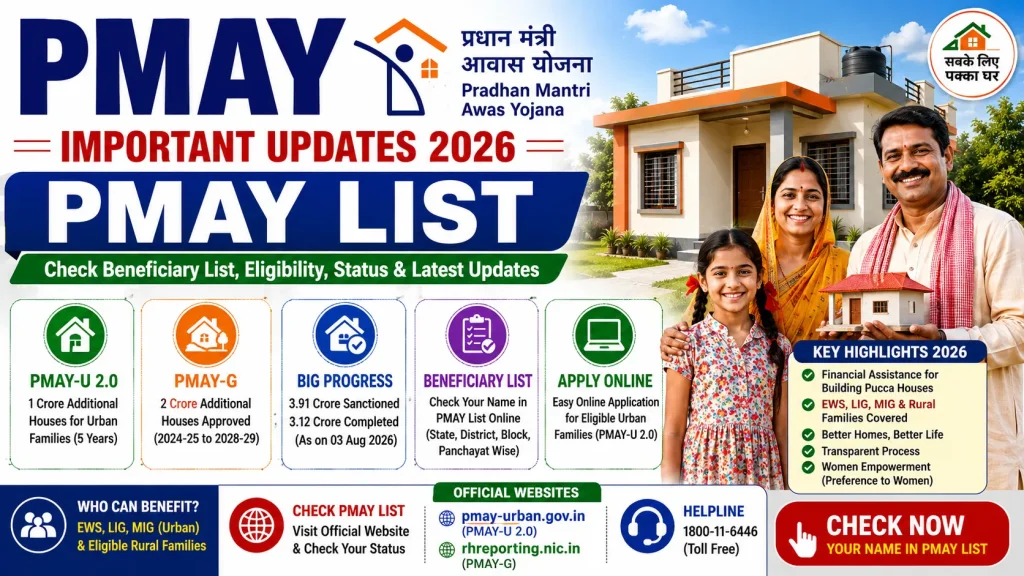
As of 3 August 2026, against an overall target of 4.18 crore houses allocated to States and Union Territories under PMAY-G, approximately 3.91 crore houses had been sanctioned and 3.12 crore houses had been completed.
Around 79 lakh sanctioned houses were reported as being under construction at that point.
The new PMAY-G phase has also been approved for construction of 2 crore additional houses from FY 2024-25 to FY 2028-29.
This means rural housing implementation, sanctioning and construction continue to be highly relevant for beneficiaries checking their PMAY information in 2026.
PMAY-U 2.0 Eligibility
PMAY-U 2.0 has defined eligibility requirements for urban households.
Families belonging to EWS, LIG and MIG categories living in urban areas and not owning a pucca house anywhere in India can be eligible, subject to other scheme conditions.
The broad income categories are:
| Category | Annual Household Income |
|---|---|
| EWS | Up to ₹3 lakh |
| LIG | Above ₹3 lakh and up to ₹6 lakh |
| MIG | Above ₹6 lakh and up to ₹9 lakh |
States and Union Territories have certain flexibility regarding the EWS income criterion under the official guidelines.
Another important condition is related to previous government housing benefits. Applicants who have already received a house under specified Central Government, State/UT Government or local-government housing schemes within the period defined by PMAY-U 2.0 guidelines may not be eligible for another benefit.
PMAY List 2026 – How to Check Your Name
“PMAY List 2026” is a popular search term, but users should not assume there is one universal PDF containing the names of every PMAY beneficiary in India.
PMAY-U 2.0 and PMAY-G use different systems.
PMAY-G List for Rural Households
Rural beneficiaries should use the official PMAY-G beneficiary and reporting facilities.
Depending on the particular service, you may need to select or enter details such as:
- State
- District
- Block
- Gram Panchayat
- Village
- Financial Year
- Scheme
- Registration or beneficiary details
After entering the required information, submit the search to view the available beneficiary or housing records.
PMAY-U 2.0 for Urban Households
Urban households should use PMAY-U 2.0’s official applicant-related services.
Depending on the service selected, applicants may be asked to provide application, Aadhaar, personal or other identifying details.
Always use the official PMAY system rather than an unknown website claiming to provide a guaranteed “PMAY 2026 New List.”
PMAY-G Latest Housing Progress
PMAY-G has reached a significant scale.
As of 3 August 2026:
| PMAY-G Progress | Approximate Number |
|---|---|
| Total Allocated Target | 4.18 crore houses |
| Houses Sanctioned | 3.91 crore |
| Houses Completed | 3.12 crore |
| Sanctioned Houses Under Construction | 79 lakh |
These figures show that PMAY-G construction continues across India and that millions of sanctioned homes are still progressing through implementation.
PMAY-G New Phase 2024-25 to 2028-29
The Union Cabinet approved continuation of PMAY-G from FY 2024-25 to FY 2028-29 for construction of another 2 crore houses.
As reported by the Government on 28 July 2026, out of a target of 1.22 crore allocated to States under the new phase, approximately 97.48 lakh houses had already been sanctioned.
This new phase is particularly important for rural families waiting for housing assistance or checking their beneficiary status.
How to Check PMAY Application Status
Applicants and beneficiaries can check relevant information through the applicable PMAY system.
For urban applicants, use the PMAY-U 2.0 applicant services.
For rural households, use PMAY-G beneficiary and reporting services.
Keep the following information available where applicable:
- Application number
- Registration number
- Aadhaar information
- Registered mobile number
- Beneficiary name
- State
- District
- Block
- Gram Panchayat
The exact information required varies according to the service being used.
Documents Commonly Required for PMAY
Document requirements depend on the scheme component and beneficiary category.
| Document / Information | Purpose |
|---|---|
| Aadhaar | Identity and authentication |
| Mobile Number | Communication and verification |
| Address Details | Residence information |
| Family Details | Household verification |
| Income Details | Category/eligibility assessment |
| Bank Account Details | Benefit processing where applicable |
| Property/Land Details | Housing verification where required |
| Category Certificate | Where applicable |
Applicants should always follow the document requirements displayed by the relevant official authority.
How to Apply for PMAY-U 2.0
Eligible urban households can use the PMAY-U 2.0 application facility.
The process generally includes:
Step 1: Visit the official PMAY-U 2.0 portal.
Step 2: Read the eligibility conditions.
Step 3: Choose the appropriate application option.
Step 4: Complete Aadhaar authentication where required.
Step 5: Enter personal, family, income and housing details.
Step 6: Select the applicable PMAY-U 2.0 vertical.
Step 7: Provide the requested information and documents.
Step 8: Review the application carefully.
Step 9: Submit the application.
Step 10: Save the application/reference details for future status checking.
Submitting an application does not automatically guarantee approval. Eligibility and application information remain subject to verification.
PMAY List Download – Important Information
Many websites use terms such as “PMAY New List PDF Download 2026.”
Users should be careful with this wording.
PMAY beneficiary information can be generated through official systems using beneficiary, location, financial-year or other relevant filters. Not every beneficiary database is necessarily offered as one nationwide downloadable PDF.
If the official reporting system provides a download, print or export option, users can use the available facility.
Avoid downloading unknown files that claim to contain a “Guaranteed PMAY Selection List.”
Important Tips for PMAY Applicants
Always use official government services to check PMAY information.
Make sure you select the correct urban or rural programme.
Enter Aadhaar and application information carefully.
Keep your application or registration number safely.
Do not share Aadhaar OTPs or banking passwords with unknown agents.
Do not pay anyone who claims they can guarantee your name will be added to the PMAY beneficiary list.
Final eligibility and housing assistance depend on official verification and applicable programme rules.
Frequently Asked Questions (FAQ)
1. What is PMAY?
PMAY stands for Pradhan Mantri Awas Yojana, a Government of India housing initiative covering eligible urban and rural households through separate programmes.
2. Is PMAY active in 2026?
Yes. PMAY-U 2.0 continues for eligible urban households, while PMAY-G continues its approved rural housing programme.
3. What is PMAY List 2026?
It generally refers to beneficiary or sanction information available through the relevant PMAY-U or PMAY-G official systems.
4. How can I check my name in the PMAY List?
Identify whether you need PMAY-U 2.0 or PMAY-G and use the relevant official applicant or beneficiary service.
5. Can I check the PMAY-G beneficiary list online?
Yes. Rural beneficiary and housing information can be checked through applicable official PMAY-G reporting services.
6. Who is eligible for PMAY-U 2.0?
Eligible EWS, LIG and MIG families in urban areas that meet the income, housing-ownership and other applicable requirements may qualify.
7. What are the PMAY-U 2.0 income limits?
The broad annual household income limits are up to ₹3 lakh for EWS, above ₹3 lakh to ₹6 lakh for LIG and above ₹6 lakh to ₹9 lakh for MIG.
8. How many PMAY-G houses have been completed?
As of 3 August 2026, approximately 3.12 crore houses had been completed against the overall allocated target of 4.18 crore houses.
9. How many PMAY-G houses have been sanctioned?
As of 3 August 2026, approximately 3.91 crore houses had been sanctioned.
10. Can I apply for PMAY online?
Eligible urban applicants can access PMAY-U 2.0’s application services. PMAY-G follows its applicable rural beneficiary identification and selection processes.
11. Can I download the PMAY New List 2026?
Where an official PMAY reporting service provides download, print or export functionality, users can use it. Do not assume one nationwide PMAY PDF exists for all beneficiaries.
12. Does applying for PMAY guarantee approval?
No. Applications and beneficiary information are subject to eligibility checks, verification and sanction.
13. What documents are required for PMAY?
Commonly relevant information includes Aadhaar, address, family details, income information, mobile number and bank details. Requirements vary by scheme and category.
14. What should I do if my name is not on the PMAY list?
First make sure you are checking the correct PMAY component and entering the correct details. Rural households can also contact the relevant Gram Panchayat or local authority for information about the applicable beneficiary-selection process.
15. Is it safe to pay an agent to add my name to PMAY?
Be cautious. No unknown agent should be trusted simply because they promise guaranteed inclusion or approval. Use official government channels for PMAY services.
Conclusion
PMAY Pradhan Mantri Awas Yojana remains an important housing programme in 2026, covering eligible households through PMAY-U 2.0 and PMAY-G.
For rural India, PMAY-G continues on a large scale. As of 3 August 2026, approximately 3.91 crore houses had been sanctioned and 3.12 crore completed against the overall allocated target of 4.18 crore houses.
The additional PMAY-G phase from FY 2024-25 to FY 2028-29 has also been approved for construction of 2 crore more houses.
Urban households should check PMAY-U 2.0 eligibility and applicant services, while rural households should use PMAY-G beneficiary and reporting facilities.
If you are searching for the PMAY List 2026, always identify the correct scheme first and use official government services to check beneficiary information, application status and housing records.
Declaration
The information provided on this website is published for informational purposes only. While every effort is made to ensure the accuracy and timely updating of the content, we do not guarantee the completeness, reliability, or authenticity of any information. Candidates and users are strongly advised to visit the official websites of the respective departments, organizations, or authorizing bodies before applying for any job, scheme, examination, or benefit program. This website is not associated with any government organisation and does not provide any recruitment guarantee or official confirmation. We are not responsible for any loss, error, or misunderstanding arising from the use of the information available on this website.