PMAY Pradhan Mantri Awas Yojana Application Process – New List Download
Pradhan Mantri Awas Yojana (PMAY) is one of the Government of India’s major housing initiatives designed to support eligible households in obtaining or improving a permanent home. People searching for PMAY information commonly want to know how to apply, what eligibility conditions apply, which documents may be required, how to check application status and how to find their name in the latest beneficiary information.
An important point is that PMAY has separate urban and rural components. PMAY-Urban 2.0 (PMAY-U 2.0) focuses on eligible urban households, while Pradhan Mantri Awaas Yojana-Gramin (PMAY-G) covers eligible rural households.
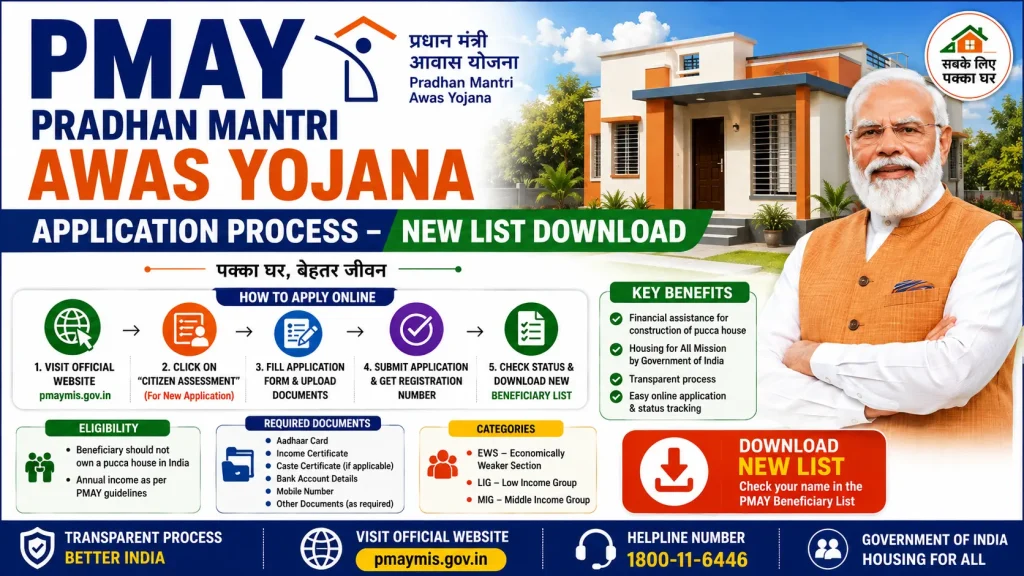
Therefore, there is not one identical application or “new list download” process for every applicant. The correct portal and procedure depend on whether the household is located in an urban or rural area.
This guide explains the PMAY application process, eligibility, documents, beneficiary-list checking and application status process in a simple way.
PMAY 2026 – Quick Overview
| Particular | Details |
|---|---|
| Scheme | Pradhan Mantri Awas Yojana |
| Major Components | PMAY-U 2.0 and PMAY-G |
| Main Objective | Housing assistance for eligible households |
| Urban Coverage | Eligible families in urban areas |
| Rural Coverage | Eligible households in rural areas |
| Application | Depends on PMAY component |
| Beneficiary Information | Available through relevant official systems |
| Status Check | Online facilities available |
| Documents | Aadhaar and other applicable documents |
| Benefit | Depends on scheme component/category |
| Official Authority | Ministry of Housing & Urban Affairs / Ministry of Rural Development |
What Is Pradhan Mantri Awas Yojana?
PMAY is a housing initiative intended to help eligible households obtain a pucca house with basic amenities, subject to the conditions of the applicable component.
The two major parts should not be confused.
PMAY-Urban 2.0
PMAY-U 2.0 is administered by the Ministry of Housing and Urban Affairs and is intended to address the housing requirements of eligible urban families.
The mission includes different verticals through which eligible beneficiaries may receive assistance depending on their circumstances.
PMAY-Gramin
PMAY-G is implemented under the Ministry of Rural Development and focuses on providing housing assistance to eligible rural households that are houseless or otherwise qualify under the applicable selection framework.
Understanding whether you fall under urban or rural PMAY is the first step before looking for an application form or beneficiary list.
PMAY-U 2.0 Eligibility
PMAY-U 2.0 eligibility depends on the applicable scheme guidelines and assistance vertical.
Under the current PMAY-U 2.0 framework, eligible families belonging to Economically Weaker Section (EWS), Low Income Group (LIG) and Middle Income Group (MIG) categories in urban areas may be covered, subject to scheme conditions.
A key eligibility condition is that the beneficiary family should not own a pucca house anywhere in India.
The current income categories under PMAY-U 2.0 are broadly defined as:
| Category | Annual Household Income |
|---|---|
| EWS | Up to ₹3 lakh |
| LIG | ₹3 lakh to ₹6 lakh |
| MIG | ₹6 lakh to ₹9 lakh |
Other conditions can apply depending on the assistance vertical selected.
Applicants should therefore verify eligibility rather than assuming that meeting only the income condition guarantees assistance.
PMAY-U 2.0 Application Process
Eligible urban households can use the official PMAY-U 2.0 system to start the application process.
Step 1: Visit the Official PMAY-U 2.0 Portal
Open the official PMAY-U 2.0 website.
Avoid third-party websites claiming that they can guarantee PMAY approval in exchange for payment.
Step 2: Check Scheme Instructions
Read the eligibility requirements and understand the available assistance options.
This is particularly important because the scheme includes different verticals for different housing requirements.
Step 3: Start the Application
Choose the appropriate option to apply for PMAY-U 2.0.
You may need to complete Aadhaar-based verification as part of the process.
Step 4: Enter Applicant Information
Provide the requested personal and household information carefully.
This may include details such as:
- Applicant name
- Aadhaar information
- Family information
- Present address
- State and city
- Income details
- Housing details
- Bank information where required
Step 5: Select the Applicable Vertical
Choose the assistance option applicable to your housing requirement and eligibility.
Do not randomly select a category simply because it appears to offer a particular benefit.
Step 6: Review the Application
Check every detail before final submission.
Incorrect Aadhaar, income, address or family information can create problems during verification.
Step 7: Submit and Save the Reference Details
Complete the submission process and safely store the application/reference details generated by the system.
These details may be useful for checking the application later.
Documents Required for PMAY Application
Document requirements can differ according to the component, beneficiary category, state and assistance vertical.
Commonly relevant information or documents may include:
| Document / Information | Purpose |
|---|---|
| Aadhaar | Identity/authentication |
| Mobile Number | Communication/verification |
| Address Details | Residence information |
| Income Information | Eligibility/category assessment |
| Bank Account Details | Benefit-related processing where applicable |
| Family Details | Household verification |
| Land/Property Details | Required in applicable cases |
| Other Certificates | As required by scheme/category |
Applicants should follow the document list displayed on the relevant official portal or provided by the implementing authority.
How to Check PMAY Application Status
After submitting an application, applicants naturally want to know whether it has been received, verified or approved.
For PMAY-U 2.0, use the official portal’s applicant-related services and enter the information requested by the system.
The exact status options and terminology can vary during processing.
An application may need to pass through verification by the relevant authorities before final eligibility or assistance is determined.
Therefore, submission of an application does not mean automatic approval.
PMAY New List – What Does It Mean?
The phrase “PMAY New List” is commonly used online, but it can be misleading if treated as one national PDF containing every PMAY beneficiary.
Beneficiary information is maintained through the respective PMAY systems.
For rural housing, PMAY-G beneficiary and sanction information can be accessed through official rural-development reporting and beneficiary services.
For urban housing, applicant and beneficiary information is managed through PMAY-U systems.
Therefore, first identify whether you need:
PMAY-G beneficiary information for a rural household, or
PMAY-U 2.0 applicant/beneficiary information for an urban household.
This will help you use the correct official service.
How to Check PMAY-G Beneficiary Information
For rural beneficiaries, official PMAY-G systems provide facilities for viewing beneficiary-related information and reports.
The general process is:
- Open the official PMAY-G or reporting service.
- Select the relevant beneficiary/report option.
- Enter or choose the requested information.
- Select State where applicable.
- Select District.
- Select Block.
- Select Gram Panchayat where applicable.
- Provide other requested details.
- Submit the search.
- Review the beneficiary or housing information displayed.
The exact fields can vary depending on the report/service being used.
Can You Download the PMAY Beneficiary List?
Where the relevant official PMAY reporting system provides a download, print or export facility, you can use that option to save the displayed information.
However, do not assume that every PMAY list is provided as one downloadable PDF.
In many cases, beneficiary information is generated through state, district, block, Gram Panchayat, financial-year or other report filters.
If a website promises an “All India PMAY New List PDF” without explaining the official source, verify it carefully before entering personal information or downloading files.
How Are PMAY-G Beneficiaries Selected?
PMAY-G beneficiary selection is not simply based on whoever fills out an online form first.
The rural housing programme uses eligibility and deprivation-related information along with prescribed verification and prioritisation processes.
The Awaas+ 2024 survey has also been used to identify additional eligible rural households under the programme’s expanded implementation.
Therefore, rural households should follow the official PMAY-G/Awaas+ process applicable in their area rather than relying on unofficial paid-registration websites.
PMAY-U 2.0 vs PMAY-G
| Feature | PMAY-U 2.0 | PMAY-G |
|---|---|---|
| Area | Urban | Rural |
| Ministry | Ministry of Housing & Urban Affairs | Ministry of Rural Development |
| Target | Eligible urban families | Eligible rural households |
| Application/Selection | PMAY-U 2.0 process | PMAY-G eligibility/survey/selection process |
| Beneficiary Information | Urban PMAY systems | PMAY-G reporting systems |
| Assistance | Depends on applicable vertical | Rural housing assistance as per guidelines |
This distinction is important because using the wrong portal may lead to confusion.
Important Tips Before Applying for PMAY
Applicants should take a few precautions before submitting personal information.
Use only official government PMAY portals or authorized local government channels.
Check your eligibility carefully before applying.
Keep Aadhaar and other required information ready.
Make sure the name and other details entered in the application are accurate.
Do not pay an unknown person who promises guaranteed approval.
Keep your application/reference number safely after submission.
If you are checking a rural beneficiary list, make sure you select the correct State, District, Block and Gram Panchayat.
Most importantly, remember that final assistance depends on verification and applicable PMAY guidelines.
Frequently Asked Questions (FAQ)
1. What is PMAY?
PMAY stands for Pradhan Mantri Awas Yojana, a Government of India housing initiative covering eligible urban and rural households through separate components.
2. What is the difference between PMAY-U 2.0 and PMAY-G?
PMAY-U 2.0 is for eligible households in urban areas, while PMAY-G focuses on eligible rural households.
3. Can I apply for PMAY online?
PMAY-U 2.0 provides an online application facility for eligible urban applicants. Rural selection/application processes differ and should be checked through PMAY-G/Awaas+ and the relevant local authorities.
4. Who is eligible for PMAY-U 2.0?
Eligible EWS, LIG and MIG urban families can be covered subject to scheme conditions, including applicable income and housing-ownership requirements.
5. What is the PMAY new beneficiary list?
“PMAY new list” generally refers to beneficiary information available through the relevant PMAY-U or PMAY-G system. There is not necessarily one universal national PDF for every beneficiary.
6. How can I check my name in the PMAY-G list?
Use the official PMAY-G beneficiary/reporting services and enter or select the requested location and beneficiary information.
7. Can I download a PMAY list?
If the official report or beneficiary service offers a download, print or export option, you can use it. Availability depends on the particular system/report.
8. Is Aadhaar required for PMAY?
Aadhaar is an important part of beneficiary identification/authentication in PMAY processes, subject to applicable programme rules.
9. Does submitting a PMAY application guarantee a house?
No. Submission does not guarantee approval or assistance. Eligibility and application information must be verified under the applicable scheme rules.
10. Can someone guarantee PMAY approval for a fee?
Be cautious of anyone promising guaranteed government housing assistance in exchange for money. Use official government channels.
11. How can I check PMAY application status?
Use the applicant/status-related facility available through the applicable official PMAY portal and provide the requested application details.
12. What should I do if my name is not in the PMAY list?
First confirm that you are checking the correct PMAY component and location. For PMAY-G, eligible rural households should check the applicable survey/selection process and contact the relevant Gram Panchayat or local authority if necessary.
Conclusion
The PMAY Pradhan Mantri Awas Yojana application process and new beneficiary list should always be checked through the correct official scheme channel.
Urban applicants should look at PMAY-U 2.0, understand the relevant eligibility category and assistance vertical, complete the required verification and keep their application details for status tracking.
Rural households should use PMAY-G beneficiary and reporting services and follow the applicable survey, verification and Gram Panchayat-level processes.
When looking for a “PMAY New List Download,” remember that beneficiary information may be displayed through location-based reports rather than one nationwide PDF.
Use official government services, verify your eligibility and avoid websites or agents promising guaranteed PMAY approval.
Declaration
The information provided on this website is published for informational purposes only. While every effort is made to ensure the accuracy and timely updating of the content, we do not guarantee the completeness, reliability, or authenticity of any information. Candidates and users are strongly advised to visit the official websites of the respective departments, organizations, or authorizing bodies before applying for any job, scheme, examination, or benefit program. This website is not associated with any government organisation and does not provide any recruitment guarantee or official confirmation. We are not responsible for any loss, error, or misunderstanding arising from the use of the information available on this website.